English spelling can be confusing when two words look and sound almost alike. One common spelling question is compair vs compare. If you are unsure which form to use in an essay, email, school assignment, or everyday message, the answer is simple: compare is the correct spelling in standard English. Compair is a misspelling when you intend to use the verb compare.
The word compare means to examine two or more people, things, ideas, or situations to identify their similarities and differences. For example, a student may compare two books to decide which one is easier to understand. You might also compare prices before buying a product or compare your current skills with your past performance. The word is useful in academic writing, business communication, and daily conversations. Learning its correct spelling will help you write more clearly and avoid common mistakes. In this guide, you will discover the meaning of compare, see practical examples, understand related words, and learn a simple trick for remembering the correct spelling.
Quick Answer: Compair vs Compare
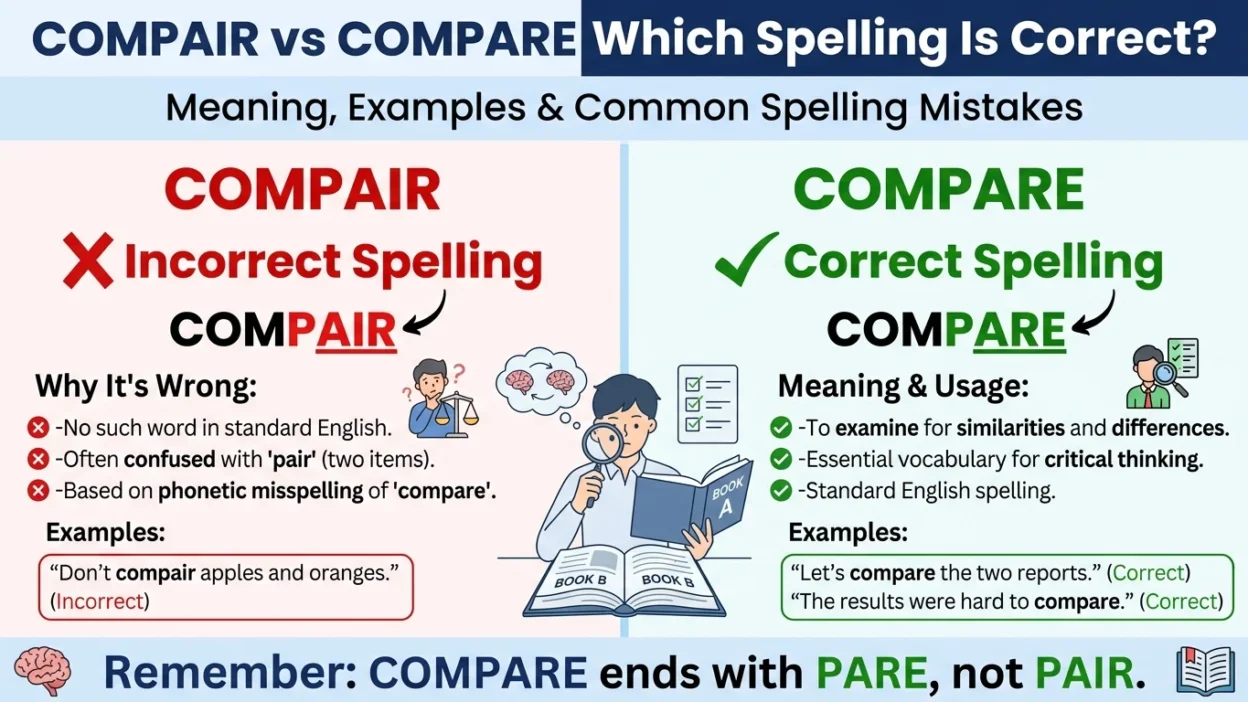
Compare is the correct spelling in standard English. It is a verb meaning to examine two or more things to find similarities and differences. Compair is a misspelling when used in place of compare. For example, write Compare these two pictures, not Compair these two pictures. Remember that the correct word ends with -pare, not -pair.
Why Do People Confuse Compair and Compare?
People confuse compair and compare because the words have similar sounds, especially when spoken quickly or with certain accents. The ending of compare may sound like the English word pair, leading some writers to choose the wrong spelling.
Another reason is that English spelling does not always match pronunciation perfectly. Someone who has heard the word many times but has rarely seen it written may spell it according to the sound.
The best way to avoid this mistake is to remember the standard spelling: C-O-M-P-A-R-E. Reading examples and practicing the word in sentences can also help you recognize it more easily.
What Does Compare Mean?
Compare is a verb that means to examine two or more things to discover what is similar or different about them.
You can compare people, products, ideas, places, experiences, prices, results, or objects. Depending on the context, comparison can focus on similarities, differences, or both.
Examples of Compare in Sentences
- Compare the two essays before choosing the better one.
- We compared the prices of three laptops.
- Teachers often compare students’ answers to identify common mistakes.
- You should compare the advantages and disadvantages of each option.
- I like to compare different books before buying one.
Common Uses of Compare
- Compare prices: Examine costs to find differences or the best value.
- Compare two things: Look at their similarities and differences.
- Compare results: Examine outcomes to understand performance.
- Compare with the past: Examine how something has changed over time.
- Compare options: Evaluate choices before making a decision.
Example: Before choosing a school, parents may compare its fees, facilities, and teaching methods.
What Does Compair Mean?
Compair is not the standard spelling of the English verb compare. When you want to describe examining things for similarities and differences, use compare instead.
You may encounter compair in informal writing, online posts, search queries, or text containing spelling errors. However, it should not replace compare in schoolwork, professional emails, articles, reports, or other standard English writing.
Incorrect and Correct Examples
- Incorrect: Please compair these two products.
- Correct: Please compare these two products.
- Incorrect: I want to compair the results.
- Correct: I want to compare the results.
- Incorrect: We should compair both options.
- Correct: We should compare both options.
Compair vs Compare: Comparison Table
| Feature | Compare | Compair |
|---|---|---|
| Spelling status | Correct | Incorrect for this meaning |
| Part of speech | Verb | Not the standard word intended here |
| Meaning | Examine similarities and differences | No standard meaning as a spelling of compare |
| Suitable for formal writing | Yes | No |
| Example | Compare the two answers. | Compair the two answers. |
| Recommended usage | Use this spelling | Correct it to compare |
When Should You Use Compare Instead of Compair?
Use compare whenever you want to examine two or more things to identify similarities, differences, or relative qualities.
1. When Comparing Prices
Use compare when checking the costs of products or services.
Example: Compare the prices before making a purchase.
2. When Writing School Assignments
Students often compare characters, stories, historical events, or scientific ideas.
Example: Compare the main characters in the two novels.
3. When Evaluating Products
Compare helps you examine features, quality, and value before buying something.
Example: I compared three phones before choosing one.
4. When Discussing Performance
Use compare to examine results or progress.
Example: The coach compared this year’s results with last year’s results.
5. When Making Decisions
Comparing options helps people understand the advantages and disadvantages of different choices.
Example: We need to compare both plans before deciding.
In all these situations, compare is the correct spelling. Do not use compair as an alternative.
15 Example Sentences: Compair vs Compare
The following examples show how to use compare correctly and recognize the common misspelling.
- Correct: Please compare these two photographs.
- Correct: We need to compare the prices of different products.
- Correct: Students compare their answers after the test.
- Correct: It is helpful to compare different learning methods.
- Correct: I compared the two proposals before making a decision.
- Correct: Do not compare yourself with others all the time.
- Correct: The report compares the results of two experiments.
- Correct: She wants to compare the features of both computers.
- Correct: You can compare the benefits and risks of each choice.
- Correct: The teacher asked us to compare two poems.
- Incorrect: Can you compair these two books?
- Correct: Can you compare these two books?
- Incorrect: We should compair the available options.
- Correct: We should compare the available options.
- Correct: Comparing your progress over time can help you identify improvements.
Common Mistakes to Avoid
1. Writing Compair Instead of Compare
Incorrect: I will compair the two reports.
Correct: I will compare the two reports.
The correct spelling ends with -pare, not -pair.
2. Choosing Spelling Based Only on Sound
The final part of compare may sound similar to pair, but the spelling is different. Always remember the written form rather than relying only on pronunciation.
3. Confusing Compare With Comparison
Compare is a verb, while comparison is a noun.
- Correct: We compare the two products.
- Correct: We made a comparison between the two products.
4. Assuming Compare Always Means Finding Differences
Compare can involve similarities, differences, or both. The exact meaning depends on the context.
Example: The two students have similar strengths, so comparing their work reveals several similarities.
5. Forgetting to Proofread
Spelling mistakes can make an assignment or professional document less polished. Check the spelling of compare when writing essays, reports, product reviews, and emails.
Easy Memory Trick: Compair vs Compare
Use this simple memory trick:
Compare ends with PARE, not PAIR.
Remember the correct spelling:
C-O-M-P-A-R-E = COMPARE
You can also connect compare with comparison. Both words contain the same compar- spelling pattern.
Practice this sentence:
Compare the pair of pictures.
Notice that compare is the action, while pair refers to two things considered together. This sentence helps you remember that compare and pair are different words with different spellings.
American vs British English: Compare or Compair?
There is no spelling difference between American and British English for this word. Both varieties use compare.
| English variety | Correct spelling |
|---|---|
| American English | Compare |
| British English | Compare |
| Canadian English | Compare |
| Australian English | Compare |
Compair is not a standard regional alternative in these varieties. Whether you are writing for an American, British, Canadian, or Australian audience, use compare.
Similar Words: Compare, Contrast, and Comparison
Learning related words helps you choose the right expression for your sentence.
- Compare: Examine similarities or differences between things.
- Contrast: Focus especially on the differences between things.
- Comparison: The act or result of comparing.
- Comparable: Similar enough to be compared fairly.
- Compared: Examined in relation to another person or thing.
- Differentiate: Identify or explain what makes things different.
- Evaluate: Judge the quality, value, or effectiveness of something.
Examples of Similar Words
- Compare: Compare the two plans before choosing one.
- Contrast: Contrast the characters’ personalities.
- Comparison: The comparison revealed several differences.
- Comparable: The two products have comparable features.
- Differentiate: The teacher helped us differentiate between the two concepts.
- Evaluate: We evaluated each option before making a decision.
Although these words are related, they are not always interchangeable. Choose the word that best expresses your intended meaning.
Final Verdict: Compair or Compare?
The correct spelling is compare. It is a standard English verb meaning to examine two or more things to identify their similarities and differences.
Compair is a misspelling when used in place of compare. It should be corrected in essays, assignments, emails, reports, and other standard English writing.
Remember the simple rule: compare ends with -pare, not -pair. Practicing the word in everyday sentences will help you remember its spelling and use it confidently.
FAQs
1. Is compair or compare correct?
Compare is correct. Compair is a misspelling when you intend to use the standard English verb meaning to examine similarities and differences.
2. What does compare mean in simple English?
Compare means to look at two or more things to see what is similar or different about them.
3. Why is compare not spelled compair?
The established English spelling is compare. Although its ending may sound like pair, the correct letters are P-A-R-E.
4. Is compair a real English word?
Compair is not the standard spelling of compare. In ordinary English writing, use compare for this meaning.
5. What is an example sentence using compare?
Compare the two products before deciding which one offers better value.
6. Is compare spelled differently in British and American English?
No. Both British and American English use compare.
7. What is the difference between compare and comparison?
Compare is a verb describing the action of examining things. Comparison is a noun describing the act or result of that examination.
8. What is another word for compare?
Depending on the context, alternatives include contrast, evaluate, examine, assess, and analyze. Each word has a slightly different meaning, so choose one that fits your sentence.
Remember This
- Compare = correct spelling.
- Compair = misspelling when intended to mean compare.
- Compare means to examine similarities and differences.
- American and British English both use compare.
- Memory trick: Compare ends with PARE, not PAIR.
Conclusion
Understanding the difference between compair and compare is easy once you remember the correct spelling. Compare is the standard English verb used when examining two or more things for similarities and differences. Compair is an incorrect spelling for this meaning and should be avoided in formal and informal writing.
To improve your spelling, practice using compare in sentences about schoolwork, shopping, decision-making, and everyday experiences. Remember that compare ends with P-A-R-E, not P-A-I-R. This small spelling rule can help you write more clearly and confidently.

Gabriel John is a language enthusiast and grammar writer at Synolexes. He creates clear, practical content on English grammar, vocabulary, and writing, helping learners improve communication skills with confidence.