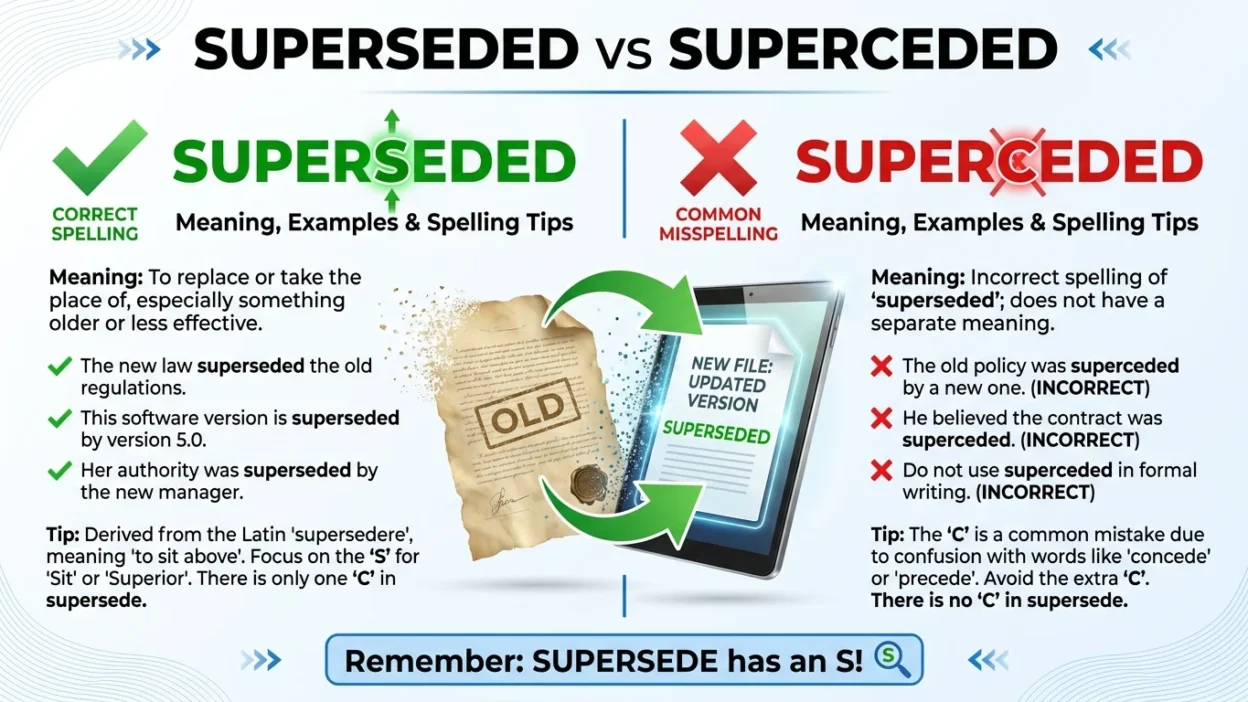
English spelling can be confusing, especially when two words look almost identical. Superseded and superceded are a common example. They differ by only one letter, but only one is the standard spelling of the word meaning replaced, outdated, or made no longer effective.
The correct spelling is superseded. It is the past tense and past participle of the verb supersede, which means to replace something older with something newer or more suitable. You might see it in legal documents, workplace policies, technology updates, official announcements, and everyday writing. The spelling superceded is a common misspelling, often caused by confusion with words such as precede and proceed.
In this guide, you will learn the difference between superseded and superceded, see practical examples, and discover an easy memory trick to help you spell the word correctly.
Quick Answer: Superseded or Superceded?
Superseded is the correct standard spelling. It means replaced by something newer, better, or more authoritative. Superceded is a common spelling mistake and should generally be avoided in formal and informal writing. Remember that the correct verb is supersede, which contains an s after the prefix super-.
Why Do People Confuse Superseded and Superceded?
People often confuse these spellings because they sound similar when spoken. The ending -cede also appears in familiar English words such as precede and recede, which can make the incorrect spelling superceded seem reasonable.
Another reason is that English spelling does not always follow predictable patterns. Writers may remember the sound of the word but forget the exact letters.
The easiest solution is to remember the correct base word: supersede. Once you know that spelling, the past-tense form is straightforward: superseded.
What Does Superseded Mean?
Superseded means that something has been replaced by something newer, more suitable, or more authoritative. The older item may no longer be used, followed, or considered current.
It is the past tense and past participle of supersede.
Examples of Superseded in Sentences
- The old company policy was superseded by a new set of rules.
- This software version has been superseded by a newer release.
- The updated contract superseded the previous agreement.
- Older safety guidelines were superseded by stricter regulations.
- Digital cameras gradually superseded many traditional film cameras.
- The new textbook superseded the outdated edition.
When Should You Use Superseded?
Use superseded when explaining that something has been replaced or is no longer the current version.
Common contexts include:
- Technology: An older device or software version is replaced.
- Law: A new regulation or agreement replaces an earlier one.
- Business: A revised policy replaces an outdated policy.
- Education: A new edition replaces an older textbook.
- Everyday communication: A previous plan is replaced by a new plan.
What Does Superceded Mean?
Superceded is a common misspelling of superseded. It is not the standard spelling used for the meaning of being replaced by something newer or more authoritative.
Writers may accidentally use it because the word sounds similar to other English words or because they confuse the spelling of supersede with words ending in -cede.
Incorrect Examples of Superceded
- Incorrect: The old policy was superceded by a new policy.
- Correct: The old policy was superseded by a new policy.
- Incorrect: This edition has been superceded by a revised version.
- Correct: This edition has been superseded by a revised version.
- Incorrect: The previous agreement was superceded last year.
- Correct: The previous agreement was superseded last year.
For standard English writing, use superseded, not superceded.
Superseded vs Superceded: Key Differences
| Feature | Superseded | Superceded |
|---|---|---|
| Spelling status | Correct standard spelling | Common misspelling |
| Base word | Supersede | Incorrect spelling of supersede |
| Meaning | Replaced by something newer or more suitable | Intended to mean the same thing, but misspelled |
| Formal writing | Recommended | Avoid |
| Example | The old rule was superseded. | The old rule was superceded. |
When Should You Use Each Spelling?
Use Superseded
Choose superseded whenever you mean that something has been replaced or is no longer current.
Examples:
- The previous version was superseded by an update.
- A new agreement superseded the original contract.
- The old instructions have been superseded.
Avoid Superceded
Do not use superceded as the standard spelling of this word.
Instead of writing:
The outdated procedure was superceded by a new process.
Write:
The outdated procedure was superseded by a new process.
This correction is especially important in academic papers, professional emails, reports, legal writing, and official documents.
15 Example Sentences: Superseded vs Superceded
Here are 15 examples showing how to use the correct spelling.
- The outdated policy was superseded by a new policy.
- This model has been superseded by a more efficient design.
- The revised agreement superseded the original contract.
- New regulations superseded the previous requirements.
- The old software was superseded after the latest update.
- The first edition was superseded by an expanded version.
- Modern equipment has superseded many older machines.
- The original plan was superseded by a better proposal.
- Previous instructions were superseded by the manager’s latest announcement.
- The court considered whether the earlier ruling had been superseded.
- The new curriculum superseded the outdated syllabus.
- That technology has largely been superseded by newer alternatives.
- The amended document superseded the earlier draft.
- The old procedure was superseded to improve workplace safety.
- The previous schedule was superseded by an updated timetable.
In all these sentences, superseded is the correct form. Replacing it with superceded would introduce a spelling error.
Common Mistakes to Avoid
1. Writing Superceded Instead of Superseded
Incorrect: The previous version was superceded.
Correct: The previous version was superseded.
The correct spelling contains an s after super.
2. Confusing Supersede With Precede
The words supersede and precede have different spellings and meanings.
- Supersede: To replace something.
- Precede: To come before something.
Example: The new policy will supersede the old one, while the introduction will precede the main discussion.
3. Assuming Superseded Is a Typographical Error
Although superseded may look unusual, it is the correct spelling. Do not change it to superceded simply because the latter looks more familiar.
4. Using the Word Without Understanding Its Meaning
Superseded does not simply mean old. It means that something has been replaced or made no longer current by something else.
For example, an old document is not necessarily superseded unless a newer document or authority replaces it.
Easy Memory Trick: How to Remember Superseded
Use this simple trick:
Supersede has an S, so superseded has an S.
Remember the base word first:
- Supersede — correct base verb
- Superseded — correct past tense
- Superseding — correct present participle
All three forms retain the s in supersede.
You can also remember this sentence:
The new version supersedes the old version.
If you can spell supersedes, you can spell superseded.
American vs British English: Superseded or Superceded?
There is no standard American-versus-British spelling difference here.
Both American English and British English use superseded. The spelling superceded is generally considered incorrect in both varieties when it is intended to mean replaced.
| English variety | Standard spelling |
|---|---|
| American English | Superseded |
| British English | Superseded |
| Australian English | Superseded |
| Canadian English | Superseded |
You do not need to change the spelling based on your audience’s country.
Similar Words You Should Know
Understanding related words can help you avoid spelling mistakes.
| Word | Meaning | Example |
|---|---|---|
| Supersede | Replace something | The new law may supersede the old law. |
| Superseded | Replaced by something newer | The old system was superseded. |
| Superseding | Replacing something | The superseding policy takes effect tomorrow. |
| Precede | Come before | The introduction will precede the conclusion. |
| Recede | Move backward or diminish | The floodwaters began to recede. |
| Replace | Put something new in place of another | We will replace the broken machine. |
| Outdated | No longer modern or current | The manual contains outdated information. |
These words are related in some contexts, but they are not interchangeable in every sentence.
Final Verdict: Superseded or Superceded?
The correct spelling is superseded. Use it when describing something that has been replaced by a newer version, a different policy, or a more authoritative decision.
Superceded is a common misspelling and should be avoided in standard English writing. The distinction is the letter s in the base verb supersede.
For school assignments, workplace communication, official documents, and online articles, remember to write superseded.
FAQs
1. Is superseded or superceded correct?
Superseded is correct. Superceded is a common misspelling of the past tense of supersede.
2. What does superseded mean?
Superseded means replaced by something newer, more suitable, or more authoritative. For example, a new policy may supersede an old policy.
3. Why is superceded incorrect?
Superceded is incorrect because the standard base verb is supersede, spelled with an s after super.
4. Is superseded used in American and British English?
Yes. Both American and British English use superseded. There is no regional spelling difference.
5. What is the base word of superseded?
The base word is supersede, which means to replace something with something else.
6. Can I use superseded in formal writing?
Yes. Superseded is appropriate for formal writing, including legal documents, academic papers, business reports, technical manuals, and official policies.
7. What is another word for superseded?
Depending on the context, alternatives include replaced, outdated, rendered obsolete, and made redundant. These expressions have slightly different meanings, so choose one that fits the sentence.
Remember This
- Superseded = correct spelling.
- Superceded = common misspelling.
- Supersede = the base verb.
- Both American and British English use superseded.
- Memory trick: Remember the S in supersede.
Conclusion
The difference between superseded and superceded is simple once you remember the correct base word. Superseded is the standard spelling and describes something that has been replaced by a newer, more suitable, or more authoritative alternative. The spelling superceded is a common mistake that should be corrected in standard writing.
To improve your spelling, practice using supersede, superseded, and superseding in sentences. Remember that the word keeps its s after super in every form. This small detail can help you write more accurately in schoolwork, professional documents, emails, and everyday communication.