English greetings are part of everyday communication, but even simple expressions can cause spelling confusion. One common example is goodmorning vs good morning. Both versions may appear in text messages, social media posts, emails, and online conversations, leaving writers unsure whether the greeting should be written as one word or two.
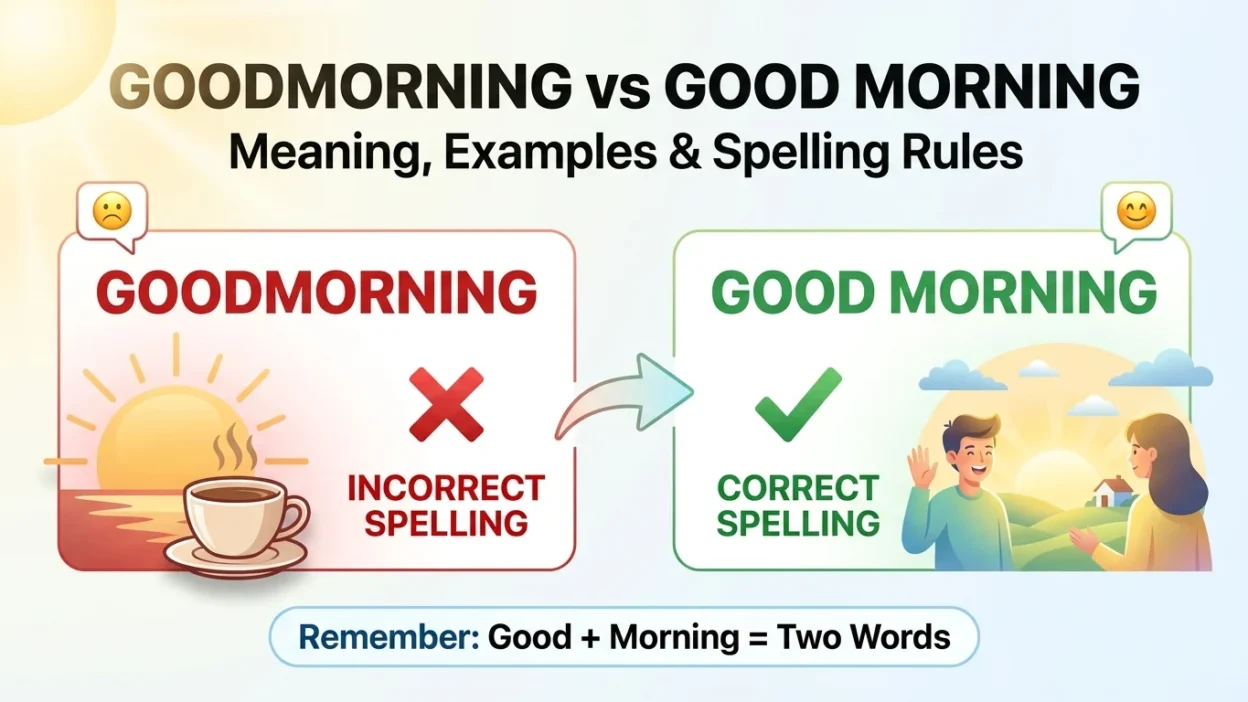
The correct standard spelling is good morning, written as two separate words. It is a friendly greeting used when meeting someone or communicating with them during the morning. The one-word form, goodmorning, is generally considered incorrect in standard English. Whether you are writing a professional email, greeting a teacher, sending a message to a friend, or creating a social media post, using the two-word form will help your writing look clear and polished.
In this guide, you will learn the difference between goodmorning and good morning, discover practical examples, understand common mistakes, and find easy ways to remember the correct spelling.
Quick Answer: Goodmorning or Good Morning?
Good morning is the correct standard spelling. It is a greeting made up of two separate words: good and morning. Goodmorning is generally incorrect when used as the greeting in standard English. Use good morning in messages, emails, conversations, schoolwork, and professional communication.
Why Do People Confuse Goodmorning and Good Morning?
People often confuse these forms because many English expressions combine words over time. For example, goodbye is written as one word, while good morning remains two words.
Digital communication also contributes to this confusion. People type quickly in chats and on social media, sometimes joining words together without noticing the spelling mistake.
Another reason is that greetings are often used as short expressions rather than complete sentences. Writers may assume that a familiar phrase can be written as one word, even when standard spelling requires two.
The easiest solution is to remember that good morning is always written as two words when used as a greeting.
What Does Good Morning Mean?
Good morning is a polite and friendly expression used to greet someone in the morning. It can communicate respect, friendliness, warmth, or professionalism depending on the situation and tone.
It is commonly used when meeting someone early in the day or beginning a morning conversation.
Examples of Good Morning in Sentences
- Good morning! How are you today?
- Good morning, everyone. Let’s begin the meeting.
- I said good morning to my teacher.
- Good morning! I hope you have a wonderful day.
- She greeted her colleagues with a cheerful good morning.
When Should You Use Good Morning?
Use good morning in situations such as:
- Everyday conversations: Greeting family, friends, or neighbors.
- School: Greeting teachers, classmates, or students.
- Workplace communication: Starting a meeting or greeting colleagues.
- Emails: Opening a professional or friendly message.
- Social media: Sharing a morning greeting or positive message.
- Customer service: Welcoming customers politely in the morning.
What Does Goodmorning Mean?
Goodmorning is a nonstandard spelling of the greeting good morning. In ordinary English writing, it should be written as two separate words.
Although you may see the one-word form in usernames, brand names, creative designs, hashtags, or informal online posts, those special uses do not make it the standard spelling of the greeting.
Incorrect and Correct Examples
- Incorrect: Goodmorning, everyone!
- Correct: Good morning, everyone!
- Incorrect: I sent my teacher a goodmorning message.
- Correct: I sent my teacher a good morning message.
- Incorrect: Goodmorning! Have a great day.
- Correct: Good morning! Have a great day.
In standard writing, separate the two words.
Goodmorning vs Good Morning: Key Differences
| Feature | Goodmorning | Good Morning |
|---|---|---|
| Spelling status | Generally incorrect as a greeting | Correct standard spelling |
| Number of words | One | Two |
| Meaning | Intended as a morning greeting | A morning greeting |
| Formal writing | Avoid | Recommended |
| Everyday messages | Nonstandard | Correct |
| Example | Goodmorning, Sara! | Good morning, Sara! |
The difference is simple: the correct greeting contains a space between good and morning.
When Should You Use Each Form?
Use Good Morning
Choose good morning whenever you want to greet someone during the morning.
Examples:
- Good morning, teacher.
- Good morning, everyone.
- Good morning! How did you sleep?
- Good morning, team. Thank you for joining the meeting.
- Good morning! Wishing you a peaceful and productive day.
It is appropriate for both casual and formal communication.
Avoid Goodmorning in Standard Writing
Do not combine the words when using the expression as a normal greeting.
Instead of writing:
Goodmorning, sir. I hope you are doing well.
Write:
Good morning, sir. I hope you are doing well.
The two-word form is more appropriate for school assignments, professional emails, business messages, and public-facing content.
15 Example Sentences: Goodmorning vs Good Morning
Here are 15 examples showing how to use the correct greeting naturally.
- Good morning, Mom! Did you sleep well?
- Good morning, teacher. I have completed my homework.
- Good morning, everyone. Welcome to today’s class.
- I sent my friend a good morning message.
- Good morning! I hope your day goes well.
- The manager greeted the employees with good morning.
- Good morning, sir. May I ask you a question?
- She smiled and said, Good morning!
- Good morning, team. Let’s review our goals.
- He always says good morning to his neighbors.
- Good morning! May today bring you happiness and success.
- The teacher began the lesson by saying, Good morning, students.
- Please start your email with Good morning if it suits the time and context.
- Good morning, everyone. Thank you for coming early.
- I like sending my family a cheerful good morning greeting.
In each example, the greeting is written as two words.
Common Mistakes to Avoid
1. Joining Good and Morning Together
Incorrect: Goodmorning!
Correct: Good morning!
Always include a space between the two words when using the standard greeting.
2. Using the Wrong Form in Professional Emails
Incorrect: Goodmorning, Mr. Ahmed.
Correct: Good morning, Mr. Ahmed.
A correctly written greeting creates a more polished impression in professional communication.
3. Confusing a Greeting With a Compound Word
Some English expressions are written as one word, while others are written separately. You cannot assume that every familiar phrase should be combined.
For example:
- Good morning — two words
- Good afternoon — two words
- Good evening — two words
- Goodbye — one word
Learn the standard form of each expression.
4. Forgetting Capitalization
At the beginning of a sentence or email greeting, capitalize the first word:
Good morning, everyone.
Within a sentence, lowercase is usually appropriate:
I wished everyone good morning.
5. Adding Unnecessary Punctuation
Use punctuation according to the sentence.
- Good morning!
- Good morning, everyone.
- Good morning, Mr. Khan.
A comma is commonly used when directly addressing someone by name or title.
Easy Memory Trick: How to Remember Good Morning
Use this simple trick:
Good + Morning = Two Words.
Think of the greeting as two separate ideas:
- Good: A positive or pleasant quality.
- Morning: The early part of the day.
Put them together with a space: good morning.
You can also remember this pattern:
- Good morning
- Good afternoon
- Good evening
All three greetings are written as two words.
American vs British English: Goodmorning or Good Morning?
There is no spelling difference between American and British English for this greeting. Both use good morning as two separate words.
| English variety | Correct form |
|---|---|
| American English | Good morning |
| British English | Good morning |
| Australian English | Good morning |
| Canadian English | Good morning |
The same standard spelling is used in these varieties of English. The one-word form goodmorning is generally nonstandard when intended as the ordinary greeting.
Similar Greetings You Should Know
Learning related expressions can help you communicate naturally at different times of the day.
| Greeting | When to Use It | Example |
|---|---|---|
| Good morning | In the morning | Good morning, everyone. |
| Good afternoon | In the afternoon | Good afternoon, Mr. Khan. |
| Good evening | In the evening | Good evening, guests. |
| Hello | At many times of the day | Hello, how are you? |
| Hi | Informal situations | Hi, Sara! |
| Greetings | Formal or written contexts | Greetings to all participants. |
| Have a good day | When wishing someone well | Have a good day at work. |
These greetings serve different purposes, but good morning, good afternoon, and good evening all follow the two-word spelling pattern.
Final Verdict: Goodmorning or Good Morning?
The correct standard spelling is good morning, written as two separate words. It is a polite greeting used in everyday conversations, school settings, professional emails, and social media messages.
Goodmorning is generally considered incorrect when used as the ordinary greeting. Although it may appear in creative names, usernames, or branding, those special uses do not change the standard spelling rule.
Whenever you greet someone in the morning, remember to leave a space between good and morning.
FAQs
1. Is goodmorning or good morning correct?
Good morning is correct. The greeting consists of two separate words. Goodmorning is generally a spelling mistake in standard English.
2. Why is good morning written as two words?
It is an established English greeting made up of the adjective good and the noun morning. Standard usage keeps them separate.
3. Can I write goodmorning in a text message?
You may see it in informal messages, but good morning is the standard spelling and is the better choice, even in casual conversations.
4. Is good morning one word or two words?
It is two words: good and morning.
5. Should Good Morning be capitalized?
Capitalize it at the beginning of a sentence or as an email greeting: Good morning, everyone. Use lowercase when it appears within a sentence, unless a specific style or title requires capitalization.
6. Is good morning the same in American and British English?
Yes. Both American and British English use good morning as two words.
7. Is Good Morning appropriate for a professional email?
Yes. It is a polite and professional opening when appropriate for the time of day and your relationship with the recipient. For example: Good morning, Ms. Ali.
Remember This
- Good morning = correct spelling.
- Goodmorning = generally incorrect as a standard greeting.
- Always write the greeting as two words.
- American and British English follow the same rule.
- Use a comma when directly addressing someone: Good morning, everyone.
Conclusion
The difference between goodmorning and good morning is simple but important. Good morning is the standard spelling because the expression consists of two separate words. The joined form goodmorning is generally incorrect when used as an ordinary English greeting.
Whether you are writing to a friend, greeting your teacher, starting a business email, or posting a morning message online, use good morning. Remembering the two-word pattern will help you avoid a common spelling mistake and make your communication clearer and more professional.

Julian Luke is a passionate grammar and language writer at Synolexes. He simplifies complex grammar rules, vocabulary, and writing concepts, helping learners improve their English communication skills with confidence.