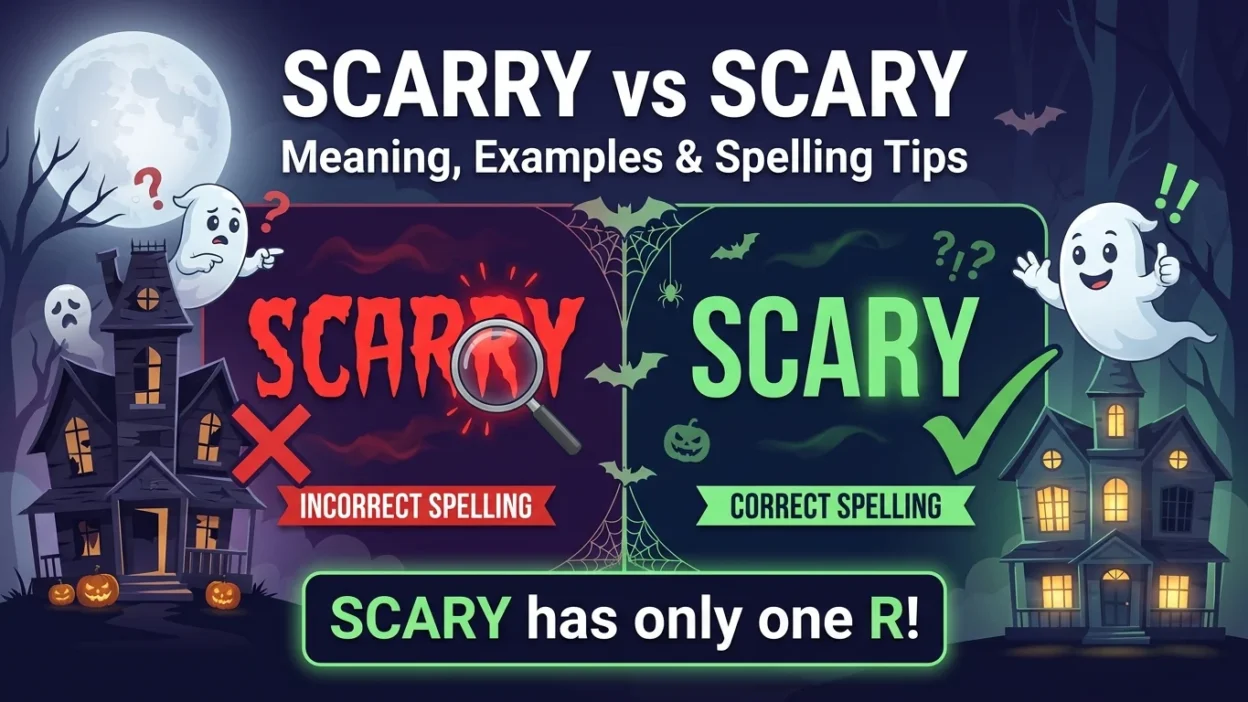
English spelling can be confusing when two words look almost identical. One common example is scarry vs scary. Both spellings may appear in online searches, social media posts, and informal messages, but only one is the standard spelling of the adjective meaning frightening or causing fear.
The correct spelling is scary. It describes something that makes people feel afraid, nervous, or frightened. For example, a scary movie may make you jump, while a scary story may leave you feeling uneasy. The spelling scarry is generally considered incorrect when you intend to use this adjective in standard English.
Understanding the difference between these forms can help you write more accurately in school assignments, everyday conversations, emails, and online content. In this guide, you will learn the meaning of scary, see practical example sentences, discover common spelling mistakes, and find a simple memory trick to remember the correct form.
Quick Answer: Scarry or Scary?
Scary is the correct standard spelling of the adjective meaning frightening or causing fear. Scarry is generally a misspelling when used with this meaning. Use scary to describe a frightening movie, a creepy sound, a dangerous situation, or an experience that makes someone feel afraid.
Why Do People Confuse Scarry and Scary?
People confuse scarry and scary because the words look similar and have almost the same pronunciation in many accents. Adding an extra r may seem natural to some writers, especially when typing quickly.
Another reason is that English contains many words with doubled consonants, such as happy, terrible, and horrible. Writers may mistakenly assume that scary follows the same pattern.
However, the standard spelling contains only one r after the letter a: scary.
Remembering the correct spelling will help you avoid this common mistake.
What Does Scary Mean?
Scary is an adjective that describes something frightening, alarming, or capable of causing fear. It can refer to a person, place, sound, story, event, or situation.
The word can describe real danger as well as fictional experiences.
Examples of Scary in Sentences
- That was a scary movie.
- I heard a scary noise outside my window.
- The abandoned house looked scary at night.
- Driving through the storm was a scary experience.
- The children told scary stories around the campfire.
When Should You Use Scary?
Use scary when describing something that makes someone feel afraid or uncomfortable.
Common contexts include:
- Movies: A scary horror film.
- Stories: A scary story about a haunted house.
- Situations: A scary experience during a storm.
- Places: A dark and scary tunnel.
- Sounds: A scary noise coming from upstairs.
- Real-life events: A scary moment during an emergency.
The word can also be used informally to describe something worrying or unexpectedly serious, such as a scary financial problem.
What Does Scarry Mean?
Scarry is not the standard spelling of the adjective scary. If you want to describe something as frightening, you should write scary, not scarry.
However, Scarry can appear as a proper name or surname. In that context, it is not necessarily a spelling mistake.
Incorrect and Correct Examples
- Incorrect: The movie was very scarry.
- Correct: The movie was very scary.
- Incorrect: We heard a scarry sound in the forest.
- Correct: We heard a scary sound in the forest.
- Incorrect: It was a scarry experience.
- Correct: It was a scary experience.
For standard English writing, use scary whenever you mean frightening.
Scarry vs Scary: Key Differences
| Feature | Scarry | Scary |
|---|---|---|
| Spelling status | Generally incorrect for the adjective | Correct standard spelling |
| Part of speech | Not the standard adjective spelling | Adjective |
| Meaning | Often intended to mean frightening | Frightening or causing fear |
| Standard writing | Avoid for this meaning | Recommended |
| Example | A scarry story | A scary story |
The main difference is spelling. When describing something frightening, scary is the correct choice.
When Should You Use Each Form?
Use Scary
Choose scary when you want to describe something that causes fear, anxiety, or fright.
Examples:
- The scary film kept me awake all night.
- That was a scary moment.
- The children heard a scary sound.
- The forest looked scary after sunset.
- It was scary to walk alone in the dark.
Avoid Scarry as an Adjective
Do not use scarry as the standard spelling of the word meaning frightening.
Instead of writing:
The haunted house was scarry.
Write:
The haunted house was scary.
If Scarry is someone’s surname or part of a proper name, follow the correct spelling of that name.
15 Example Sentences: Scarry vs Scary
Here are 15 examples showing how to use the correct spelling naturally.
- The scary movie made everyone scream.
- I heard a scary noise coming from the basement.
- The abandoned building looked scary at night.
- It was a scary experience during the thunderstorm.
- My little brother dislikes scary stories.
- The dark forest seemed scary to the children.
- She had a scary dream about a monster.
- The sudden sound was quite scary.
- Walking across the narrow bridge felt scary.
- The horror game becomes more scary as you progress.
- It was scary when the lights suddenly went out.
- The news described a scary situation in the neighborhood.
- The strange shadow made the room look scary.
- His first experience on a roller coaster was scary.
- The film had several scary scenes.
In all these examples, scary is the correct spelling. Writing scarry would be a mistake when using the adjective.
Common Mistakes to Avoid
1. Adding an Extra R
Incorrect: Scarry
Correct: Scary
The adjective contains one r. You do not need to double it.
2. Confusing Scary With Scared
These words are related but have different meanings.
- Scary: Something that causes fear.
- Scared: The feeling experienced by someone who is afraid.
Examples:
- The movie was scary.
- I was scared during the movie.
The movie causes the feeling; the person experiences it.
3. Assuming Scarry Is an Alternative Spelling
Although scarry may appear in online writing, it is not the standard spelling of the adjective scary. Use scary in schoolwork, professional writing, and everyday communication.
4. Using Scary When You Mean Worried
Scary usually describes something frightening or alarming. If you mean that a person feels concern about a problem, words such as worried, anxious, or concerned may be more suitable.
For example:
- The situation was scary.
- I was worried about the situation.
Both sentences are correct, but they express different ideas.
Easy Memory Trick: How to Remember Scary
Here is a simple memory trick:
Scary has one R, just like frightening has one main idea: fear.
Remember the correct spelling:
- Scary — correct
- Scarry — generally incorrect for the adjective
- Scared — feeling afraid
- Scarier — more frightening
- Scariest — most frightening
You can also remember this short phrase:
A scary story has only one R in scary.
Practice writing the word in a few sentences, and the spelling will become easier to remember.
American vs British English: Scarry or Scary?
There is no standard American-versus-British spelling difference for this word. Both American and British English use scary.
| English variety | Correct spelling |
|---|---|
| American English | Scary |
| British English | Scary |
| Australian English | Scary |
| Canadian English | Scary |
The spelling scarry is generally incorrect when intended to mean frightening in all these varieties.
Similar Words You Should Know
Learning related words can help you describe fear more accurately.
| Word | Meaning | Example |
|---|---|---|
| Scary | Causing fear | The movie was scary. |
| Scared | Feeling afraid | The child was scared. |
| Frightening | Causing fear or alarm | It was a frightening experience. |
| Frightened | Feeling fear | She looked frightened. |
| Terrifying | Extremely frightening | The storm was terrifying. |
| Creepy | Strange or unsettling | The old house felt creepy. |
| Spooky | Mysterious or slightly frightening | We walked through a spooky forest. |
| Alarming | Causing worry or concern | The report contained alarming details. |
These words have related meanings, but they are not always interchangeable. Choose the one that best describes the situation.
Final Verdict: Scarry or Scary?
The correct standard spelling is scary. Use it whenever you want to describe something frightening, alarming, or capable of causing fear. The spelling scarry is generally incorrect when used as this adjective, although Scarry may be correct as a proper name or surname.
Remember that scary contains only one r. Whether you are writing about a horror movie, a strange sound, a frightening dream, or an unsettling experience, choose scary for accurate standard English.
FAQs
1. Is scarry or scary correct?
Scary is correct when describing something frightening. Scarry is generally a misspelling of this adjective.
2. What does scary mean?
Scary means frightening or capable of causing fear. For example, a scary movie may make viewers feel afraid.
3. Why is scarry incorrect?
Scarry is not the standard spelling of the adjective. The accepted spelling is scary, with one r.
4. Is scary the same as scared?
No. Scary describes something that causes fear, while scared describes someone who feels afraid.
5. Is scary spelled differently in American and British English?
No. Both American and British English use scary.
6. What is the comparative form of scary?
The comparative form is scarier, meaning more frightening. For example, This movie is scarier than the first one.
7. Can Scarry ever be correct?
Yes. Scarry can be correct as a surname or part of a proper name. However, it is not the standard spelling of the adjective meaning frightening.
Remember This
- Scary = correct standard spelling.
- Scarry = generally incorrect when meaning frightening.
- Scared = feeling afraid.
- Scarier = more frightening.
- American and British English both use scary.
Conclusion
The difference between scarry and scary is simple once you remember the correct spelling. Scary is the standard adjective used to describe something frightening or capable of causing fear. The spelling scarry should generally be avoided when you mean frightening, although it may be correct as a proper name.
To improve your English writing, practice using scary, scared, scarier, and scariest in sentences. Understanding their meanings and remembering that scary has only one r will help you avoid common spelling mistakes in schoolwork, messages, articles, and everyday communication.

Julian Luke is a passionate grammar and language writer at Synolexes. He simplifies complex grammar rules, vocabulary, and writing concepts, helping learners improve their English communication skills with confidence.