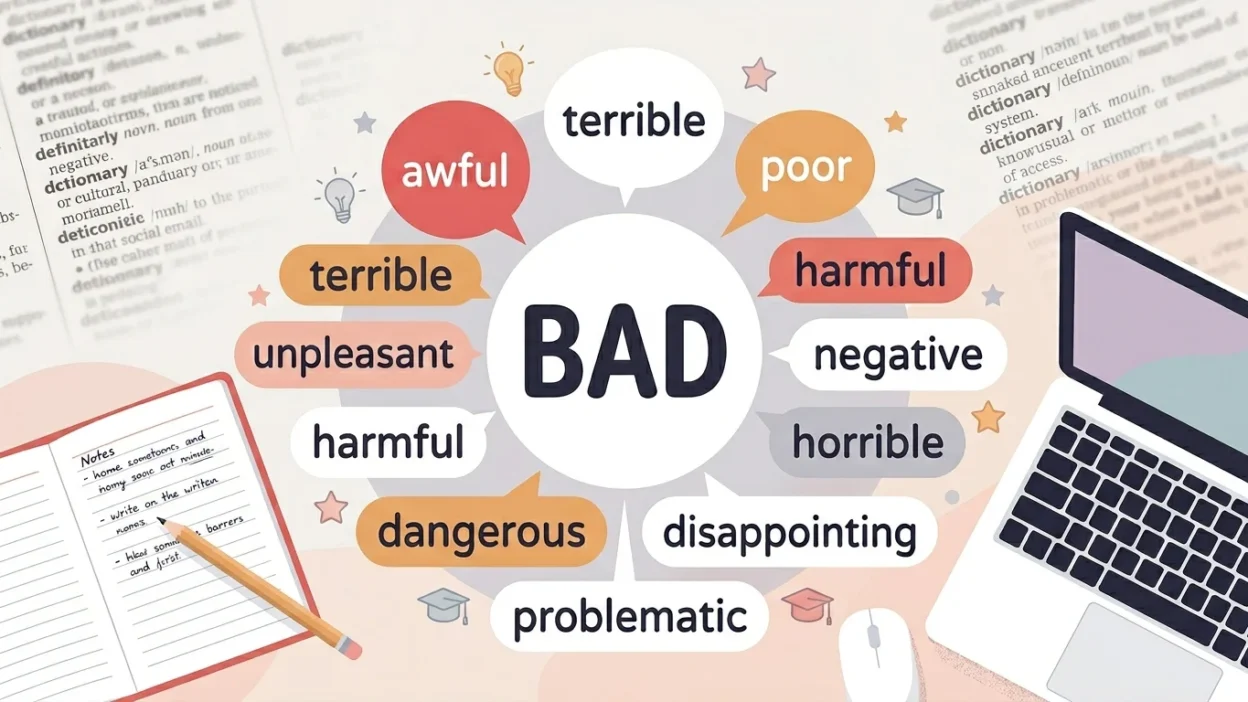
The word bad is one of the most common adjectives in English. We use it to describe something negative, unpleasant, poor in quality, harmful, or morally wrong.
Students use it in school essays, ESL learners hear it in daily conversations, writers use it in stories, and content creators use it in captions, scripts, and blog posts. Because it is such a basic and useful word, it appears very often in English.
But there is one problem: bad is very broad. It can describe a bad movie, a bad habit, a bad person, a bad result, bad weather, or bad behavior. These all mean different things. That is why learning synonyms for bad is so useful.
A stronger synonym can show whether something is unpleasant, harmful, poor quality, serious, cruel, or disappointing. This helps your writing sound clearer and more natural.
In this article, you will learn 30 useful synonyms for bad with simple meanings, example sentences, and easy usage notes. You will also find a comparison table and a practical guide to help you choose the right word based on tone and meaning.
The article is written in simple English, so it is easy to understand for students, ESL learners, writers, and content creators.
What Does “Bad” Mean?
The word bad means not good, poor in quality, unpleasant, harmful, or wrong. It can describe things, people, actions, experiences, situations, or results.
Simple meaning of bad
Something is bad if it:
- is not good
- causes problems
- feels unpleasant
- has poor quality
- is harmful or morally wrong
Example sentences
- I had a bad day at school.
- The food tasted bad.
- Smoking is bad for your health.
The word bad is useful because it is simple and easy to understand. But because it is so general, it may not always be the best choice. Sometimes a more specific word can express your meaning better.
Why Learn Synonyms for Bad?
Learning different synonyms for bad can improve your writing and vocabulary in many ways.
It reduces repetition
If you use bad again and again in an essay, story, or article, your writing can sound repetitive.
It makes your meaning clearer
A synonym can show exactly what kind of “bad” you mean. For example, awful sounds stronger than bad, while harmful focuses on damage or danger.
It improves tone
Some synonyms sound casual, some sound formal, and some sound emotional. Choosing the right word helps your writing match the situation.
It makes writing more natural
Using different words helps your English sound richer, more fluent, and more precise.
What Do “Given Keywords” Mean in This Article?
In this article, given keywords means the 30 target words listed as synonyms for bad. These are the vocabulary words you are learning and comparing.
Simple meaning of given keywords
“Given keywords” simply means:
- the words provided in the article
- the vocabulary items being explained
- the target terms you should focus on
Tone and usage context
The phrase given keywords is neutral and instructional. It is often used in:
- SEO content briefs
- writing prompts
- vocabulary exercises
- school assignments
- article outlines
Example in context
- In this guide, the given keywords are the 30 synonyms for bad explained below.
So in this article, the given keywords are words like awful, terrible, harmful, and poor—all of which can express different shades of the meaning of bad.
30 Synonyms for Bad
1. Awful
Meaning
Very bad, unpleasant, or upsetting.
Example sentence
We had an awful experience at the hotel.
Best usage context
Use for strong negative feelings, bad experiences, or poor situations.
2. Terrible
Meaning
Extremely bad or serious.
Example sentence
The movie was terrible, so we left early.
Best usage context
Good for strong opinions, bad results, or serious problems.
3. Poor
Meaning
Not good in quality, standard, or condition.
Example sentence
He got a poor grade on the test.
Best usage context
Best for performance, quality, results, or service.
4. Harmful
Meaning
Causing damage, injury, or negative effects.
Example sentence
Too much sugar can be harmful to your health.
Best usage context
Use for health, behavior, chemicals, habits, or risky actions.
5. Unpleasant
Meaning
Not enjoyable or comfortable.
Example sentence
The smell in the room was very unpleasant.
Best usage context
Useful for experiences, weather, smells, conversations, or feelings.
6. Negative
Meaning
Bad in effect, attitude, or result.
Example sentence
The team received negative feedback after the event.
Best usage context
Good for feedback, emotions, opinions, and outcomes.
7. Inferior
Meaning
Lower in quality, value, or standard.
Example sentence
This material is inferior to the one we used before.
Best usage context
Best for comparing quality in formal or academic writing.
8. Defective
Meaning
Having a fault or problem that stops something from working properly.
Example sentence
The shop replaced the defective phone charger.
Best usage context
Use for products, machines, equipment, or manufactured items.
9. Faulty
Meaning
Not working correctly because of a problem or mistake.
Example sentence
The fire alarm went off because of a faulty wire.
Best usage context
Good for machines, electronics, systems, or reasoning with errors.
10. Inadequate
Meaning
Not enough or not good enough for a need or purpose.
Example sentence
The classroom had inadequate lighting.
Best usage context
Useful in formal writing about resources, support, systems, or preparation.
11. Unsatisfactory
Meaning
Not good enough or not meeting expectations.
Example sentence
His work was unsatisfactory, so he had to do it again.
Best usage context
Best for school, business, performance reviews, and formal feedback.
12. Dreadful
Meaning
Very bad, unpleasant, or shocking.
Example sentence
They had dreadful weather during the trip.
Best usage context
Use for dramatic negative situations, weather, or strong dislike.
13. Horrible
Meaning
Very unpleasant, upsetting, or frightening.
Example sentence
I had a horrible headache all day.
Best usage context
Good for pain, bad experiences, or emotional reactions.
14. Nasty
Meaning
Unpleasant, mean, dirty, or harmful depending on context.
Example sentence
He made a nasty comment during the meeting.
Best usage context
Useful for rude behavior, bad smells, illness, or unpleasant surprises.
15. Rotten
Meaning
Very bad, morally wrong, or physically spoiled.
Example sentence
The fruit had gone rotten in the kitchen.
Best usage context
Best for spoiled food, unfair behavior, or informal speech about something bad.
16. Damaging
Meaning
Causing harm to someone or something.
Example sentence
Spreading false rumors can be very damaging.
Best usage context
Use for reputation, relationships, health, or emotional harm.
17. Dangerous
Meaning
Likely to cause harm or injury.
Example sentence
It is dangerous to drive in heavy fog.
Best usage context
Best for safety, health, travel, weather, or risky actions.
18. Severe
Meaning
Very serious, strong, or harsh.
Example sentence
The area faced severe flooding after the storm.
Best usage context
Useful for weather, illness, punishment, damage, or serious problems.
19. Disappointing
Meaning
Not as good as expected.
Example sentence
The exam results were disappointing for many students.
Best usage context
Good for outcomes, performances, events, or unmet expectations.
20. Substandard
Meaning
Below the expected quality level.
Example sentence
The building materials were substandard and unsafe.
Best usage context
Formal writing about quality, products, construction, or services.
21. Unacceptable
Meaning
Too bad to be allowed or approved.
Example sentence
Cheating during an exam is unacceptable.
Best usage context
Use for behavior, rules, work quality, or official standards.
22. Wrong
Meaning
Not correct, not fair, or morally bad.
Example sentence
It was wrong to blame her without proof.
Best usage context
Useful for morals, decisions, answers, and behavior.
23. Wicked
Meaning
Morally bad or evil.
Example sentence
The story’s villain was a wicked king.
Best usage context
Best for stories, strong moral judgment, or dramatic writing.
24. Evil
Meaning
Very morally bad, cruel, or harmful.
Example sentence
The novel describes an evil ruler who hurt his people.
Best usage context
Use for extreme moral wrong, villains, or serious harmful behavior.
25. Miserable
Meaning
Very unhappy, uncomfortable, or unpleasant.
Example sentence
I felt miserable after being sick all weekend.
Best usage context
Good for emotions, weather, physical discomfort, or difficult experiences.
26. Pathetic
Meaning
Very poor, weak, or disappointing.
Example sentence
The team gave a pathetic performance in the final match.
Best usage context
Use carefully for criticism of weak effort, quality, or results.
27. Appalling
Meaning
Shocking and very bad.
Example sentence
The condition of the roads was appalling.
Best usage context
Best for serious social issues, poor conditions, or shocking behavior.
28. Atrocious
Meaning
Extremely bad in quality or behavior.
Example sentence
The customer service at that store was atrocious.
Best usage context
Strong criticism for quality, behavior, service, or performance.
29. Lousy
Meaning
Very bad in an informal, everyday way.
Example sentence
I had a lousy day at work.
Best usage context
Casual conversation about bad days, weather, service, or results.
30. Problematic
Meaning
Causing problems or likely to create difficulty.
Example sentence
This plan may be problematic because it costs too much.
Best usage context
Useful for formal, academic, or professional discussions about issues.
Comparison Table: When to Use Different Synonyms for Bad
| Word | Simple Meaning | Tone | Best Used When |
|---|---|---|---|
| awful | very bad or upsetting | strong | bad experiences, strong dislike |
| terrible | extremely bad | strong | serious problems or opinions |
| poor | low in quality or result | neutral | grades, work, quality, service |
| harmful | causing damage | neutral/formal | health, habits, risky behavior |
| unpleasant | not enjoyable | neutral | smells, situations, feelings |
| negative | bad in effect or attitude | neutral/formal | feedback, emotions, outcomes |
| inferior | lower in quality | formal | comparisons, products, standards |
| defective | broken because of a fault | neutral/formal | products and manufactured items |
| faulty | not working correctly | neutral | systems, machines, electronics |
| inadequate | not enough or not good enough | formal | support, resources, preparation |
| unsatisfactory | not meeting expectations | formal | school, business, performance |
| dreadful | very bad or upsetting | strong | weather, situations, feelings |
| horrible | very unpleasant or upsetting | strong | pain, experiences, emotions |
| nasty | unpleasant, rude, or harmful | informal | comments, smells, behavior |
| rotten | very bad or spoiled | informal | food, luck, behavior |
| damaging | causing harm | formal | reputation, relationships, health |
| dangerous | likely to cause harm | neutral | safety, driving, weather, actions |
| severe | very serious or harsh | formal | weather, illness, damage |
| disappointing | not as good as expected | neutral | results, events, performances |
| substandard | below quality level | formal | products, materials, services |
| unacceptable | too bad to allow | formal/strong | behavior, rules, standards |
| wrong | not correct or morally bad | neutral | morals, answers, actions |
| wicked | morally bad | dramatic | stories, strong moral judgment |
| evil | extremely morally bad | very strong | villains, cruelty, serious harm |
| miserable | very unhappy or uncomfortable | emotional | feelings, weather, illness |
| pathetic | very weak or poor | critical | effort, quality, performance |
| appalling | shockingly bad | strong/formal | conditions, behavior, social issues |
| atrocious | extremely bad | very strong | service, performance, behavior |
| lousy | very bad in casual speech | informal | daily complaints and conversation |
| problematic | causing problems | formal | plans, ideas, systems, discussions |
How to Choose the Right Synonym
Choosing the right synonym for bad depends on what kind of bad you mean. Is something poor in quality? Harmful? Unpleasant? Morally wrong? Disappointing? Here is a simple guide.
If Something Is Poor in Quality
Use
- poor
- inferior
- substandard
- unsatisfactory
- pathetic
Quick guide
- poor = simple and general
- inferior = lower than another option
- substandard = below the expected level
- unsatisfactory = does not meet expectations
- pathetic = very weak or disappointing, often critical
If Something Is Harmful or Risky
Use
- harmful
- damaging
- dangerous
- severe
- problematic
Quick guide
- harmful = causes damage over time
- damaging = hurts a person, reputation, or relationship
- dangerous = may cause injury or serious harm
- severe = serious and intense
- problematic = causes difficulty or concern
If Something Is Unpleasant or Upsetting
Use
- awful
- terrible
- horrible
- dreadful
- unpleasant
- lousy
Quick guide
- awful = strong and common negative word
- terrible = very strong dislike or serious problem
- horrible = upsetting, painful, or frightening
- dreadful = dramatic and strongly negative
- unpleasant = softer and more polite
- lousy = casual and informal
If Something Is Disappointing
Use
- disappointing
- poor
- unsatisfactory
- pathetic
Quick guide
- disappointing = not as good as hoped
- poor = weak quality or result
- unsatisfactory = not good enough
- pathetic = harsh criticism for weak effort or quality
If Something Is Morally Wrong or Cruel
Use
- wrong
- wicked
- evil
- nasty
Quick guide
- wrong = general moral or factual problem
- wicked = morally bad, often dramatic or literary
- evil = extremely cruel or morally bad
- nasty = rude, mean, or unpleasant in behavior
If You Are Writing Formally
Use
- inadequate
- problematic
- negative
- substandard
- unacceptable
- consequentially harmful (avoid unless truly needed; usually “harmful” or “damaging” is better)
Quick guide
- inadequate = not enough
- problematic = causes issues
- negative = bad effect or reaction
- substandard = below quality
- unacceptable = cannot be approved
When You Should Still Use “Bad”
Even though there are many useful synonyms for bad, the word bad itself is still a good choice in many situations. It is simple, natural, and easy to understand. Sometimes it is the clearest word, especially in basic writing or everyday conversation.
Use bad when:
- you want a simple and general word
- the exact type of negativity is not important
- you are writing for beginners or ESL learners
- you want your sentence to sound natural and direct
Example
- It is a bad idea to stay up all night before an exam.
This sentence is clear and easy to understand, so bad works well here.
Common Mistakes When Using Synonyms for Bad
Choosing a word that is too strong
Words like atrocious, evil, or appalling are much stronger than bad. Use them only when the situation really deserves strong language.
Using formal words in casual speech
Words like inadequate or substandard may sound unnatural in a simple conversation with friends.
Using moral words for simple problems
Do not use evil or wicked for small everyday problems like a boring movie or cold food. Those words are too strong.
Replacing bad every time
You do not need to avoid bad completely. Good writing is about choosing the right word, not the fanciest word.
Tips for Students, ESL Learners, and Writers
Ask what kind of “bad” you mean
Before choosing a synonym, ask:
- Is it poor in quality?
- Is it harmful?
- Is it disappointing?
- Is it morally wrong?
- Is it simply unpleasant?
Match the tone to the context
Use informal words like lousy or nasty in casual situations. Use words like problematic, inadequate, or unacceptable in essays, reports, or professional writing.
Learn words in groups
This makes them easier to remember.
Quality words
- poor
- inferior
- substandard
- unsatisfactory
Harm words
- harmful
- damaging
- dangerous
- severe
Emotional or unpleasant words
- awful
- horrible
- dreadful
- miserable
Moral or behavior words
- wrong
- wicked
- evil
- nasty
Practice with your own sentences
Try replacing bad with different synonyms and see how the meaning changes.
Example
Original:
- The weather was bad.
Try:
- The weather was awful.
- The weather was unpleasant.
- The weather was severe.
Each word gives the sentence a slightly different meaning and tone.
Final Thoughts
Learning useful synonyms for bad can make your English much more precise and expressive. Instead of using the same word again and again, you can choose a synonym that better fits the situation.
Sometimes something is bad because it is poor quality, sometimes because it is harmful, and sometimes because it is morally wrong or simply disappointing. Knowing the difference helps you write more clearly and naturally.
The best way to learn these words is to group them by meaning. Use poor, substandard, and unsatisfactory for weak quality.
Use harmful, dangerous, and damaging for risk or harm. Use awful, terrible, and horrible for strong negative feelings. Use wrong, wicked, or evil only when you mean moral problems or cruelty.
Most importantly, remember that bad is still a useful word. You do not need to replace it every time. Just choose a different word when it makes your meaning clearer, stronger, or more natural.