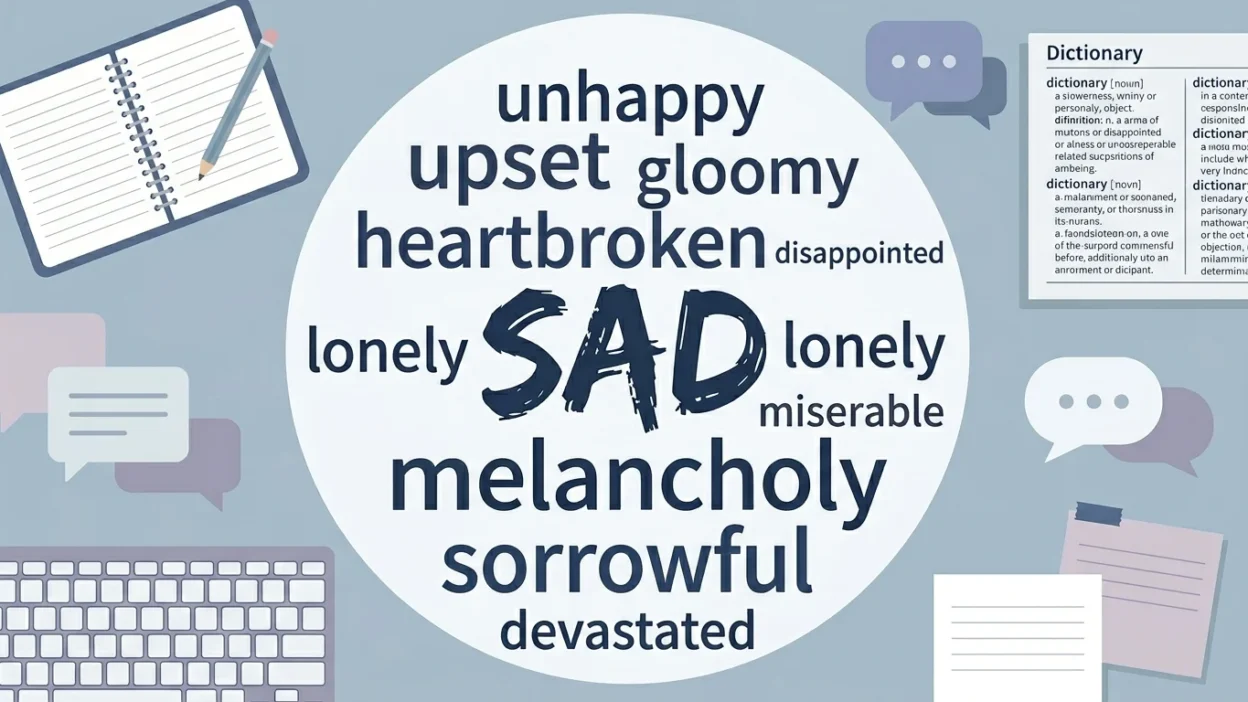
The word sad is one of the most common emotional words in English. We use it to describe feelings of unhappiness, disappointment, sorrow, loneliness, or emotional pain.
Students use it in essays, ESL learners hear it in daily conversation, writers use it in stories and dialogue, and content creators use it in captions, scripts, and blog posts.
Because it is simple and useful, it appears often in both spoken and written English.
But sad is also a very broad word. A person can feel sad because they are disappointed, heartbroken, lonely, regretful, depressed, or simply upset for a short time.
These feelings are not exactly the same. That is why learning synonyms for sad is so helpful. A more specific synonym can show the exact kind of sadness more clearly and make your writing sound more natural and expressive.
In this article, you will learn 30 useful synonyms for sad with simple meanings, example sentences, and beginner-friendly usage notes. You will also find a comparison table and a practical guide to choosing the right synonym based on tone and meaning.
The article is written in simple English, so it is easy to understand for students, ESL learners, writers, and content creators.
What Does “Sad” Mean?
The word sad means feeling unhappy, emotionally hurt, disappointed, or sorrowful. It can describe a short feeling, a deep emotional state, or a mood caused by loss, failure, loneliness, or bad news.
Simple meaning of sad
Someone is sad if they:
- feel unhappy
- feel hurt or disappointed
- feel lonely or down
- feel sorrow because of something difficult
- are not emotionally cheerful
Example sentences
- I felt sad after hearing the news.
- She looked sad when the trip was canceled.
- It’s normal to feel sad sometimes.
The word sad is clear and natural, but it does not always show what kind of sadness you mean. That is where synonyms can help.
Why Learn Synonyms for Sad?
Learning different synonyms for sad can improve your English in several ways.
It reduces repetition
If you use sad too many times in a story, essay, or article, your writing can sound repetitive.
It makes emotions more precise
A synonym can show whether the sadness is mild, deep, temporary, lonely, or caused by disappointment.
It improves tone
Some words sound gentle, some sound serious, and some sound literary or emotional. Choosing the right synonym helps your writing match the situation.
It makes writing more expressive
A better word can help readers understand the emotion more clearly and connect with your writing.
What Do “Given Keywords” Mean in This Article?
In this article, given keywords means the 30 target words listed as synonyms for sad. These are the vocabulary words you are learning and comparing.
Simple meaning of given keywords
“Given keywords” simply means:
- the words provided in the article
- the vocabulary items being explained
- the target terms you should focus on
Tone and usage context
The phrase given keywords is neutral and instructional. It is often used in:
- SEO content briefs
- writing prompts
- vocabulary exercises
- school assignments
- article outlines
Example in context
- In this guide, the given keywords are the 30 synonyms for sad explained below.
So in this article, the given keywords are words like unhappy, gloomy, heartbroken, and disappointed—all of which express different shades of sadness.
30 Synonyms for Sad
1. Unhappy
Meaning
Not happy; feeling upset or low.
Example sentence
She felt unhappy about the decision.
Best usage context
Use as a simple, general alternative to sad.
2. Upset
Meaning
Emotionally disturbed, unhappy, or worried.
Example sentence
He was upset after the argument.
Best usage context
Good for emotional reactions to problems, bad news, or conflict.
3. Disappointed
Meaning
Sad because something was not as good as expected.
Example sentence
I was disappointed that the event was canceled.
Best usage context
Use when expectations are not met.
4. Down
Meaning
Feeling low, sad, or lacking energy.
Example sentence
She’s been feeling a little down lately.
Best usage context
Informal and common for mild sadness or low mood.
5. Blue
Meaning
Sad or emotionally low.
Example sentence
He felt blue after moving away from his friends.
Best usage context
Informal and natural for gentle sadness.
6. Gloomy
Meaning
Sad, dark, and without much hope or joy.
Example sentence
The room felt gloomy after the bad news.
Best usage context
Good for mood, atmosphere, or a negative emotional tone.
7. Miserable
Meaning
Very unhappy, uncomfortable, or emotionally troubled.
Example sentence
She felt miserable during the long, lonely winter.
Best usage context
Use for strong sadness, discomfort, or emotional pain.
8. Heartbroken
Meaning
Extremely sad because of loss, disappointment, or emotional pain.
Example sentence
He was heartbroken when his pet died.
Best usage context
Best for grief, breakups, loss, or deep emotional pain.
9. Sorrowful
Meaning
Full of sadness, especially deep or serious sadness.
Example sentence
They gave a sorrowful goodbye at the station.
Best usage context
Good for serious, emotional, or literary writing.
10. Depressed
Meaning
Very sad, hopeless, or emotionally heavy for a period of time.
Example sentence
He felt depressed after losing his job.
Best usage context
Use carefully for deep sadness; avoid casual overuse because it can also refer to a medical condition.
11. Melancholy
Meaning
A quiet, thoughtful kind of sadness.
Example sentence
The old song gave her a melancholy feeling.
Best usage context
Best for reflective, poetic, or gentle sadness.
12. Mournful
Meaning
Sad in a way that shows grief or loss.
Example sentence
The violin had a mournful sound.
Best usage context
Useful for grief, funerals, emotional music, or serious sadness.
13. Regretful
Meaning
Sad because you wish you had done something differently.
Example sentence
He felt regretful after speaking so harshly.
Best usage context
Best for sadness connected to guilt, mistakes, or past choices.
14. Lonely
Meaning
Sad because you feel alone or disconnected.
Example sentence
She felt lonely in the new city.
Best usage context
Use when sadness comes from isolation or missing people.
15. Hurt
Meaning
Emotionally pained by words, actions, or events.
Example sentence
I was deeply hurt by his comment.
Best usage context
Good for emotional pain caused by people or situations.
16. Grief-stricken
Meaning
Extremely sad because of death or major loss.
Example sentence
The family was grief-stricken after the accident.
Best usage context
Best for serious loss, mourning, or tragedy.
17. Dejected
Meaning
Sad, discouraged, and lacking confidence.
Example sentence
He looked dejected after losing the match.
Best usage context
Use for failure, rejection, or disappointment.
18. Despairing
Meaning
Very sad because you feel there is no hope.
Example sentence
She gave him a despairing look after hearing the result.
Best usage context
Strong emotional writing about hopelessness or emotional collapse.
19. Crestfallen
Meaning
Sad, embarrassed, or disappointed after failure.
Example sentence
The child looked crestfallen when the toy broke.
Best usage context
Good for visible disappointment or emotional letdown.
20. Somber
Meaning
Serious, quiet, and a little sad.
Example sentence
The meeting had a somber mood after the announcement.
Best usage context
Useful for serious situations, respectful sadness, or quiet emotional tone.
21. Woeful
Meaning
Very sad or full of sorrow.
Example sentence
He gave a woeful sigh and sat down.
Best usage context
Best for literary, dramatic, or emotional writing.
22. Dismayed
Meaning
Sad, worried, and disappointed by something troubling.
Example sentence
She was dismayed by the poor test results.
Best usage context
Use when sadness is mixed with concern or shock.
23. Low
Meaning
Feeling emotionally weak, tired, or sad.
Example sentence
I’ve been feeling low since the holidays ended.
Best usage context
Informal and common for mild emotional sadness.
24. Tearful
Meaning
Sad enough to cry or almost cry.
Example sentence
She became tearful during the farewell speech.
Best usage context
Good for emotional scenes, speeches, or personal moments.
25. Brokenhearted
Meaning
Deeply sad, especially because of love or loss.
Example sentence
He was brokenhearted after the breakup.
Best usage context
Best for romantic loss, grief, or intense emotional pain.
26. Heavyhearted
Meaning
Feeling sad and emotionally burdened.
Example sentence
She left the hospital heavyhearted.
Best usage context
Use for emotional sadness, worry, or serious concern.
27. Desolate
Meaning
Extremely sad, empty, and alone.
Example sentence
He felt desolate after the family moved away.
Best usage context
Strong word for loneliness, grief, or emotional emptiness.
28. Glum
Meaning
Quietly sad, disappointed, or not cheerful.
Example sentence
He looked glum after hearing the news.
Best usage context
Good for visible sadness or a low mood in casual writing.
29. Morose
Meaning
Gloomy, sad, and unwilling to be cheerful.
Example sentence
She became morose after the long week.
Best usage context
Best for dark moods, withdrawn behavior, or literary writing.
30. Inconsolable
Meaning
So sad that nothing seems able to comfort you.
Example sentence
The little girl was inconsolable after losing her puppy.
Best usage context
Use for extreme sadness, grief, or emotional breakdown.
Comparison Table: When to Use Different Synonyms for Sad
| Word | Simple Meaning | Tone | Best Used When |
|---|---|---|---|
| unhappy | not happy | neutral | general sadness |
| upset | emotionally disturbed or worried | common | conflict, bad news, stress |
| disappointed | sad because expectations failed | neutral | plans, results, outcomes |
| down | low in mood | informal | mild sadness |
| blue | gently sad | informal | emotional low mood |
| gloomy | dark and sad in mood | expressive | mood, atmosphere |
| miserable | very unhappy | strong | discomfort, emotional pain |
| heartbroken | deeply sad because of loss | emotional | grief, breakups, loss |
| sorrowful | full of sorrow | formal/literary | deep sadness, serious writing |
| depressed | deeply sad and hopeless | serious | prolonged sadness; use carefully |
| melancholy | quiet reflective sadness | literary/soft | thoughtful sadness |
| mournful | sad with grief | emotional | loss, music, funerals |
| regretful | sad about a mistake | reflective | guilt, past choices |
| lonely | sad because alone | emotional | isolation, missing people |
| hurt | emotionally pained | common | personal conflict |
| grief-stricken | devastated by loss | very strong | death, tragedy |
| dejected | discouraged and sad | formal/common | failure, rejection |
| despairing | sad without hope | strong | hopeless situations |
| crestfallen | visibly disappointed | expressive | embarrassment, failure |
| somber | serious and quietly sad | formal | respectful or heavy situations |
| woeful | very sorrowful | literary | dramatic or emotional writing |
| dismayed | sad and troubled | formal | bad results, concern |
| low | emotionally tired or sad | informal | mild ongoing sadness |
| tearful | close to crying | emotional | emotional scenes |
| brokenhearted | deeply hurt by love or loss | emotional | breakup, grief |
| heavyhearted | emotionally burdened | warm/serious | worry, serious sadness |
| desolate | empty and extremely sad | strong | loneliness, grief |
| glum | quietly unhappy | casual | visible low mood |
| morose | gloomy and withdrawn | literary/formal | dark moods |
| inconsolable | impossible to comfort | very strong | intense grief or shock |
How to Choose the Right Synonym
Choosing the right synonym for sad depends on what kind of sadness you want to express. Is it mild disappointment? Deep grief? Loneliness? Regret? A quiet emotional mood? Here is a simple guide.
If You Mean Mild or Everyday Sadness
Use
- unhappy
- down
- blue
- low
- glum
Quick guide
- unhappy = simple and general
- down = common and informal
- blue = soft emotional sadness
- low = tired, emotionally low mood
- glum = visible, quiet unhappiness
If You Mean Disappointment or Emotional Letdown
Use
- disappointed
- dejected
- crestfallen
- dismayed
Quick guide
- disappointed = expectations were not met
- dejected = discouraged after failure
- crestfallen = visibly sad or embarrassed
- dismayed = sad and troubled by something upsetting
If You Mean Deep Emotional Pain or Loss
Use
- heartbroken
- brokenhearted
- grief-stricken
- inconsolable
- desolate
Quick guide
- heartbroken = deeply hurt by loss
- brokenhearted = strong sadness, often from love or grief
- grief-stricken = extreme sadness after loss or death
- inconsolable = too sad to be comforted
- desolate = empty, lonely, and deeply sad
If You Mean Quiet, Serious, or Reflective Sadness
Use
- melancholy
- somber
- sorrowful
- mournful
- heavyhearted
Quick guide
- melancholy = thoughtful, gentle sadness
- somber = serious and quiet sadness
- sorrowful = deep sadness with emotional weight
- mournful = grief-related sadness
- heavyhearted = emotionally burdened and sad
If Sadness Is Caused by Isolation or Personal Hurt
Use
- lonely
- hurt
- regretful
Quick guide
- lonely = sadness from being alone
- hurt = emotional pain caused by someone or something
- regretful = sadness about something you did or did not do
When You Should Still Use “Sad”
Even though there are many useful synonyms for sad, the word sad itself is still a strong and natural choice. It is simple, clear, and easy to understand. In many situations, it is the best word.
Use sad when:
- you want a general emotional word
- the exact type of sadness is not important
- you are writing for beginners or ESL learners
- you want the sentence to sound natural and direct
Example
- I felt sad when the summer ended.
This sentence is clear, natural, and emotionally easy to understand.
Common Mistakes When Using Synonyms for Sad
Choosing a word that is too strong
Words like inconsolable, grief-stricken, or desolate are much stronger than sad. Use them only when the situation truly involves deep emotional pain.
Using medical or serious terms too casually
The word depressed can describe deep sadness, but it is also linked to mental health. It should not be used casually for every small disappointment.
Using literary words in simple conversation
Words like woeful, morose, or melancholy may sound too formal or dramatic in everyday speech.
Replacing sad every time
You do not need to remove every use of sad. The goal is to choose a more specific word only when it adds clarity or emotional detail.
Tips for Students, ESL Learners, and Writers
Ask what kind of sadness you mean
Before choosing a synonym, ask:
- Is the sadness mild or deep?
- Is it caused by loss, failure, loneliness, or regret?
- Is it temporary or long-lasting?
- Do you want a casual, formal, or emotional tone?
Match the tone to the context
Use simple words like sad, unhappy, or upset in everyday writing. Use words like heartbroken, melancholy, or somber when you want more emotional or literary detail.
Learn words in groups
This makes them easier to remember.
Mild sadness words
- unhappy
- down
- blue
- low
- glum
Disappointment words
- disappointed
- dejected
- crestfallen
- dismayed
Deep grief words
- heartbroken
- grief-stricken
- inconsolable
- desolate
Quiet emotional words
- melancholy
- sorrowful
- somber
- heavyhearted
Practice with your own sentences
Try replacing sad with different synonyms and notice how the emotional meaning changes.
Example
Original:
- She felt sad after the concert ended.
Try:
- She felt disappointed after the concert ended.
- She felt melancholy after the concert ended.
- She felt heartbroken after the concert ended.
Each word changes the level and type of sadness.
Final Thoughts
Learning useful synonyms for sad can make your English more expressive, more accurate, and more natural. Instead of using one general word for every negative feeling, you can choose a synonym that better matches the situation.
Sometimes sadness is mild and temporary, sometimes it comes from disappointment, and sometimes it is deep grief, loneliness, or regret. The right word helps you show that difference clearly.
The best way to learn these words is to group them by feeling. Use unhappy, down, and blue for everyday sadness.
Use disappointed, dejected, and crestfallen for emotional letdown. Use heartbroken, grief-stricken, and inconsolable for deep emotional pain.
Use melancholy, somber, and heavyhearted for quiet, serious sadness.
Most importantly, remember that sad is still a useful and natural word. You do not need to replace it every time. Just choose a different word when it helps your writing sound clearer, richer, or more emotionally precise.