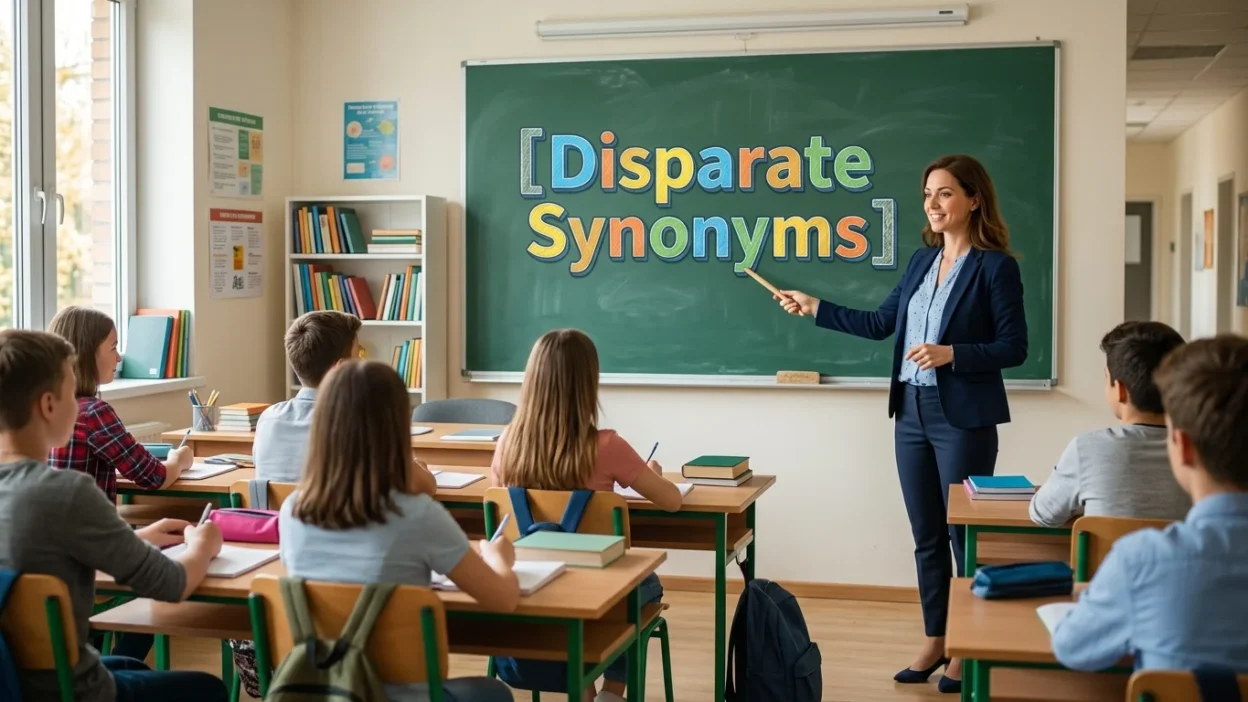
The word disparate describes things that are very different from one another and do not seem to belong together. It is commonly used in academic writing, journalism, business, and everyday English when comparing people, ideas, groups, or objects that have little in common.
Learning disparate synonyms helps students, writers, and English learners express differences more precisely. While some synonyms emphasize contrast, others highlight diversity, separation, or inconsistency. Understanding these subtle differences allows you to choose the best word for each situation.
In this guide, you’ll learn the meaning of disparate, explore 30 useful synonyms and related words, and discover simple definitions, example sentences, and usage tips for each one.
What Does “Disparate” Mean?
Disparate means fundamentally different, distinct, or not alike in any important way. It describes people, ideas, objects, or situations that are so different that they cannot easily be compared or grouped together.
For example, a scientist and a musician may have disparate careers because their work is very different.
Tone: Neutral, formal, and descriptive.
Common Usage:
- Academic writing
- Journalism
- Business
- Literature
- Research
- Everyday English
30 Disparate Synonyms
1. Different
Meaning: Not the same as another person or thing.
Example Sentence: The twins have very different personalities.
Best Usage Context: Everyday conversations and writing.
2. Distinct
Meaning: Clearly separate or different.
Example Sentence: The two cultures have distinct traditions.
Best Usage Context: Academic and professional writing.
3. Dissimilar
Meaning: Not alike in appearance or nature.
Example Sentence: Their opinions are completely dissimilar.
Best Usage Context: Formal writing and comparisons.
4. Divergent
Meaning: Moving or developing in different directions.
Example Sentence: The researchers reached divergent conclusions.
Best Usage Context: Research, business, and education.
5. Contrasting
Meaning: Showing obvious differences.
Example Sentence: The painting uses contrasting colors.
Best Usage Context: Art, design, and general writing.
6. Unrelated
Meaning: Not connected or associated.
Example Sentence: The two events were completely unrelated.
Best Usage Context: Everyday English and journalism.
7. Separate
Meaning: Existing independently rather than together.
Example Sentence: They worked in separate departments.
Best Usage Context: Everyday and business writing.
8. Independent
Meaning: Not influenced or controlled by another.
Example Sentence: The projects are independent of each other.
Best Usage Context: Business, education, and science.
9. Diverse
Meaning: Including many different types or varieties.
Example Sentence: The city has a diverse population.
Best Usage Context: Education, culture, and business.
10. Varied
Meaning: Containing many different kinds.
Example Sentence: The museum has a varied collection of art.
Best Usage Context: Everyday writing and education.
11. Mixed
Meaning: Made up of different elements.
Example Sentence: The class included students from mixed backgrounds.
Best Usage Context: General communication.
12. Incompatible
Meaning: Unable to exist or work together successfully.
Example Sentence: Their goals were incompatible.
Best Usage Context: Business, relationships, and technology.
13. Contrary
Meaning: Opposite in nature or direction.
Example Sentence: She expressed a contrary opinion.
Best Usage Context: Formal writing and discussions.
14. Opposite
Meaning: Completely different or facing another direction.
Example Sentence: They stood on opposite sides of the room.
Best Usage Context: Everyday English.
15. Discordant
Meaning: Lacking agreement or harmony.
Example Sentence: The committee heard several discordant views.
Best Usage Context: Literature, music, and formal writing.
16. Contradictory
Meaning: Expressing ideas that oppose each other.
Example Sentence: The two reports contained contradictory information.
Best Usage Context: Research, journalism, and academic writing.
17. Inconsistent
Meaning: Not staying the same or not matching.
Example Sentence: His answers were inconsistent throughout the interview.
Best Usage Context: Business, education, and everyday writing.
18. Unmatched
Meaning: Not equal or similar to another.
Example Sentence: Their skills were unmatched by the competition.
Best Usage Context: Comparisons and descriptive writing.
19. Unequal
Meaning: Not equal in size, quality, or importance.
Example Sentence: The resources were distributed unequally.
Best Usage Context: Mathematics, economics, and social studies.
20. Unalike
Meaning: Not similar in appearance or character.
Example Sentence: Although they are siblings, they are completely unalike.
Best Usage Context: Everyday English and descriptive writing.
21. Miscellaneous
Meaning: Made up of many different types that do not belong to one category.
Example Sentence: The drawer contained miscellaneous tools.
Best Usage Context: Organization, business, and education.
22. Heterogeneous
Meaning: Consisting of different kinds or types.
Example Sentence: The research group was heterogeneous in experience.
Best Usage Context: Academic writing, science, and sociology.
23. Multifaceted
Meaning: Having many different aspects or features.
Example Sentence: The issue is multifaceted and requires careful analysis.
Best Usage Context: Business, education, and professional writing.
24. Assorted
Meaning: Collected from different types or categories.
Example Sentence: The box contained assorted chocolates.
Best Usage Context: Shopping, retail, and everyday writing.
25. Diverse
Meaning: Including many different people, ideas, or things.
Example Sentence: The conference attracted a diverse audience.
Best Usage Context: Education, culture, and workplace communication.
26. Distinguishable
Meaning: Able to be recognized as different.
Example Sentence: The two brands are easily distinguishable.
Best Usage Context: Academic writing and product comparisons.
27. Nonuniform
Meaning: Not the same throughout.
Example Sentence: The fabric had a nonuniform texture.
Best Usage Context: Science, manufacturing, and technical writing.
28. Disconnected
Meaning: Not linked or related.
Example Sentence: The events seemed disconnected at first.
Best Usage Context: Journalism, storytelling, and business.
29. Irreconcilable
Meaning: Too different to be brought into agreement.
Example Sentence: The two sides had irreconcilable differences.
Best Usage Context: Politics, law, and relationships.
30. Diverse in Nature
Meaning: Having many different characteristics.
Example Sentence: The organization serves communities that are diverse in nature.
Best Usage Context: Formal reports, education, and presentations.
Comparison Guide: When to Use Different Disparate Synonyms
| Synonym | Best Used For | Tone |
|---|---|---|
| Different | General comparisons | Neutral |
| Distinct | Clearly separate ideas | Formal |
| Dissimilar | Direct comparisons | Formal |
| Divergent | Opinions and directions | Academic |
| Contrasting | Visible differences | Descriptive |
| Unrelated | No connection | Everyday |
| Separate | Independent items | Neutral |
| Independent | Separate systems or projects | Professional |
| Diverse | Variety and inclusion | Positive |
| Varied | Mixed collections | Neutral |
| Incompatible | Things that cannot work together | Formal |
| Contrary | Opposing ideas | Formal |
| Opposite | Complete contrast | Everyday |
| Discordant | Lack of harmony | Literary |
| Contradictory | Opposing statements | Academic |
| Heterogeneous | Mixed groups | Technical |
| Multifaceted | Many aspects | Professional |
| Assorted | Mixed collections | Casual |
| Disconnected | Lack of connection | Neutral |
| Irreconcilable | Impossible to agree | Formal |
How to Choose the Right Synonym
The best synonym for disparate depends on whether you are describing differences, variety, disagreement, or lack of connection.
For Everyday Conversations
Use different, separate, unalike, varied, and unrelated because they are simple and easy to understand.
For Academic and Professional Writing
Choose distinct, dissimilar, divergent, heterogeneous, multifaceted, and contradictory for essays, research papers, and reports.
For Business and Workplace Communication
Words like independent, incompatible, inconsistent, disconnected, and diverse clearly describe projects, teams, or ideas.
For Literature and Creative Writing
Use discordant, contrasting, irreconcilable, and contrary to create stronger descriptions and emphasize differences.
Common Mistakes When Using Disparate Synonyms
Many learners confuse disparate with different. Although they are related, disparate usually describes things that are very different or completely unrelated, while different can refer to even small differences.
For example:
- Different colors may still look similar.
- Disparate cultures may have almost nothing in common.
Also remember:
- Diverse highlights variety rather than conflict.
- Incompatible means two things cannot work well together.
- Heterogeneous is mainly used in scientific, academic, or technical writing.
- Irreconcilable describes differences that cannot be resolved.
Choosing the right synonym makes your writing clearer and more precise.
Conclusion
Learning disparate synonyms helps you describe differences with greater accuracy and variety. Whether you’re writing an academic paper, business report, article, or creative story, using the right synonym improves clarity and keeps your writing engaging.
Practice these alternatives regularly to expand your vocabulary and become more confident in both spoken and written English.
FAQs
What is the closest synonym for disparate?
The closest synonyms for disparate are different, distinct, dissimilar, divergent, and unrelated, depending on the context.
Is “different” the same as “disparate”?
Not exactly. Different refers to any difference, while disparate usually describes things that are extremely different or unrelated.
What is a formal synonym for disparate?
Formal alternatives include dissimilar, heterogeneous, divergent, irreconcilable, and contradictory.
Can I use “diverse” instead of “disparate”?
Sometimes. Diverse emphasizes variety, while disparate emphasizes significant differences or lack of similarity.
Why should I learn disparate synonyms?
Learning disparate synonyms helps you avoid repetition, improve your vocabulary, and communicate differences more accurately in academic, professional, and everyday writing.

Julian Luke is a passionate grammar and language writer at Synolexes. He simplifies complex grammar rules, vocabulary, and writing concepts, helping learners improve their English communication skills with confidence.