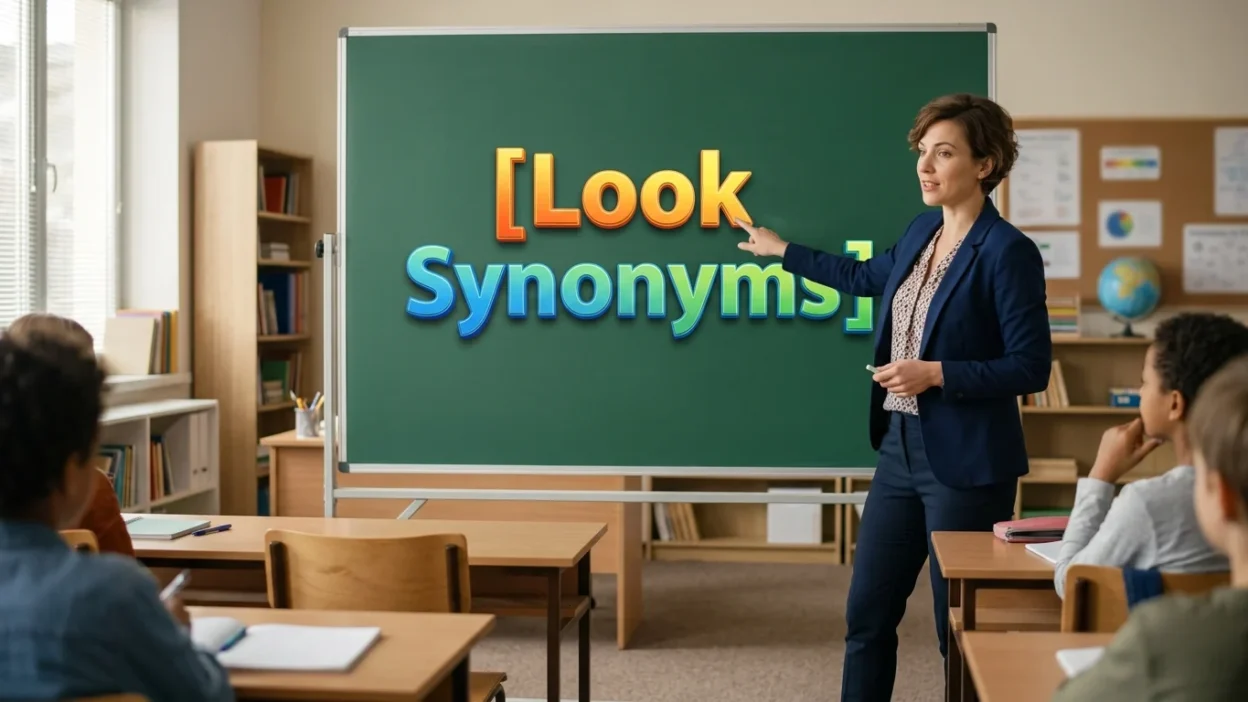
The word look is one of the most common verbs in English. It usually means to direct your eyes toward something, but it can also describe someone’s appearance, the act of searching, or paying attention. Because look has several meanings, learning its synonyms helps you choose the most accurate word for every situation.
Understanding look synonyms can improve your vocabulary and make your writing and speaking more natural. Some alternatives describe a quick glance, while others refer to careful observation or searching. Knowing the difference between these words helps students, writers, and English learners communicate more clearly.
In this guide, you’ll learn the meaning of look, discover 30 useful synonyms, and see simple definitions, example sentences, and usage tips for each one.
What Does “Look” Mean?
Look means to direct your eyes toward someone or something to see it. It can also mean to appear in a certain way or to search for something.
For example, you can look at a picture, look for your keys, or look happy after receiving good news.
Tone: Neutral and suitable for both formal and informal English.
Common Usage:
- Everyday conversations
- Education
- Business
- Literature
- Travel
- Media
30 Look Synonyms
1. See
Meaning: To notice something with your eyes.
Example Sentence: I can see the mountains from my window.
Best Usage Context: Everyday conversations and general writing.
2. Watch
Meaning: To look at something carefully over time.
Example Sentence: We watched the football match together.
Best Usage Context: Television, sports, and events.
3. Observe
Meaning: To look at something carefully and thoughtfully.
Example Sentence: Scientists observed the animals in their natural habitat.
Best Usage Context: Science, education, and research.
4. View
Meaning: To look at something, especially formally.
Example Sentence: Visitors viewed the museum exhibits.
Best Usage Context: Formal writing, museums, and business.
5. Glance
Meaning: To take a quick look.
Example Sentence: She glanced at her phone during the meeting.
Best Usage Context: Everyday conversations and storytelling.
6. Gaze
Meaning: To look steadily, often with admiration or wonder.
Example Sentence: They gazed at the stars all night.
Best Usage Context: Literature and descriptive writing.
7. Stare
Meaning: To look fixedly for a long time.
Example Sentence: Don’t stare at people.
Best Usage Context: Everyday English and storytelling.
8. Peek
Meaning: To take a quick or secret look.
Example Sentence: The children peeked through the window.
Best Usage Context: Casual conversations and stories.
9. Peep
Meaning: To look secretly through a small opening.
Example Sentence: He peeped through the keyhole.
Best Usage Context: Informal writing and storytelling.
10. Glimpse
Meaning: To see something briefly.
Example Sentence: I caught a glimpse of the rainbow.
Best Usage Context: Everyday English and creative writing.
11. Examine
Meaning: To look at something carefully for details.
Example Sentence: The doctor examined the patient’s eyes.
Best Usage Context: Healthcare, education, and research.
12. Inspect
Meaning: To carefully check something for quality or problems.
Example Sentence: Engineers inspected the bridge.
Best Usage Context: Business, construction, and safety.
13. Survey
Meaning: To look over a large area carefully.
Example Sentence: She surveyed the classroom before speaking.
Best Usage Context: Geography, military, and formal writing.
14. Scan
Meaning: To look quickly over something to find information.
Example Sentence: He scanned the newspaper headlines.
Best Usage Context: Reading, technology, and education.
15. Study
Meaning: To look at something closely in order to understand it.
Example Sentence: She studied the map before the journey.
Best Usage Context: Education, science, and research.
16. Notice
Meaning: To become aware of something by seeing it.
Example Sentence: Did you notice the new sign outside?
Best Usage Context: Everyday conversations and general writing.
17. Spot
Meaning: To see or find something quickly.
Example Sentence: She spotted a rare bird in the forest.
Best Usage Context: Casual conversations and nature writing.
18. Behold
Meaning: To look at something with admiration or surprise.
Example Sentence: They beheld the beautiful waterfall.
Best Usage Context: Literature, speeches, and poetic writing.
19. Witness
Meaning: To see an event happen.
Example Sentence: Many people witnessed the solar eclipse.
Best Usage Context: News, law, and storytelling.
20. Eye
Meaning: To look at something with interest or attention.
Example Sentence: He eyed the new laptop carefully.
Best Usage Context: Informal writing and conversations.
21. Monitor
Meaning: To watch something regularly or continuously.
Example Sentence: Nurses monitor patients throughout the day.
Best Usage Context: Healthcare, business, and technology.
22. Review
Meaning: To look over something carefully for evaluation.
Example Sentence: The manager reviewed the report before the meeting.
Best Usage Context: Business, education, and professional writing.
23. Search
Meaning: To look carefully for something that is missing.
Example Sentence: We searched the house for the lost keys.
Best Usage Context: Everyday English and investigations.
24. Seek
Meaning: To try to find something.
Example Sentence: They sought advice from an expert.
Best Usage Context: Formal writing, education, and business.
25. Browse
Meaning: To look through items casually.
Example Sentence: She browsed the bookstore for a new novel.
Best Usage Context: Shopping, websites, and everyday conversations.
26. Check
Meaning: To look at something to make sure it is correct.
Example Sentence: Please check your answers before submitting the test.
Best Usage Context: Everyday English, work, and education.
27. Read
Meaning: To look at and understand written words.
Example Sentence: He read the instructions carefully.
Best Usage Context: Education, business, and daily life.
28. Contemplate
Meaning: To look at or think about something deeply.
Example Sentence: She contemplated the painting for several minutes.
Best Usage Context: Literature, philosophy, and creative writing.
29. Admire
Meaning: To look at something with pleasure or respect.
Example Sentence: Tourists admired the historic castle.
Best Usage Context: Travel, art, and descriptive writing.
30. Focus On
Meaning: To direct your attention toward something.
Example Sentence: Students should focus on the teacher during class.
Best Usage Context: Education, business, and self-improvement.
Comparison Guide: When to Use Different Look Synonyms
| Synonym | Best Used For | Tone |
|---|---|---|
| See | General vision | Neutral |
| Watch | Ongoing observation | Everyday |
| Observe | Careful study | Formal |
| View | Formal viewing | Professional |
| Glance | Quick look | Casual |
| Gaze | Long, admiring look | Descriptive |
| Stare | Fixed look | Neutral |
| Peek | Secret or quick look | Informal |
| Glimpse | Brief sight | Neutral |
| Examine | Careful inspection | Academic |
| Inspect | Checking quality | Professional |
| Survey | Looking over a wide area | Formal |
| Scan | Quick search | Everyday |
| Study | Detailed observation | Educational |
| Notice | Becoming aware | Everyday |
| Spot | Finding quickly | Casual |
| Witness | Seeing an event | Formal |
| Search | Looking for something | Neutral |
| Browse | Casual looking | Informal |
| Monitor | Continuous observation | Professional |
| Focus On | Giving full attention | Neutral |
How to Choose the Right Synonym
The best synonym for look depends on your purpose and the situation.
For Everyday Conversations
Use see, notice, glance, spot, browse, and check because they are common and easy to understand.
For Academic and Professional Writing
Choose observe, examine, inspect, review, monitor, and survey when writing reports, essays, or research papers.
For Literature and Creative Writing
Words like gaze, behold, contemplate, admire, and glimpse create vivid descriptions and stronger imagery.
For Searching or Finding Something
Use search, seek, scan, spot, and focus on when describing finding information or objects.
Common Mistakes When Using Look Synonyms
Many learners think all look synonyms have the same meaning, but each word has a different purpose.
For example:
- See means using your eyes naturally.
- Look means directing your eyes toward something.
- Watch means looking at something over a period of time.
- Glance is a quick look, while stare is a long, fixed look.
- Observe and examine suggest careful attention and are more formal.
Choosing the right synonym makes your writing clearer and more natural.
Conclusion
Learning look synonyms helps you describe seeing, observing, searching, and paying attention more accurately. Whether you’re writing an essay, telling a story, creating content, or improving your English vocabulary, using the right synonym adds variety and precision to your communication.
Practice these alternatives regularly to build a richer vocabulary and express yourself with greater confidence.
FAQs
What is the closest synonym for look?
The closest synonyms for look are see, watch, observe, view, and glance, depending on the context.
Is “see” the same as “look”?
Not exactly. See happens naturally with your eyes, while look means directing your eyes toward something intentionally.
What is a formal synonym for look?
Formal alternatives include observe, examine, inspect, survey, review, and view.
Can I use “watch” instead of “look”?
Sometimes. Watch is used when you observe something over time, such as a movie or a sports event, while look is more general.
Why should I learn look synonyms?
Learning look synonyms helps you avoid repetition, improve your vocabulary, and communicate more clearly in everyday, academic, and professional English.