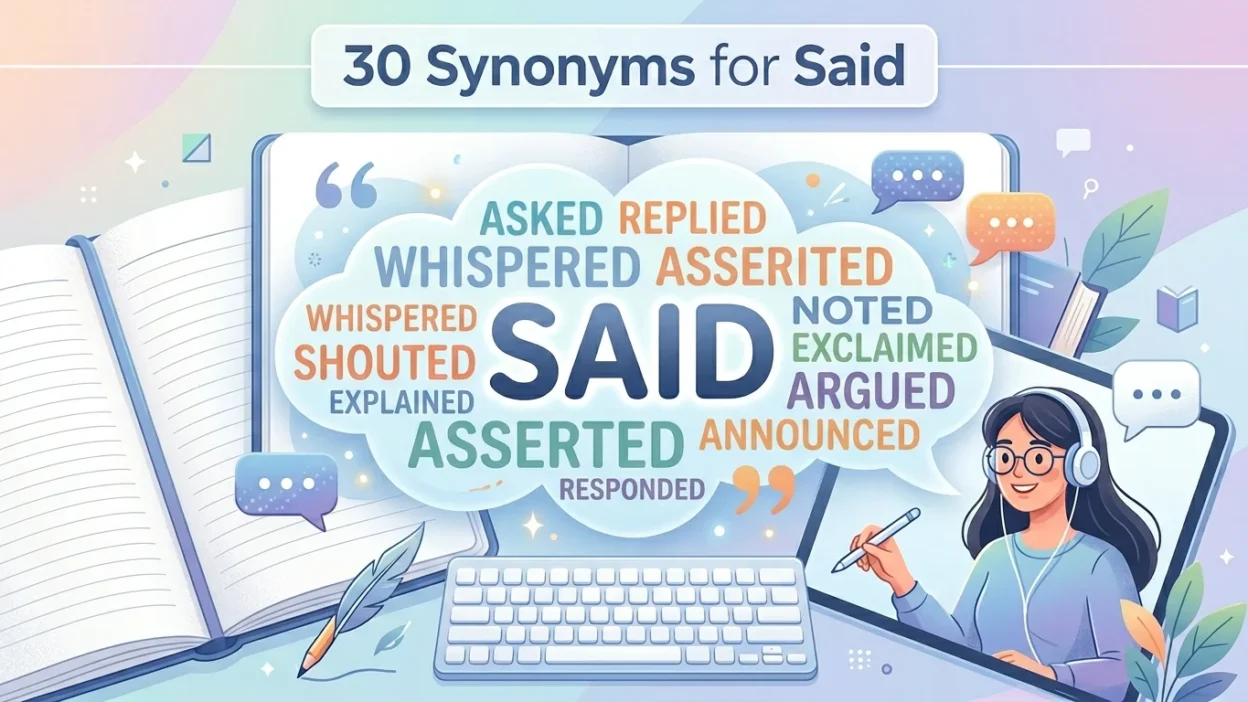
The word said is one of the most common reporting verbs in English. It appears in stories, essays, school assignments, blog posts, scripts, and even social media captions. It is simple, correct, and useful, which is why writers use it so often. But when it appears again and again in the same paragraph, it can make writing sound repetitive.
That is why many students, ESL learners, writers, and content creators search for synonyms for said. A good synonym can do more than replace one word. It can show emotion, tone, volume, attitude, or purpose. For example, a person can whisper, argue, reply, or announce instead of simply saying something. These choices help readers understand how the words were spoken.
In this article, you will learn 30 useful synonyms for said with easy meanings, example sentences, and clear usage notes. You will also find a comparison table and a practical guide to choosing the right word based on tone and intent. The explanations are written in simple English, so they are easy to follow for beginners and helpful for anyone trying to improve vocabulary and writing style.
What Does “Said” Mean?
The word said is the past tense of say. It means to speak words, to tell someone something, or to express an idea aloud.
Simple meaning of said
- To speak
- To tell
- To express something in words
Example
- “I’m ready,” she said.
The word said is not a bad word. In many cases, it is actually the best choice because it is short, clear, and natural. But when you want to show how someone spoke or what feeling they had, a different word may work better.
Why Learn Synonyms for Said?
Learning synonyms for said can improve your writing in several ways.
It reduces repetition
If every line of dialogue ends with said, your writing may start to feel repetitive.
It adds emotion
Words like cried, snapped, or whispered can show how the speaker feels.
It shows tone
Some words tell the reader whether the speaker sounds calm, polite, angry, nervous, formal, or excited.
It makes writing more vivid
A better dialogue tag can make stories, essays, scripts, and online content more engaging and easier to imagine.
What Do “Given Keywords” Mean in This Article?
In this article, given keywords means the 30 target words or phrases included in the list of synonyms for said. These are the vocabulary items you are learning and comparing.
Simple meaning of given keywords
“Given keywords” simply means:
- the words provided in the article
- the vocabulary items being explained
- the target terms you should focus on
Tone and usage context
The phrase given keywords is neutral and instructional. It is often used in:
- writing prompts
- SEO briefs
- vocabulary exercises
- school tasks
- content outlines
Example in context
- In this guide, the given keywords are the 30 synonyms for said listed below.
So in this article, the given keywords are words like asked, replied, whispered, and announced—all of which can be used instead of said in the right context.
30 Synonyms for Said
1. Asked
Meaning
Used when someone says something in the form of a question.
Example sentence
“Can you help me with this?” Amina asked.
Best usage context
Use when the speaker is asking a direct question.
2. Replied
Meaning
Answered someone after they said something.
Example sentence
“I’ll send it tonight,” he replied.
Best usage context
Best for natural conversation and message replies.
3. Answered
Meaning
Gave a response to a question.
Example sentence
“The answer is B,” the student answered.
Best usage context
Use when someone directly responds to a question.
4. Responded
Meaning
Said something back after hearing or reading something.
Example sentence
She responded politely to the email.
Best usage context
Useful in both spoken and written communication.
5. Explained
Meaning
Gave details to help someone understand.
Example sentence
The teacher explained the rule step by step.
Best usage context
Best for teaching, clarifying, or giving extra information.
6. Told
Meaning
Gave information, advice, or instructions to someone.
Example sentence
My brother told me to wait outside.
Best usage context
Good for directions, advice, and everyday communication.
7. Mentioned
Meaning
Spoke about something briefly.
Example sentence
She mentioned the meeting during lunch.
Best usage context
Use when something is only referred to quickly.
8. Added
Meaning
Said something extra after already speaking.
Example sentence
“And don’t forget your notebook,” she added.
Best usage context
Best when a speaker continues with one more point.
9. Stated
Meaning
Said something clearly and formally.
Example sentence
The notice stated that school would start at 8 a.m.
Best usage context
Useful in formal, academic, or professional writing.
10. Announced
Meaning
Said something publicly or officially.
Example sentence
The principal announced the exam dates.
Best usage context
Use for public news, school updates, or official statements.
11. Declared
Meaning
Said something strongly, clearly, or officially.
Example sentence
“I will finish this today,” he declared.
Best usage context
Strong opinions, dramatic scenes, or formal announcements.
12. Claimed
Meaning
Said something was true, often without full proof.
Example sentence
He claimed that he had completed the project already.
Best usage context
Use when the truth of the statement may be uncertain.
13. Suggested
Meaning
Gave an idea or recommendation.
Example sentence
The coach suggested taking a short break.
Best usage context
Best for polite advice and helpful ideas.
14. Admitted
Meaning
Accepted something, often something difficult or embarrassing.
Example sentence
She admitted that she had forgotten the homework.
Best usage context
Confessions, mistakes, or honest acceptance.
15. Agreed
Meaning
Said yes to an idea, opinion, or plan.
Example sentence
“That sounds fair,” he agreed.
Best usage context
Use when someone accepts or supports something.
16. Argued
Meaning
Spoke with reasons, often during disagreement.
Example sentence
The lawyer argued that the evidence was weak.
Best usage context
Debates, disagreements, or serious discussions.
17. Commented
Meaning
Gave a short opinion or remark.
Example sentence
She commented that the weather felt cooler today.
Best usage context
Best for observations and quick opinions.
18. Noted
Meaning
Pointed out something important.
Example sentence
The speaker noted that attendance had improved.
Best usage context
Useful in reports, presentations, and formal writing.
19. Confirmed
Meaning
Said that something was true or correct.
Example sentence
The manager confirmed the interview time.
Best usage context
Good for facts, schedules, and official plans.
20. Promised
Meaning
Said that you will definitely do something.
Example sentence
“I’ll help you tomorrow,” she promised.
Best usage context
Commitments, reassurance, and emotional speech.
21. Warned
Meaning
Told someone about danger or a possible problem.
Example sentence
The doctor warned him to avoid too much sugar.
Best usage context
Use for safety advice, caution, or consequences.
22. Whispered
Meaning
Spoke very quietly.
Example sentence
“Be careful,” she whispered in the dark.
Best usage context
Secrets, quiet scenes, fear, or close conversations.
23. Murmured
Meaning
Spoke softly and gently, often hard to hear.
Example sentence
“Thank you,” he murmured before leaving.
Best usage context
Shy, emotional, soft, or tired speech.
24. Muttered
Meaning
Spoke in a low and unclear voice, often to oneself.
Example sentence
He muttered something under his breath.
Best usage context
Annoyance, embarrassment, or private comments.
25. Shouted
Meaning
Spoke very loudly.
Example sentence
“Watch out!” the boy shouted from the road.
Best usage context
Warnings, urgency, or calling from far away.
26. Yelled
Meaning
Spoke loudly, often with strong emotion.
Example sentence
The coach yelled across the field.
Best usage context
Anger, excitement, or calling loudly from a distance.
27. Cried
Meaning
Said something loudly because of strong emotion.
Example sentence
“Help!” the child cried.
Best usage context
Fear, sadness, pain, or emotional scenes.
28. Snapped
Meaning
Spoke in a sharp, angry, or impatient way.
Example sentence
“Leave me alone,” she snapped.
Best usage context
Use when someone sounds irritated or stressed.
29. Exclaimed
Meaning
Said something suddenly with strong feeling.
Example sentence
“That’s amazing!” he exclaimed.
Best usage context
Surprise, joy, excitement, or shock.
30. Insisted
Meaning
Said something firmly and refused to change the point.
Example sentence
He insisted that he had locked the door.
Best usage context
Strong belief, repeated statements, or disagreement.
Comparison Table: When to Use Different Synonyms for Said
| Word | Simple Meaning | Tone | Best Used When |
|---|---|---|---|
| asked | said a question | neutral | when someone asks something |
| replied | answered back | neutral | normal conversation |
| answered | gave a response | neutral | direct answers |
| responded | said something back | neutral/formal | spoken or written replies |
| explained | made something clear | helpful | teaching or clarifying |
| told | gave information or instruction | neutral | advice or directions |
| mentioned | referred to briefly | casual | quick reference |
| added | said more | neutral | extra information |
| stated | said clearly and formally | formal | reports, essays, notices |
| announced | said publicly | formal | public updates |
| declared | said strongly | strong | bold or dramatic speech |
| claimed | said something may be true | cautious | doubtful or unproven statements |
| suggested | gave an idea | polite | recommendations |
| admitted | accepted something difficult | honest | mistakes or confessions |
| agreed | accepted an idea | positive | support or approval |
| argued | spoke with reasons in disagreement | serious | debate or conflict |
| commented | gave a remark | casual/neutral | observations |
| noted | pointed out something | formal | reports and speeches |
| confirmed | verified something | formal | facts and plans |
| promised | committed to do something | emotional | reassurance |
| warned | advised about danger | serious | risk or caution |
| whispered | spoke quietly | soft | secrets or quiet moments |
| murmured | spoke softly | gentle | shy or emotional speech |
| muttered | spoke unclearly or quietly | negative | annoyance or self-talk |
| shouted | spoke loudly | strong | warning or urgency |
| yelled | spoke loudly with emotion | intense | anger or excitement |
| cried | called out emotionally | emotional | fear, pain, sadness |
| snapped | spoke sharply | angry | irritation or impatience |
| exclaimed | spoke with surprise | excited | sudden emotion |
| insisted | said firmly again | strong | refusal to change position |
How to Choose the Right Synonym
Choosing the best synonym for said depends on intent, tone, and context. Instead of replacing said randomly, ask yourself what the speaker is doing and how they sound.
If Someone Is Asking a Question
Use
- asked
Example
- “Where is my phone?” she asked.
This is the clearest and most natural choice when the sentence is a question.
If Someone Is Answering
Use
- answered
- replied
- responded
Quick guide
- answered = direct response to a question
- replied = natural in conversation or texting
- responded = slightly more formal or neutral
If Someone Is Giving Information
Use
- explained
- told
- stated
- mentioned
- noted
Quick guide
- explained = gives details
- told = gives information to a person
- stated = formal and clear
- mentioned = quick reference
- noted = points out something important
If Someone Is Speaking Quietly
Use
- whispered
- murmured
- muttered
Quick guide
- whispered = very quiet on purpose
- murmured = soft and gentle
- muttered = low and unclear, often annoyed or shy
If Someone Is Speaking Loudly
Use
- shouted
- yelled
- cried
Quick guide
- shouted = loud voice, often for warning
- yelled = loud and emotional
- cried = emotional call for help, pain, or fear
If Someone Is Showing Strong Emotion
Use
- snapped
- exclaimed
- promised
- admitted
- insisted
Quick guide
- snapped = angry or impatient
- exclaimed = surprised or excited
- promised = emotional commitment
- admitted = honest confession
- insisted = strong belief or refusal to change
If Someone Is Speaking Formally or Publicly
Use
- announced
- stated
- declared
- confirmed
Quick guide
- announced = public message
- stated = formal written or spoken statement
- declared = strong or official statement
- confirmed = verifies facts or plans
When You Should Still Use “Said”
Many learners think they should replace said every time, but that is not true. In many cases, said is still the best choice because it is simple, natural, and easy to read.
Use said when:
- the emotion is already clear from the dialogue
- you do not need to show tone or volume
- you want the sentence to feel clean and natural
- the synonym would sound too dramatic
Example
- “I can’t believe you did that,” she said.
This sentence works perfectly well as it is.
Common Mistakes When Using Synonyms for Said
Choosing a word that changes the meaning
Not every synonym means the same thing. For example:
- whispered means quiet speech
- snapped means angry speech
- announced sounds public and formal
If the tone does not match the situation, the sentence can feel unnatural.
Using dramatic verbs too often
If every character shouts, declares, cries, and snaps, the writing can feel heavy or unrealistic.
Replacing said just to avoid repetition
You do not need to remove every use of said. Good writing is about using the right word, not always the fanciest one.
Tips for Students, ESL Learners, and Writers
Read the sentence carefully
Ask yourself what the speaker is doing:
- asking
- answering
- warning
- whispering
- arguing
- promising
Focus on tone
Is the speaker calm, angry, shy, excited, nervous, or formal? Tone will guide your choice.
Keep your writing natural
A simple synonym that fits well is better than a dramatic word that feels forced.
Learn words in groups
This makes them easier to remember.
Question word
- asked
Answer words
- replied
- answered
- responded
Quiet speaking words
- whispered
- murmured
- muttered
Loud speaking words
- shouted
- yelled
- cried
Formal speaking words
- stated
- announced
- confirmed
- noted
Practice with your own sentences
Take one line of dialogue and replace said with three different words. Then notice how the tone changes.
Example
Original:
- “I finished the homework,” Sara said.
Try:
- “I finished the homework,” Sara murmured.
- “I finished the homework,” Sara snapped.
- “I finished the homework,” Sara exclaimed.
Each version creates a different feeling.
Final Thoughts
Learning useful synonyms for said is one of the easiest ways to improve your English writing. It helps you avoid repetition, show emotion more clearly, and make dialogue feel more natural. If you are a student writing essays, an ESL learner building vocabulary, a fiction writer shaping stronger dialogue, or a content creator improving scripts and captions, better word choice can make a real difference.
The goal is not to replace said every single time. Instead, use a synonym when it adds meaning. Choose asked for questions, explained for clarity, whispered for quiet speech, shouted for urgency, and snapped or exclaimed when emotion matters. At the same time, remember that said is still a strong and natural word in many situations.
If you want stronger vocabulary and smoother writing, start by learning a few useful alternatives and practicing them in real sentences. Over time, choosing the right synonym for said will become easier, more natural, and more effective.