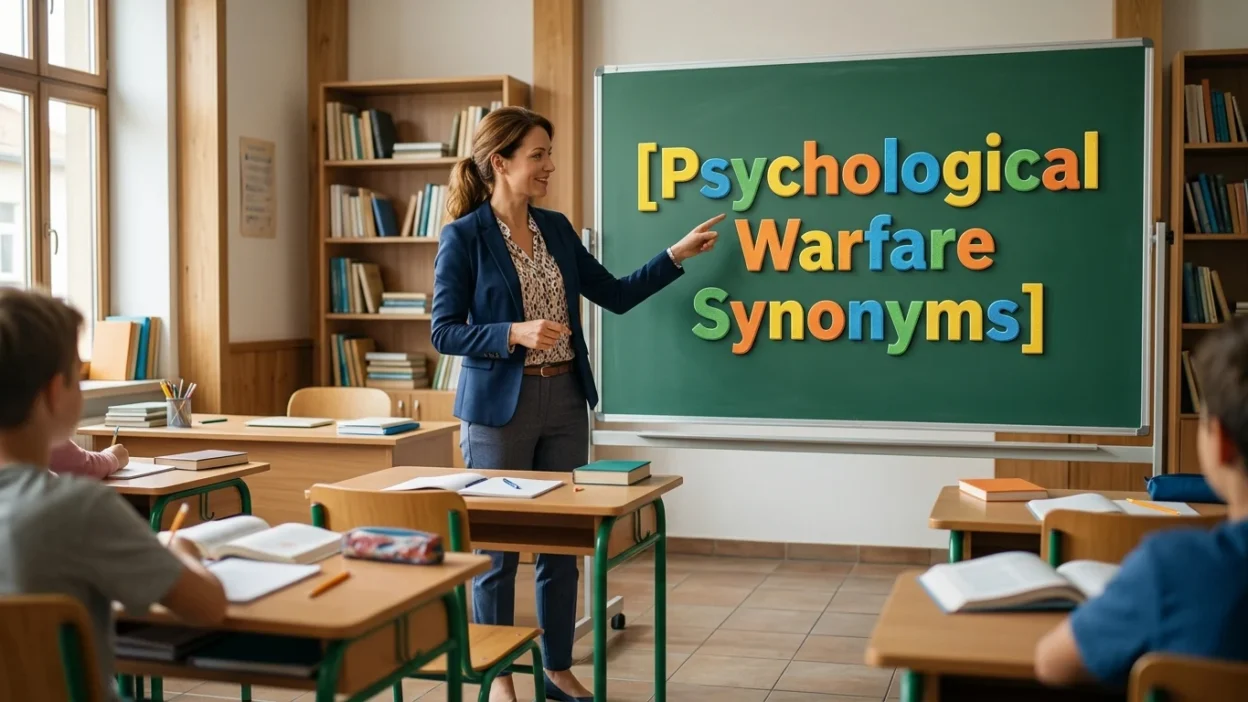
Psychological warfare is a term used to describe strategies that influence a person’s thoughts, emotions, confidence, or decisions without relying on direct physical force. It is commonly discussed in military history, politics, business, sports, psychology, and even everyday conversations where people describe mental pressure or emotional tactics.
Learning psychological warfare synonyms helps students, ESL learners, writers, and content creators understand similar words and expressions used in different contexts. Some alternatives refer to military operations, while others describe persuasion, intimidation, manipulation, or mental influence.
In this guide, you’ll learn the meaning of psychological warfare, explore 30 useful synonyms and related expressions, and understand when to use each one through simple definitions, example sentences, and usage notes.
What Does “Psychological Warfare” Mean?
Psychological warfare means using communication, information, fear, persuasion, or other mental strategies to influence another person’s thoughts, emotions, or behavior instead of using physical force.
For example:
- The army used psychological warfare to weaken the enemy’s morale.
- Some athletes use psychological warfare to distract their opponents before a match.
Tone: Military, strategic, political, psychological, and sometimes figurative.
Common Usage:
- Military history
- Politics
- International relations
- Sports
- Business competition
- Psychology
- Media analysis
30 Psychological Warfare Synonyms
1. Mind Games
Meaning: Actions intended to confuse or influence someone’s thinking.
Example Sentence: He played mind games to distract his opponent.
Best Usage Context: Sports, relationships, and casual conversations.
2. Mental Manipulation
Meaning: Influencing someone’s thoughts or decisions.
Example Sentence: The advertisement relied on mental manipulation.
Best Usage Context: Psychology and media discussions.
3. Psychological Operations (PsyOps)
Meaning: Planned actions that influence people’s attitudes or behavior.
Example Sentence: The military launched psychological operations during the conflict.
Best Usage Context: Military, politics, and history.
4. Propaganda
Meaning: Information designed to influence public opinion.
Example Sentence: The government spread propaganda during the war.
Best Usage Context: Politics, history, and media.
5. Intimidation
Meaning: Using fear to influence someone.
Example Sentence: The team’s aggressive behavior was meant as intimidation.
Best Usage Context: Sports, law, and everyday English.
6. Mental Pressure
Meaning: Stress placed on someone’s mind to influence their actions.
Example Sentence: The interview created mental pressure.
Best Usage Context: General discussions and psychology.
7. Emotional Manipulation
Meaning: Influencing someone through their emotions.
Example Sentence: Emotional manipulation can damage relationships.
Best Usage Context: Psychology and personal relationships.
8. Persuasion
Meaning: Convincing someone to think or act differently.
Example Sentence: Persuasion is an important communication skill.
Best Usage Context: Business, education, and marketing.
9. Influence Campaign
Meaning: An organized effort to shape opinions.
Example Sentence: The organization launched an influence campaign online.
Best Usage Context: Politics, media, and public relations.
10. Information Warfare
Meaning: Using information to gain an advantage over others.
Example Sentence: Information warfare has become more common in the digital age.
Best Usage Context: Cybersecurity, politics, and military studies.
11. Fear Tactics
Meaning: Using fear to change someone’s behavior.
Example Sentence: Some advertisements rely on fear tactics.
Best Usage Context: Marketing, politics, and psychology.
12. Coercion
Meaning: Forcing someone to act through pressure or threats.
Example Sentence: The confession was obtained through coercion.
Best Usage Context: Law, politics, and ethics.
13. Brainwashing
Meaning: Intensive attempts to change a person’s beliefs.
Example Sentence: The novel explored themes of brainwashing.
Best Usage Context: Psychology, history, and fiction.
14. Strategic Influence
Meaning: Carefully planned efforts to shape decisions or opinions.
Example Sentence: Strategic influence played an important role in the campaign.
Best Usage Context: Business, leadership, and politics.
15. Morale Attack
Meaning: An attempt to reduce another person’s or group’s confidence and determination.
Example Sentence: The repeated criticism became a morale attack on the team.
Best Usage Context: Military history, sports, and organizational leadership.
16. Psychological Pressure
Meaning: Mental stress used to influence decisions or behavior.
Example Sentence: The negotiators applied psychological pressure throughout the meeting.
Best Usage Context: Business, negotiations, psychology, and sports.
17. Mental Intimidation
Meaning: Using fear or confidence to mentally overpower someone.
Example Sentence: The champion relied on mental intimidation before the match.
Best Usage Context: Sports, leadership, and competition.
18. Cognitive Manipulation
Meaning: Influencing how someone thinks or processes information.
Example Sentence: Researchers studied cognitive manipulation in advertising.
Best Usage Context: Psychology, media studies, and academic writing.
19. Emotional Influence
Meaning: Affecting someone’s emotions to shape decisions.
Example Sentence: The speech had a strong emotional influence on the audience.
Best Usage Context: Communication, marketing, and psychology.
20. Behavioral Influence
Meaning: Attempts to change how people behave.
Example Sentence: The campaign focused on behavioral influence through education.
Best Usage Context: Psychology, education, and public health.
21. Strategic Persuasion
Meaning: Carefully planned efforts to convince others.
Example Sentence: Strategic persuasion helped the company gain customer trust.
Best Usage Context: Business, leadership, and communication.
22. Opinion Shaping
Meaning: Influencing what people think about an issue.
Example Sentence: Social media plays a role in opinion shaping.
Best Usage Context: Politics, journalism, and media.
23. Perception Management
Meaning: Guiding how people view a person, event, or organization.
Example Sentence: The company invested in perception management after the crisis.
Best Usage Context: Public relations, politics, and business.
24. Psychological Tactics
Meaning: Mental strategies used to influence others.
Example Sentence: The coach taught psychological tactics for high-pressure games.
Best Usage Context: Sports, military, and leadership.
25. Mental Strategy
Meaning: A planned psychological approach to achieve a goal.
Example Sentence: Remaining calm was part of her mental strategy.
Best Usage Context: Sports, business, and personal development.
26. Confidence Undermining
Meaning: Actions that reduce another person’s confidence.
Example Sentence: Constant criticism became a form of confidence undermining.
Best Usage Context: Psychology, workplace, and relationships.
27. Psychological Influence
Meaning: Affecting someone’s thoughts or emotions.
Example Sentence: Advertising often uses psychological influence.
Best Usage Context: Marketing, psychology, and communication.
28. Manipulative Tactics
Meaning: Unfair methods used to influence others.
Example Sentence: The manager avoided manipulative tactics during negotiations.
Best Usage Context: Ethics, leadership, and relationships.
29. Mental Conditioning
Meaning: Training or influencing the mind to respond in a certain way.
Example Sentence: Athletes use mental conditioning before major competitions.
Best Usage Context: Sports psychology, education, and personal development.
30. Strategic Communication
Meaning: Planned communication designed to achieve specific goals.
Example Sentence: Strategic communication improved public confidence during the campaign.
Best Usage Context: Government, business, public relations, and leadership.
Comparison Guide: When to Use Different Psychological Warfare Synonyms
| Term | Best Used For | Tone |
|---|---|---|
| Psychological Warfare | Military and strategy | Formal |
| Psychological Operations (PsyOps) | Military | Technical |
| Propaganda | Politics and history | Formal |
| Information Warfare | Cybersecurity and military | Technical |
| Mind Games | Everyday conversations | Informal |
| Intimidation | Sports and competition | Neutral |
| Psychological Pressure | Negotiations | Professional |
| Emotional Manipulation | Relationships | Psychological |
| Fear Tactics | Marketing and politics | Critical |
| Perception Management | Public relations | Professional |
| Strategic Persuasion | Business | Formal |
| Opinion Shaping | Media | Neutral |
| Mental Strategy | Sports and leadership | Positive |
| Psychological Influence | Psychology | Academic |
| Strategic Communication | Business and government | Professional |
How to Choose the Right Synonym
The best synonym for psychological warfare depends on the context and the level of formality.
For Military and Political Discussions
Use psychological operations (PsyOps), information warfare, propaganda, strategic influence, and psychological warfare when discussing military strategy, history, or international relations.
For Psychology and Human Behavior
Choose mental manipulation, emotional manipulation, psychological influence, cognitive manipulation, and behavioral influence when explaining how people affect each other’s thoughts and emotions.
For Business and Leadership
Use strategic persuasion, perception management, strategic communication, psychological pressure, and opinion shaping in professional or organizational settings.
For Everyday Conversations
Expressions like mind games, mental pressure, fear tactics, intimidation, and confidence undermining are easier to understand and commonly used.
Common Mistakes When Using Psychological Warfare Synonyms
Many learners assume every synonym has the same meaning, but each has a different focus.
For example:
- Psychological warfare usually refers to organized strategies in military or political contexts.
- Mind games is an informal expression often used for sports or personal relationships.
- Propaganda specifically refers to information intended to influence public opinion.
- Perception management is commonly used in business and public relations.
- Psychological operations (PsyOps) is a technical military term.
Using the right expression makes your writing clearer and more accurate.
Conclusion
Learning psychological warfare synonyms helps you describe mental influence, persuasion, and strategic communication with greater precision. Whether you choose mind games, psychological operations, information warfare, strategic persuasion, or perception management, each term fits a different situation and tone.
Understanding these subtle differences will strengthen your vocabulary, improve your writing, and help you communicate more effectively in academic, professional, and everyday contexts.
FAQs
What is the closest synonym for psychological warfare?
Psychological operations (PsyOps) is the closest technical synonym, while mind games is the closest informal alternative.
Is psychological warfare always related to the military?
No. Although it originated in military strategy, the phrase is also used in sports, politics, business, negotiations, and everyday conversations to describe mental influence.
What is the difference between propaganda and psychological warfare?
Propaganda is one tool that can be used in psychological warfare. Propaganda focuses on influencing public opinion, while psychological warfare includes many broader mental strategies.
Is “mind games” the same as psychological warfare?
Not exactly. Mind games usually describe personal or informal psychological tactics, while psychological warfare often refers to organized or strategic efforts.
Why should I learn psychological warfare synonyms?
Learning these synonyms helps you understand historical, political, psychological, and business discussions while improving your vocabulary and writing skills.