Have you ever used the word serious several times in the same piece of writing? While serious is a useful and common English word, repeating it can make your writing sound less engaging.
Learning different synonyms for serious helps you express emotions, situations, and attitudes more accurately.
If you’re a student writing an essay, an ESL learner expanding your vocabulary, a writer creating realistic characters, or a content creator looking for stronger word choices, understanding alternatives to serious can improve your communication.
Each synonym has its own meaning and works best in different situations.
In this guide, you’ll learn 30 useful synonyms for serious, along with simple meanings, example sentences, and the best situations to use each one.
By the end, you’ll be able to choose the right word with confidence and make your writing more precise and natural.
What Does “Serious” Mean?
Simple Meaning of Serious
The word serious describes something that is important, requiring careful attention, or not intended as a joke. It can also describe a person who is thoughtful, responsible, or focused.
When Do We Use the Word “Serious”?
We use serious when talking about important situations, difficult problems, responsible people, or conversations that should not be taken lightly.
Examples:
- This is a serious problem.
- She gave me a serious look.
- We need to have a serious discussion.
Although serious is a useful everyday word, using different synonyms helps make your writing more varied and accurate.
30 Synonyms for Serious
Complete List of Synonyms
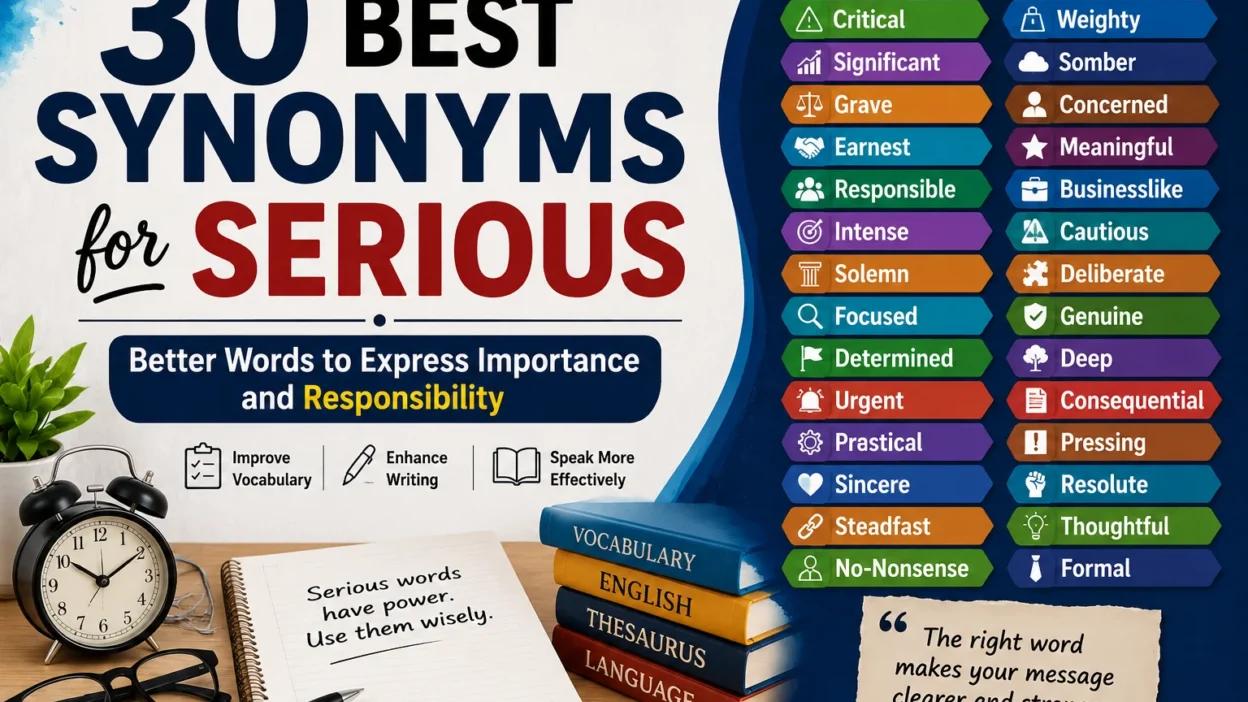
Here are 30 useful synonyms for serious:
- Important
- Grave
- Critical
- Significant
- Solemn
- Earnest
- Sincere
- Thoughtful
- Responsible
- Formal
- Severe
- Weighty
- Intense
- Somber
- Concerned
- Urgent
- Meaningful
- Determined
- Businesslike
- Focused
- Practical
- Cautious
- Deliberate
- Genuine
- Deep
- Consequential
- Pressing
- No-Nonsense
- Resolute
- Steadfast
Synonyms for Serious with Meanings, Examples, and Usage
1. Important
Meaning: Having great value or needing attention.
Example Sentence:
This is an important decision for our future.
Best Usage Context:
Perfect for discussions about education, work, health, and major life decisions.
2. Grave
Meaning: Very serious, especially when the situation is dangerous or worrying.
Example Sentence:
The doctor explained the patient’s grave condition.
Best Usage Context:
Best for health, emergencies, legal matters, and difficult situations.
3. Critical
Meaning: Extremely important or at a crucial stage.
Example Sentence:
We are facing a critical moment in the project.
Best Usage Context:
Ideal for business, medicine, engineering, and emergency situations.
4. Significant
Meaning: Important enough to have a noticeable effect.
Example Sentence:
The research produced significant results.
Best Usage Context:
Useful for academic writing, reports, research, and business.
5. Solemn
Meaning: Serious, quiet, and respectful.
Example Sentence:
Everyone remained solemn during the ceremony.
Best Usage Context:
Suitable for memorials, religious events, and formal occasions.
6. Earnest
Meaning: Showing sincere and serious intention.
Example Sentence:
She made an earnest effort to improve her grades.
Best Usage Context:
Perfect for education, work, personal goals, and formal communication.
7. Sincere
Meaning: Honest, genuine, and free from pretending.
Example Sentence:
He offered a sincere apology.
Best Usage Context:
Ideal for apologies, conversations, relationships, and speeches.
8. Thoughtful
Meaning: Carefully considering things before acting or speaking.
Example Sentence:
She gave a thoughtful answer to the difficult question.
Best Usage Context:
Useful for discussions, essays, decision-making, and leadership.
9. Responsible
Meaning: Reliable and able to make good decisions.
Example Sentence:
He is a responsible employee who always meets deadlines.
Best Usage Context:
Best for work, parenting, education, and leadership.
10. Formal
Meaning: Following official rules or behaving in a respectful way.
Example Sentence:
The meeting required formal business attire.
Best Usage Context:
Suitable for workplaces, ceremonies, official letters, and interviews.
11. Severe
Meaning: Very serious, harsh, or intense.
Example Sentence:
The country experienced severe flooding.
Best Usage Context:
Ideal for weather, health conditions, punishments, and emergencies.
12. Weighty
Meaning: Very important and deserving careful thought.
Example Sentence:
The committee discussed several weighty issues.
Best Usage Context:
Best for debates, legal matters, philosophy, and academic writing.
13. Intense
Meaning: Strong, powerful, and requiring complete attention.
Example Sentence:
The team faced intense competition throughout the tournament.
Best Usage Context:
Useful for emotions, sports, discussions, work, and experiences.
14. Somber
Meaning: Serious, quiet, and slightly sad.
Example Sentence:
The audience remained somber after hearing the news.
Best Usage Context:
Perfect for emotional events, memorials, news, and reflective writing.
15. Concerned
Meaning: Worried about someone or something important.
Example Sentence:
Parents were concerned about their children’s safety.
Best Usage Context:
Suitable for health, family, education, community issues, and public safety.
16. Urgent
Meaning: Needing immediate attention or action.
Example Sentence:
The manager called an urgent meeting to discuss the problem.
Best Usage Context:
Perfect for emergencies, deadlines, healthcare, and business matters.
17. Meaningful
Meaning: Having importance, value, or purpose.
Example Sentence:
We had a meaningful conversation about our future.
Best Usage Context:
Ideal for relationships, education, speeches, and personal growth.
18. Determined
Meaning: Strongly decided to achieve a goal.
Example Sentence:
She was determined to complete the project on time.
Best Usage Context:
Best for goals, education, sports, careers, and personal achievements.
19. Businesslike
Meaning: Professional, practical, and focused on work.
Example Sentence:
He handled the meeting in a calm, businesslike manner.
Best Usage Context:
Suitable for offices, meetings, negotiations, and professional communication.
20. Focused
Meaning: Giving full attention to a task or goal.
Example Sentence:
The students stayed focused during the exam.
Best Usage Context:
Useful for studying, work, sports, and personal development.
21. Practical
Meaning: Sensible and based on real-life situations.
Example Sentence:
She offered practical advice for managing time.
Best Usage Context:
Perfect for education, business, everyday life, and problem-solving.
22. Cautious
Meaning: Careful to avoid mistakes or danger.
Example Sentence:
Drivers should be cautious during heavy rain.
Best Usage Context:
Best for safety, health, finance, travel, and decision-making.
23. Deliberate
Meaning: Done carefully and intentionally.
Example Sentence:
The committee made a deliberate decision after reviewing the facts.
Best Usage Context:
Ideal for legal matters, business decisions, research, and planning.
24. Genuine
Meaning: Honest, real, and sincere.
Example Sentence:
Her genuine concern made everyone feel supported.
Best Usage Context:
Suitable for emotions, relationships, customer service, and communication.
25. Deep
Meaning: Showing strong thought, emotion, or understanding.
Example Sentence:
They had a deep discussion about climate change.
Best Usage Context:
Perfect for conversations, literature, philosophy, and emotional topics.
26. Consequential
Meaning: Important because it has major results or effects.
Example Sentence:
The election was one of the most consequential events of the year.
Best Usage Context:
Best for politics, history, business, and major decisions.
27. Pressing
Meaning: Requiring quick attention because it is important.
Example Sentence:
The company faced several pressing financial issues.
Best Usage Context:
Ideal for business, healthcare, education, and urgent situations.
28. No-Nonsense
Meaning: Practical, direct, and serious without unnecessary talk.
Example Sentence:
The coach had a no-nonsense approach to training.
Best Usage Context:
Useful for leadership, workplaces, coaching, and management.
29. Resolute
Meaning: Firm and determined to achieve something.
Example Sentence:
She remained resolute despite the challenges.
Best Usage Context:
Perfect for leadership, personal goals, careers, and difficult situations.
30. Steadfast
Meaning: Loyal, dependable, and not changing despite difficulties.
Example Sentence:
He remained steadfast in supporting his team.
Best Usage Context:
Suitable for relationships, leadership, values, and long-term commitments.
Comparison Guide: When to Use Different Synonyms
Choosing the Best Word for the Situation
| Synonym | Best Used For | Tone |
|---|---|---|
| Important | Everyday discussions, education | Neutral |
| Grave | Medical emergencies, danger | Formal |
| Critical | Business, healthcare, engineering | Professional |
| Significant | Research, reports, essays | Academic |
| Solemn | Ceremonies, memorials | Respectful |
| Earnest | Goals, conversations | Sincere |
| Sincere | Apologies, relationships | Warm |
| Responsible | Work, parenting, leadership | Positive |
| Severe | Weather, illness, punishment | Strong |
| Somber | Emotional events, news | Reflective |
| Urgent | Deadlines, emergencies | Immediate |
| Focused | Work, studies, sports | Positive |
| Practical | Advice, problem-solving | Neutral |
| Resolute | Leadership, challenges | Inspirational |
| Steadfast | Loyalty, long-term commitment | Positive |
How to Choose the Right Synonym
For Academic Writing
Formal writing often requires precise and professional vocabulary.
Good choices include:
- Significant
- Critical
- Consequential
- Weighty
- Deliberate
- Grave
For Creative Writing
Stories become more realistic when the characters’ emotions and situations are described accurately.
Try these words:
- Somber
- Earnest
- Resolute
- Deep
- Solemn
- Intense
For Everyday Conversation
Simple words are usually the most natural in daily communication.
Consider using:
- Important
- Serious
- Concerned
- Focused
- Practical
- Responsible
For Business and Professional Writing
Professional communication benefits from clear and respectful language.
Useful options include:
- Businesslike
- Critical
- Focused
- Practical
- Deliberate
- Urgent
For Motivational or Leadership Content
Words that express determination and commitment are often the most effective.
Excellent choices are:
- Determined
- Resolute
- Steadfast
- Earnest
- Responsible
- Focused
Common Mistakes to Avoid
Don’t Use Every Synonym Interchangeably
Although these words are similar, they are not identical. For example, grave usually describes dangerous or life-threatening situations, while solemn often describes respectful or emotional occasions.
Match the Tone
Formal writing sounds better with words like consequential, significant, or critical, while everyday conversations usually work best with important or serious.
Consider the Situation
Choose a synonym that fits the context. A business meeting may be businesslike, while a funeral is more appropriately described as solemn.
FAQs
What is the best synonym for “serious”?
Some of the best synonyms are important, grave, critical, significant, and earnest. The right choice depends on the situation.
Which synonym is best for essays?
For academic writing, significant, critical, consequential, weighty, and deliberate are excellent choices.
Is “grave” stronger than “serious”?
Yes. Grave usually describes situations that are extremely serious, especially those involving danger, illness, or major consequences.
Can I use “earnest” instead of “serious”?
Yes, but only in certain contexts. Earnest describes someone who is sincere, determined, and genuinely committed rather than simply serious.
Conclusion
Learning different synonyms for serious helps you express ideas with greater accuracy and variety.
While serious is a useful everyday word, choosing the right synonym allows you to match the tone and purpose of your writing more effectively.
If you’re writing an academic essay, giving a professional presentation, creating a story, or having an important conversation, words like critical, grave, earnest, solemn, resolute, and focused can make your communication clearer and more impactful.
Practice using these alternatives in different situations to build a stronger vocabulary and become a more confident English speaker and writer.

Julian Luke is a passionate grammar and language writer at Synolexes. He simplifies complex grammar rules, vocabulary, and writing concepts, helping learners improve their English communication skills with confidence.