If you are wondering whether the correct spelling is adict or addict, the correct English word is addict, with two ds. Adict is a misspelling and is not the standard spelling of the English word. Addict can be a noun meaning a person who is dependent on a substance or strongly devoted to something, or a verb meaning to cause someone to become dependent on something.
This spelling confusion is common because the word is pronounced with a single /d/ sound, which can make the second d easy to overlook when writing. Learning the correct spelling is useful for students, English learners, writers, and anyone who wants to communicate clearly. This guide explains the difference between adict and addict, shows how to use addict correctly, and gives simple examples to help you remember the spelling.
Quick Answer
Addict is the correct spelling. Adict is incorrect. The word addict can be a noun or a verb. As a noun, it describes someone dependent on a substance or strongly devoted to something. As a verb, it means to cause someone to become dependent on something.
Why Do People Confuse Adict and Addict?
People often confuse adict and addict because the pronunciation does not make the double d especially obvious.
English spelling also contains many words where letters are not pronounced exactly as learners expect. When people write a word based mainly on how it sounds, they may leave out one of the repeated letters.
The important point is simple:
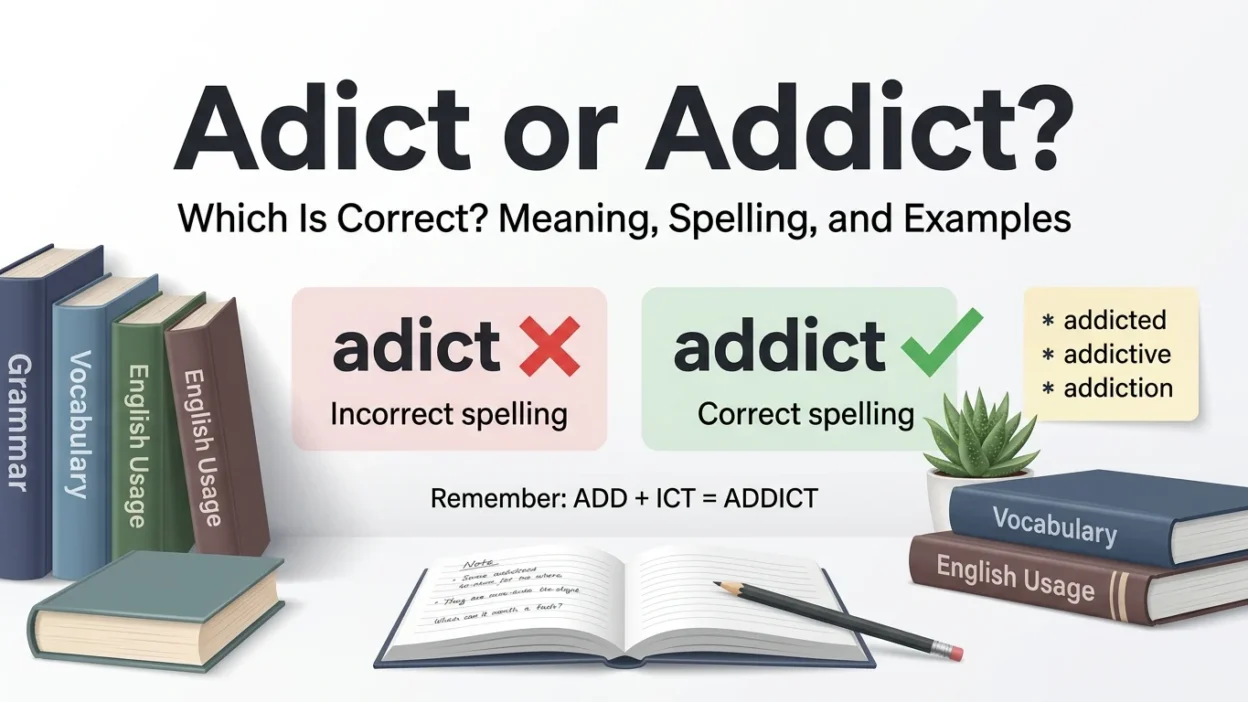
- Adict ❌ — incorrect spelling
- Addict ✅ — correct spelling
First Word: Adict
Adict is not the standard spelling of the English word.
If you write adict in an essay, email, school assignment, article, or other formal writing, it should normally be corrected to addict.
Is Adict a Word?
In standard modern English, adict is not the correct spelling for the noun or verb addict.
For example:
- He is an adict. ❌
- He is an addict. ✅
Second Word: Addict
Addict is the correct English spelling.
It has two common grammatical uses.
Addict as a Noun
As a noun, addict can refer to someone who is dependent on a substance or strongly devoted to a particular activity, thing, or interest.
Examples:
- He is a recovering addict.
- She is a coffee addict.
- My brother is a fitness addict.
- He is a video game addict.
In modern everyday English, people also use addict informally to describe someone who spends a lot of time enjoying something.
Addict as a Verb
As a verb, addict means to cause someone to become dependent on something.
The verb is less common in everyday conversation than the noun and is often seen in the form addicted.
Examples:
- The drug can addict people quickly.
- Some substances are highly addictive.
- He became addicted to gambling.
- She is addicted to social media.
Notice the related forms:
- addict — noun or verb
- addicted — adjective/past participle
- addictive — adjective
- addiction — noun
Adict vs Addict: Comparison Table
| Word | Correct? | Meaning | Example |
|---|---|---|---|
| adict | ❌ No | Incorrect spelling | He is an adict. ❌ |
| addict | ✅ Yes | A dependent person; also a verb | He is an addict. |
| addicted | ✅ Yes | Dependent on or strongly attached to something | She is addicted to games. |
| addictive | ✅ Yes | Causing dependence or a strong desire to continue | The game is addictive. |
| addiction | ✅ Yes | A condition or pattern of dependence | Addiction can affect daily life. |
When Should You Use Adict or Addict?
There is no standard situation in which you should use adict.
Use addict when you need the noun or verb.
Use Addict as a Noun
Use addict when referring to a person who has a dependence or, informally, someone who is extremely enthusiastic about something.
Example:
He is a sports addict.
Use Addicted as an Adjective
Use addicted to describe a person who is dependent on or strongly attached to something.
Example:
She is addicted to her phone.
Use Addictive as an Adjective
Use addictive when describing something that can cause dependence or create a strong desire to keep using or doing it.
Example:
Some online games can be highly addictive.
Use Addiction as a Noun
Use addiction when talking about the condition or pattern itself.
Example:
Internet addiction can interfere with everyday activities.
10+ Examples of Addict in Sentences
Here are simple examples showing how addict and its related forms are used.
- He is a coffee addict.
- She is a recovering drug addict.
- My friend is a fitness addict.
- He became addicted to online games.
- Some substances can be extremely addictive.
- The treatment helped him overcome his addiction.
- She jokingly calls herself a chocolate addict.
- He is addicted to checking his phone.
- The new game became very popular among young players.
- His addiction affected his work and relationships.
- The doctor explained that addiction can require professional treatment.
- She loves books and jokingly describes herself as a book addict.
The meaning depends on context. Addict can refer to serious substance dependence, while informal expressions such as book addict or coffee addict can simply mean someone who strongly enjoys something.
Common Mistakes
Mistake 1: Writing Adict
Incorrect:
He is an adict.
Correct:
He is an addict.
Mistake 2: Forgetting the Second D
The most common spelling error is writing only one d.
Remember:
ad + dict = addict
The correct word contains dd.
Mistake 3: Confusing Addict and Addicted
These words are related but do not always work in the same sentence.
Correct:
He is an addict.
Correct:
He is addicted to gaming.
Incorrect:
He is an addicted.
Mistake 4: Confusing Addictive and Addicted
Use addictive for something that causes or encourages dependence.
The substance is addictive.
Use addicted for a person who is dependent on something.
He is addicted to the substance.
Memory Trick: Remember the Double D
A simple way to remember the spelling is:
Addict has two Ds because you need to add another D.
Think:
ADD + ICT = ADDICT
The first part add already contains two ds.
So when you write the word, remember:
ADDICT = A + DD + ICT
Not:
ADICT = A + D + ICT
American vs British English
The spelling addict is the standard spelling in both American English and British English.
There is no standard British spelling adict and no standard American spelling adict.
So whether you are writing for an American, British, or international English audience, use:
addict ✅
The related words are also spelled consistently:
- addicted
- addictive
- addiction
Similar Words
Several words are related to addict but have different meanings or grammatical functions.
Addicted
Addicted describes someone who is dependent on something or strongly attached to it.
Example:
He is addicted to social media.
Addictive
Addictive describes something that can cause dependence or make someone want to continue using or doing it.
Example:
The substance is highly addictive.
Addiction
Addiction refers to the condition or pattern of dependence.
Example:
His addiction affected his health and daily routine.
Dependent
Dependent can describe someone who relies heavily on a substance or another thing, depending on context.
Example:
The patient became dependent on the medication.
Enthusiast
Enthusiast usually has a more positive meaning and describes someone who is very interested in a particular activity or subject.
Example:
She is a photography enthusiast.
Final Verdict
The correct spelling is addict, not adict.
If you are writing a sentence about a person, you can use addict as a noun:
He is an addict.
If you want to describe someone as dependent on something, use addicted:
He is addicted to gambling.
If you are describing something that can cause dependence or a strong desire to continue, use addictive:
The substance is addictive.
The easiest spelling rule to remember is that addict has two Ds.
FAQs
Is Adict a correct spelling?
No. Adict is not the standard English spelling. The correct spelling is addict, with two ds.
What is the correct word, adict or addict?
Addict is correct. Adict is a spelling mistake.
What does addict mean?
Addict can mean a person who is dependent on a substance or someone who is extremely devoted to something. It can also function as a verb meaning to cause dependence.
What is the difference between addict and addicted?
Addict is commonly used as a noun for a person. Addicted is used to describe someone who is dependent on something.
Example: He is an addict.
Example: He is addicted to drugs.
What is the difference between addicted and addictive?
Addicted describes the person experiencing dependence, while addictive describes something that can cause dependence or a strong desire to continue.
Example: She is addicted to gaming.
Example: The game is addictive.
Is addict the same in American and British English?
Yes. Addict is spelled the same in standard American and British English.
How do you remember how to spell addict?
Remember the double d: A + DD + ICT = ADDICT. You can also think of the word as beginning with add, which already contains two ds.
Remember This
Adict ❌
Addict ✅
The correct spelling has two Ds.
- Addict = noun or verb
- Addicted = dependent on something
- Addictive = capable of causing dependence
- Addiction = the condition or pattern of dependence
When in doubt, remember: ADD + ICT = ADDICT.
Conclusion
If you are choosing between adict or addict, always choose addict. The spelling with two ds is the standard English form. Understanding the related words addicted, addictive, and addiction can also help you use the word naturally and accurately.
For students, beginners, and English learners, the easiest rule is to remember the first part of the word: add. Once you remember the double d, the correct spelling becomes much easier to recognize and use.

Gabriel John is a language enthusiast and grammar writer at Synolexes. He creates clear, practical content on English grammar, vocabulary, and writing, helping learners improve communication skills with confidence.