The word important is one of the most common words in English. We use it when something matters, has value, needs attention, or has a strong effect on a person, decision, event, or result. Students use it in essays, teachers use it in lessons, writers use it in articles, and content creators use it in scripts, captions, and posts. Because it is so useful, many people use it again and again in writing.
But using the same word too often can make your writing feel repetitive. That is why many students, ESL learners, writers, and content creators search for better synonyms for important. A good synonym can make your sentence more precise. It can show whether something is important because it is serious, valuable, powerful, necessary, or influential. In other words, not all “important” things are important in the same way.
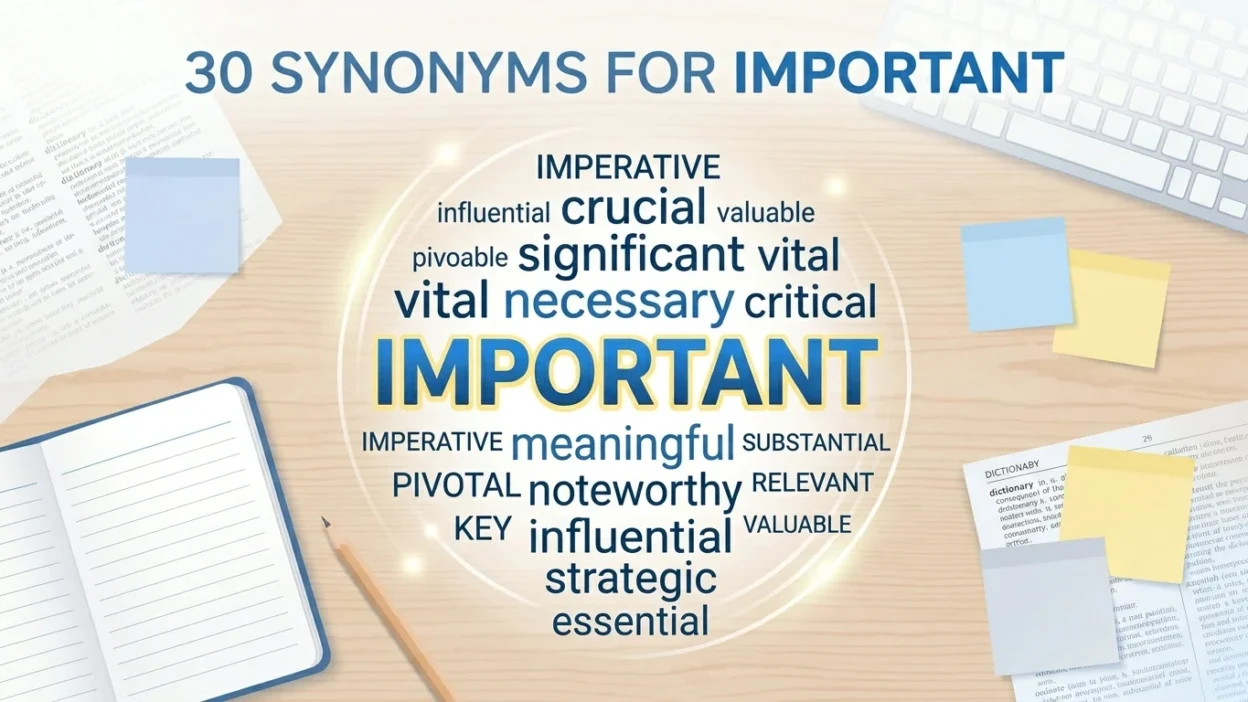
In this article, you will learn 30 useful synonyms for important with simple meanings, easy example sentences, and short notes about the best usage context. You will also find a comparison table and a practical guide to choosing the right synonym based on tone and meaning. The article is written in simple English so it is easy to follow for beginners and helpful for anyone trying to improve vocabulary and writing style.
What Does “Important” Mean?
The word important means something that matters a lot, has great value, or needs special attention. It can describe a person, event, idea, task, rule, reason, or decision.
Simple meaning of important
Something is important if it:
- matters a lot
- has strong value
- affects results or decisions
- should not be ignored
- needs attention or care
Example sentences
- It is important to study regularly before exams.
- Family is very important to many people.
- This is an important decision for the company.
The word important is a general word, so it works in many situations. But sometimes you may want a synonym that sounds more formal, stronger, or more specific.
Why Learn Synonyms for Important?
Learning different synonyms for important can make your English clearer and more natural.
It reduces repetition
If you use important too many times in the same article, essay, or paragraph, your writing may sound repetitive.
It adds precision
Some synonyms show a very specific kind of importance. For example, essential means something is necessary, while influential means it has power over people or ideas.
It improves tone
Some words sound formal, academic, emotional, or professional. Choosing the right synonym helps your writing match the situation.
It makes writing stronger
A more exact word can make your message more powerful and easier for the reader to understand.
What Do “Given Keywords” Mean in This Article?
In this article, given keywords means the 30 target words listed as synonyms for important. These are the vocabulary words you are learning and comparing.
Simple meaning of given keywords
“Given keywords” simply means:
- the words provided in the article
- the vocabulary items being explained
- the target terms you should focus on
Tone and usage context
The phrase given keywords is neutral and instructional. It is often used in:
- SEO content briefs
- writing prompts
- vocabulary worksheets
- classroom tasks
- blog outlines
Example in context
- In this guide, the given keywords are the 30 synonyms for important explained below.
So in this article, the given keywords are words like essential, significant, vital, and meaningful—all of which can express different shades of importance.
30 Synonyms for Important
1. Essential
Meaning
Absolutely necessary; something you cannot do without.
Example sentence
Water is essential for human life.
Best usage context
Use when something is required or necessary.
2. Crucial
Meaning
Very important because it can strongly affect the result of something.
Example sentence
This final exam is crucial for your overall grade.
Best usage context
Best for key moments, decisions, or turning points.
3. Significant
Meaning
Important in a noticeable or meaningful way.
Example sentence
The company made a significant change to its policy.
Best usage context
Useful in academic, formal, and general writing.
4. Vital
Meaning
Extremely important for life, success, or continued existence.
Example sentence
Good communication is vital in any team.
Best usage context
Use for things that are very necessary or critical.
5. Necessary
Meaning
Needed in order to do something or achieve something.
Example sentence
It is necessary to bring your ID card to the exam hall.
Best usage context
Best for rules, instructions, and practical needs.
6. Critical
Meaning
Very important, especially because a situation may become serious without it.
Example sentence
Time management is critical during exams.
Best usage context
Use for urgent, serious, or high-stakes situations.
7. Key
Meaning
Very important and central to understanding or success.
Example sentence
Practice is a key part of language learning.
Best usage context
Great for simple, modern, and natural writing.
8. Major
Meaning
Very important or large in effect.
Example sentence
This was a major reason for the team’s success.
Best usage context
Use for large changes, events, or reasons.
9. Central
Meaning
At the core of something; highly important to the main idea.
Example sentence
Trust is central to a healthy friendship.
Best usage context
Useful for ideas, themes, and systems.
10. Fundamental
Meaning
Basic and very important to the structure or understanding of something.
Example sentence
Reading is a fundamental skill for students.
Best usage context
Best for education, theory, and basic principles.
11. Valuable
Meaning
Important because it has worth, benefit, or usefulness.
Example sentence
Her advice was very valuable to me.
Best usage context
Use for help, experience, lessons, or resources.
12. Meaningful
Meaning
Important because it has deep value, purpose, or emotional meaning.
Example sentence
It was a meaningful conversation between the two friends.
Best usage context
Good for relationships, memories, and emotional topics.
13. Influential
Meaning
Important because it has the power to affect people or ideas.
Example sentence
She is one of the most influential writers of her generation.
Best usage context
Best for people, books, leaders, or ideas with strong impact.
14. Powerful
Meaning
Important because it has strength, force, or strong effect.
Example sentence
Education is a powerful tool for change.
Best usage context
Use for ideas, emotions, speeches, or tools that create impact.
15. Weighty
Meaning
Important and serious, especially in thought or discussion.
Example sentence
The judge had to make a weighty decision.
Best usage context
Formal writing, serious decisions, or deep discussions.
16. Serious
Meaning
Important in a way that needs careful attention.
Example sentence
This is a serious problem that must be solved quickly.
Best usage context
Best for problems, risks, or difficult situations.
17. Notable
Meaning
Important because it is interesting, special, or worth noticing.
Example sentence
There was a notable improvement in her speaking skills.
Best usage context
Use for achievements, changes, or results that stand out.
18. Prominent
Meaning
Important, well-known, or easy to notice.
Example sentence
He played a prominent role in the campaign.
Best usage context
Good for people, positions, and public roles.
19. Consequential
Meaning
Important because it leads to important results or effects.
Example sentence
It was one of the most consequential decisions of his career.
Best usage context
Formal writing, long-term results, and serious choices.
20. Substantial
Meaning
Important because it is large in amount, value, or effect.
Example sentence
The school made a substantial investment in new technology.
Best usage context
Useful for money, progress, change, or support.
21. Relevant
Meaning
Important because it is connected to the topic or situation.
Example sentence
Please include only relevant details in your answer.
Best usage context
Essays, interviews, research, and discussions.
22. Imperative
Meaning
Extremely important and necessary.
Example sentence
It is imperative that the report be submitted on time.
Best usage context
Formal, urgent, or professional situations.
23. Pressing
Meaning
Important because it needs immediate attention.
Example sentence
Climate change is a pressing global issue.
Best usage context
Urgent problems, deadlines, or serious concerns.
24. Historic
Meaning
Important because it has a special place in history.
Example sentence
The agreement was a historic moment for both countries.
Best usage context
History, politics, major events, and big achievements.
25. Memorable
Meaning
Important because it stays in your mind for a long time.
Example sentence
Graduation day was a memorable event for the whole family.
Best usage context
Personal moments, celebrations, and experiences.
26. Strategic
Meaning
Important because it helps achieve a larger goal or plan.
Example sentence
This partnership is strategic for the company’s growth.
Best usage context
Business, planning, leadership, and long-term goals.
27. Decisive
Meaning
Important because it determines the final result.
Example sentence
Her final goal was decisive in winning the match.
Best usage context
Sports, elections, arguments, or turning points.
28. Necessary-to-know / Need-to-know
Meaning
Important because a person must know it.
Example sentence
The teacher shared the need-to-know details before the exam.
Best usage context
Informal guides, study notes, or practical information.
29. Core
Meaning
Most important and central part of something.
Example sentence
Respect is a core value of the school.
Best usage context
Values, ideas, beliefs, and main systems.
30. High-priority
Meaning
Important because it should be dealt with first.
Example sentence
Customer safety is a high-priority issue.
Best usage context
Work, planning, business, and task management.
Comparison Table: When to Use Different Synonyms for Important
| Word | Simple Meaning | Tone | Best Used When |
|---|---|---|---|
| essential | absolutely necessary | neutral/formal | something required |
| crucial | very important to the result | strong | turning points and outcomes |
| significant | important in a meaningful way | formal | essays, reports, research |
| vital | extremely important for success or life | strong | health, teamwork, success |
| necessary | needed to do something | neutral | instructions and rules |
| critical | very important in a serious situation | serious | urgent or high-stakes topics |
| key | central and very important | natural | everyday and professional writing |
| major | large and important | neutral | events, reasons, changes |
| central | at the core of something | formal | ideas, systems, themes |
| fundamental | basic and essential | formal | education, theory, principles |
| valuable | important because useful or beneficial | warm/neutral | advice, support, lessons |
| meaningful | important with emotional value | emotional | relationships, memories |
| influential | powerful in shaping others | formal | people, ideas, books |
| powerful | strong in effect | strong | tools, emotions, messages |
| weighty | serious and important | formal | decisions and discussions |
| serious | needing careful attention | neutral | problems and risks |
| notable | worth noticing | formal/neutral | results and achievements |
| prominent | important and visible | formal | people and public roles |
| consequential | leading to major results | formal | decisions and long-term effects |
| substantial | large and important in amount or effect | formal | investment, growth, support |
| relevant | connected and useful to the topic | neutral | essays, research, answers |
| imperative | extremely necessary | formal | urgent instructions or duties |
| pressing | urgent and important | serious | deadlines and global issues |
| historic | important in history | formal | events, agreements, milestones |
| memorable | important because unforgettable | warm | life events and experiences |
| strategic | important for a larger plan | professional | business and planning |
| decisive | determining the result | strong | matches, debates, elections |
| need-to-know | important information to know | casual | study notes and quick guides |
| core | most central part | neutral | values, beliefs, systems |
| high-priority | important enough to handle first | professional | tasks, safety, deadlines |
How to Choose the Right Synonym
Choosing the right synonym for important depends on why something matters. Is it necessary? Emotional? Urgent? Powerful? Formal? Here is a simple guide.
If Something Is Necessary or Required
Use
- essential
- necessary
- vital
- imperative
Quick guide
- essential = cannot do without it
- necessary = needed for a task or goal
- vital = extremely important for success or life
- imperative = formal and urgent necessity
If Something Affects the Final Result
Use
- crucial
- critical
- decisive
- consequential
Quick guide
- crucial = very important to the outcome
- critical = serious and high-stakes
- decisive = directly determines the result
- consequential = leads to important effects
If Something Is Central to an Idea or System
Use
- key
- central
- fundamental
- core
Quick guide
- key = simple and widely useful
- central = at the heart of the topic
- fundamental = basic and foundational
- core = most central part or value
If Something Is Valuable or Emotionally Important
Use
- valuable
- meaningful
- memorable
- powerful
Quick guide
- valuable = useful or beneficial
- meaningful = emotionally important
- memorable = unforgettable and special
- powerful = strong emotional or practical impact
If Something Is Formal, Academic, or Professional
Use
- significant
- notable
- prominent
- strategic
- substantial
Quick guide
- significant = formal and balanced
- notable = worth noticing
- prominent = important and visible
- strategic = linked to long-term planning
- substantial = large in value or effect
If Something Needs Immediate Attention
Use
- pressing
- critical
- high-priority
Quick guide
- pressing = urgent and serious
- critical = urgent with high risk
- high-priority = should be handled first
When You Should Still Use “Important”
Even though there are many useful synonyms for important, the word important itself is still a great choice. It is simple, natural, and easy to understand. In many cases, it is the clearest option, especially for students and ESL learners.
Use important when:
- you want a simple and general word
- you are writing for beginners
- the exact type of importance does not need to be explained
- you want the sentence to sound natural and direct
Example
- Sleep is important for good health.
This sentence is clear and correct. You do not always need a more advanced synonym.
Common Mistakes When Using Synonyms for Important
Choosing a word that sounds stronger than you need
Some words like imperative, critical, or vital are much stronger than important. Use them only when the situation truly feels serious or necessary.
Using formal words in casual writing
Words like consequential or substantial may sound too formal in everyday conversation or simple blog writing.
Replacing important in every sentence
You do not need to remove every use of important. The goal is to choose a better word only when it adds clarity or precision.
Tips for Students, ESL Learners, and Writers
Ask why it is important
Before choosing a synonym, ask:
- Is it necessary?
- Is it urgent?
- Does it affect the result?
- Is it emotionally meaningful?
- Is it central to the topic?
Match the tone to the context
Use simple words in casual writing and stronger or more formal words in essays, reports, and professional content.
Learn words in groups
This makes them easier to remember.
Necessary words
- essential
- vital
- necessary
- imperative
Result-focused words
- crucial
- decisive
- critical
- consequential
Central idea words
- key
- central
- fundamental
- core
Emotional or valuable words
- meaningful
- memorable
- valuable
- powerful
Practice with your own sentences
Try replacing important with different synonyms and notice how the meaning changes.
Example
Original:
- Exercise is important for health.
Try:
- Exercise is essential for health.
- Exercise is vital for health.
- Exercise is beneficial for health.
(This last one changes the meaning slightly, so choose carefully.)
Final Thoughts
Learning useful synonyms for important can make your English more precise, more natural, and more powerful. It helps you avoid repetition and choose words that better match your meaning. Sometimes something is important because it is necessary, sometimes because it is influential, and sometimes because it is emotionally meaningful. A stronger vocabulary helps you show those differences clearly.
The best approach is to learn synonyms by purpose. Use essential and vital for things that are necessary, crucial and decisive for things that affect the result, meaningful and memorable for emotional value, and significant or strategic for formal or professional writing. At the same time, remember that the word important is still a good and useful word in many situations.
If you want to improve your vocabulary, start by learning a few strong alternatives and using them in your own sentences. Over time, choosing the right synonym for important will become easier and more natural.