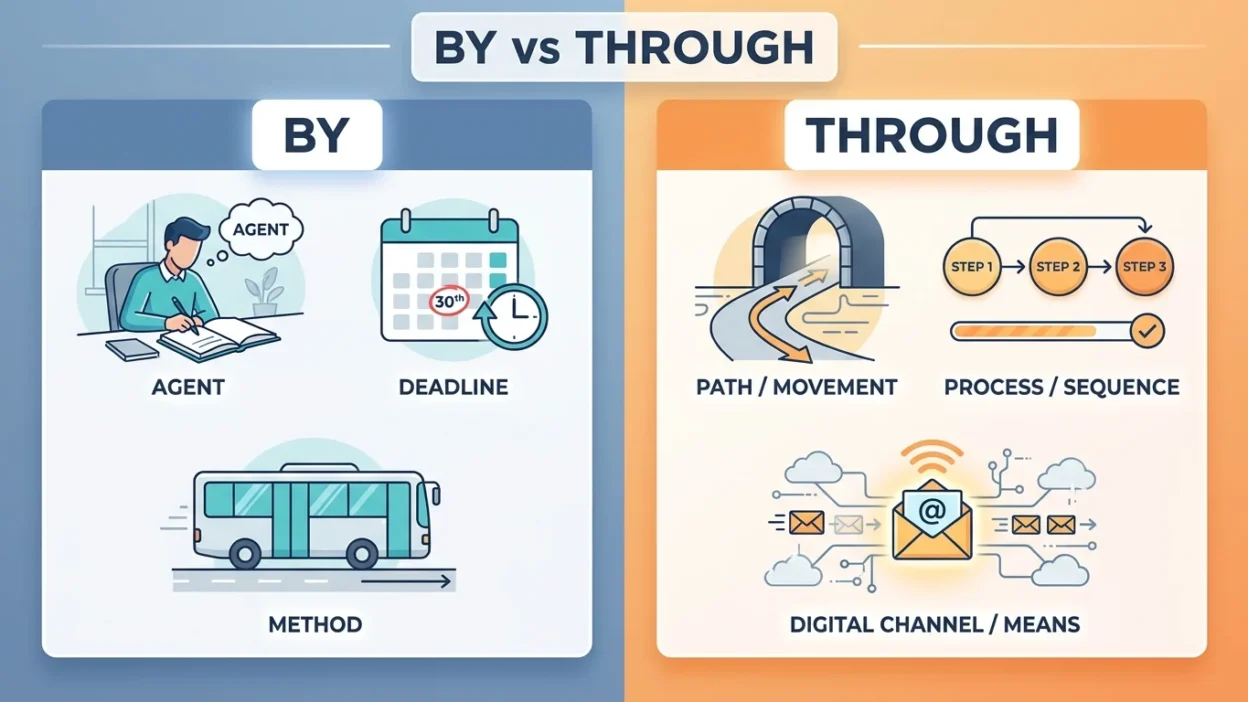
The words by and through can both describe how something happens, but they do not mean the same thing. By often identifies the person, method, or deadline connected to an action. Through usually describes movement from one side or stage to another, or the means by which someone completes a process.
For example, The report was written by Maya identifies who wrote it. We walked through the park describes the route we took. In I learned about the job through a friend, through means the friend was the source of the information. Choosing the right word depends on the relationship you want to express: who did something, how it was done, where movement occurred, or how information reached you.
Quick Answer
Use by to identify an agent, method, or deadline: The book was written by Ana; Send it by Friday. Use through for movement across or within something, or for a process or channel: We drove through the tunnel; I heard about it through a colleague. The right choice depends on the sentence’s meaning.
Why People Confuse By and Through
Both words can describe how an action happens. They may also appear in sentences about communication, travel, and completing tasks.
The difference is the relationship each word expresses:
- By often answers who?, how?, or by when?
- Through often answers where along or across? or by means of what channel or process?
Sometimes both are grammatical, but they give different meanings. I sent the form by email focuses on the method. I sent the form through the website focuses on the channel or system used.
First Word: By
By is a preposition with several common uses.
1. To identify who performs an action
In a passive sentence, by can name the person or thing that performs the action.
- The song was composed by her brother.
- The window was broken by the storm.
2. To describe a method or means
By can explain how someone does something.
- She traveled by train.
- You can improve your writing by practicing every day.
3. To give a deadline
By can mean no later than a particular time.
- Please submit the assignment by Monday.
- I’ll be home by six.
4. To describe who or what is nearby
By can mean beside or near.
- She sat by the window.
- There’s a small shop by the station.
Second Word: Through
Through also has several common uses.
1. To describe movement from one side to another
Use through when someone or something moves inside or across a space.
- We walked through the forest.
- The train passed through a tunnel.
2. To describe a process or period
Through can refer to experiencing or completing stages of something.
- He got through a difficult week.
- Read through the instructions before starting.
3. To identify a channel or source
Through can describe how information, help, or an opportunity reaches someone.
- I found the course through a friend.
- We received the update through the company’s website.
4. To mean from beginning to end
In some contexts, through means continuing until something is finished.
- She worked through the night.
- The store is open Monday through Friday.
By vs Through: Comparison Table
| Use | By | Through |
|---|---|---|
| Person responsible | The poem was written by Lee. | Not usually used to name the direct writer |
| Method | I paid by card. | I paid through the app. |
| Movement | We went by bus. | We walked through the park. |
| Deadline or time | Finish it by noon. | Work through the afternoon. |
| Process or channel | I learned by watching. | I learned through experience. |
When to Use Each
Use by when you mean:
- Who did it: The cake was made by my aunt.
- How it was done: He solved the problem by checking each step.
- No later than a deadline: Please reply by Thursday.
- Beside or near: Leave your bag by the door.
Use through when you mean:
- Movement within or across a place: We drove through the city.
- A process or experience: She learned through trial and error.
- A channel or source: I heard the news through a coworker.
- From start to finish: He read through the entire report.
10+ Examples of By and Through
- The novel was written by a young author.
- You can reach the museum by bus.
- Please finish the form by tomorrow.
- She improved her pronunciation by listening carefully.
- He stood by the entrance.
- We walked through the garden.
- The sunlight came through the curtains.
- I got the job through a former classmate.
- They worked through the night.
- Read through the email before replying.
- The package should arrive by Friday.
- The children ran through the sprinklers.
Common Mistakes
Using through for a deadline
Incorrect: Please send the file through Monday.
Correct: Please send the file by Monday.
Use by when you mean no later than a deadline.
Using by for movement inside a place
Incorrect: We walked by the tunnel to reach the other side.
Correct: We walked through the tunnel to reach the other side.
Use through when the route goes inside or across the space.
Assuming the words are always interchangeable
I learned by practice emphasizes the method. I learned through practice emphasizes practice as the experience or process. Both can be natural, but the focus is slightly different.
Memory Trick
Think of by as pointing to a person, method, or deadline. Think of through as pointing along a route, process, or channel.
- By: who, how, or by what time?
- Through: across what, through which process, or by what channel?
American vs British English
The main differences between by and through are the same in American and British English. Both varieties use by for agents, methods, and deadlines, and through for movement, processes, and channels.
Some expressions may vary by context or region, but the basic distinction remains consistent.
Similar Words
- Via: Often means by way of a route or communication channel. We sent the document via email.
- Across: Emphasizes movement from one side to another, often over a surface or area. They walked across the bridge.
- Along: Describes movement following a line or path. We cycled along the river.
- Until: Means up to a particular time. The office is open until six. Unlike by, it does not always mean the action must be completed before that time.
Final Verdict
Use by when naming who performs an action, the method used, or a deadline. Use through when describing movement inside or across a place, progress through a process, or a channel that connects people or information. If both words seem possible, choose the one that best expresses the relationship you mean.
FAQs
Is it correct to say by email or through email?
Both can be correct. By email presents email as the method of communication. Through email can emphasize email as the channel through which something was received or arranged.
Do you say by Friday or through Friday?
Use by Friday to mean no later than Friday. Through Friday usually means continuing up to and including Friday, as in The sale runs through Friday.
What is the difference between by and through in a sentence?
By often identifies an agent, method, or deadline. Through often describes movement, a process, or a channel.
Can by and through both describe a method?
Yes. I learned by practicing and I learned through practice are both possible. By often highlights the action used; through often highlights the experience or process.
Is by the same as via?
They can overlap when describing a route or method. Via often means by way of a particular route or channel, while by has additional uses, such as naming an agent or deadline.
Does through always mean inside something?
No. Through can describe movement inside a space, but it can also refer to a process, experience, or channel, as in She found the opportunity through a friend.
Remember This
By often tells who, how, or by what time. Through often tells where movement goes, what process is involved, or which channel connects people.
Conclusion
The difference between by and through becomes clearer when you focus on the meaning of the sentence. Use by for the person responsible, the method, or a deadline. Use through for movement across or within a space, a process, or a channel.
When you are unsure, ask what the word needs to explain. If it answers who, how, or by when, by may be the right choice. If it explains a route, process, or channel, through is often more suitable.

Gabriel John is a language enthusiast and grammar writer at Synolexes. He creates clear, practical content on English grammar, vocabulary, and writing, helping learners improve communication skills with confidence.