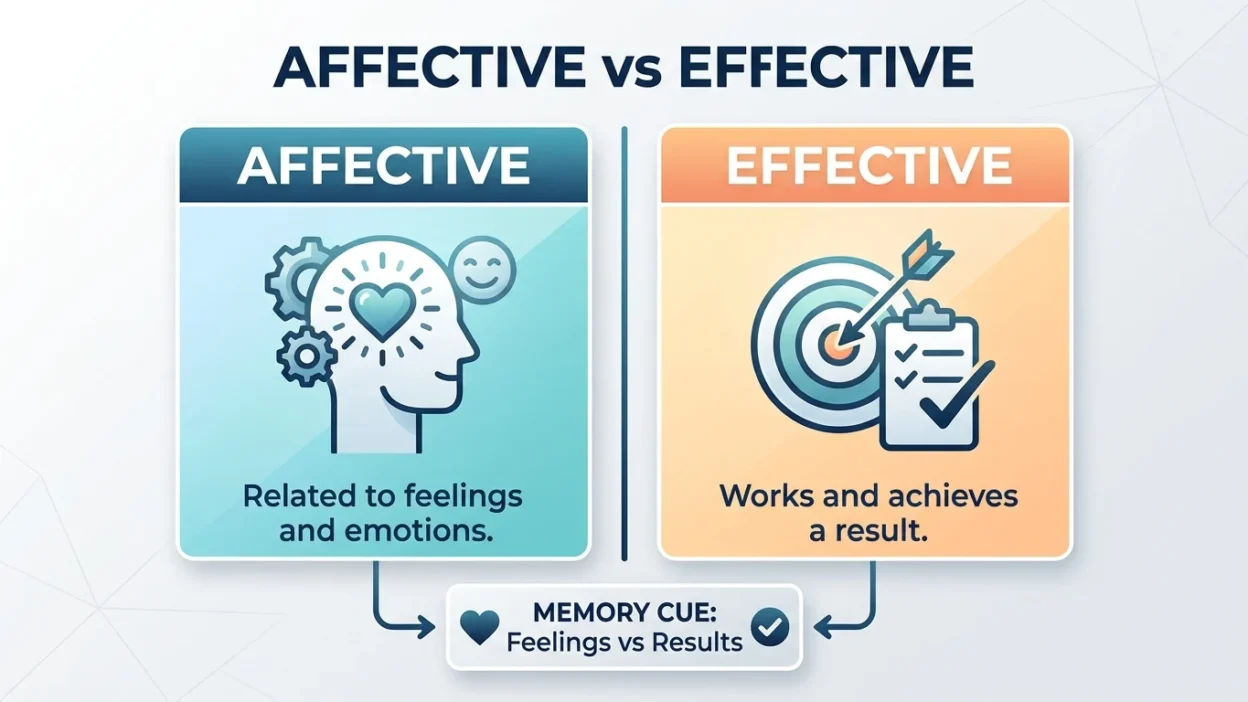
Affective and effective look similar, but they have different meanings. Affective relates to feelings, emotions, or moods. Effective means producing the intended result or having the desired effect. For example, an affective response involves emotion, while an effective strategy works well and achieves its goal.
These words appear in education, psychology, healthcare, business, and everyday writing. Because they differ by only a few letters, it is easy to mix them up. The best way to choose is to focus on the meaning: if you are describing feelings or emotional responses, use affective. If you mean that something works or gets results, use effective. The distinction is especially important in phrases such as affective learning and effective teaching, where each word points to a different aspect of the subject.
Quick Answer
Affective means related to feelings or emotions. Effective means successful in producing a desired result. An affective response is emotional; an effective plan works. Use affective when discussing emotions, and effective when describing something that achieves its purpose.
Why People Confuse Them
The words look and sound alike, and both can describe how a person, action, or situation relates to an outcome. However, their meanings are different:
- Affective is connected with emotion and feeling.
- Effective is connected with results and success.
A sentence can even use both words correctly: An effective lesson can support students’ affective development. The lesson achieves its goal, and the development concerns students’ feelings, attitudes, or values.
First Word: Affective
Affective is an adjective meaning related to feelings, emotions, moods, or attitudes.
It is common in psychology and education. For example, the phrase affective skills may refer to emotional or interpersonal abilities, while affective development concerns the growth of feelings, attitudes, or values.
Examples:
- The counselor helped the student manage an affective response.
- The course includes affective learning goals.
- Music can influence a person’s affective state.
Second Word: Effective
Effective is an adjective meaning successful in producing the intended result.
It is often used to describe plans, methods, tools, communication, treatments, or actions that work well.
Examples:
- The team created an effective plan.
- Clear instructions are more effective than vague ones.
- The treatment was effective for many patients.
Comparison Table
| Word | Meaning | Example |
|---|---|---|
| Affective | Related to feelings or emotions | The activity supports affective learning. |
| Effective | Producing the intended result | The activity is an effective way to teach the skill. |
When to Use Each
Use affective when:
- You are discussing emotions, feelings, moods, or attitudes.
- You are writing about psychology or emotional development.
- You mean the emotional aspect of learning or behavior.
Example: “The activity encourages affective growth by helping students identify their feelings.”
Use effective when:
- You mean that something works well.
- You are describing a successful method, plan, or action.
- You want to emphasize results or achievement.
Example: “The activity is effective because students remember the key ideas.”
10+ Examples
- The therapist explored the patient’s affective responses.
- The lesson includes both cognitive and affective goals.
- The film had a strong affective impact on its audience.
- The teacher encouraged students to reflect on their affective reactions.
- The survey measured participants’ affective attitudes toward the topic.
- The new schedule is an effective way to reduce delays.
- She used an effective method to explain the concept.
- The campaign was effective in raising awareness.
- Regular practice is an effective way to build confidence.
- The manager gave clear and effective feedback.
- An effective classroom activity can also support students’ affective development.
- The report explains how emotional responses can affect the effectiveness of a treatment.
Common Mistakes
1. Using affective to mean successful
Incorrect: The new plan was affective.
Correct: The new plan was effective.
Use effective when you mean that a plan works or achieves its goal.
2. Using effective to mean emotional
Incorrect: The story had an effective impact on her feelings.
Better: The story had an affective impact on her feelings.
Use affective when you mean related to emotions. In everyday writing, emotional impact may sound more natural.
3. Assuming the words are interchangeable
They are not interchangeable. Affective describes the emotional dimension; effective describes success or results.
Memory Trick
Affective has an a like affect in the sense of emotion. Effective has an e like efficient and execute—words often connected with getting something done.
Remember: affective = feelings; effective = results.
American vs British English
The meanings and spellings of affective and effective are the same in American and British English. Both words are used in formal and academic writing in either variety.
Similar Words
- Emotional: Related to feelings; often a more familiar everyday alternative to affective.
- Successful: Achieving the result that was wanted; close to effective in some contexts.
- Efficient: Achieving a result with little wasted time, effort, or resources. Something can be effective without being efficient.
- Impactful: Having a strong effect or influence; it does not mean exactly the same thing as effective.
FAQs
What is the difference between affective and effective?
Affective means related to emotions or feelings. Effective means successful in producing a desired result.
Does affective mean emotional?
Yes. Affective is related to feelings, emotions, moods, or attitudes. In everyday language, emotional is often the simpler word.
Does effective mean successful?
Usually, yes. Effective describes something that achieves its intended purpose or produces the desired result.
What does affective learning mean?
Affective learning concerns students’ feelings, attitudes, values, or emotional responses as part of learning.
Can something be both affective and effective?
Yes. A teaching method can be effective at helping students learn while also supporting their affective development, such as confidence or interest.
What is a simple way to remember affective vs effective?
Remember affective = feelings and effective = results.
Remember This
Affective relates to feelings and emotions. Effective means that something works or achieves its goal.
Conclusion
Although affective and effective look similar, they describe different things. Affective is used for emotions, feelings, moods, and attitudes, while effective describes something that produces the intended result.
To choose correctly, identify the idea you want to express. If it concerns emotion, use affective. If it concerns how well something works, use effective.