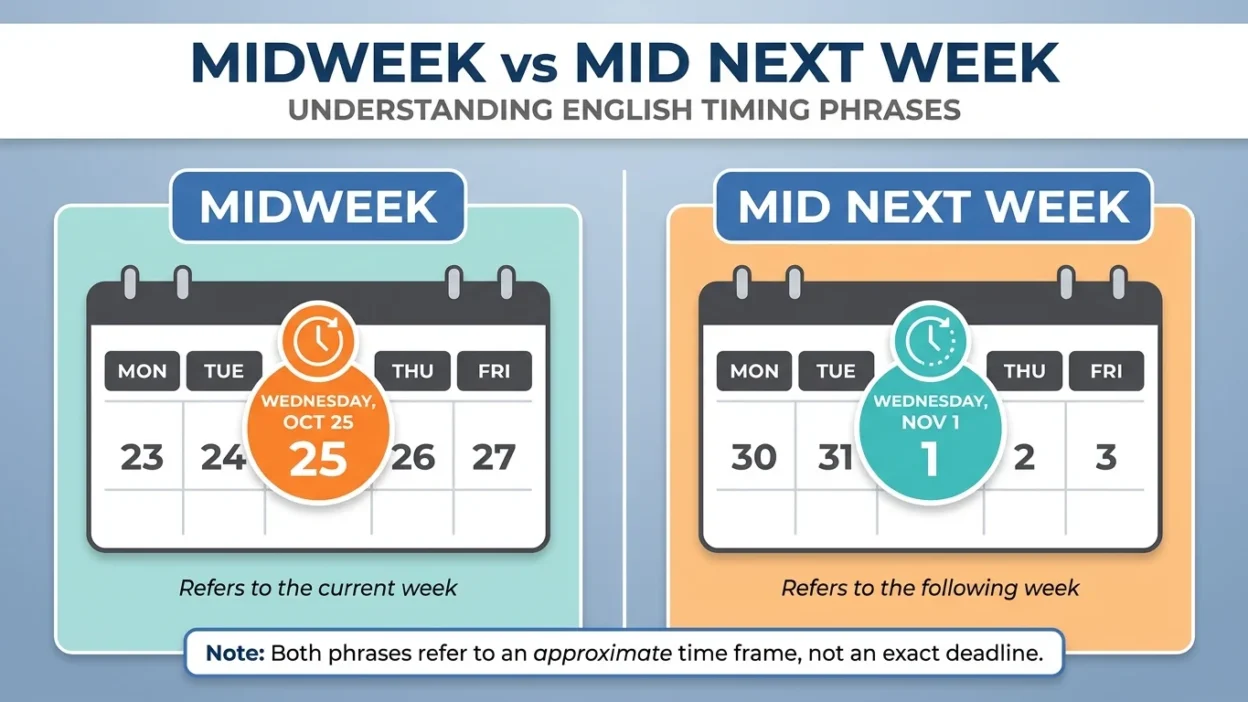
The phrases midweek and mid next week both refer to a time around the middle of a week, but they point to different weeks. Midweek usually means the middle of the current week, often Wednesday. Mid next week means around the middle of the following week. For example, if someone says on Monday, “I’ll finish it midweek,” they usually mean around Wednesday of that same week. If they say, “I’ll finish it mid next week,” they mean around Wednesday of the next week.
The phrase mid next week is understandable, especially in casual conversation, but the middle of next week or around the middle of next week is often clearer. Neither phrase gives an exact date, so in work messages, appointments, or deadlines, it is helpful to name the day or date when precision matters.
Quick Answer
Midweek usually means the middle of the current week, commonly Wednesday. Mid next week means around the middle of the following week. The second phrase is understandable but can sound less natural than the middle of next week. Since both are approximate, use a specific day or date when timing needs to be clear.
Why People Confuse Them
Both expressions contain mid, which means “in the middle.” The difference is the time reference:
- Midweek usually refers to the week currently being discussed.
- Mid next week points to the middle of the next week.
The exact day can depend on context. A person may use midweek loosely to mean Tuesday, Wednesday, or Thursday, rather than one fixed day.
First Word: Midweek
Midweek means the middle part of a week. In many contexts, people use it to mean Wednesday or the days around Wednesday.
Examples:
- We’ll review the proposal midweek.
- The package should arrive midweek.
- I usually feel busiest around midweek.
Midweek is one word. It does not automatically mean the middle of next week; the surrounding conversation determines which week is meant.
Second Phrase: Mid Next Week
Mid next week means around the middle of the week after the current one.
Examples:
- I expect to hear back mid next week.
- The repairs should be finished mid next week.
- Let’s schedule the call for the middle of next week.
The phrase is common in informal speech and messages, but the middle of next week is often a smoother choice in writing. If the timing is important, say something more exact, such as Wednesday, 14 May.
Comparison Table
| Phrase | Usual meaning | Example |
|---|---|---|
| Midweek | Around the middle of the week being discussed, often Wednesday | I’ll send the draft midweek. |
| Mid next week | Around the middle of the following week | I’ll send the draft mid next week. |
| The middle of next week | A clearer way to refer to the middle of the following week | We expect delivery in the middle of next week. |
When to Use Each
Use midweek when:
- You mean the middle of the current or already-mentioned week.
- The exact day is not important.
- The context makes the relevant week clear.
Example: “I’ll update you midweek.”
Use mid next week when:
- You mean the middle of the week after this one.
- You are speaking casually and the timing is approximate.
Example: “The team should have an answer mid next week.”
For a clearer or more formal message, use around the middle of next week or name the expected day.
10+ Examples
- I’ll send you the revised document midweek.
- The shipment is expected to arrive midweek.
- We usually have our team meeting midweek.
- I should know the results midweek.
- The weather may improve midweek.
- We’re hoping to launch the update mid next week.
- The contractor expects to finish the work mid next week.
- I’ll be able to confirm the booking mid next week.
- The new schedule should be ready around the middle of next week.
- Let’s check in mid next week if we haven’t heard anything.
- She expects to return by the middle of next week.
- Could you send the final version by Wednesday next week?
Common Mistakes
1. Treating the phrases as identical
Midweek does not automatically mean the middle of next week. Use mid next week or the middle of next week when you mean the following week.
2. Assuming “midweek” always means Wednesday
Wednesday is a common interpretation, but midweek can refer more loosely to the middle part of a week.
3. Using “mid next week” when the date must be exact
The phrase is approximate. For a deadline or appointment, name the day or date to avoid confusion.
4. Writing “mid-week” unnecessarily
Midweek is generally written as one word. The hyphenated form may appear in some uses, but the closed form is standard for the usual time expression.
Memory Trick
Think of midweek as “the middle of the week we’re talking about.” Think of mid next week as “the middle of the week after this one.”
If the timing matters, replace either phrase with a specific day or date.
American vs British English
The basic meanings are the same in American and British English. Midweek is widely used in both varieties. Mid next week is understandable in both, though the middle of next week or around the middle of next week may sound clearer in formal writing.
Similar Words and Phrases
- Midweek: Around the middle of the relevant week.
- The middle of next week: A clear phrase for the middle of the following week.
- Wednesday next week: A more specific reference to a day.
- Later next week: A broader phrase that usually means the latter part of the following week.
- Early next week: The beginning part of the following week.
These expressions are not exact substitutes. Choose one based on how much timing detail you need to communicate.
Final Verdict
Midweek usually refers to the middle of the week being discussed, often Wednesday. Mid next week means around the middle of the following week, though the middle of next week is often clearer. For important plans or deadlines, specify the day or date.
FAQs
Does midweek mean Wednesday?
Often, yes. People commonly use midweek to mean Wednesday or the days around it, but it is not always an exact reference to Wednesday.
Does mid next week mean this Wednesday or next Wednesday?
It usually means around the middle of the week after the current one—not the Wednesday of the current week.
Is “mid next week” grammatically correct?
It is understandable and used in casual communication. The middle of next week or around the middle of next week is often clearer and more natural in careful writing.
Is midweek one word?
Yes. Midweek is generally written as one word when it refers to the middle part of a week.
What is a clearer alternative to “mid next week”?
Use around the middle of next week for an approximate time, or name the day or date if you need to be precise.
Is “midweek” the same as “middle of the week”?
They usually mean the same general time period. Midweek is the shorter form, while the middle of the week is more explicit.
Remember This
Midweek means the middle of the week being discussed. Mid next week means the middle of the following week. For exact timing, give a day or date.
Conclusion
The main difference between midweek and mid next week is which week you mean. Midweek usually points to the middle of the current or already-mentioned week, while mid next week points to the middle of the following week.
Both phrases are approximate, so they may not be precise enough for a deadline or appointment. When clarity matters, use around the middle of next week or give the exact day or date.