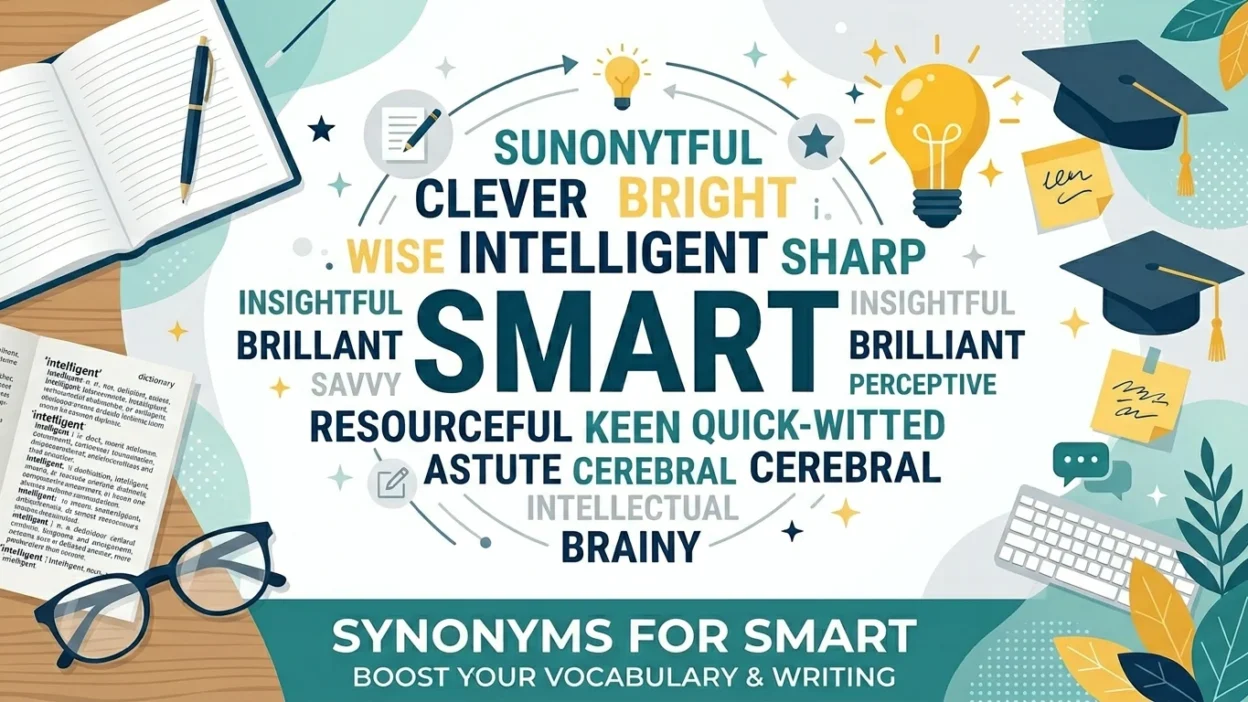
The word smart is one of the most common and useful words in English. We use it to describe people who learn quickly, think clearly, solve problems well, and make good decisions.
But smart can also describe ideas, choices, clothes, devices, and even ways of speaking. A student can be smart, a plan can be smart, and a person can wear a smart outfit.
Because the word is so flexible, it appears often in essays, conversations, stories, blog posts, and social media content.
However, using smart again and again can make your writing sound repetitive. It can also be too general. Sometimes you want to say someone is academically intelligent.
Other times you may mean clever, wise, quick-thinking, well-informed, or stylish. That is why learning synonyms for smart is so helpful.
The right synonym helps you express the exact kind of intelligence, judgment, or style you want to describe.
In this article, you will learn 30 useful synonyms for smart with simple meanings, example sentences, and easy usage notes. You will also find a comparison table and a practical guide to help you choose the right synonym based on tone and context.
Everything is written in simple English, so it is beginner-friendly and useful for students, ESL learners, writers, and content creators.
What Does “Smart” Mean?
The word smart usually means intelligent, quick-thinking, skillful, or showing good judgment. In some contexts, it can also mean stylish and neat in appearance.
Simple meaning of smart
Something or someone is smart if they:
- learn quickly
- understand things easily
- make good decisions
- solve problems well
- show skill or clever thinking
- look neat and stylish in some contexts
Example sentences
- She is a smart student who always asks thoughtful questions.
- That was a smart way to solve the problem.
- He wore a smart jacket to the interview.
The word smart is useful because it works in many situations, but it is also broad. Sometimes you need a more exact word to show whether someone is intelligent, wise, clever, sharp, or simply well-dressed.
Why Learn Synonyms for Smart?
Learning different synonyms for smart can improve your English in several ways.
It reduces repetition
If you use smart too many times in one paragraph, your writing can sound repetitive and flat.
It makes your meaning more precise
A synonym can show the exact kind of smartness you mean. For example, intelligent is a broad word for mental ability, while wise focuses more on judgment and life experience.
It improves tone
Some synonyms sound formal, some sound casual, and some are better for school writing, stories, or daily conversation.
It makes writing more expressive
A more specific synonym helps your reader understand your meaning more clearly and naturally.
What Do “Given Keywords” Mean in This Article?
In this article, given keywords means the 30 target words listed as synonyms for smart. These are the vocabulary words you are learning and comparing.
Simple meaning of given keywords
“Given keywords” simply means:
- the words provided in the article
- the vocabulary items being explained
- the target terms you should focus on
Tone and usage context
The phrase given keywords is neutral and instructional. It is often used in:
- SEO content briefs
- writing prompts
- vocabulary exercises
- school assignments
- blog outlines
Example in context
- In this guide, the given keywords are the 30 synonyms for smart explained below.
So in this article, the given keywords are words like intelligent, clever, wise, and sharp—all of which express different shades of the meaning of smart.
30 Synonyms for Smart
1. Intelligent
Meaning: Good at learning, understanding, and thinking clearly.
Example sentence: Maria is an intelligent student who enjoys solving difficult math problems.
Best usage context: Best for school, formal writing, general intelligence, and professional descriptions.
2. Clever
Meaning: Quick at thinking and finding solutions in a skillful way.
Example sentence: That was a clever answer to a difficult question.
Best usage context: Great for problem-solving, witty ideas, and creative thinking.
3. Bright
Meaning: Intelligent and quick to learn.
Example sentence: He is a bright young boy with a love for science.
Best usage context: Common for children, students, and positive descriptions of learning ability.
4. Wise
Meaning: Smart because of experience, knowledge, and good judgment.
Example sentence: Her grandmother gave her some wise advice about life.
Best usage context: Best for life advice, decisions, maturity, and thoughtful judgment.
5. Sharp
Meaning: Quick to notice, understand, or respond.
Example sentence: She has a sharp mind and catches small mistakes quickly.
Best usage context: Good for fast thinking, observation, and mental alertness.
6. Brainy
Meaning: Very smart, especially in school subjects or study.
Example sentence: My cousin is the brainy one in the family and loves reading science books.
Best usage context: Informal word for academic intelligence and studious people.
7. Brilliant
Meaning: Extremely smart, talented, or impressive in thought.
Example sentence: Einstein was a brilliant scientist with groundbreaking ideas.
Best usage context: Best for very high intelligence, creative ideas, and outstanding talent.
8. Knowledgeable
Meaning: Knowing a lot about a subject because of study or experience.
Example sentence: Our history teacher is very knowledgeable about ancient cultures.
Best usage context: Great for experts, teachers, guides, and subject-specific knowledge.
9. Insightful
Meaning: Able to understand people or situations deeply and clearly.
Example sentence: Her comments about the novel were thoughtful and insightful.
Best usage context: Best for analysis, writing, discussions, and deep understanding.
10. Perceptive
Meaning: Good at noticing things that others may miss.
Example sentence: He made a perceptive observation about the team’s communication problem.
Best usage context: Useful for people who notice details, emotions, or hidden meaning.
11. Astute
Meaning: Very smart and good at understanding situations quickly.
Example sentence: She made an astute business decision at the right time.
Best usage context: Best for business, politics, strategy, and formal writing.
12. Savvy
Meaning: Practical and well-informed, especially in a specific area.
Example sentence: He is very savvy when it comes to social media marketing.
Best usage context: Great for technology, business, money, trends, and modern practical knowledge.
13. Quick-witted
Meaning: Able to think and reply quickly in a smart or funny way.
Example sentence: The comedian was quick-witted and kept the audience laughing.
Best usage context: Best for conversations, humor, debate, and fast responses.
14. Resourceful
Meaning: Good at finding clever ways to solve problems with what is available.
Example sentence: The hikers were resourceful and built a shelter before the storm.
Best usage context: Great for practical problem-solving, survival, work, and real-life challenges.
15. Inventive
Meaning: Good at creating new ideas, methods, or solutions.
Example sentence: She is an inventive designer who always brings fresh ideas to the team.
Best usage context: Best for creativity, design, innovation, and original thinking.
16. Analytical
Meaning: Good at examining facts and understanding how things work.
Example sentence: He has an analytical mind and enjoys studying data.
Best usage context: Useful for academics, business, research, and problem-solving.
17. Logical
Meaning: Thinking in a clear and sensible way.
Example sentence: Her explanation was calm, logical, and easy to follow.
Best usage context: Best for arguments, reasoning, essays, and structured thinking.
18. Capable
Meaning: Having the skill and ability to do something well.
Example sentence: She is a capable manager who handles pressure well.
Best usage context: Great for work, leadership, responsibility, and general ability.
19. Competent
Meaning: Skilled enough to do something properly and successfully.
Example sentence: The new nurse is friendly, calm, and highly competent.
Best usage context: Best for jobs, professional performance, and workplace ability.
20. Educated
Meaning: Having a good level of learning or formal knowledge.
Example sentence: He is a highly educated man with degrees in law and economics.
Best usage context: Useful for formal education, academic background, and knowledge.
21. Scholarly
Meaning: Showing serious knowledge and interest in study or academic work.
Example sentence: The article had a scholarly tone and included many references.
Best usage context: Best for academic writing, research, and formal study.
22. Talented
Meaning: Naturally good at something, often with intelligence or skill.
Example sentence: She is a talented writer with a strong voice and clear ideas.
Best usage context: Good for arts, school, work, and natural ability.
23. Gifted
Meaning: Naturally very intelligent or talented.
Example sentence: He is a gifted musician who learned piano at a very young age.
Best usage context: Best for children, artists, students, and natural talent.
24. Shrewd
Meaning: Smart in a practical way, especially in business or judging people.
Example sentence: The shop owner made a shrewd investment before prices increased.
Best usage context: Useful for money, business, negotiation, and practical decisions.
25. Judicious
Meaning: Showing good judgment and careful thinking.
Example sentence: She made a judicious choice after comparing all the options.
Best usage context: Best for formal writing, decisions, leadership, and careful choices.
26. Sensible
Meaning: Smart in a practical and reasonable way.
Example sentence: Taking notes during class is a sensible habit.
Best usage context: Great for everyday decisions, advice, parenting, and practical actions.
27. Smartly Dressed
Meaning: Neat, stylish, and well-dressed.
Example sentence: He arrived smartly dressed for the interview.
Best usage context: Use when smart means stylish in appearance rather than intelligent.
28. Polished
Meaning: Refined, confident, and skillful in presentation or behavior.
Example sentence: She gave a polished presentation to the clients.
Best usage context: Best for public speaking, professional behavior, and finished work.
29. Sharp-minded
Meaning: Having a clear, quick, and active mind.
Example sentence: Even in old age, my grandfather remained sharp-minded and curious.
Best usage context: Good for mental alertness, older adults, and intellectual ability.
30. Genius
Meaning: A person with extremely high intelligence or exceptional creative ability.
Example sentence: Many people consider Leonardo da Vinci a genius.
Best usage context: Best for extraordinary intelligence, creativity, and world-changing talent.
Comparison Table: When to Use Different Synonyms for Smart
| Word | Simple Meaning | Tone | Best Used When |
|---|---|---|---|
| intelligent | good at learning and understanding | neutral/formal | school, essays, general intelligence |
| clever | quick and skillful in thinking | neutral | ideas, solutions, witty responses |
| bright | quick to learn | positive | children, students, learning |
| wise | smart with good judgment and experience | positive | advice, life lessons, decisions |
| sharp | mentally quick and alert | neutral | noticing details, fast thinking |
| brainy | very smart in studies | informal | students, academic ability |
| brilliant | extremely smart or impressive | strong/positive | top talent, ideas, achievements |
| knowledgeable | knows a lot about a subject | neutral | experts, teachers, guides |
| insightful | deeply understanding | positive | discussions, analysis, writing |
| perceptive | good at noticing things | positive | emotions, details, hidden meaning |
| astute | smart in judgment and strategy | formal | business, politics, leadership |
| savvy | practical and well-informed | casual/modern | tech, money, media, business |
| quick-witted | fast and clever in replies | lively | humor, debate, conversation |
| resourceful | good at solving problems creatively | positive | work, emergencies, practical challenges |
| inventive | good at creating new ideas | positive | design, creativity, innovation |
| analytical | good at studying facts and patterns | formal | research, business, academics |
| logical | clear and sensible in reasoning | neutral | arguments, essays, problem-solving |
| capable | able and skilled | neutral | work, leadership, tasks |
| competent | skilled enough to do a job well | formal | workplace, professional ability |
| educated | well taught or formally learned | neutral/formal | academic background, knowledge |
| scholarly | academic and research-focused | formal | articles, study, research |
| talented | naturally good at something | positive | arts, writing, performance |
| gifted | naturally very talented or intelligent | positive | children, artists, students |
| shrewd | smart in a practical or business way | slightly formal | money, deals, judgment |
| judicious | showing careful good judgment | formal | decisions, leadership, writing |
| sensible | practical and reasonable | neutral | daily choices, advice, habits |
| smartly dressed | neat and stylish | descriptive | clothing, appearance, events |
| polished | refined and professional | positive | presentations, speaking, work |
| sharp-minded | mentally quick and clear | positive | older adults, intellectual ability |
| genius | extremely intelligent or creative | very strong | exceptional talent, famous thinkers |
How to Choose the Right Synonym
Choosing the right synonym for smart depends on what kind of smartness you want to describe. Do you mean school intelligence? practical thinking? life wisdom? fast replies? creative talent? or stylish appearance? Here is a simple guide.
If You Mean Academic Intelligence or Learning Ability
Use
- intelligent
- bright
- brainy
- educated
- scholarly
Quick guide
- intelligent = generally smart and able to learn well
- bright = quick to learn, often used for children or students
- brainy = very smart in studies, more informal
- educated = has learning or formal education
- scholarly = serious and academic in knowledge or style
If You Mean Good Judgment or Practical Thinking
Use
- wise
- sensible
- judicious
- shrewd
- astute
Quick guide
- wise = smart because of experience and judgment
- sensible = practical and reasonable
- judicious = careful and thoughtful in decisions
- shrewd = practical and smart, especially in money or people
- astute = quick and strategic in understanding situations
If You Mean Fast Thinking or Mental Sharpness
Use
- sharp
- quick-witted
- perceptive
- sharp-minded
- clever
Quick guide
- sharp = mentally quick and alert
- quick-witted = fast with replies, often funny or clever
- perceptive = notices details and hidden meaning
- sharp-minded = mentally clear and active
- clever = skillful and quick in thinking
If You Mean Problem-Solving or Skill
Use
- resourceful
- analytical
- logical
- capable
- competent
Quick guide
- resourceful = finds practical solutions with what is available
- analytical = studies facts carefully
- logical = reasons clearly and sensibly
- capable = has the ability to do something well
- competent = skilled enough to do a job properly
If You Mean Creativity or Special Talent
Use
- inventive
- talented
- gifted
- brilliant
- genius
Quick guide
- inventive = creates new ideas and solutions
- talented = naturally good at something
- gifted = naturally very talented or intelligent
- brilliant = extremely smart or impressive
- genius = exceptionally intelligent or creative
If You Mean Stylish Appearance
Use
- smartly dressed
- polished
Quick guide
- smartly dressed = neat, stylish, and well-dressed
- polished = refined, professional, and smooth in appearance or behavior
When You Should Still Use “Smart”
Even though there are many useful synonyms for smart, the word smart itself is still one of the best choices in many situations. It is simple, natural, and easy to understand. Sometimes it is exactly the right word.
Use smart when:
- you want a general word for intelligence or good thinking
- the exact type of intelligence does not matter
- you are writing for beginners or ESL learners
- you want your sentence to sound direct and natural
Example
- She is smart, hardworking, and easy to talk to.
This sentence is simple and clear, so smart works perfectly.
Common Mistakes When Using Synonyms for Smart
Choosing a word that changes the meaning
Not every synonym for smart means the same thing.
- wise is about good judgment and life experience
- clever is about quick thinking and skill
- educated is about formal learning
- smartly dressed is about appearance, not intelligence
Always think about the exact kind of smartness you want to describe.
Using very strong words too often
Words like genius, brilliant, and gifted are stronger than smart. Use them when the situation truly fits.
Using formal words in casual writing
Words like judicious, astute, and scholarly may sound too formal in everyday conversation.
Replacing smart every time
You do not need to avoid smart completely. Good writing is about choosing the best word for the situation, not always choosing a more advanced one.
Tips for Students, ESL Learners, and Writers
Ask what kind of “smart” you mean
Before choosing a synonym, ask:
- Is it about intelligence in school?
- Is it about practical problem-solving?
- Is it about good judgment?
- Is it about creativity or talent?
- Is it about appearance and style?
Match the word to the context
Use simple words like smart, clever, or bright in everyday writing. Use words like analytical, judicious, or insightful when you want a more exact meaning.
Learn words in groups
This makes them easier to remember.
Intelligence and study words
- intelligent
- bright
- brainy
- educated
Judgment and practical thinking words
- wise
- sensible
- astute
- shrewd
Creative and talented words
- inventive
- talented
- gifted
- brilliant
Fast-thinking words
- sharp
- quick-witted
- perceptive
- clever
Practice with your own sentences
Try replacing smart with different synonyms and notice how the meaning changes.
Example
Original:
- She is a smart student.
Try:
- She is an intelligent student.
- She is a bright student.
- She is a gifted student.
Each word changes the tone and exact meaning slightly.
Final Thoughts
Learning useful synonyms for smart can make your English more precise, natural, and expressive. Instead of using one general word in every situation, you can choose a synonym that better matches the meaning you want to share.
Sometimes someone is smart because they are intelligent, sometimes because they are wise, and sometimes because they are quick-thinking, resourceful, analytical, or creative.
The right word helps your reader understand exactly what kind of smartness you mean.
The best way to learn these words is to group them by context. Use intelligent, bright, and brainy for learning and school.
Use wise, judicious, and sensible for judgment and decisions. Use sharp, quick-witted, and perceptive for fast thinking. Use inventive, talented, and brilliant for creativity and ability.
Most importantly, remember that smart is still a useful and natural word. You do not need to replace it every time. Choose a synonym when it makes your writing clearer, more accurate, and more engaging.