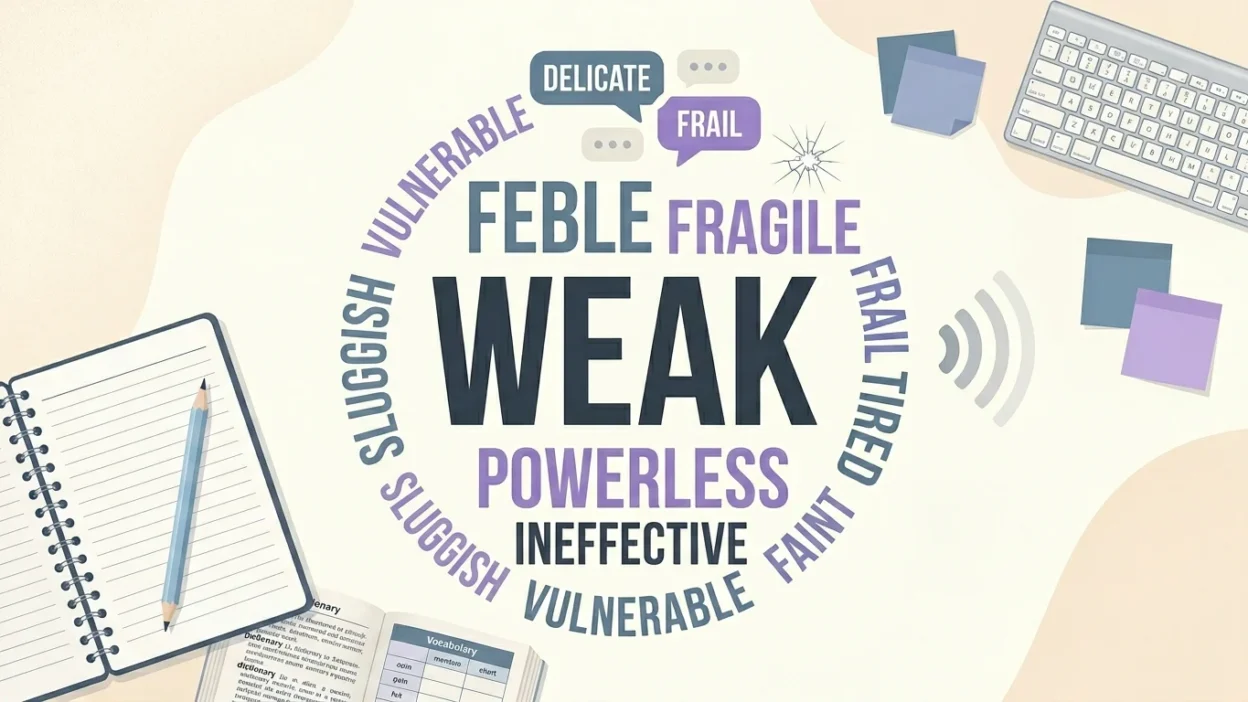
The word weak is a common English word, but it can mean many different things. We use it to talk about physical strength, emotional energy, arguments, signals, sounds, performance, and even flavors.
A person can feel weak after being sick, a weak argument may not convince anyone, and a weak internet signal can make online work frustrating.
Because the word is so flexible, students, ESL learners, writers, and content creators use it often in schoolwork, blog posts, stories, and everyday conversation.
But using weak again and again can make writing sound repetitive. More importantly, weak is a broad word. Sometimes you want to say someone lacks physical power.
Other times you may mean something is fragile, ineffective, mild, unconvincing, or low in intensity. That is where learning synonyms for weak becomes useful.
The right synonym helps you express the exact shade of meaning you want.
In this article, you will learn 30 useful synonyms for weak with simple meanings, example sentences, and easy usage notes. You will also find a comparison table and a practical guide to help you choose the right synonym based on tone and context.
Everything is written in simple English, so it is beginner-friendly and useful for students, ESL learners, writers, and content creators.
What Does “Weak” Mean?
The word weak usually means not strong, lacking power, not effective, or not intense enough. It can describe people, objects, ideas, performance, sounds, and feelings.
Simple meaning of weak
Something is weak if it:
- does not have much physical strength
- lacks energy or power
- is not convincing or effective
- is easy to break or damage
- feels mild, faint, or low in force
Example sentences
- I felt weak after the long illness.
- His explanation was weak and did not answer the question.
- The phone has a weak signal in this area.
The word weak is useful because it fits many situations, but it is also general. Sometimes you need a more exact word to show whether something is fragile, tired, ineffective, or unconvincing.
Why Learn Synonyms for Weak?
Learning different synonyms for weak can improve your English in several ways.
It reduces repetition
If you use weak too many times in one paragraph, your writing can sound flat and repetitive.
It makes your meaning more precise
A synonym can show the exact type of weakness you mean. For example, fragile is better for something delicate and easy to break, while feeble often suggests low physical strength or low energy.
It improves tone
Some synonyms sound neutral, some sound formal, and some can sound more emotional or descriptive. Choosing the right word helps your sentence sound natural.
It makes writing more expressive
A more specific synonym helps your reader understand your message more clearly, whether you are describing a person, an argument, a product, or a feeling.
What Do “Given Keywords” Mean in This Article?
In this article, given keywords means the 30 target words listed as synonyms for weak. These are the vocabulary words you are learning and comparing.
Simple meaning of given keywords
“Given keywords” simply means:
- the words provided in the article
- the vocabulary items being explained
- the target terms you should focus on
Tone and usage context
The phrase given keywords is neutral and instructional. It is often used in:
- SEO content briefs
- writing prompts
- vocabulary exercises
- school assignments
- blog outlines
Example in context
- In this guide, the given keywords are the 30 synonyms for weak explained below.
So in this article, the given keywords are words like feeble, fragile, faint, and ineffective—all of which express different shades of the meaning of weak.
30 Synonyms for Weak
1. Feeble
Meaning: Very weak in strength, energy, or effect.
Example sentence: After the fever, he felt too feeble to leave bed.
Best usage context: Best for people, voices, efforts, or actions with very little strength.
2. Fragile
Meaning: Easy to break, damage, or hurt.
Example sentence: The glass vase is too fragile to carry without a box.
Best usage context: Great for objects, health, emotions, or delicate situations.
3. Frail
Meaning: Physically weak and often delicate, especially because of age or illness.
Example sentence: The frail old man walked slowly with a stick.
Best usage context: Best for elderly people, health, or physical weakness.
4. Faint
Meaning: Very slight, weak, or hard to notice.
Example sentence: I heard a faint sound coming from the next room.
Best usage context: Useful for sounds, smells, lights, signs, or weak feelings.
5. Tired
Meaning: Lacking energy because of work, stress, or lack of sleep.
Example sentence: I felt tired after studying all night.
Best usage context: Everyday word for low energy or temporary weakness.
6. Exhausted
Meaning: Extremely tired and low in energy.
Example sentence: She was exhausted after the long trip.
Best usage context: Best for physical or mental tiredness after hard effort.
7. Powerless
Meaning: Without strength, control, or ability to change a situation.
Example sentence: He felt powerless during the argument.
Best usage context: Best for emotions, social situations, and lack of control.
8. Helpless
Meaning: Unable to take care of yourself or solve a problem.
Example sentence: The child looked helpless in the crowd.
Best usage context: Good for emotional scenes, people in need, or difficult situations.
9. Delicate
Meaning: Easily damaged, hurt, or affected.
Example sentence: Her skin is very delicate in cold weather.
Best usage context: Best for skin, flowers, health, feelings, or sensitive topics.
10. Flimsy
Meaning: Weakly made and not strong or solid.
Example sentence: The chair felt flimsy and unsafe.
Best usage context: Use for cheap materials, weak objects, or poor construction.
11. Ineffective
Meaning: Not producing the result you want.
Example sentence: The old marketing plan was ineffective.
Best usage context: Best for strategies, methods, medicine, policies, or tools.
12. Unconvincing
Meaning: Not strong enough to make people believe something.
Example sentence: His excuse sounded unconvincing to the teacher.
Best usage context: Best for excuses, arguments, speeches, and explanations.
13. Poor
Meaning: Not good in quality, strength, or performance.
Example sentence: The team gave a poor performance in the second half.
Best usage context: Everyday word for quality, results, performance, or conditions.
14. Thin
Meaning: Weak, not full, or lacking depth or strength.
Example sentence: The soup tasted thin and needed more flavor.
Best usage context: Useful for sound, stories, liquids, arguments, or explanations.
15. Mild
Meaning: Not strong, harsh, or intense.
Example sentence: It was a mild headache, so I did not take medicine.
Best usage context: Best for weather, pain, flavor, reactions, or emotions.
16. Soft
Meaning: Not strong, hard, or forceful.
Example sentence: He spoke in a soft voice during the interview.
Best usage context: Good for voices, sounds, textures, tones, and gentle actions.
17. Sluggish
Meaning: Weak in energy, speed, or activity.
Example sentence: I felt sluggish after eating too much at lunch.
Best usage context: Best for energy, movement, traffic, business, or slow systems.
18. Lethargic
Meaning: Weak, tired, and lacking energy.
Example sentence: She felt lethargic all afternoon.
Best usage context: Useful for health, mood, and physical energy.
19. Insecure
Meaning: Not strong or stable emotionally, mentally, or structurally.
Example sentence: He felt insecure about speaking in public.
Best usage context: Best for confidence, emotions, relationships, or unstable structures.
20. Vulnerable
Meaning: Easily hurt, attacked, or affected.
Example sentence: Young plants are vulnerable to strong wind.
Best usage context: Best for health, emotions, safety, security, and risk.
21. Brittle
Meaning: Hard but easy to break.
Example sentence: Dry branches become brittle in summer heat.
Best usage context: Great for materials, hair, nails, or things that crack easily.
22. Shaky
Meaning: Not strong, steady, or certain.
Example sentence: His hands were shaky after the stressful exam.
Best usage context: Use for movement, confidence, plans, or weak support.
23. Wobbly
Meaning: Weak, unstable, or not steady.
Example sentence: The old table is wobbly and needs repair.
Best usage context: Best for furniture, balance, legs, or unstable objects.
24. Underpowered
Meaning: Not powerful enough for what is needed.
Example sentence: The small engine felt underpowered on steep roads.
Best usage context: Great for machines, devices, cars, or technology.
25. Deficient
Meaning: Lacking something important; not strong enough in quality or amount.
Example sentence: The report was deficient in detail.
Best usage context: Best for formal writing, reports, nutrition, skills, or systems.
26. Inferior
Meaning: Lower in quality, strength, or value.
Example sentence: This material is inferior to the original one.
Best usage context: Useful for products, quality comparisons, and formal writing.
27. Limp
Meaning: Weak, loose, or lacking firmness and energy.
Example sentence: The flowers looked limp after a day in the heat.
Best usage context: Best for plants, body movement, handshakes, or weak appearance.
28. Failing
Meaning: Becoming weak or not working properly anymore.
Example sentence: His failing eyesight made reading difficult.
Best usage context: Best for health, systems, memory, or performance that is getting worse.
29. Subtle
Meaning: Weak in force but still noticeable in a gentle way.
Example sentence: The perfume has a subtle scent of jasmine.
Best usage context: Best for flavors, scents, design, hints, or small effects.
30. Hollow
Meaning: Weak because it lacks depth, truth, or real support.
Example sentence: His apology sounded hollow and insincere.
Best usage context: Best for promises, words, emotions, or arguments that feel empty.
Comparison Table: When to Use Different Synonyms for Weak
| Word | Simple Meaning | Tone | Best Used When |
|---|---|---|---|
| feeble | very weak in strength or energy | neutral/formal | people, voices, efforts |
| fragile | easy to break or damage | neutral | objects, health, emotions |
| frail | physically weak and delicate | descriptive | age, illness, health |
| faint | slight and hard to notice | neutral | sounds, smells, lights |
| tired | low in energy | simple | daily life, work, study |
| exhausted | extremely tired | strong/neutral | travel, work, stress |
| powerless | without control or strength | emotional | conflict, social situations |
| helpless | unable to help yourself | emotional | people in trouble, emotional scenes |
| delicate | easily affected or damaged | soft/neutral | skin, feelings, flowers |
| flimsy | weakly made | slightly negative | cheap materials, furniture |
| ineffective | not working well | formal/neutral | plans, medicine, methods |
| unconvincing | not believable enough | neutral | excuses, arguments, speeches |
| poor | low in quality or strength | simple | performance, results, conditions |
| thin | lacking depth or strength | neutral | soup, stories, sound, ideas |
| mild | not strong or intense | positive/neutral | weather, pain, flavor |
| soft | not forceful or hard | neutral | voice, sound, tone |
| sluggish | slow and low-energy | neutral | people, business, traffic |
| lethargic | tired and lacking energy | formal | health, mood, energy |
| insecure | lacking confidence or stability | emotional | confidence, relationships |
| vulnerable | easy to harm or affect | formal/neutral | safety, health, risk |
| brittle | easy to break | descriptive | materials, hair, branches |
| shaky | not steady or reliable | informal | hands, plans, confidence |
| wobbly | unstable and weak | casual | furniture, balance, legs |
| underpowered | not powerful enough | technical | engines, devices, machines |
| deficient | lacking something important | formal | reports, skills, nutrition |
| inferior | lower in quality or strength | formal | products, comparisons |
| limp | loose, weak, or lifeless | descriptive | plants, handshakes, movement |
| failing | becoming weak over time | descriptive | health, memory, systems |
| subtle | gentle and not strong | positive | scents, design, flavor |
| hollow | empty and not sincere or strong | negative | promises, apologies, arguments |
How to Choose the Right Synonym
Choosing the right synonym for weak depends on what kind of weakness you want to describe. Is it physical weakness? Low energy? a weak argument? a fragile object? a mild taste? Here is a simple guide.
If You Mean Physical Weakness or Low Energy
Use
- feeble
- frail
- tired
- exhausted
- lethargic
Quick guide
- feeble = very weak in strength
- frail = weak and delicate, often because of age or illness
- tired = low in energy
- exhausted = extremely tired
- lethargic = tired and slow with low energy
If You Mean Something Is Easy to Break or Damage
Use
- fragile
- delicate
- flimsy
- brittle
- wobbly
Quick guide
- fragile = easy to break
- delicate = easily affected or damaged
- flimsy = weakly made
- brittle = hard but breaks easily
- wobbly = unstable and not firm
If You Mean a Weak Argument, Excuse, or Result
Use
- ineffective
- unconvincing
- poor
- thin
- hollow
Quick guide
- ineffective = does not work well
- unconvincing = not believable enough
- poor = low quality or weak result
- thin = lacking detail or strength
- hollow = empty and not sincere
If You Mean Low Power, Control, or Stability
Use
- powerless
- helpless
- insecure
- vulnerable
- underpowered
Quick guide
- powerless = no control or ability to change things
- helpless = unable to solve or manage the situation
- insecure = lacking confidence or stability
- vulnerable = easy to hurt or affect
- underpowered = not powerful enough for the job
If You Mean Something Mild, Soft, or Faint
Use
- faint
- mild
- soft
- subtle
Quick guide
- faint = very slight and hard to notice
- mild = not strong or intense
- soft = gentle and not forceful
- subtle = light but still noticeable
When You Should Still Use “Weak”
Even though there are many useful synonyms for weak, the word weak itself is still one of the best choices in many situations. It is simple, clear, and easy to understand. Sometimes it is exactly the right word.
Use weak when:
- you want a general word for lack of strength or power
- the exact type of weakness does not matter
- you are writing for beginners or ESL learners
- you want your sentence to sound direct and natural
Example
- I still feel weak after the flu.
This sentence is clear and natural, so weak works perfectly.
Common Mistakes When Using Synonyms for Weak
Choosing a word that changes the meaning
Not every synonym for weak means the same thing.
- fragile is about being easy to break
- ineffective is about poor results
- mild is about low intensity
- powerless is about lack of control
Always think about the exact kind of weakness you want to describe.
Using very negative words too often
Words like inferior, hollow, and flimsy can sound more critical than weak. Use them carefully when tone matters.
Using formal words in casual writing
Words like deficient, vulnerable, and ineffective may sound too formal in everyday conversation.
Replacing weak every time
You do not need to avoid weak completely. Good writing is about choosing the best word for the situation, not always using a more advanced one.
Tips for Students, ESL Learners, and Writers
Ask what kind of “weak” you mean
Before choosing a synonym, ask:
- Is it about physical strength?
- Is it about low energy?
- Is it about a weak argument or excuse?
- Is it about something easy to break?
- Is it about low power, low quality, or low intensity?
Match the word to the context
Use simple words like weak, tired, or poor in everyday writing. Use words like fragile, ineffective, or vulnerable when you want a more exact meaning.
Learn words in groups
This makes them easier to remember.
Physical weakness words
- feeble
- frail
- tired
- exhausted
Fragile or unstable words
- fragile
- delicate
- brittle
- wobbly
Weak argument or result words
- ineffective
- unconvincing
- poor
- hollow
Low intensity words
- faint
- mild
- soft
- subtle
Practice with your own sentences
Try replacing weak with different synonyms and notice how the meaning changes.
Example
Original:
- The argument was weak.
Try:
- The argument was unconvincing.
- The argument was thin.
- The argument was hollow.
Each word changes the tone and exact meaning slightly.
FAQs
What is another word for weak?
Another word for weak depends on the context. Common synonyms include feeble, fragile, frail, tired, powerless, ineffective, mild, and unconvincing. Each word has a slightly different meaning, so it is important to choose the one that fits your sentence.
What is the best synonym for weak in physical strength?
If you are talking about physical weakness, good synonyms include feeble, frail, exhausted, tired, and lethargic.
For example:
- He felt feeble after being sick.
- She looked frail after the long winter.
What synonym for weak should I use for an argument?
If you mean a weak argument, excuse, or explanation, the best choices are unconvincing, ineffective, thin, poor, or hollow.
For example:
- His explanation was unconvincing.
- The report made a weak argument, so you could also say it was thin or ineffective.
What is the difference between weak and fragile?
Weak is a general word that means not strong or not powerful.
Fragile means easy to break, damage, or hurt.
For example:
- I felt weak after the flu.
- The glass is fragile, so handle it carefully.
Is tired a synonym for weak?
Yes, tired can be a synonym for weak in some situations, especially when you are talking about low energy. However, tired usually means a lack of energy from work, stress, or lack of sleep, while weak can also mean not strong, not effective, or not intense.
Final Thoughts
Learning useful synonyms for weak can make your English more precise, more natural, and more expressive. Instead of using one general word for every situation, you can choose a synonym that better matches the meaning you want to share.
Sometimes something is weak because it is physically tired, sometimes because it is fragile, and sometimes because it is unconvincing, ineffective, or low in intensity. The right word helps your reader understand your exact message.
The best way to learn these words is to group them by context.
Use feeble, frail, and exhausted for physical weakness. Use fragile, delicate, and brittle for things that are easy to damage.
Use ineffective, unconvincing, and hollow for weak ideas or arguments. Use faint, mild, and subtle for low intensity.
Most importantly, remember that weak is still a useful and natural word. You do not need to replace it every time. Choose a synonym when it makes your writing clearer, more accurate, and more expressive.