The word slow is one of the most common words in English. We use it to describe movement, learning speed, progress, reactions, traffic, machines, and even personal habits.
A car can be slow, a computer can be slow, a person can walk slowly, and a project can move at a slow pace. Because it is such a useful word, students, ESL learners, writers, and content creators use it often in essays, stories, blog posts, captions, and daily conversation.
But slow can mean different things depending on the situation. Sometimes it means something moves with low speed. Sometimes it means something takes a long time.
In other cases, it can describe a person who reacts late, a process that develops gradually, or a calm and relaxed pace. That is why learning synonyms for slow is helpful. A better synonym can show the exact kind of slowness you want to express.
In this article, you will learn 30 useful synonyms for slow with simple meanings, example sentences, and easy usage notes. You will also find a comparison table and a practical guide to help you choose the right synonym based on tone and context.
The explanations are written in simple English, so they are beginner-friendly and useful for students, ESL learners, writers, and content creators.
What Does “Slow” Mean?
The word slow usually means not fast, taking a long time, or moving at a low speed. It can describe physical movement, work speed, growth, reactions, and progress.
Simple meaning of slow
Something is slow if it:
- moves without much speed
- takes a long time to happen
- responds late
- develops gradually
- works less quickly than expected
Example sentences
- The bus was slow because of traffic.
- My old laptop is very slow.
- Business has been slow this month.
The word slow is simple and useful, but it is broad. Sometimes you may want a more specific word to show whether something is delayed, relaxed, gradual, heavy, or inactive.
Why Learn Synonyms for Slow?
Learning different synonyms for slow can improve your English in several ways.
It reduces repetition
If you use slow too many times in one paragraph or article, your writing can sound repetitive.
It makes your meaning more exact
A synonym can show exactly what kind of slowness you mean. For example, gradual is good for change over time, while sluggish suggests something that moves slowly because it lacks energy.
It improves tone
Some synonyms sound casual, some sound formal, and some are better for stories, essays, or professional writing.
It makes writing more expressive
A better word can help readers understand speed, mood, effort, or progress more clearly.
What Do “Given Keywords” Mean in This Article?
In this article, given keywords means the 30 target words listed as synonyms for slow. These are the vocabulary words you are learning and comparing.
Simple meaning of given keywords
“Given keywords” simply means:
- the words provided in the article
- the vocabulary items being explained
- the target terms you should focus on
Tone and usage context
The phrase given keywords is neutral and instructional. It is often used in:
- SEO content briefs
- writing prompts
- vocabulary worksheets
- school assignments
- blog outlines
Example in context
- In this guide, the given keywords are the 30 synonyms for slow explained below.
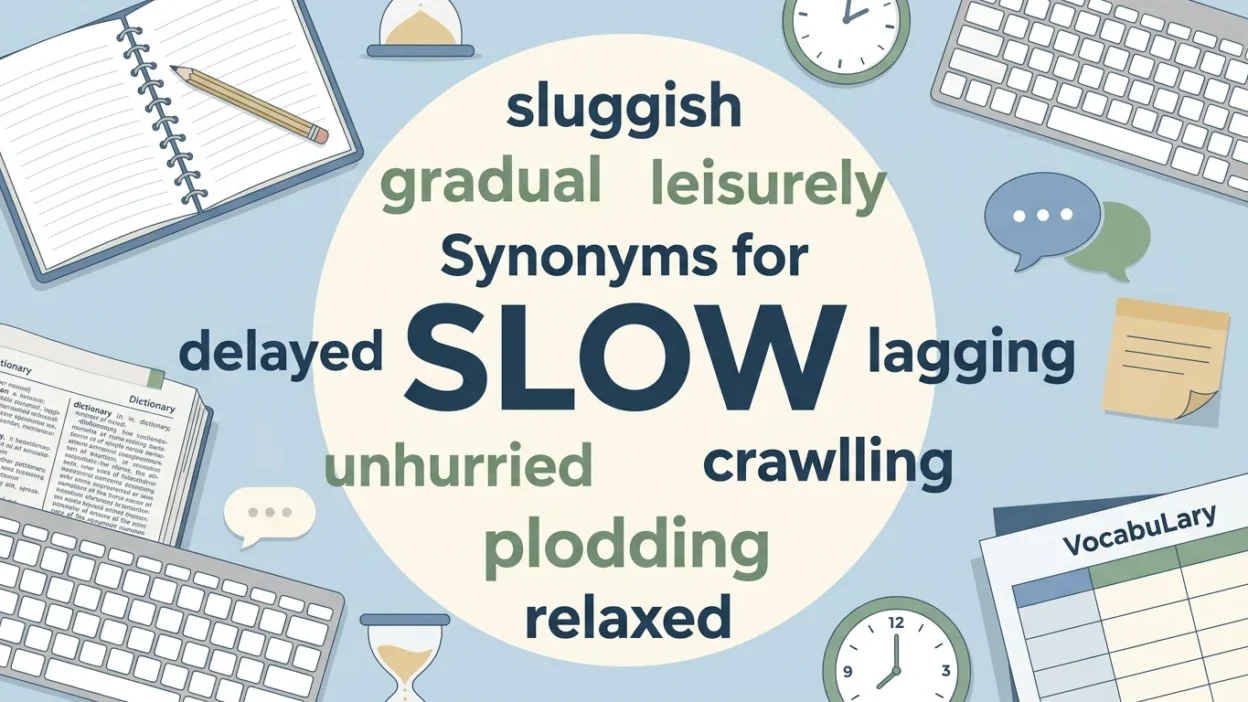
So in this article, the given keywords are words like sluggish, gradual, leisurely, and delayed—all of which express different shades of the meaning of slow.
30 Synonyms for Slow
1. Sluggish
Meaning
Moving or working slowly because of low energy.
Example sentence
I felt sluggish after staying up too late.
Best usage context
Use for people, business, traffic, or systems that feel heavy or low-energy.
2. Leisurely
Meaning
Done slowly in a relaxed and unhurried way.
Example sentence
We took a leisurely walk along the beach.
Best usage context
Best for calm activities, travel, walks, meals, or peaceful routines.
3. Gradual
Meaning
Happening slowly over time, not all at once.
Example sentence
There was a gradual improvement in her English.
Best usage context
Use for change, growth, recovery, progress, and development.
4. Unhurried
Meaning
Done without rushing.
Example sentence
He spoke in an unhurried voice during the meeting.
Best usage context
Best for calm movement, speech, and a relaxed pace.
5. Delayed
Meaning
Happening later than expected.
Example sentence
Our flight was delayed by two hours.
Best usage context
Use for travel, plans, projects, replies, or events that are late.
6. Late
Meaning
Not happening at the expected time.
Example sentence
The delivery arrived late in the evening.
Best usage context
Simple everyday word for time-related delay.
7. Lazy
Meaning
Not willing to work quickly or with much effort.
Example sentence
He gave a lazy answer without thinking much.
Best usage context
Use carefully for behavior, movement, or style when you mean low effort.
8. Lethargic
Meaning
Feeling tired, weak, and slow.
Example sentence
The patient looked lethargic after the long journey.
Best usage context
Best for health, energy levels, mood, or physical weakness.
9. Dragging
Meaning
Moving or continuing very slowly.
Example sentence
The afternoon meeting kept dragging on.
Best usage context
Use for time, events, meetings, or tasks that feel long and slow.
10. Plodding
Meaning
Moving or working slowly in a steady but heavy way.
Example sentence
The old horse continued at a plodding pace.
Best usage context
Useful for physical movement, writing style, or steady but slow work.
11. Crawling
Meaning
Moving extremely slowly.
Example sentence
Traffic was crawling after the accident.
Best usage context
Best for traffic, internet speed, queues, or anything moving very slowly.
12. Slothful
Meaning
Very slow because of laziness.
Example sentence
The story describes a slothful character who avoids hard work.
Best usage context
More literary or descriptive; use for behavior and personality.
13. Measured
Meaning
Done slowly and carefully.
Example sentence
She answered in a measured tone.
Best usage context
Best for speech, decisions, steps, or careful movement.
14. Lagging
Meaning
Falling behind or moving more slowly than others.
Example sentence
Sales are lagging behind last year’s numbers.
Best usage context
Use for progress, performance, business, internet, or competition.
15. Moderate
Meaning
Not fast or extreme; somewhere in the middle.
Example sentence
We walked at a moderate pace through the park.
Best usage context
Useful when something is neither fast nor very slow.
16. Gentle
Meaning
Soft, calm, and not fast or forceful.
Example sentence
A gentle stream flowed through the garden.
Best usage context
Best for movement, weather, tone, or peaceful action.
17. Tardy
Meaning
Slow because of being late.
Example sentence
His tardy reply caused confusion.
Best usage context
Formal word for lateness in replies, arrivals, or tasks.
18. Prolonged
Meaning
Continuing for a long time.
Example sentence
The city faced a prolonged power outage.
Best usage context
Use for events, delays, pain, conflict, or long situations.
19. Drawn-out
Meaning
Lasting too long and feeling slow.
Example sentence
It was a drawn-out discussion with no clear result.
Best usage context
Good for meetings, arguments, stories, and long processes.
20. Labored
Meaning
Done slowly with visible effort or difficulty.
Example sentence
He climbed the stairs with labored breathing.
Best usage context
Best for speech, movement, breathing, or writing that feels forced.
21. Heavy
Meaning
Slow in movement because of weight, effort, or tiredness.
Example sentence
She walked with heavy steps after the long shift.
Best usage context
Use for footsteps, mood, movement, or emotional scenes.
22. Idle
Meaning
Not active or moving; inactive for a time.
Example sentence
The machines sat idle during the repair work.
Best usage context
Best for machines, workers, business periods, or inactive time.
23. Inactive
Meaning
Not active, moving, or progressing much.
Example sentence
The volcano has been inactive for many years.
Best usage context
Use for people, groups, accounts, systems, or natural activity.
24. Relaxed
Meaning
Calm and not rushed.
Example sentence
We spent a relaxed weekend at home.
Best usage context
Best for lifestyle, tone, travel, and calm personal pace.
25. Slow-moving
Meaning
Moving or changing at a low speed.
Example sentence
This is a slow-moving process that needs patience.
Best usage context
Useful for projects, weather systems, traffic, and business trends.
26. Stagnant
Meaning
Not moving, growing, or developing.
Example sentence
The market remained stagnant for months.
Best usage context
Best for business, careers, ideas, and situations with no progress.
27. Sleepy
Meaning
Slow, quiet, and lacking energy.
Example sentence
It is a sleepy town with very little traffic.
Best usage context
Use for places, moods, afternoons, or calm environments.
28. Drowsy
Meaning
Feeling sleepy and slow.
Example sentence
I felt drowsy during the long lecture.
Best usage context
Best for people, health, tiredness, or low alertness.
29. Slack
Meaning
Moving slowly or with less energy than usual.
Example sentence
Business is usually slack in January.
Best usage context
Useful for work, sales, activity, or effort that has slowed down.
30. Sedate
Meaning
Calm, slow, and controlled.
Example sentence
The ceremony continued at a sedate pace.
Best usage context
Best for formal settings, behavior, and calm movement.
Comparison Table: When to Use Different Synonyms for Slow
| Word | Simple Meaning | Tone | Best Used When |
|---|---|---|---|
| sluggish | slow because of low energy | neutral/slightly negative | people, traffic, business, systems |
| leisurely | slow and relaxed | positive | walks, meals, travel, free time |
| gradual | happening slowly over time | neutral | growth, learning, change, recovery |
| unhurried | calm and not rushed | positive | speech, movement, routines |
| delayed | happening later than planned | neutral | flights, messages, projects |
| late | not on time | simple | everyday timing and arrivals |
| lazy | slow because of low effort | negative | behavior, movement, style |
| lethargic | tired and slow | formal/neutral | health, mood, energy |
| dragging | continuing too slowly | informal | meetings, afternoons, tasks |
| plodding | slow but steady | descriptive | movement, work, writing |
| crawling | extremely slow | vivid | traffic, internet, queues |
| slothful | very lazy and slow | literary/negative | character descriptions |
| measured | slow and careful | formal/positive | speech, steps, decisions |
| lagging | falling behind | neutral | sales, performance, progress |
| moderate | not fast or extreme | neutral | pace, speed, activity |
| gentle | soft and calm | positive | movement, tone, weather |
| tardy | late or delayed | formal | replies, arrivals, tasks |
| prolonged | lasting a long time | formal | delays, pain, events |
| drawn-out | lasting too long | neutral/negative | discussions, stories, processes |
| labored | slow with effort | descriptive | breathing, speech, movement |
| heavy | slow because of weight or emotion | descriptive | steps, mood, movement |
| idle | inactive for a time | neutral | machines, workers, business |
| inactive | not active | neutral | systems, people, natural activity |
| relaxed | calm and not rushed | positive | lifestyle, tone, weekend plans |
| slow-moving | moving or changing slowly | neutral | projects, weather, trends |
| stagnant | not progressing | negative | markets, careers, ideas |
| sleepy | quiet and low-energy | friendly/descriptive | towns, moods, afternoons |
| drowsy | sleepy and slow | neutral | health, tiredness, alertness |
| slack | slow with reduced activity | neutral | business, work, sales |
| sedate | calm and controlled | formal | ceremonies, behavior, pace |
How to Choose the Right Synonym
Choosing the right synonym for slow depends on what kind of slowness you want to describe. Is it physical movement? A late response? Low energy? A calm pace? A process that takes time? Here is a simple guide.
If You Mean Slow Physical Movement
Use
- sluggish
- plodding
- crawling
- heavy
- labored
Quick guide
- sluggish = slow because of low energy
- plodding = slow but steady and heavy
- crawling = extremely slow
- heavy = slow because of tiredness, weight, or emotion
- labored = slow with effort or difficulty
If You Mean Calm, Relaxed, or Unrushed
Use
- leisurely
- unhurried
- relaxed
- gentle
- sedate
Quick guide
- leisurely = slow in a pleasant, relaxed way
- unhurried = calm and not rushed
- relaxed = easy and comfortable pace
- gentle = soft and calm movement or tone
- sedate = formal word for calm and controlled slowness
If You Mean Something Happens Slowly Over Time
Use
- gradual
- slow-moving
- prolonged
- drawn-out
- stagnant
Quick guide
- gradual = happening step by step over time
- slow-moving = moving or changing with low speed
- prolonged = continuing for a long time
- drawn-out = taking too long
- stagnant = not moving or developing at all
If You Mean Late, Behind, or Delayed
Use
- delayed
- late
- tardy
- lagging
Quick guide
- delayed = later than planned
- late = not on time
- tardy = formal word for late
- lagging = falling behind others or expected progress
If You Mean Low Energy or Inactivity
Use
- lethargic
- drowsy
- sleepy
- idle
- inactive
- slack
Quick guide
- lethargic = tired and weak
- drowsy = sleepy and less alert
- sleepy = calm, quiet, and low-energy
- idle = not working or moving for a time
- inactive = not active or not progressing
- slack = slower than usual with less activity
If You Mean Negative Slowness Caused by Low Effort
Use
- lazy
- slothful
- dragging
Quick guide
- lazy = not willing to put in effort
- slothful = very lazy, often literary
- dragging = moving or continuing too slowly and tiring people
When You Should Still Use “Slow”
Even though there are many useful synonyms for slow, the word slow itself is still one of the best choices in many situations. It is clear, natural, and easy to understand. Sometimes it is exactly the right word.
Use slow when:
- you want a general word for low speed
- the exact type of slowness does not matter
- you are writing for beginners or ESL learners
- you want your sentence to sound simple and direct
Example
- The internet is slow today.
This sentence is clear and natural, so slow works perfectly.
Common Mistakes When Using Synonyms for Slow
Choosing a word that changes the meaning
Not every synonym for slow means the same thing.
- gradual is about change over time
- delayed is about being late
- lethargic is about low energy
- stagnant means no progress at all
Always think about the exact meaning before replacing slow.
Using negative words in the wrong situation
Words like lazy, slothful, and stagnant can sound critical or negative. Do not use them if you only mean calm or relaxed.
Using formal words in very casual writing
Words like tardy, sedate, and prolonged may sound too formal in everyday conversation.
Replacing slow every time
You do not need to avoid slow completely. Good writing is about using the best word for the situation, not always using a harder word.
Tips for Students, ESL Learners, and Writers
Ask what kind of “slow” you mean
Before choosing a synonym, ask:
- Is it about movement?
- Is it about being late?
- Is it about low energy?
- Is it about a calm pace?
- Is it about gradual change over time?
Match the word to the context
Use simple words like slow, late, or relaxed in everyday writing. Use words like gradual, lagging, or prolonged when you want a more exact meaning.
Learn words in groups
This makes them easier to remember.
Movement words
- sluggish
- crawling
- plodding
- labored
Relaxed pace words
- leisurely
- unhurried
- relaxed
- sedate
Delay and progress words
- delayed
- late
- lagging
- gradual
Low energy words
- lethargic
- sleepy
- drowsy
- slack
Practice with your own sentences
Try replacing slow with different synonyms and notice how the meaning changes.
Example
Original:
- The project is slow.
Try:
- The project is delayed.
- The project is lagging.
- The project is slow-moving.
Each word changes the tone and exact meaning slightly.
Final Thoughts
Learning useful synonyms for slow can make your English more precise, more natural, and more expressive. Instead of using one general word for every situation, you can choose a synonym that better fits the meaning.
Sometimes something is slow because it moves with low speed, sometimes because it is late or delayed, and sometimes because it is calm, gradual, or low in energy. The right word helps your reader understand your meaning more clearly.
The best way to learn these words is to group them by context. Use sluggish, crawling, and plodding for slow movement.
Use gradual, prolonged, and slow-moving for change over time. Use delayed, late, and lagging for timing and progress. Use leisurely, unhurried, and relaxed for a calm pace.
Most importantly, remember that slow is still a very useful word. You do not need to replace it every time. Choose a synonym when it helps your writing sound clearer, more natural, or more exact.

Julian Luke is a passionate grammar and language writer at Synolexes. He simplifies complex grammar rules, vocabulary, and writing concepts, helping learners improve their English communication skills with confidence.