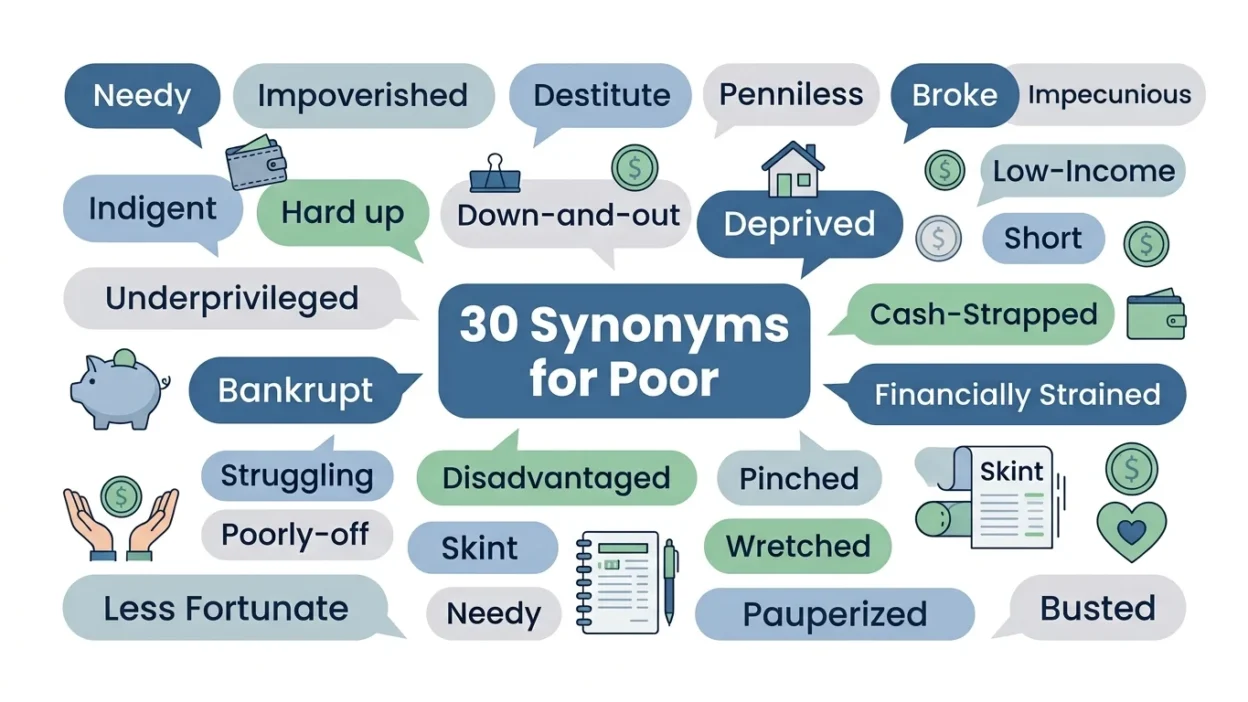
If you’re looking for the best synonyms for poor, you’ve come to the right place.
If you’re a student, ESL learner, writer, or content creator, learning different words for poor can help you communicate more clearly and avoid repeating the same word.
The word poor usually describes someone who has little money or lacks the resources needed for a comfortable life.
However, English has many other words that express different levels of poverty, financial hardship, or lack of quality.
Some synonyms are formal, some are informal, and others are better suited for creative writing or academic work.
In this guide, you’ll learn 30 synonyms for poor, along with their simple meanings, example sentences, and the best situations to use each one. By understanding these words, you’ll improve your vocabulary and choose the right word for every situation.
What Does “Poor” Mean?
Meaning of Poor
The word poor generally means having very little money, few possessions, or limited resources. It can describe people, families, communities, or even countries.
However, poor is not always about money. It can also describe something of low quality, weak performance, or an unsatisfactory condition.
For example:
- The family was poor but happy.
- He gave a poor performance during the interview.
- The village has poor healthcare facilities.
- They live in a poor neighborhood.
Choosing the right synonym helps your writing sound more natural, accurate, and interesting.
30 Synonyms for Poor
1. Needy
Meaning: Lacking enough money or basic necessities.
Example Sentence:
The charity provides food for needy families.
Best Usage Context:
Charities, social programs, and formal writing.
2. Impoverished
Meaning: Extremely poor and lacking resources.
Example Sentence:
Many impoverished communities need better schools.
Best Usage Context:
Academic writing, reports, and news articles.
3. Destitute
Meaning: Having no money, home, or possessions.
Example Sentence:
The flood left many families destitute.
Best Usage Context:
Serious situations and formal writing.
4. Penniless
Meaning: Having no money at all.
Example Sentence:
After losing his job, he was penniless.
Best Usage Context:
Stories, biographies, and everyday English.
5. Broke
Meaning: Having little or no money at the moment.
Example Sentence:
I’m broke until payday.
Best Usage Context:
Casual conversations and informal writing.
6. Indigent
Meaning: Extremely poor and in need of help.
Example Sentence:
The hospital offers free treatment for indigent patients.
Best Usage Context:
Legal, medical, and government writing.
7. Hard Up
Meaning: Having financial difficulties.
Example Sentence:
They’re a little hard up this month.
Best Usage Context:
Informal conversations.
8. Underprivileged
Meaning: Lacking opportunities because of poverty.
Example Sentence:
She volunteers to help underprivileged children.
Best Usage Context:
Education, charities, and social discussions.
9. Disadvantaged
Meaning: Having fewer opportunities because of financial or social conditions.
Example Sentence:
The program supports disadvantaged students.
Best Usage Context:
Education and public policy.
10. Low-Income
Meaning: Earning a small amount of money.
Example Sentence:
The government provides assistance to low-income families.
Best Usage Context:
Official documents and financial discussions.
11. Struggling
Meaning: Finding it difficult to earn enough money.
Example Sentence:
Many small businesses are struggling this year.
Best Usage Context:
Everyday English and business writing.
12. Insolvent
Meaning: Unable to pay debts.
Example Sentence:
The company became insolvent after years of losses.
Best Usage Context:
Business, law, and finance.
13. Bankrupt
Meaning: Legally unable to pay debts.
Example Sentence:
The retailer filed for bankruptcy after becoming bankrupt.
Best Usage Context:
Finance and legal writing.
14. Deprived
Meaning: Lacking basic needs or opportunities.
Example Sentence:
Many deprived areas need better public services.
Best Usage Context:
Social issues and community discussions.
15. Less Fortunate
Meaning: Having fewer financial resources than others.
Example Sentence:
She regularly donates to help the less fortunate.
Best Usage Context:
Respectful and polite writing about poverty.
16. Poverty-Stricken
Meaning: Severely affected by poverty.
Example Sentence:
Many poverty-stricken villages lack clean drinking water.
Best Usage Context:
News reports, charities, and humanitarian writing.
17. Cash-Strapped
Meaning: Having very little money available to spend.
Example Sentence:
The small business is cash-strapped after a slow season.
Best Usage Context:
Business, finance, and everyday conversations.
18. Financially Strained
Meaning: Experiencing money-related difficulties.
Example Sentence:
Many families are financially strained because of rising living costs.
Best Usage Context:
Personal finance, news, and formal writing.
19. Down-and-Out
Meaning: Having no money, job, or home.
Example Sentence:
The shelter provides meals for down-and-out individuals.
Best Usage Context:
Storytelling, journalism, and informal writing.
20. In Need
Meaning: Requiring financial or practical help.
Example Sentence:
The community organized a fundraiser for families in need.
Best Usage Context:
Charities, nonprofits, and community support.
21. Barely Getting By
Meaning: Having just enough money to survive.
Example Sentence:
After paying the bills, they were barely getting by.
Best Usage Context:
Informal conversations and personal stories.
22. Economically Disadvantaged
Meaning: Having limited financial resources.
Example Sentence:
The scholarship is available to economically disadvantaged students.
Best Usage Context:
Education, government programs, and research.
23. Depleted
Meaning: Having very limited financial or material resources.
Example Sentence:
After months without work, their savings were depleted.
Best Usage Context:
Finance, reports, and general writing.
24. Modest
Meaning: Having a simple income or lifestyle, not wealthy.
Example Sentence:
They live a modest life in a small town.
Best Usage Context:
Polite descriptions of income or lifestyle.
25. Frugal
Meaning: Careful with spending money.
Example Sentence:
She is frugal and always looks for discounts.
Best Usage Context:
Personal finance and lifestyle discussions.
26. Threadbare
Meaning: Extremely poor or worn out due to lack of money.
Example Sentence:
The family lived in a threadbare apartment.
Best Usage Context:
Creative writing and literature.
27. Beggared
Meaning: Reduced to poverty.
Example Sentence:
The long drought beggared many farming families.
Best Usage Context:
Historical writing and literature.
28. Unfortunate
Meaning: Experiencing difficult financial circumstances.
Example Sentence:
The organization supports unfortunate families in rural areas.
Best Usage Context:
Respectful discussions about hardship.
29. Without Means
Meaning: Lacking sufficient money or financial resources.
Example Sentence:
Many people without means depend on community support.
Best Usage Context:
Formal writing and social services.
30. Financially Challenged
Meaning: Facing financial difficulties.
Example Sentence:
The program offers assistance to financially challenged households.
Best Usage Context:
Professional, respectful, and educational writing.
Synonyms for Poor Comparison Table
When Should You Use Each Word?
| Synonym | Meaning | Best Used For | Tone |
|---|---|---|---|
| Needy | Needs financial help | Charity and community work | Neutral |
| Impoverished | Extremely poor | Academic and formal writing | Formal |
| Destitute | Has almost nothing | Serious situations | Formal |
| Penniless | No money at all | Stories and conversations | Neutral |
| Broke | Temporarily has no money | Everyday speech | Informal |
| Underprivileged | Lacks opportunities | Education and charities | Respectful |
| Low-Income | Earns a small income | Government and finance | Professional |
| Cash-Strapped | Short of money | Business and daily life | Informal |
| Financially Strained | Facing money problems | News and finance | Neutral |
| Modest | Living simply | Lifestyle writing | Positive |
| Frugal | Careful with spending | Personal finance | Positive |
| Threadbare | Poor and worn-out | Literature | Descriptive |
How to Choose the Right Synonym
For Everyday Conversations
Use these words in casual speech:
- Broke
- Struggling
- Hard Up
- Cash-Strapped
- Barely Getting By
These sound natural and are commonly used in everyday English.
For Formal Writing
Choose these words for essays, reports, and professional documents:
- Impoverished
- Destitute
- Indigent
- Low-Income
- Economically Disadvantaged
- Without Means
These terms are more precise and suitable for formal contexts.
For Respectful Discussions
When talking about poverty with sensitivity, consider using:
- Needy
- Less Fortunate
- Underprivileged
- In Need
- Financially Challenged
- Disadvantaged
These expressions are more considerate and appropriate in educational or charitable settings.
For Creative Writing
If you’re writing stories or novels, these words add detail and emotion:
- Penniless
- Down-and-Out
- Threadbare
- Beggared
- Destitute
They help create vivid descriptions of difficult circumstances.
Common Mistakes When Using Synonyms for Poor
Don’t Treat Every Synonym as the Same
Although these words relate to poverty or limited resources, they have different meanings.
For example:
- Broke usually means temporarily having no money.
- Destitute describes extreme poverty.
- Low-Income is an official financial term.
- Frugal does not mean poor—it means careful with money.
- Underprivileged refers to limited opportunities, not just low income.
Choosing the correct synonym makes your writing clearer, more accurate, and more respectful.
Conclusion
Learning different synonyms for poor helps you communicate with greater precision and sensitivity.
While poor is the most common word, alternatives such as needy, impoverished, destitute, low-income, cash-strapped, and underprivileged each express different aspects of financial hardship.
If you’re writing an essay, improving your English vocabulary, creating blog content, or simply trying to avoid repetition, using the right synonym will make your writing more engaging and meaningful.
Continue practicing these words in different contexts to build a richer and more confident vocabulary.

Julian Luke is a passionate grammar and language writer at Synolexes. He simplifies complex grammar rules, vocabulary, and writing concepts, helping learners improve their English communication skills with confidence.