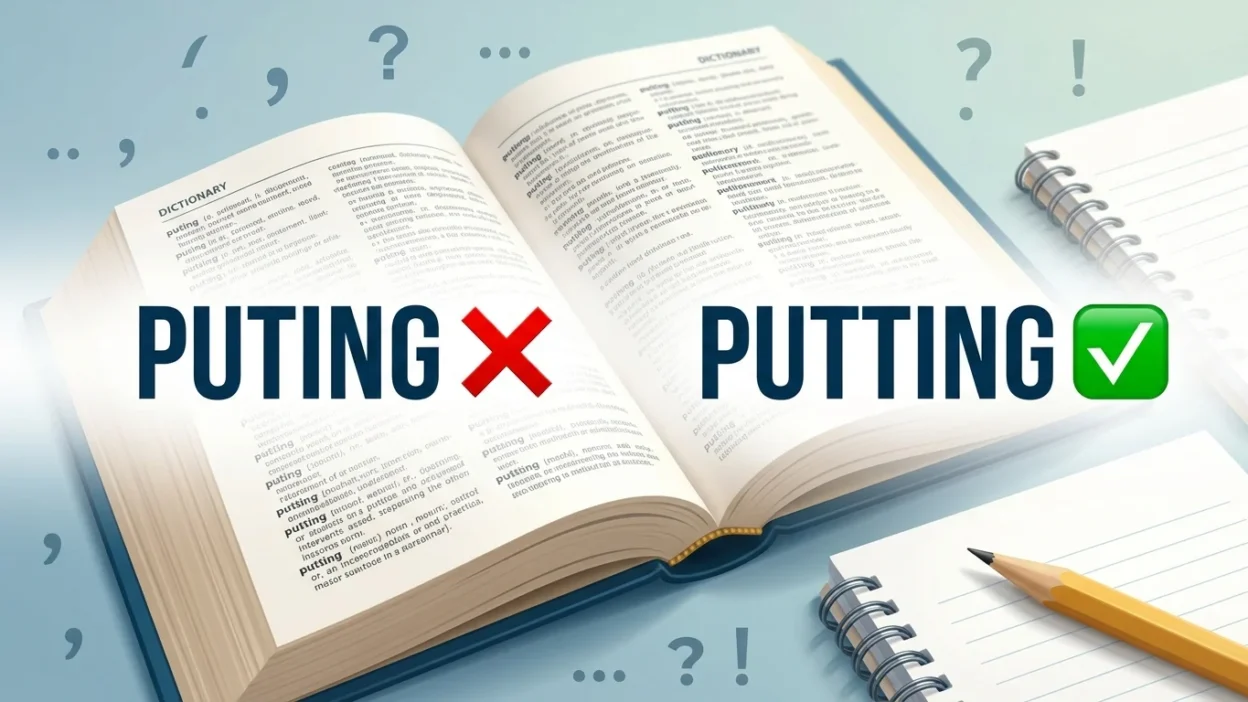
If you are confused about puting vs putting, the correct spelling in standard English is putting. The word puting is generally a spelling mistake. Putting is the present participle and gerund form of the verb put, and it means placing something somewhere or taking part in an action involving putting something in a particular position.
This spelling can be confusing because many English verbs form their -ing form by simply adding -ing. However, put is a short verb with a special spelling pattern. When -ing is added, the final t is doubled: put + ting = putting. Learning this pattern can help you avoid a common spelling error in schoolwork, emails, essays, messages, and everyday writing.
Quick Answer: Puting vs Putting
Putting is the correct spelling. Puting is incorrect in standard English. Putting is the -ing form of the verb put, meaning to place, position, or move something somewhere. The final t is doubled before adding -ing, giving us putting, not puting.
Why Do People Confuse Puting and Putting?
The confusion comes from the way English verbs form their present participles.
For many verbs, you simply add -ing:
- play → playing
- work → working
- help → helping
- clean → cleaning
This can make put + ing = puting seem logical.
However, put follows a doubling pattern. Because the verb is a short, one-syllable word ending in a consonant, the final consonant is doubled before -ing.
So:
put + ing → putting
The same general spelling pattern appears in words such as:
- run → running
- sit → sitting
- stop → stopping
- get → getting
- plan → planning
Therefore, putting is the correct spelling.
First Word: Puting
What does puting mean?
Puting is not the standard spelling of the English word.
When someone writes puting, they usually mean putting but have accidentally left out one of the two t letters.
For example:
Incorrect: I am puting the book on the table.
Correct: I am putting the book on the table.
The missing t makes puting an incorrect spelling in standard English.
Why is puting incorrect?
The verb put keeps its final t and doubles it when forming putting.
The correct formation is:
put + ing = putting
Not:
put + ing = puting
Second Word: Putting
What does putting mean?
Putting is the present participle and gerund form of put.
The verb put has several related meanings, but its basic meaning is to move or place something in a particular position.
Examples include:
- putting a book on a desk
- putting clothes in a bag
- putting food on a plate
- putting a key in a drawer
- putting a child to bed
Putting can also be used in many expressions.
For example:
She is putting her phone on the table.
He is putting his shoes away.
They are putting the chairs outside.
Putting in grammar
Putting is commonly used with forms of be to create the present continuous tense:
- I am putting
- You are putting
- He is putting
- She is putting
- We are putting
- They are putting
It can also function as a gerund:
Putting things away keeps the room tidy.
Here, putting acts like a noun.
Puting vs Putting: Comparison Table
| Feature | Puting | Putting |
|---|---|---|
| Standard spelling | No | Yes |
| Meaning | Usually intended to mean putting | Placing or positioning something |
| Grammar | Incorrect spelling | Present participle / gerund |
| Correct form of put + -ing | No | Yes |
| Example | I am puting the book. | I am putting the book away. |
| Recommended in writing | No | Yes |
When Should You Use Each Word?
When to use putting
Use putting whenever you need the -ing form of the verb put.
It can describe an action happening now:
She is putting the groceries away.
It can also describe an activity in general:
Putting your ideas into writing takes practice.
It may appear in many common expressions:
- putting something away
- putting something down
- putting something on
- putting something off
- putting something together
- putting something aside
- putting something back
- putting something in place
When to use puting
In standard English, you should not use puting.
If you see it in informal writing, it is usually a spelling error for putting.
10+ Examples of Putting
1. Putting a book away
She is putting the book back on the shelf.
Putting means placing the book somewhere.
2. Putting something on
He is putting on his jacket before leaving.
Here, putting is part of the phrasal verb put on.
3. Putting something down
Please stop putting your bag on the floor.
The phrase put down means to place something somewhere.
4. Putting food away
I am putting the leftover food in the refrigerator.
The action involves placing the food in a particular location.
5. Putting clothes in a suitcase
She is putting her clothes into the suitcase.
Putting describes the action of placing the clothes inside.
6. Putting a key in a drawer
He is putting the keys in the drawer.
The keys are being placed in a particular position.
7. Putting an idea into words
She is putting her thoughts into words.
Here, putting has a more abstract meaning.
8. Putting things together
We are putting the furniture together.
The phrase put together can mean assembling separate parts.
9. Putting something aside
I am putting some money aside for the future.
Putting aside can mean saving or reserving something.
10. Putting something off
They keep putting off the meeting.
Putting off means delaying something.
11. Putting a plan into action
The team is putting its new plan into action.
This means beginning to use or carry out the plan.
12. Putting someone to bed
The mother is putting the baby to bed.
This means helping the baby get ready to sleep.
Common Mistakes With Puting and Putting
Mistake 1: Writing puting
Incorrect:
I am puting my shoes away.
Correct:
I am putting my shoes away.
Always use two t letters in putting.
Mistake 2: Assuming every verb only needs -ing
English spelling rules have exceptions and patterns.
Although we write:
help → helping
we write:
put → putting
The final consonant is doubled.
Mistake 3: Confusing putting with put
Put is the base form.
Putting is the -ing form.
Examples:
Please put the book here.
She is putting the book here.
Mistake 4: Forgetting the second t
The most common problem is simply missing the second t.
Remember:
putting
not:
puting
Mistake 5: Confusing putting with putting something
Putting normally needs an object when it means placing something.
For example:
She is putting the cup on the table.
The object is the cup.
However, the word can also appear in expressions where the meaning is more abstract:
Putting things clearly is important.
A Simple Memory Trick
Use this easy rule:
Put has one t, but putting has two ts.
Think of it visually:
PUT → PUTTING
The final t gets doubled before -ing.
You can remember the same pattern with:
- sit → sitting
- run → running
- stop → stopping
- get → getting
- put → putting
So whenever you write the -ing form of put, remember the double t.
American vs British English
There is no meaningful spelling difference between American and British English for this word.
Both varieties use:
putting
The spelling puting is not the standard form in either variety.
For example, both American and British English use:
She is putting her bag on the chair.
The same spelling applies in formal writing, education, journalism, business communication, and everyday English.
Similar Words to Putting
Depending on the context, several words can have meanings related to putting.
Placing
Placing means putting something in a particular position.
She is placing the flowers on the table.
Setting
Setting can mean putting something in a particular position.
He is setting the glass on the counter.
Positioning
Positioning means putting something in a specific location or arrangement.
The worker is positioning the equipment carefully.
Moving
Moving can describe changing the location of something.
They are moving the chairs outside.
Inserting
Inserting means putting something into another thing.
She is inserting the card into the machine.
Adding
Adding means putting something together with something else.
He is adding sugar to the tea.
Arranging
Arranging means putting things into an organized order or position.
She is arranging the books by size.
These words are related to putting, but they are not always interchangeable. The best choice depends on the exact meaning.
Final Verdict: Puting or Putting?
Putting is the correct spelling.
Puting is an incorrect spelling in standard English and should normally be avoided.
The reason is simple: when the verb put takes the -ing ending, its final t is doubled.
Put + ing = putting
This rule is especially useful for students and English learners because putting is a very common word.
If you are writing an essay, email, message, report, or assignment, always choose putting.
FAQs
Is puting a correct spelling?
No. Puting is not the standard spelling. The correct spelling is putting, with two t letters.
Why does putting have two t’s?
The final t in the short verb put is doubled when -ing is added. Therefore, put + ing becomes putting.
What is the correct form of put with ing?
The correct form is putting.
Example:
She is putting the books on the shelf.
Is putting a verb?
Yes. Putting is the present participle of the verb put. It can also function as a gerund when it acts like a noun.
What is the difference between put and putting?
Put is the base form of the verb, while putting is its -ing form.
Example:
Put the keys on the table.
She is putting the keys on the table.
Is putting spelled the same in American and British English?
Yes. Both American and British English use putting. The spelling puting is not the standard form in either variety.
How can I remember the spelling of putting?
Remember this simple rule: put has one t, but putting has two ts. Think of it as PUT → PUTTING.
Remember This
- Putting is correct.
- Puting is incorrect in standard English.
- Putting is the -ing form of put.
- The final t is doubled before -ing.
- Put → putting
- Use putting in academic, professional, and everyday writing.
- The spelling is the same in American and British English.
Conclusion
The difference between puting vs putting is straightforward once you remember the spelling pattern. Putting is the correct form of the verb put when -ing is added. The extra t is important, so writing puting is considered a spelling error in standard English.
For students, beginners, and ESL learners, the easiest way to remember the word is to connect put with putting. Whenever you describe the action of placing, positioning, or moving something into a particular position using the -ing form, write putting with two t letters.

Julian Luke is a passionate grammar and language writer at Synolexes. He simplifies complex grammar rules, vocabulary, and writing concepts, helping learners improve their English communication skills with confidence.