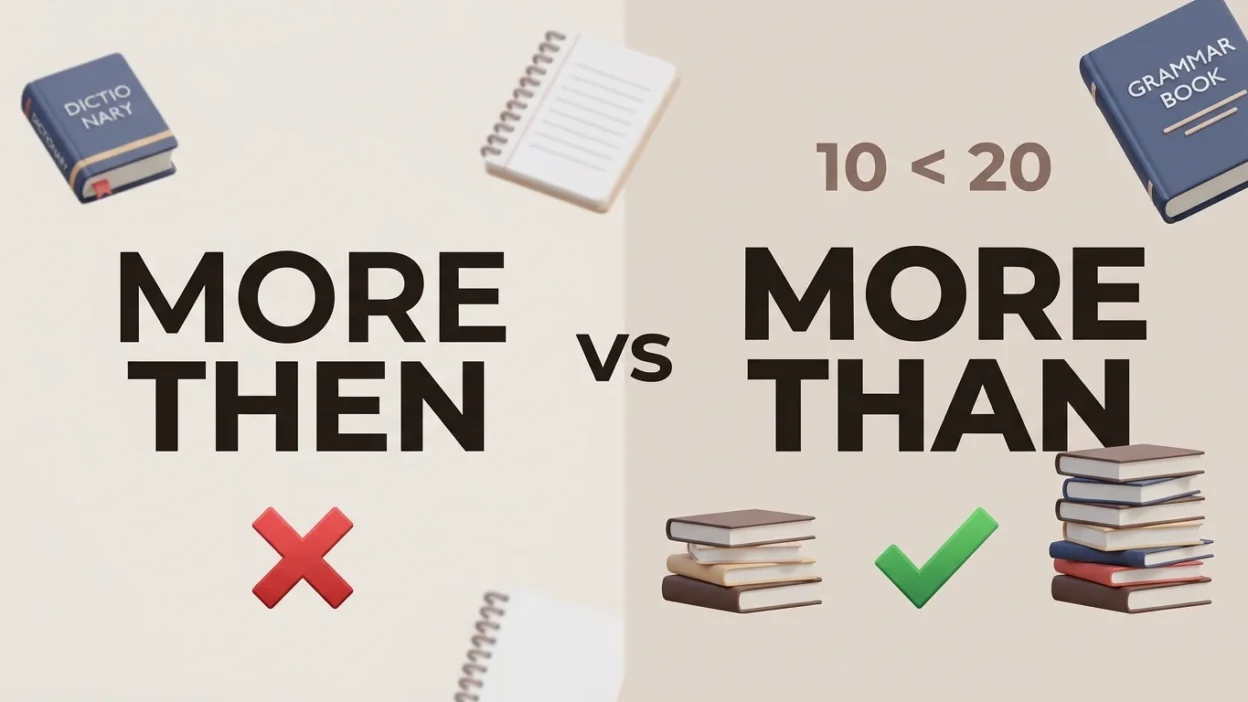
More then and more than look and sound similar, but they have completely different meanings and grammatical roles. If you are unsure whether to write more then or more than, the correct choice depends on what you are trying to say. In comparisons involving quantity, number, age, price, time, or degree, more than is the correct phrase. More then is usually a spelling or usage mistake.
The confusion happens because then and than are both common English words with similar pronunciation in some accents. However, they are not interchangeable. Than is mainly used for comparisons, while then usually relates to time, sequence, or a result. Learning this simple difference can help you avoid a very common writing mistake in emails, school assignments, articles, and everyday messages.
Quick Answer
More than is correct when making a comparison or saying something exceeds an amount, number, degree, or limit. More then is normally incorrect in this meaning. Use then for time, sequence, or consequence, not for comparisons.
Why Do People Confuse More Then and More Than?
The main reason people confuse these expressions is that then and than are pronounced similarly in many varieties of English.
There is also a spelling pattern that makes the mistake easy to overlook when typing quickly.
Remember that the two words perform different jobs:
- Than = comparison
- Then = time, sequence, or result
For example:
- She has more than five books.
- Finish your homework, then watch television.
The first sentence compares or measures quantity. The second describes what happens next.
What Does More Than Mean?
More than means a quantity, number, amount, degree, or level that is greater than something else.
It is commonly used with:
- Numbers
- Amounts
- Ages
- Measurements
- Time
- Comparisons
- Degrees
- Quantities
Examples:
- More than 100 people attended.
- He is more than six feet tall.
- The project took more than two weeks.
- This phone costs more than mine.
In all these examples, than introduces a comparison or greater amount.
More Than in Comparisons
More than is especially common when comparing two things.
- Sarah earns more than Tom.
- This road is more than five miles long.
- I like this book more than the other one.
- The new model is more expensive than the old one.
What Does More Then Mean?
More then is generally incorrect when you want to express a comparison or greater amount.
For example:
- Incorrect: I have more then ten dollars.
- Correct: I have more than ten dollars.
However, then is a legitimate English word. It simply does not normally belong after more when you are making a comparison.
Then can mean:
- At that time
- Next
- After that
- In that case
Examples:
- I lived there then.
- First, read the instructions, then begin.
- If you agree, then we can continue.
So, the problem is not that then is an incorrect word. The problem is using it where than is required.
First Word: More
The word more indicates a greater quantity, amount, degree, or extent.
Examples:
- more money
- more time
- more students
- more information
- more difficult
- more carefully
More can be followed by than when you are comparing two things or stating that something exceeds a particular amount.
Examples:
- I need more than five minutes.
- This bag weighs more than ten kilograms.
- She is more than ready.
Second Word: Then
Then is mainly associated with time, order, sequence, or consequence.
Examples:
- We went home then.
- First, eat dinner; then do your homework.
- If that is true, then we need another plan.
A useful question to ask is:
Am I talking about a comparison or about what happens next?
If it is a comparison, use than.
If it is about time or sequence, use then.
More Then vs More Than: Comparison Table
| Phrase | Correct? | Main Meaning | Example |
|---|---|---|---|
| More than | Yes | Greater quantity or comparison | I have more than ten books. |
| More then | Usually no | Incorrect substitute for than | I have more then ten books. |
| Then | Yes | Time or sequence | Eat first, then leave. |
| Than | Yes | Comparison | She is taller than me. |
When Should You Use More Than?
Use more than whenever you mean greater than or in excess of.
1. For quantities
- We need more than 20 chairs.
- More than 500 students participated.
2. For numbers
- The video has more than one million views.
- More than ten people called.
3. For measurements
- The wall is more than three meters high.
- The journey is more than 50 kilometers.
4. For time
- I waited for more than an hour.
- The meeting lasted more than two hours.
5. For age
- The building is more than 100 years old.
- He has been working there for more than ten years.
6. For comparisons
- She knows more than I do.
- This book costs more than that one.
7. For degree or extent
More than can also express a degree that goes beyond an expected level.
- She was more than happy to help.
- The result was more than we expected.
- His explanation was more than enough.
10+ Examples of More Than
Here are practical examples to make the difference easier to remember:
- I have more than ten dollars in my wallet.
- She has lived here for more than five years.
- The class has more than thirty students.
- This box weighs more than ten kilograms.
- He is more than six feet tall.
- We need more than one day to finish the work.
- The company has more than 500 employees.
- This book contains more than 300 pages.
- The journey took more than three hours.
- She received more than twenty applications.
- The problem is more than we expected.
- I would like more than one explanation.
- This phone costs more than my old phone.
- He has more than enough experience for the job.
Common Mistakes
Mistake 1: Using Then for a Comparison
Incorrect:
- She has more then five years of experience.
Correct:
- She has more than five years of experience.
Mistake 2: Confusing Then With Than
Incorrect:
- This costs more then that one.
Correct:
- This costs more than that one.
The sentence compares two prices, so than is required.
Mistake 3: Thinking They Are Interchangeable
They are not interchangeable.
Compare:
- I am older than my brother.
- I was younger then.
The first sentence makes a comparison. The second refers to a previous time.
Mistake 4: Relying Only on Pronunciation
In some accents, than and then can sound very similar.
When writing, focus on the meaning rather than the sound.
Easy Memory Trick
Use this simple rule:
THAN = comparison
THEN = time or next
You can remember it with:
Than compares. Then continues.
For example:
- More than 50 people = greater than 50
- Eat first, then sleep = what happens next
Whenever you see more, less, fewer, greater, older, younger, taller, or another comparison, check whether than is needed.
American vs British English
There is no important American-versus-British spelling difference for more than.
Both American English and British English use:
- more than
- less than
- greater than
- older than
- taller than
The distinction between than and then is the same in both varieties of standard English.
The main issue is simply choosing the correct word based on meaning.
Similar Words and Related Expressions
Understanding related comparison words can make the rule easier to apply.
Less Than
Less than means a smaller amount or degree.
- The journey takes less than an hour.
Fewer Than
Fewer than is generally used with countable plural nouns.
- Fewer than 20 students attended.
Greater Than
Greater than indicates a larger amount, number, or value.
- The number is greater than 100.
Rather Than
Rather than means instead of.
- I would walk rather than drive.
Other Than
Other than means apart from or besides.
- I have no plans other than studying.
More and More
More and more means increasingly.
- The weather is becoming more and more unpredictable.
Final Verdict
If you are writing more then when you mean a greater quantity or comparison, change it to more than.
The simplest rule is:
More than = greater than
Then = time, sequence, or result
So:
- More than 20 students ✅
- More then 20 students ❌
When you are unsure, ask yourself whether you are comparing two things or saying something is greater than an amount. If yes, choose than.
FAQs
Is more then or more than correct?
More than is correct when you mean a greater amount, number, degree, or quantity. More then is normally a spelling or usage mistake in this context.
Is more then grammatically correct?
Not when then is being used as a replacement for than in a comparison. For example, more than ten is correct, while more then ten is incorrect.
What is the difference between then and than?
Than is mainly used for comparisons, while then refers to time, sequence, or consequence.
How do I remember than vs then?
Remember: than compares, then continues. If you are comparing quantities, ages, prices, sizes, or other things, use than.
Is more than used for numbers?
Yes. More than is commonly used before numbers to indicate a quantity greater than a stated number.
Example: More than 100 people attended.
Is more than correct in British English?
Yes. More than is standard in both British English and American English.
Can then ever come after more?
Then can appear near more in a sentence for other grammatical reasons, but more then is not the correct phrase when you mean a greater amount or comparison.
Is more than two hours correct?
Yes. More than two hours means a period exceeding two hours.
Remember This
- More than is the correct phrase for comparisons and greater amounts.
- Then is connected with time, order, or what happens next.
- More than 50 is correct.
- More then 50 is incorrect.
- Than and then are not interchangeable.
- American and British English follow the same basic distinction.
- Use meaning, not pronunciation, to choose the correct word.
Conclusion
The difference between more then and more than is simple once you understand the jobs of than and then. Use more than when you are talking about a greater number, amount, measurement, age, degree, or comparison. Use then when you are talking about time, sequence, or a consequence.
If you remember only one rule, remember this: than is for comparisons, while then is for time and sequence. Therefore, phrases such as more than ten people, more than an hour, and more than enough are correct. Avoid more then when you mean greater than, and your writing will immediately become more accurate.

Gabriel John is a language enthusiast and grammar writer at Synolexes. He creates clear, practical content on English grammar, vocabulary, and writing, helping learners improve communication skills with confidence.