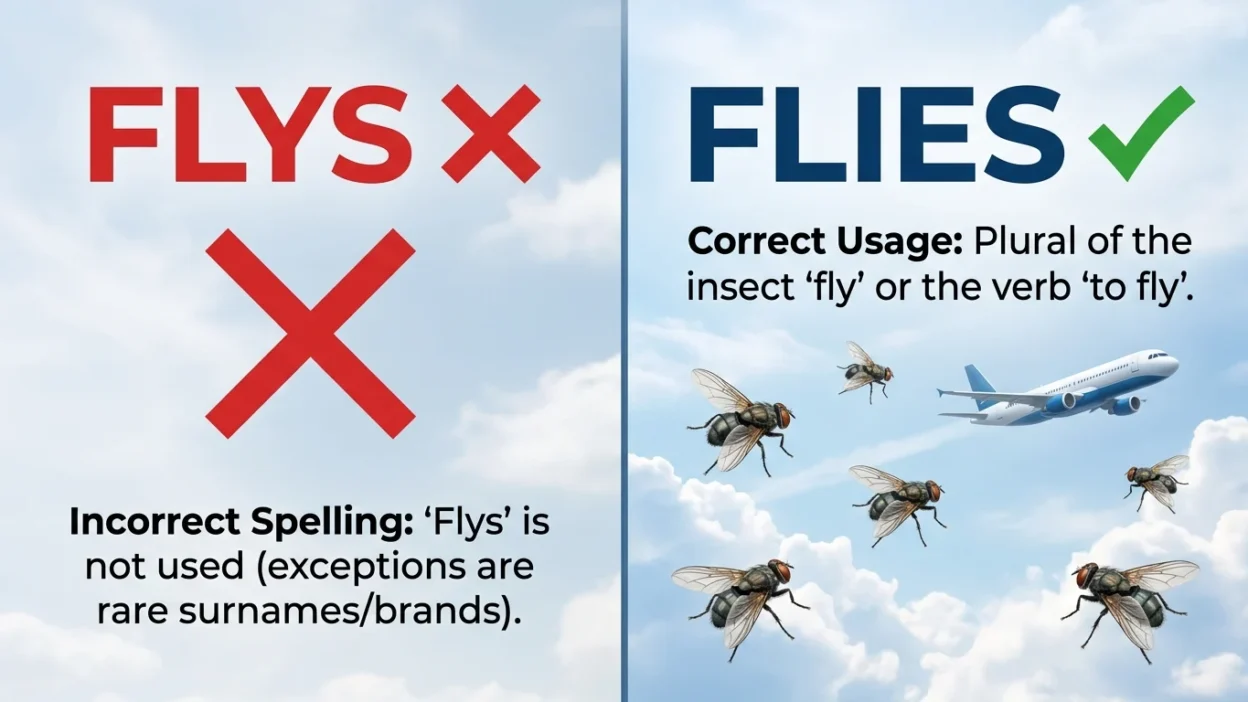
If you are confused about flys vs flies, the correct spelling depends on what you are trying to say. In standard modern English, flies is the correct plural of the noun fly, and it is also the third-person singular form of the verb fly. Flys is generally not the correct spelling in these common situations. However, flys can occasionally appear as a specialized or informal form, so context matters.
The word flies has several uses. It can refer to more than one flying insect, as in two flies, or it can describe someone or something moving through the air, as in she flies every week. It can also be the plural of fly in other meanings, such as theatrical equipment called flies. Learning when to use flies instead of flys will help you write more naturally and avoid a common spelling mistake.
Quick Answer
Flies is the standard spelling in normal English. Use flies as the plural of fly, as in three flies, and as the third-person singular verb, as in the bird flies. Flys is generally incorrect in standard English and should normally be avoided.
Why Do People Confuse Flys and Flies?
The confusion happens because English has several nouns and verbs ending in y, and their plural or verb forms do not always follow the same pattern.
For many words ending in a consonant + y, the y changes to i before -es:
- fly → flies
- baby → babies
- city → cities
- story → stories
- party → parties
This makes flies the expected standard form.
Another source of confusion is the pronunciation. Flys and flies may look different in writing, but people can easily overlook the spelling difference when speaking.
The safest rule is:
fly → flies
not:
fly → flys
First Word: Flys
Flys is generally not the standard spelling you should use when forming the plural of fly or the third-person singular form of the verb fly.
Is Flys a Correct Word?
In ordinary modern English, flys is generally considered incorrect when you mean:
- more than one fly
- he/she/it flies
- something moves through the air
For example:
- There are many flys in the kitchen. ❌
- There are many flies in the kitchen. ✅
And:
- The bird flys across the sky. ❌
- The bird flies across the sky. ✅
There are rare specialized uses of flys, particularly in technical or trade contexts, but these are not the normal uses English learners need to know.
Why Does Flys Look Correct?
The spelling flys may seem logical because some nouns simply add -s to form their plural:
- book → books
- car → cars
- chair → chairs
However, fly follows a different spelling pattern because it ends in a consonant followed by y.
Second Word: Flies
Flies is the standard spelling in the common situations where people confuse it with flys.
What Does Flies Mean?
Flies can have several grammatical uses.
Flies as a Plural Noun
Flies is the plural of fly, the insect.
Example:
There are several flies near the window.
Here:
one fly → two flies
Flies as a Verb
Flies is also the third-person singular present form of fly.
Examples:
- The bird flies over the trees.
- She flies to London tomorrow.
- The airplane flies at a high altitude.
Here, flies means moves through the air or travels by air.
Flies in Other Contexts
The noun fly has several meanings, and flies can be the plural form in those contexts too.
For example, in theater terminology, the flies refers to the space above the stage where scenery, lighting equipment, and other theatrical equipment may be stored or operated.
Flys vs Flies Comparison Table
| Word | Standard? | Main Use | Example |
|---|---|---|---|
| Flys | ❌ Generally incorrect | Usually a misspelling of flies | The bird flys away. |
| Flies | ✅ Yes | Plural of fly or third-person singular of fly | The bird flies away. |
The simple rule is:
Fly → flies
When Should You Use Each?
When to Use Flies
Use flies when:
- talking about more than one insect
- describing a person or animal that flies
- describing an aircraft that flies
- using the third-person singular form of the verb fly
Examples:
- The flies are annoying.
- The bird flies south.
- He flies to Dubai tomorrow.
- The plane flies every morning.
When to Use Flys
For ordinary modern English, do not use flys as the plural or verb form.
If you encounter flys in a specialized technical context, it may have a particular industry-specific meaning. That specialized use should not be confused with the standard grammatical forms of fly.
12 Examples of Flies in Sentences
- The bird flies high above the mountains.
- Several flies were sitting near the window.
- My brother flies to Karachi every month.
- The airplane flies over the city.
- Please close the door because flies are getting inside.
- A butterfly flies from flower to flower.
- The pilot flies the aircraft carefully.
- There were too many flies around the food.
- The eagle flies across the valley.
- He flies home every Friday.
- Two small flies landed on the table.
- The kite flies well when the wind is strong.
Incorrect and Correct Examples
- The bird flys very high. ❌
- The bird flies very high. ✅
- There are three flys in the room. ❌
- There are three flies in the room. ✅
- She flys to Paris next week. ❌
- She flies to Paris next week. ✅
Common Mistakes With Flys and Flies
Mistake 1: Adding Only S
Some writers assume:
fly + s = flys
But the correct spelling changes y to i and adds -es:
fly → flies
Mistake 2: Confusing Plural and Verb Forms
Both common uses produce flies:
- one fly → two flies
- I fly → he flies
So flies can be both a plural noun and a verb form.
Mistake 3: Using Flys for an Animal or Aircraft
Incorrect:
The plane flys over the city.
Correct:
The plane flies over the city.
Mistake 4: Forgetting the Y-to-I Change
For many words ending in consonant + y, the y changes to i before -es.
Examples:
- fly → flies
- try → tries
- cry → cries
- carry → carries
- study → studies
This pattern makes flies easier to remember.
Mistake 5: Confusing Flys With Words Ending in Vowel + Y
Not every word ending in y changes its spelling this way.
For example:
- boy → boys
- toy → toys
- day → days
- key → keys
The important difference is that fly ends in a consonant + y, while boy ends in a vowel + y.
Memory Trick: How to Remember Flies
Use this simple rule:
Consonant + Y → IES
Because fly ends in l + y, its plural becomes:
fly → flies
You can remember the phrase:
A fly becomes flies when there is more than one.
For the verb, remember:
He flies, she flies, it flies.
Not:
He flys.
A quick spelling pattern is:
fly → flies
try → tries
cry → cries
American vs British English
There is no meaningful American-versus-British spelling difference here.
Both American English and British English use flies as the standard form.
Examples in both varieties include:
- The bird flies south.
- There are flies in the kitchen.
- She flies to another country tomorrow.
Flys is not the normal standard spelling in either variety when used as the plural of fly or the third-person singular verb.
Similar Words to Fly and Flies
Several related words can help you understand the grammar and meaning.
Flying
Flying is the present participle or gerund form of fly.
Example:
The bird is flying over the lake.
Flew
Flew is the simple past tense of fly.
Example:
The airplane flew over the mountains yesterday.
Flown
Flown is the past participle of fly.
Example:
She has flown to several countries.
Fly
Fly is the base form of the verb and can also be a singular noun for the insect.
Examples:
- I can fly a plane.
- There is a fly on the wall.
Flight
A flight is a journey through the air, especially by airplane.
Example:
Our flight leaves at 8 a.m.
Airborne
Airborne means in the air or carried through the air.
Example:
The aircraft is now airborne.
Final Verdict: Flys or Flies?
For normal modern English, flies is the correct spelling.
Use flies when you mean more than one fly:
one fly → two flies
Use flies when fly is the third-person singular verb:
I fly → he flies
Flys is generally incorrect in these situations and should be avoided in standard writing.
The easiest rule to remember is:
fly + -es → flies
The y changes to i because fly ends in a consonant + y.
FAQs
Is it flys or flies?
Flies is the correct standard spelling in ordinary English. Flys is generally a misspelling when referring to multiple flies or the verb form.
Why does fly become flies?
Because fly ends in a consonant followed by y. When forming the plural or the third-person singular verb, the y changes to i and -es is added:
fly → flies
Is flies plural or singular?
Flies can be plural or singular depending on its grammatical role.
As a noun, it is plural:
There are two flies.
As a verb, it is third-person singular:
The bird flies.
Is flys ever correct?
Flys is not the standard form of the common noun or verb fly. Rare specialized uses may occur in particular industries or technical contexts, but ordinary writing should use flies.
What is the past tense of fly?
The simple past tense of fly is flew.
Example:
The bird flew across the river.
What is the past participle of fly?
The past participle is flown.
Example:
The bird has flown away.
What is the difference between fly and flies?
Fly can be the singular noun or base form of the verb. Flies can be the plural noun or the third-person singular present form of the verb.
Examples:
- one fly → two flies
- I fly → she flies
Remember This
- Flies is the standard spelling.
- Flys is generally incorrect in ordinary English.
- One insect → fly
- More than one → flies
- I fly → he/she/it flies
- Fly changes y to i before -es.
- Flew is the past tense.
- Flown is the past participle.
- American and British English both use flies.
- Remember: fly → flies.
Conclusion
The difference between flys vs flies is straightforward once you understand the spelling pattern. Flies is the correct standard form when you are talking about more than one fly or using fly as the third-person singular present-tense verb. For example, you can say there are several flies in the room, or the bird flies across the sky.
Flys is generally a spelling mistake in these everyday situations. The easiest way to remember the correct form is to apply the consonant + y rule: change y to i and add -es. This gives you fly → flies. If you remember that simple pattern, you can confidently choose flies in schoolwork, professional writing, and everyday English.

Gabriel John is a language enthusiast and grammar writer at Synolexes. He creates clear, practical content on English grammar, vocabulary, and writing, helping learners improve communication skills with confidence.