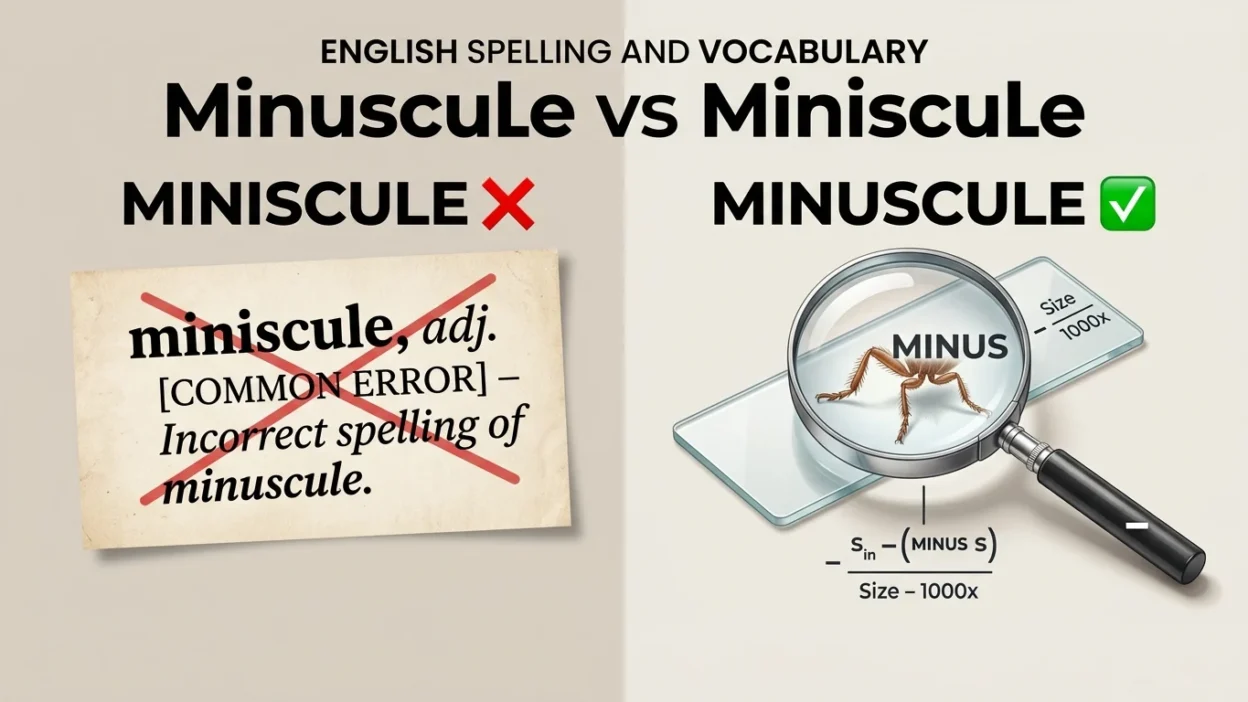
If you are unsure about minuscule vs miniscule, you are dealing with a very common English spelling confusion. The two words look almost identical, and both are pronounced similarly, so it is easy to accidentally use the wrong form. However, there is an important difference in standard usage.
Minuscule is the standard and preferred spelling. It means extremely small, tiny, or insignificant in size or importance. Miniscule is a common misspelling, although it is widely seen because people naturally associate the word with mini, meaning small. If you are writing an essay, report, article, email, or school assignment, minuscule is the spelling you should normally choose. Understanding where the word comes from and how it is used makes the spelling much easier to remember.
Quick Answer
Minuscule is the standard spelling. It means extremely small or tiny. Miniscule is a common misspelling caused by the influence of the word mini. Although miniscule appears frequently in informal writing, use minuscule in standard English, especially in academic, professional, and formal writing.
Why Do People Confuse Minuscule and Miniscule?
The main reason is the sound and appearance of the word.
When people hear minuscule, they may naturally connect it with mini, a familiar word meaning very small. This makes miniscule seem logical.
However, minuscule has a different historical origin. It is related to minus, the Latin word for less or smaller, rather than being formed from the modern English word mini.
The spelling can therefore be remembered as:
minuscule ✅
not:
miniscule ❌
Another reason for the confusion is that miniscule has become a frequent spelling in everyday writing. Seeing a misspelling repeatedly can make it look correct.
First Word: Minuscule
Minuscule is the standard spelling.
It is an adjective that means extremely small, tiny, or very insignificant in size.
What Does Minuscule Mean?
The most common meaning of minuscule is something that is extremely small.
For example:
- There was a minuscule amount of dust on the table.
- The insect was minuscule.
- She made only a minuscule error.
The word can describe physical size, quantity, degree, or importance.
Minuscule Can Mean More Than Physically Small
Although people often use minuscule for physical objects, it can also describe something that is very small in amount or significance.
Examples:
- a minuscule amount of money
- a minuscule difference
- a minuscule chance
- a minuscule improvement
- a minuscule detail
So, minuscule does not always mean something that you can physically see.
Second Word: Miniscule
Miniscule is generally considered a misspelling of minuscule in standard English.
It is easy to understand why people spell it this way because mini means small.
For example, someone might think:
mini + scule = miniscule
But that is not the standard spelling of the word.
Is Miniscule a Real Word?
You may find miniscule in dictionaries or usage discussions because it is a widespread variant or misspelling, but minuscule remains the standard preferred spelling in edited modern English.
For formal writing, academic work, professional communication, and careful English, choose minuscule.
Why Does Miniscule Look Correct?
The word mini is extremely common:
- miniature
- minibus
- miniskirt
- minicomputer
- minivan
Because these words are familiar, writers often assume miniscule follows the same pattern.
However, the correct spelling is minuscule.
Minuscule vs Miniscule Comparison Table
| Word | Standard Spelling? | Meaning | Recommended Use |
|---|---|---|---|
| Minuscule | ✅ Yes | Extremely small or insignificant | Use in standard, academic, and professional writing |
| Miniscule | ❌ Generally no | Usually intended to mean extremely small | Avoid in careful writing |
The simplest answer is:
Minuscule = correct
Miniscule = common misspelling
When Should You Use Each?
When to Use Minuscule
Use minuscule when you want to describe something that is extremely small in:
- size
- amount
- degree
- importance
- effect
- probability
Common phrases include:
- minuscule amount
- minuscule difference
- minuscule detail
- minuscule chance
- minuscule error
- minuscule quantity
- minuscule improvement
- minuscule particle
When to Use Miniscule
In standard writing, avoid miniscule and use minuscule instead.
If you are reproducing a historical source or discussing the spelling itself, you may encounter miniscule, but it should not normally be your spelling choice.
12 Examples of Minuscule in Sentences
- The scientist discovered a minuscule particle under the microscope.
- There was only a minuscule amount of sugar left in the container.
- The difference between the two measurements was minuscule.
- She noticed a minuscule crack in the glass.
- The insect was so minuscule that I could barely see it.
- He made a minuscule mistake in the final calculation.
- The company reported a minuscule increase in sales.
- There is only a minuscule chance of rain today.
- The improvement was minuscule, but it was still noticeable.
- A minuscule detail can sometimes change the meaning of a sentence.
- The machine can detect minuscule changes in temperature.
- The amount of paint needed for the repair was minuscule.
Incorrect and Correct Examples
- The difference was miniscule. ❌
- The difference was minuscule. ✅
- She found a miniscule crack. ❌
- She found a minuscule crack. ✅
- There was a miniscule amount of water. ❌
- There was a minuscule amount of water. ✅
Common Mistakes With Minuscule
Mistake 1: Adding the Mini Spelling
A common mistake is writing:
miniscule
because mini means small.
But the standard spelling is:
minuscule
Mistake 2: Forgetting the Second U
The correct word contains u after the n:
MINUSCULE
A useful way to look at it is:
minus + cule
You do not need to know the historical details to spell it correctly, but remembering the u can help.
Mistake 3: Thinking Minuscule Only Describes Objects
Minuscule can describe more than physical objects.
You can have:
- a minuscule amount
- a minuscule difference
- a minuscule chance
- a minuscule effect
- a minuscule error
Mistake 4: Confusing Minuscule With Minute
Minute can also mean extremely small when pronounced my-NOOT.
For example:
The scientist observed minute changes in temperature.
Both minute and minuscule can describe something very small, but they are separate words with different origins and pronunciations.
Memory Trick: How to Remember Minuscule
The easiest memory trick is to connect minuscule with minus.
Think:
MINUS → MINUSCULE
The spelling begins with:
MINUS…
So remember:
MINUS + CULE = MINUSCULE
Another simple trick is:
Minuscule has a U.
If you see miniscule, stop and remember that the standard spelling is minuscule.
You can also associate it with:
minus = less → minuscule = very small
American vs British English
Minuscule is the standard spelling in both American and British English.
There is no major American-versus-British spelling difference for this word.
You may encounter miniscule in writing from either variety of English because it is a common misspelling. However, careful and edited writing generally prefers minuscule.
So whether you are writing for an American or British audience, use:
Minuscule ✅
Similar Words to Minuscule
Several words have meanings similar to minuscule, but their exact meanings and tone can differ.
Tiny
Tiny means extremely small.
Example:
There was a tiny insect on the leaf.
Minute
Minute can mean extremely small or very slight when pronounced my-NOOT.
Example:
The device detected minute changes.
Microscopic
Microscopic describes something so small that it may require a microscope to see clearly.
Example:
The laboratory examined microscopic organisms.
Little
Little means small in size or amount.
Example:
There is very little water left.
Trivial
Trivial means unimportant or insignificant rather than physically small.
Example:
They argued over a trivial issue.
Negligible
Negligible means so small or unimportant that it has little practical effect.
Example:
The difference in cost was negligible.
Infinitesimal
Infinitesimal means extremely, almost unimaginably small.
Example:
The probability of the error was infinitesimal.
Final Verdict: Minuscule or Miniscule?
Minuscule is the standard and preferred spelling.
Use minuscule when you mean extremely small, tiny, very slight, or insignificant in size or amount.
Miniscule is a common misspelling caused partly by the familiar word mini. Although you may see it often, it is best avoided in formal and careful writing.
The easiest way to remember the correct spelling is:
MINUSCULE = MINUS + CULE
Think of minus as meaning less or smaller.
If you are writing an assignment, article, report, email, or professional document, choose minuscule.
FAQs
Is minuscule or miniscule correct?
Minuscule is the standard spelling. Miniscule is generally treated as a misspelling or nonstandard variant and should be avoided in careful writing.
Why is minuscule spelled with a u?
The word has historical roots connected with Latin minus, meaning less or smaller. It is not formed from the modern English word mini.
What does minuscule mean in simple English?
Minuscule means extremely small, tiny, or very slight.
Example:
There was a minuscule amount of dust on the surface.
Is miniscule ever acceptable?
You may encounter miniscule in informal writing and some dictionaries or usage references because it is widely used. However, minuscule is the standard spelling preferred for formal and careful modern English.
Is minuscule an adjective?
Yes. Minuscule is commonly used as an adjective to describe something extremely small.
Example:
The insect was minuscule.
What is the opposite of minuscule?
Depending on context, possible opposites include huge, enormous, massive, large, substantial, and significant.
For example:
A minuscule amount → a substantial amount.
What are synonyms for minuscule?
Common synonyms include tiny, minute, microscopic, little, infinitesimal, and negligible, depending on the context.
Remember This
- Minuscule is the standard spelling.
- Miniscule is generally a misspelling.
- Minuscule means extremely small or tiny.
- It can describe size, amount, degree, or significance.
- Think minus → minuscule.
- Remember the u in minuscule.
- American and British English both use minuscule.
- Use minuscule in formal, academic, and professional writing.
Conclusion
The difference between minuscule vs miniscule is mainly a spelling issue. Minuscule is the standard English word and means extremely small, tiny, or very slight. It can describe physical objects as well as amounts, differences, chances, effects, and other things that are very small or insignificant.
Miniscule is a common spelling mistake, probably influenced by the familiar word mini. Although you may see it frequently, minuscule is the better choice for standard English. The easiest memory trick is to connect the word with minus: minus → minuscule. When you need to describe something extremely small, choose minuscule.