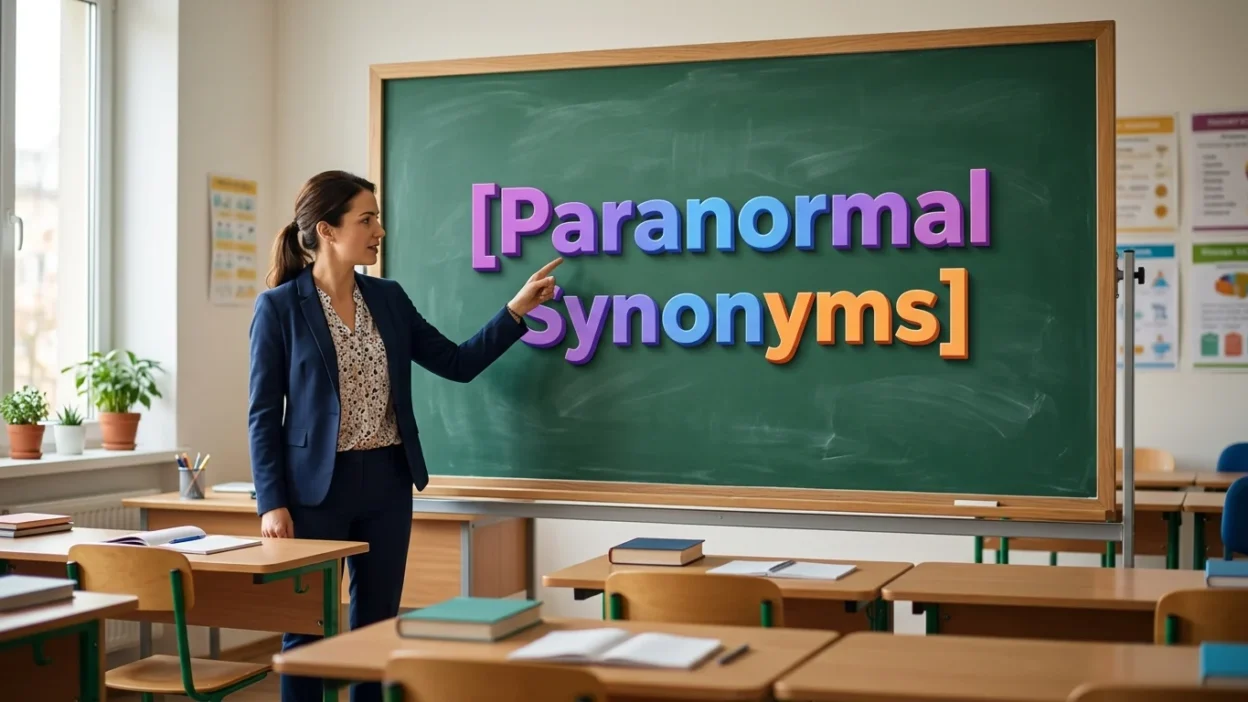
The word paranormal describes things, events, or experiences that seem to exist outside what science can normally explain. It is often connected with ghosts, unexplained sounds, strange visions, supernatural experiences, and unusual phenomena.
Learning paranormal synonyms can help students, ESL learners, writers, and content creators describe mysterious subjects with greater accuracy. While some alternatives suggest ghosts or spirits, others focus on strange, unexplained, supernatural, or seemingly impossible events.
The right word depends on the context. A horror story may need a dramatic expression such as supernatural or otherworldly, while an informative article may be better served by unexplained or mysterious.
What Does Paranormal Mean?
Paranormal means something that appears to be beyond normal scientific understanding or ordinary human experience.
It is commonly associated with subjects such as ghosts, psychic abilities, hauntings, strange phenomena, and unexplained events.
Tone
Mysterious, unusual, supernatural, and sometimes dramatic.
Common Usage
- Ghost stories
- Horror fiction
- Unexplained events
- Psychic experiences
- Mystery writing
- Supernatural discussions
- Folklore and legends
Example
The investigators reported several paranormal experiences inside the abandoned building.
30 Paranormal Synonyms and Related Words
1. Supernatural
Meaning: Connected with forces or events that seem beyond the laws of nature.
Example Sentence: The story describes a supernatural creature living in the forest.
Best Usage Context: Horror, fantasy, folklore, and general descriptions.
2. Unexplained
Meaning: Something that does not currently have a clear explanation.
Example Sentence: The researchers recorded several unexplained sounds during the investigation.
Best Usage Context: Neutral, scientific, journalistic, and mystery writing.
3. Mysterious
Meaning: Difficult to understand, explain, or identify.
Example Sentence: A mysterious light appeared over the lake late at night.
Best Usage Context: General writing, mysteries, stories, and journalism.
4. Otherworldly
Meaning: Seeming to come from another world or a reality beyond ordinary experience.
Example Sentence: The strange music created an otherworldly atmosphere.
Best Usage Context: Fiction, poetry, fantasy, and descriptive writing.
5. Unnatural
Meaning: Seeming to be different from what normally occurs in nature.
Example Sentence: The investigators noticed an unnatural silence in the room.
Best Usage Context: Horror, fiction, and dramatic descriptions.
6. Uncanny
Meaning: Strange or unsettling in a way that feels difficult to explain.
Example Sentence: There was something uncanny about the empty house.
Best Usage Context: Literature, horror, psychology, and descriptive writing.
7. Eerie
Meaning: Strange, frightening, and slightly disturbing.
Example Sentence: An eerie sound came from the basement.
Best Usage Context: Horror stories, descriptions, and suspense writing.
8. Ghostly
Meaning: Resembling or connected with ghosts.
Example Sentence: A ghostly figure appeared near the old church.
Best Usage Context: Horror, ghost stories, and fiction.
9. Spectral
Meaning: Related to or resembling a ghost or spirit.
Example Sentence: A spectral figure was seen moving through the hallway.
Best Usage Context: Literary, formal, and supernatural writing.
10. Uncanny
Meaning: Unusually strange or unsettling.
Example Sentence: The house had an uncanny atmosphere after sunset.
Best Usage Context: Horror, literature, and psychological descriptions.
11. Occult
Meaning: Related to hidden supernatural practices, powers, or beliefs.
Example Sentence: The novel explores several occult traditions.
Best Usage Context: History, fiction, religion-related discussions, and supernatural topics.
12. Mystical
Meaning: Connected with mysterious spiritual experiences or forces.
Example Sentence: The mountain was surrounded by mystical legends.
Best Usage Context: Spirituality, literature, fantasy, and folklore.
13. Esoteric
Meaning: Understood by only a small group with specialized knowledge.
Example Sentence: The book discusses esoteric beliefs about the nature of consciousness.
Best Usage Context: Academic, philosophical, spiritual, and specialized writing.
14. Supernormal
Meaning: Seeming to go beyond what is considered normal.
Example Sentence: The experiment investigated claims of supernormal abilities.
Best Usage Context: Paranormal research, psychology, and specialized discussions.
15. Uncanny Phenomenon
Meaning: An unusual event that creates a strange or unsettling feeling.
Example Sentence: The researchers described the event as an uncanny phenomenon.
Best Usage Context: Mystery writing, research discussions, and descriptive prose.
16. Preternatural
Meaning: Beyond what is considered normal or natural, but not necessarily connected to traditional supernatural beliefs.
Example Sentence: The character seemed to possess a preternatural ability to sense danger.
Best Usage Context: Literary, philosophical, fantasy, and formal writing.
17. Superhuman
Meaning: Beyond normal human abilities or strength.
Example Sentence: The hero appeared to have superhuman powers.
Best Usage Context: Fiction, comics, fantasy, and science fiction.
18. Metaphysical
Meaning: Related to ideas about existence, reality, consciousness, or things beyond the physical world.
Example Sentence: The novel raises several metaphysical questions about consciousness.
Best Usage Context: Philosophy, academic writing, spirituality, and literature.
19. Spiritual
Meaning: Related to the spirit, soul, or a non-physical aspect of human experience.
Example Sentence: She described the experience as deeply spiritual.
Best Usage Context: Religion, personal experiences, literature, and discussions of belief.
20. Mystifying
Meaning: Extremely difficult to understand or explain.
Example Sentence: The sudden disappearance remained a mystifying event.
Best Usage Context: Mystery writing, journalism, and general descriptions.
21. Enigmatic
Meaning: Mysterious and difficult to understand.
Example Sentence: The strange symbol had an enigmatic meaning.
Best Usage Context: Literature, journalism, academic writing, and mysteries.
22. Strange
Meaning: Unusual or different from what is expected.
Example Sentence: Strange noises came from the empty room.
Best Usage Context: Everyday English, casual writing, and general descriptions.
23. Bizarre
Meaning: Very unusual, strange, or difficult to believe.
Example Sentence: Witnesses reported a bizarre incident near the abandoned house.
Best Usage Context: Informal writing, journalism, mysteries, and storytelling.
24. Unusual
Meaning: Not common or normal.
Example Sentence: The team documented an unusual event during the investigation.
Best Usage Context: Neutral, academic, journalistic, and everyday writing.
25. Inexplicable
Meaning: Impossible or extremely difficult to explain.
Example Sentence: An inexplicable change occurred in the room overnight.
Best Usage Context: Formal writing, mysteries, journalism, and serious descriptions.
26. Unaccountable
Meaning: Difficult to explain or understand because there seems to be no clear cause.
Example Sentence: The investigators noticed several unaccountable changes in the building.
Best Usage Context: Formal, literary, and mystery writing.
27. Unworldly
Meaning: Seeming unlike anything normally experienced in the ordinary world.
Example Sentence: The creature had an unworldly appearance.
Best Usage Context: Fantasy, horror, poetry, and descriptive writing.
28. Haunting
Meaning: Strange, memorable, or frightening in a way that stays in the mind.
Example Sentence: The abandoned house had a haunting atmosphere.
Best Usage Context: Horror, literature, photography, and emotional descriptions.
29. Ghostly
Meaning: Resembling a ghost or suggesting the presence of one.
Example Sentence: A ghostly shadow moved across the wall.
Best Usage Context: Ghost stories, horror, and fictional descriptions.
30. Supernatural
Meaning: Connected with forces, beings, or events that appear to exist beyond the natural world.
Example Sentence: The movie follows a family facing a supernatural force.
Best Usage Context: Horror, fantasy, folklore, and entertainment writing.
Comparison Guide: When to Use Different Paranormal Synonyms
| Word | Best Used For | Tone |
|---|---|---|
| Paranormal | Unusual phenomena beyond ordinary explanation | Neutral |
| Supernatural | Forces or beings beyond nature | Dramatic |
| Unexplained | Events without a known explanation | Neutral |
| Mysterious | Difficult-to-understand events | Neutral |
| Otherworldly | Something seeming from another realm | Literary |
| Unnatural | Something that seems contrary to nature | Dramatic |
| Uncanny | Strange and unsettling experiences | Literary |
| Eerie | Frightening and strange atmosphere | Dramatic |
| Ghostly | Ghost-like appearances | Descriptive |
| Spectral | Ghosts, spirits, or ghost-like forms | Formal |
| Occult | Hidden supernatural practices or beliefs | Specialized |
| Mystical | Spiritual or mysterious experiences | Spiritual |
| Esoteric | Specialized or hidden knowledge | Academic |
| Preternatural | Abilities beyond ordinary limits | Literary |
| Superhuman | Extraordinary human abilities | Fictional |
| Metaphysical | Reality, existence, or consciousness | Academic |
| Inexplicable | Something extremely difficult to explain | Formal |
| Enigmatic | Mysterious and unclear | Literary |
| Bizarre | Very strange or unusual | Informal |
| Haunting | Unsettling or memorable atmosphere | Dramatic |
How to Choose the Right Paranormal Synonym
The best paranormal synonym depends on exactly what you want to describe.
For Ghosts and Spirits
Use ghostly, spectral, haunting, or supernatural.
These words are especially useful when describing apparitions, spirits, haunted houses, or ghost stories.
For Unexplained Events
Choose unexplained, inexplicable, unaccountable, or mysterious.
These terms are useful when you want to describe an event without claiming that it is definitely supernatural.
For Horror and Suspense
Use eerie, uncanny, unnatural, haunting, or bizarre.
These words create an unsettling mood and work well in horror stories and suspense writing.
For Spiritual or Mystical Topics
Choose mystical, spiritual, metaphysical, occult, or esoteric.
These terms are more specific and should be selected according to the exact subject.
For Fantasy and Fiction
Use supernatural, otherworldly, preternatural, superhuman, or unworldly.
These alternatives can make fictional descriptions more vivid and imaginative.
Paranormal vs Supernatural
Paranormal and supernatural are closely related, but they are not always interchangeable.
Paranormal usually refers to events or experiences that appear to be outside normal scientific explanation. It can include reported psychic experiences, unusual phenomena, or unexplained events.
Supernatural more strongly suggests forces, beings, or events that are beyond the laws of nature, such as ghosts, spirits, demons, or magical powers.
For example:
- The investigators studied an unexplained paranormal event.
- The horror film features a supernatural creature.
The first expression emphasizes something unusual and unexplained. The second directly suggests a non-natural force or being.
Common Mistakes When Using Paranormal Synonyms
Not every unusual word means exactly the same thing as paranormal.
- Strange simply means unusual and does not imply anything supernatural.
- Unexplained means there is no clear explanation, but it does not prove that the event is paranormal.
- Spiritual relates to the spirit or soul and may have religious meanings.
- Occult specifically refers to hidden or supernatural practices and beliefs.
- Metaphysical mainly concerns philosophical questions about reality and existence.
- Eerie describes a frightening atmosphere rather than a supernatural event itself.
- Ghostly specifically suggests a ghost or ghost-like appearance.
- Superhuman refers to abilities beyond ordinary human limits and does not necessarily involve paranormal forces.
Using the most precise word helps your writing remain clear and avoids suggesting something supernatural when you only mean unusual or unexplained.
Conclusion
Understanding paranormal synonyms gives you many ways to describe strange, mysterious, unexplained, and supernatural subjects. Words such as unexplained, mysterious, uncanny, and inexplicable are useful when you want to describe unusual events without making a definite supernatural claim.
For ghost stories and horror writing, ghostly, spectral, eerie, haunting, and supernatural can create a stronger atmosphere. For philosophical or spiritual subjects, words such as metaphysical, mystical, and esoteric may be more appropriate.
The most important point is to choose a synonym according to its exact meaning and tone. This makes your vocabulary more precise and helps your writing sound natural, engaging, and appropriate for its audience.
FAQs
What is another word for paranormal?
Common alternatives include supernatural, unexplained, mysterious, uncanny, otherworldly, and inexplicable.
What is a simple synonym for paranormal?
Unexplained is one of the simplest alternatives when you are describing an event that does not have a clear explanation.
Is supernatural the same as paranormal?
They are closely related, but supernatural usually directly suggests forces or beings beyond nature, while paranormal can describe unusual phenomena that are simply outside ordinary explanation.
What is a synonym for paranormal activity?
Possible alternatives include supernatural activity, unexplained activity, mysterious activity, and occult activity, depending on the specific situation.
What is the opposite of paranormal?
Depending on the context, possible opposites include normal, ordinary, natural, explainable, and scientifically understood.

Gabriel John is a language enthusiast and grammar writer at Synolexes. He creates clear, practical content on English grammar, vocabulary, and writing, helping learners improve communication skills with confidence.