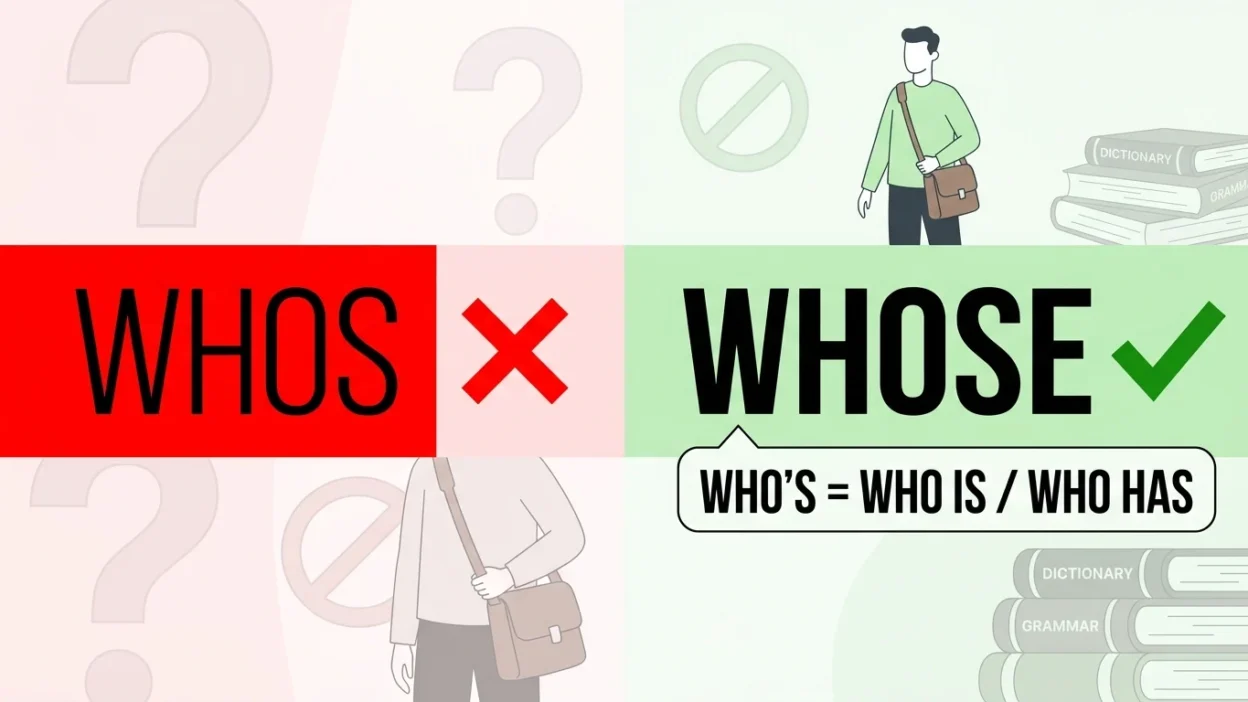
If you are wondering whether whos or whose is correct, the answer depends on what you mean. In standard English, whose is the correct word when you are asking about or describing possession or ownership. Whos is not normally a standard English word. The confusion often happens because whose sounds very similar to who’s, which is a contraction of who is or who has.
Understanding the difference between whose, who’s, and the incorrect form whos can make your writing much clearer. These words are especially easy to confuse because English uses apostrophes for contractions, while possessive words do not always follow the same pattern. Once you learn what each form means, choosing the right spelling becomes much easier.
Quick Answer
Whose is the correct word for possession or ownership. Who’s means who is or who has. Whos without an apostrophe is generally incorrect in standard English. Remember: whose = possession, while who’s = who is or who has.
Why Do People Confuse Whos and Whose?
The main confusion comes from pronunciation.
Whose and who’s are normally pronounced the same, even though they have different meanings and grammatical functions.
The form whos is usually created by accidentally leaving out the e from whose or the apostrophe from who’s.
Compare:
- Whose book is this?
- Who’s coming to the party?
- Whos coming to the party? ❌
The first asks about ownership. The second is a contraction of who is.
First Word: Whose
Whose is used to ask or state who something belongs to.
It is the possessive form of who.
Examples:
- Whose phone is this?
- Whose car are you driving?
- I know whose bag this is.
- The student whose book was lost went home.
Whose in Questions
Whose is very common in questions about ownership.
- Whose jacket is this?
- Whose keys are on the table?
- Whose idea was it?
- Whose turn is it?
In each example, whose asks about the person connected to something.
Whose in Relative Clauses
Whose can also connect information about possession.
- The woman whose car was stolen called the police.
- I met a student whose parents live abroad.
- This is the company whose products we use.
Here, whose does not necessarily begin a direct question. It connects a person or thing with something that belongs to or is associated with it.
Second Word: Whos
Whos is generally incorrect in standard English.
If you are trying to use the possessive form, write whose.
Incorrect:
- Whos phone is this?
Correct:
- Whose phone is this?
If you mean who is or who has, write who’s with an apostrophe.
Incorrect:
- Whos coming with us?
Correct:
- Who’s coming with us?
So, when you see whos, ask yourself whether you mean whose or who’s.
Whos vs Whose: Comparison Table
| Word | Correct? | Meaning | Example |
|---|---|---|---|
| Whose | Yes | Shows possession or asks about ownership | Whose bag is this? |
| Who’s | Yes | Short for who is or who has | Who’s coming? |
| Whos | Usually no | Common spelling mistake | Whos coming? ❌ |
When Should You Use Whose?
Use whose when you are talking about possession, ownership, or association.
1. To ask who owns something
- Whose laptop is this?
- Whose house are we visiting?
2. To identify the person connected to something
- Whose name is on the document?
- Whose signature is this?
3. In relative clauses
- She is the teacher whose class I joined.
- He is the man whose wallet was found.
4. With people and things
Whose can refer to people and, in some contexts, things.
- The company whose website crashed issued an apology.
- The person whose phone rang left the room.
When Should You Use Who’s?
Use who’s when you can replace it with who is or who has.
Who’s = Who Is
- Who’s there? → Who is there?
- Who’s ready? → Who is ready?
- Who’s your teacher? → Who is your teacher?
Who’s = Who Has
- Who’s finished the assignment? → Who has finished the assignment?
- Who’s taken my pen? → Who has taken my pen?
A useful test is to replace who’s with who is or who has.
If the sentence still makes sense, who’s is probably correct.
12 Examples of Whose
- Whose book is on the desk?
- Whose phone is ringing?
- Whose shoes are these?
- Do you know whose car that is?
- Whose idea was this?
- I found the person whose wallet was missing.
- She is the student whose project won the competition.
- Whose turn is it?
- We need to find out whose responsibility this is.
- The man whose house was damaged contacted the authorities.
- Whose name appears on the form?
- I know whose jacket this is.
12 Examples of Who’s
- Who’s coming to dinner?
- Who’s your new teacher?
- Who’s at the door?
- Who’s ready to leave?
- Who’s responsible for this project?
- Who’s going to help us?
- Who’s finished the assignment?
- Who’s taken my notebook?
- Who’s been using my computer?
- Who’s going to speak first?
- Who’s your favorite author?
- Who’s already completed the task?
Common Mistakes
Mistake 1: Writing Whos Instead of Whose
Incorrect:
- Whos bag is this?
Correct:
- Whose bag is this?
When asking about ownership, use whose.
Mistake 2: Writing Whos Instead of Who’s
Incorrect:
- Whos coming tonight?
Correct:
- Who’s coming tonight?
Here, who’s means who is.
Mistake 3: Using Whose When You Mean Who’s
Incorrect:
- Whose going to the meeting?
Correct:
- Who’s going to the meeting?
You can replace who’s with who is:
- Who is going to the meeting?
Therefore, who’s is correct.
Mistake 4: Thinking the Apostrophe Shows Possession
This is an especially common mistake.
In who’s, the apostrophe shows that letters have been omitted from who is or who has.
It does not show possession.
Whose is the possessive form.
Memory Trick
Use this simple rule:
Whose = possession
Who’s = who is / who has
For example:
- Whose phone is this? → asks about ownership.
- Who’s calling? → who is calling.
And remember:
Whos is usually wrong.
The Replacement Test
Whenever you are unsure about who’s, replace it with:
who is
or
who has
If the sentence works, use who’s.
If you are asking about ownership, use whose.
American vs British English
The distinction between whose, who’s, and whos is the same in American and British English.
Both varieties use:
- whose for possession
- who’s for who is or who has
- whos as a nonstandard spelling in ordinary English
For example:
- Whose coat is this?
- Who’s coming with us?
The rules do not change based on whether you are writing American or British English.
Similar Words
Whom
Whom is traditionally used as the object form of who.
- Whom did you invite?
In informal modern English, who is often used instead.
Who
Who refers to a person and is commonly used as a subject or in questions.
- Who called you?
Whoever
Whoever means any person who or the person who.
- Whoever arrives first can choose a seat.
Whichever
Whichever means any one of a group or set.
- Choose whichever option you prefer.
Their
Their is a possessive determiner used for people or groups.
- Their house is nearby.
It can sometimes appear in similar contexts to whose, but the grammar is different.
Final Verdict
Whose is the correct word when you are talking about possession or asking who something belongs to.
Who’s is correct when it means who is or who has.
Whos is generally incorrect in standard English.
Remember the three forms:
- Whose = possession
- Who’s = who is / who has
- Whos = usually incorrect
FAQs
Is whos or whose correct?
Whose is correct when asking about ownership or possession. Whos is generally an incorrect spelling.
Is whos a word?
Whos is not normally used as a standard English word. It is usually a misspelling of whose or who’s.
What is the difference between whose and who’s?
Whose shows possession, while who’s is a contraction meaning who is or who has.
Is whose possessive?
Yes. Whose is the possessive form of who and is used to ask or describe who something belongs to or is associated with.
Is who’s always short for who is?
No. Who’s can be short for either who is or who has.
For example:
- Who’s coming? = Who is coming?
- Who’s finished? = Who has finished?
How can I remember whose vs who’s?
Remember: whose = possession, while who’s = who is or who has.
Can whose be used for things?
Yes. Whose can be used in constructions referring to organizations, animals, and things, especially when describing association or possession.
Which is correct: whose coming or who’s coming?
Who’s coming is correct because who’s means who is in this sentence.
Remember This
- Whose = possession or ownership
- Who’s = who is or who has
- Whos = generally incorrect
- Whose phone is this? ✅
- Who’s calling? ✅
- Whos calling? ❌
- Use the who is / who has test for who’s
- Use whose when asking who something belongs to
Conclusion
The difference between whos and whose becomes easy once you remember that whose is connected with possession. If you want to ask who owns something or describe a person associated with something, use whose. The spelling whos is generally incorrect and should be avoided in standard English writing.
It is also important to distinguish whose from who’s. Who’s contains an apostrophe because it is a contraction of who is or who has. Whose does not use an apostrophe because it is the possessive form. Remembering whose = possession and who’s = who is or who has will help you choose the correct form confidently.

Julian Luke is a passionate grammar and language writer at Synolexes. He simplifies complex grammar rules, vocabulary, and writing concepts, helping learners improve their English communication skills with confidence.