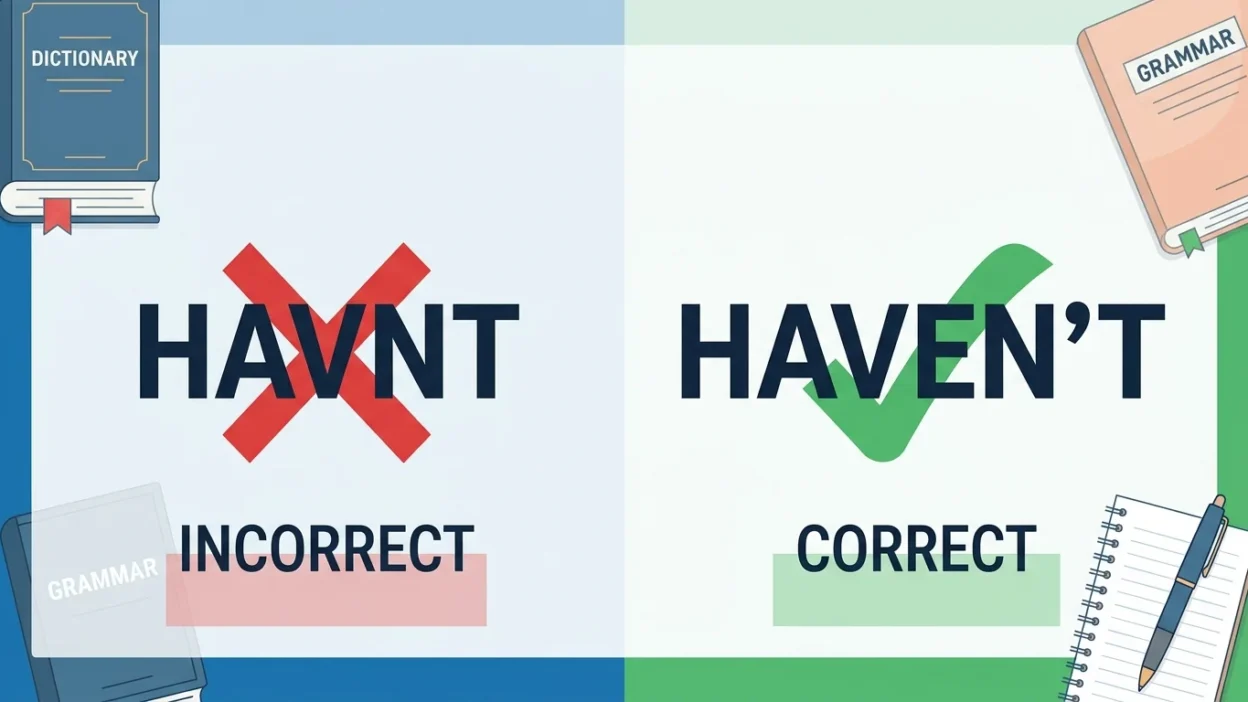
Have you ever wondered whether havnt or havent is the correct spelling? The correct form is haven’t, with an apostrophe. The spelling havnt is incorrect in standard English because it leaves out the e as well as the apostrophe.
Understanding this difference is useful for students, English learners, writers, and anyone who wants to write clear and grammatically correct English. Although haven’t is a very common word in everyday communication, it is often typed incorrectly in informal messages.
Quick Answer
Haven’t is the correct standard English form. It is the contraction of have not. Havnt is an incorrect spelling. Remember that the contraction keeps the e from have and uses an apostrophe: have + not → haven’t.
Why People Confuse Havnt and Havent
The confusion usually happens because contractions are shortened forms of two words. When people type quickly, they may remove too many letters and write havnt instead of haven’t.
Another reason is pronunciation. In normal speech, haven’t can sound quite short, so some people may incorrectly assume that the written form should also remove the e.
The correct spelling keeps the apostrophe to show that letters have been omitted.
First Word: Havnt
Havnt is generally an incorrect spelling in standard English.
It is sometimes seen in:
- Text messages
- Social media posts
- Informal online writing
- Typing mistakes
However, it should not be used in formal or standard English writing.
Incorrect: I havnt finished my homework.
Correct: I haven’t finished my homework.
Second Word: Havent
Havent is also not the standard written form because it is missing the apostrophe.
The correct spelling is haven’t.
The apostrophe is important because it marks the missing letter from have not.
Correct: We haven’t seen him today.
Incorrect: We havent seen him today.
In very informal digital writing, people sometimes omit apostrophes, but standard English requires the apostrophe.
Comparison Table
| Form | Correct? | Meaning | Usage |
|---|---|---|---|
| havnt | ❌ No | Intended to mean have not | Misspelling |
| havent | ❌ No | Intended to mean have not | Missing apostrophe |
| haven’t | ✅ Yes | Have not | Standard English |
| have not | ✅ Yes | Full form of haven’t | Formal or emphasized writing |
When to Use Each
Use Haven’t
Use haven’t when you want the contraction of have not.
Examples:
- I haven’t eaten yet.
- They haven’t arrived.
- We haven’t decided.
- You haven’t answered my question.
Use Have Not
Use have not when you want the full form, especially for emphasis or in more formal writing.
Examples:
- I have not received your email.
- We have not completed the project.
- They have not agreed to the proposal.
Do Not Use Havnt or Havent
Avoid both havnt and havent in standard English writing.
The correct contraction is always haven’t.
10+ Examples of Haven’t
- I haven’t finished my assignment yet.
- We haven’t visited that restaurant before.
- They haven’t arrived at the station.
- You haven’t told me the whole story.
- I haven’t seen your brother today.
- She hasn’t called us yet.
- We haven’t decided where to go.
- They haven’t completed the work.
- I haven’t heard that song before.
- You haven’t answered my question.
- We haven’t had enough time.
- I haven’t forgotten your advice.
Notice that haven’t is used with I, you, we, and they.
With he, she, and it, the usual form is hasn’t, not haven’t.
Common Mistakes
Mistake 1: Writing Havnt
Incorrect: I havnt finished.
Correct: I haven’t finished.
The spelling removes too much from the original words.
Mistake 2: Forgetting the Apostrophe
Incorrect: We havent started.
Correct: We haven’t started.
The apostrophe is necessary in the standard contraction.
Mistake 3: Confusing Haven’t and Hasn’t
Incorrect: She haven’t arrived.
Correct: She hasn’t arrived.
Use haven’t with I, you, we, and they. Use hasn’t with he, she, and it.
Mistake 4: Using Haven’t as a Single Word in Formal Situations
Contractions are grammatically correct, but some formal writing may prefer the full form have not.
For example:
Formal: We have not received the documents.
Less formal: We haven’t received the documents.
Memory Trick
Remember:
Have not → haven’t
The apostrophe replaces the missing o in not, while the spelling of have remains recognizable.
A simple way to remember it is:
HAVEN’T = HAVE + NOT
Never remove the e from have.
American vs British English
There is no spelling difference between American and British English for haven’t.
Both varieties use:
haven’t
The same contraction is standard in both forms of English.
Differences between American and British English may appear in vocabulary, pronunciation, or other spelling conventions, but haven’t is spelled the same way in both.
Similar Words
Here are some related contractions that follow similar patterns:
- hasn’t = has not
- hadn’t = had not
- isn’t = is not
- aren’t = are not
- wasn’t = was not
- weren’t = were not
- can’t = cannot
- couldn’t = could not
- won’t = will not
- wouldn’t = would not
Learning these contractions can help you avoid similar spelling mistakes.
Final Verdict
The correct standard spelling is haven’t.
- Havnt ❌ — incorrect spelling
- Havent ❌ — missing apostrophe
- Haven’t ✅ — correct contraction of have not
- Have not ✅ — correct full form
If you are writing an email, school assignment, article, or professional message, use haven’t when a contraction is appropriate.
FAQs
Is havnt a correct word?
No. Havnt is generally an incorrect spelling. The correct contraction is haven’t.
Is havent correct without an apostrophe?
No. In standard English, the correct form is haven’t, with an apostrophe.
What does haven’t mean?
Haven’t means have not. It is the contracted form used in sentences such as I haven’t finished.
Why does haven’t have an apostrophe?
The apostrophe shows that letters have been omitted when have not is shortened to haven’t.
Should I write haven’t or have not?
Both are correct. Haven’t is common in everyday and conversational writing, while have not can sound more formal or emphatic.
Is havnt acceptable in texting?
People may use havnt as a typing shortcut or informal misspelling, but it is not standard English spelling. Use haven’t when correct English matters.
Is havent a misspelling?
Yes. Havent is a common informal omission of the apostrophe. Standard English uses haven’t.
What is the difference between haven’t and hasn’t?
Haven’t means have not and is used with I, you, we, and they. Hasn’t means has not and is used with he, she, and it.
Remember This
Havnt ❌
Havent ❌
Haven’t ✅
Think of the full form:
have not → haven’t
Keep the e in have and add the apostrophe.
Conclusion
The difference between havnt, havent, and haven’t is simple once you understand how the contraction is formed. Haven’t is the correct standard spelling and means have not. Havnt is a misspelling, while havent leaves out the required apostrophe.
When writing in standard English, always choose haven’t or the full form have not. Remembering the original phrase makes the correct spelling easy: have not → haven’t.