If you are unsure whether to write seak or seek, you are not alone. These spellings can be confusing because they sound similar in some accents. However, only one is the standard English word used in everyday writing.
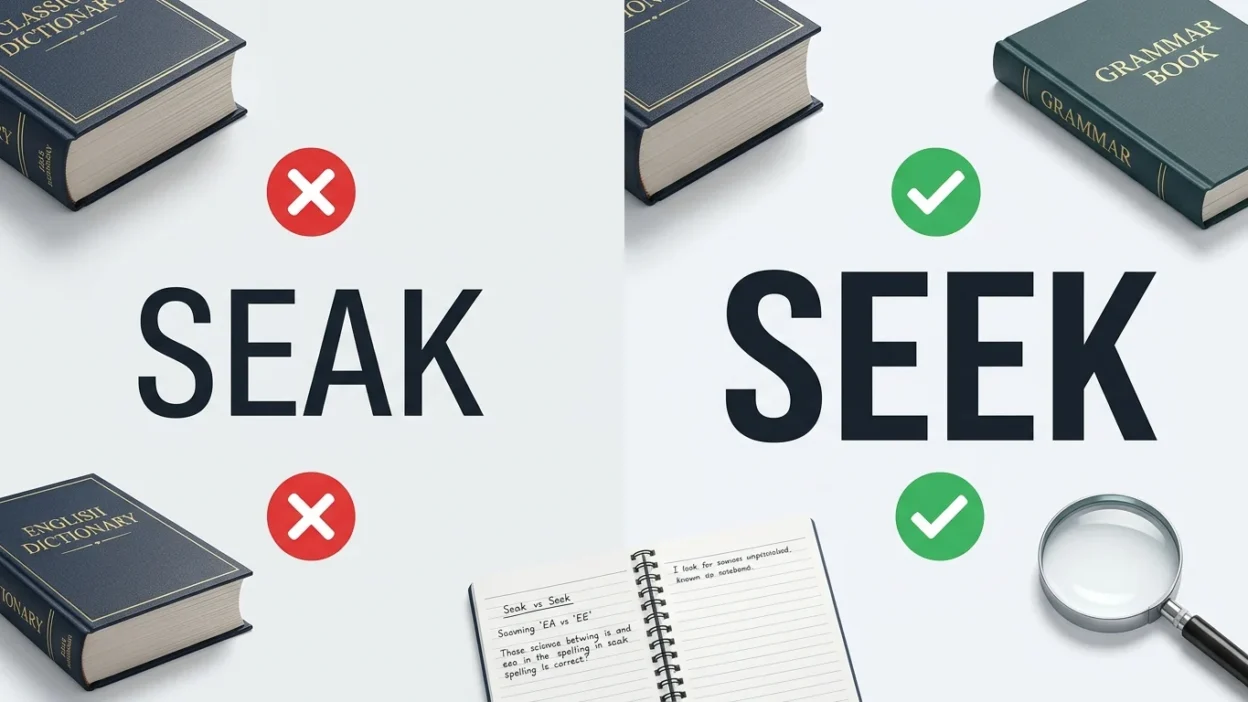
The correct spelling is seek. Seak is generally an incorrect spelling when you mean to look for, search for, or try to obtain something. Learning the difference will help you write more accurately in school assignments, emails, professional communication, and everyday English.
Quick Answer
Seek is the correct spelling when you mean to look for, search for, or try to obtain something. Seak is generally a misspelling. For example, you should write seek advice, seek help, or seek information, not seak advice, seak help, or seak information.
Why People Confuse Seak and Seek
The confusion usually comes from pronunciation. Seek is pronounced with a long ee sound, and some learners may remember the sound incorrectly and spell it as seak.
The standard spelling is:
seek
Not:
seak
A useful way to remember it is to connect seek with related words such as seeking and sought.
Seak
Seak is generally not the correct spelling when you mean to search for or look for something.
For standard English writing, use seek instead.
Is Seak a Word?
In ordinary modern English, seak is not the standard spelling of the common verb meaning to look for or search for something. If you are writing a sentence with this meaning, seek is the correct choice.
Incorrect:
She went to seak help from her teacher. ❌
Correct:
She went to seek help from her teacher. ✅
Seek
Seek is the correct standard English word.
It means to look for, search for, try to find, or try to obtain something.
Examples include:
- seek help
- seek advice
- seek information
- seek permission
- seek employment
- seek a solution
- seek an opportunity
Forms of Seek
Seek has an irregular past tense and past participle:
- Seek — present/base form
- Seeks — third-person singular
- Seeking — present participle
- Sought — past tense
- Sought — past participle
Example:
She seeks advice before making important decisions.
She is seeking a new opportunity.
He sought help from his teacher.
Seak vs Seek Comparison Table
| Word | Correct? | Meaning | Example |
|---|---|---|---|
| seak | ❌ No | Generally a misspelling of seek | I want to seak advice. |
| seek | ✅ Yes | To look for, search for, or try to obtain | I want to seek advice. |
When to Use Seek
Use seek when someone is actively looking for something or trying to obtain something.
Seek Help
When you need assistance, you can seek help.
Example:
If you have a problem, do not hesitate to seek help.
Seek Advice
Use seek advice when asking someone for guidance.
Example:
You should seek advice from an experienced teacher.
Seek Information
Use seek information when trying to find facts or details.
Example:
Many students seek information online.
Seek Permission
Use seek permission when you need approval before doing something.
Example:
You must seek permission before using the equipment.
Seek a Solution
Use seek a solution when trying to solve a problem.
Example:
The team is seeking a solution to the issue.
10+ Examples of Seek
- She decided to seek help from her teacher.
- Many students seek better educational opportunities.
- You should seek advice before making a major decision.
- They are seeking information about the new program.
- The company is seeking talented employees.
- We need to seek a practical solution.
- He went to seek medical advice.
- The organization is seeking financial support.
- She is seeking permission to join the project.
- People often seek answers to difficult questions.
- The researchers sought new evidence.
- He sought guidance from his mentor.
Common Mistakes
Mistake 1: Writing Seak Instead of Seek
Incorrect:
They are trying to seak information. ❌
Correct:
They are trying to seek information. ✅
Mistake 2: Confusing Seek With Its Past Form
The past tense of seek is sought, not seeked.
Incorrect:
She seeked help yesterday. ❌
Correct:
She sought help yesterday. ✅
Mistake 3: Forgetting the Spelling in Seeking
The correct form is seeking, not seaking.
Correct:
They are seeking a better solution. ✅
Memory Trick
A simple way to remember seek is:
Seek has two e’s.
Think:
S + EE + K = SEEK
Also remember the word family:
seek → seeking → sought
If you mean looking for something, choose seek.
American vs British English
There is no spelling difference between American and British English for this word.
Both varieties use:
seek
The forms seeking and sought are also spelled the same in both varieties.
Similar Words
Several words have meanings related to seek:
- Search — look carefully for something
- Look for — try to find something
- Find — discover or locate something
- Pursue — continue trying to achieve or obtain something
- Explore — investigate or examine something
- Request — formally ask for something
- Obtain — get or acquire something
Although these words can be related, they are not always interchangeable. Seek often emphasizes the effort or intention to find, obtain, or achieve something.
Final Verdict
Seek is the correct spelling.
Seak is generally an incorrect spelling when you mean to look for, search for, or try to obtain something.
Remember:
SEEK = S + EE + K
Use seek in expressions such as seek help, seek advice, seek information, and seek permission.
FAQs
Is seak a correct spelling?
No. Seak is generally incorrect when you mean to look for or search for something. The correct spelling is seek.
Is it seak or seek?
The correct spelling is seek.
What does seek mean?
Seek means to look for, search for, or try to obtain something.
What is the past tense of seek?
The past tense of seek is sought.
Is it seeked or sought?
The correct past form is sought, not seeked.
What is the present participle of seek?
The present participle is seeking.
Is seeking spelled seaking?
No. The correct spelling is seeking.
Is seek the same in American and British English?
Yes. Seek is spelled the same in both American and British English.
Remember This
- Seek = correct ✅
- Seak = generally incorrect ❌
- Seek means to look for or try to obtain something.
- Seeking is the -ing form.
- Sought is the past tense.
- Remember S + EE + K = SEEK.
Conclusion
The difference between seak and seek is straightforward once you remember the correct spelling. Seek is the standard English word meaning to look for, search for, or try to obtain something. Seak is generally a misspelling and should be avoided in formal and everyday writing.
When you need the word, remember the two e’s in seek. Whether you are writing about seeking help, seeking advice, seeking information, or seeking a solution, seek is the spelling you should use.

Gabriel John is a language enthusiast and grammar writer at Synolexes. He creates clear, practical content on English grammar, vocabulary, and writing, helping learners improve communication skills with confidence.