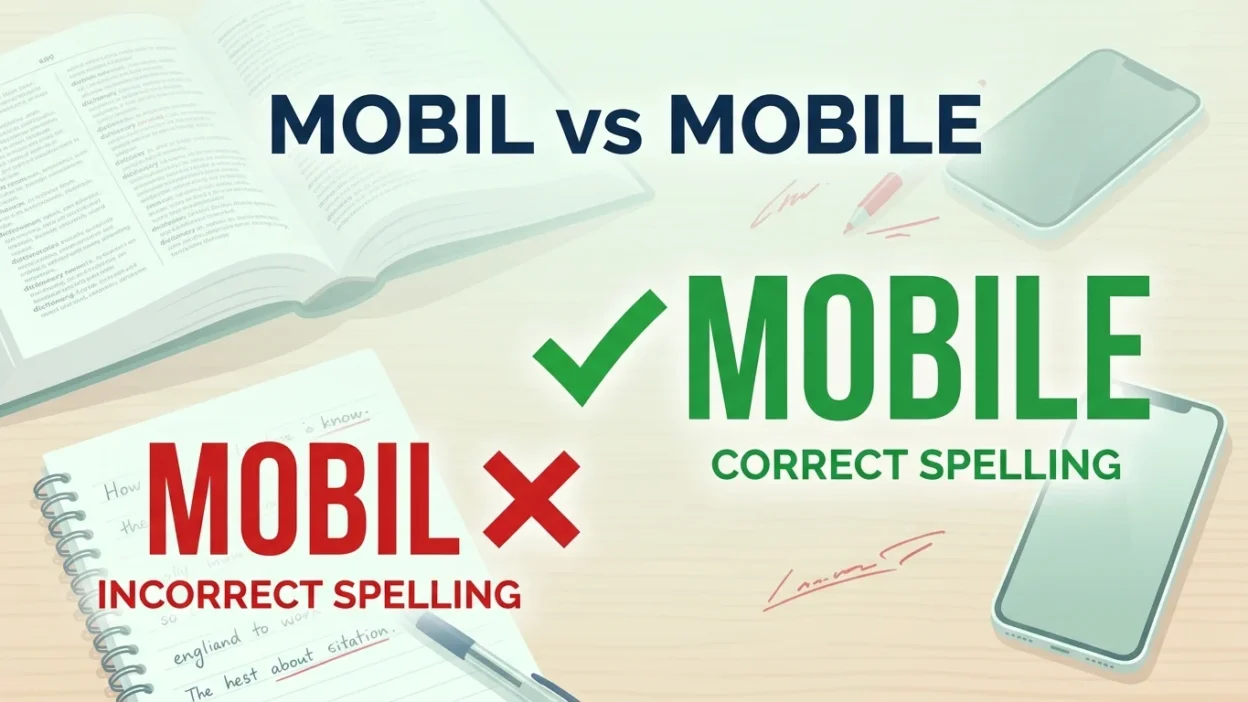
Are you confused about whether to write mobil or mobile? This spelling difference is easy to notice but can cause problems in school assignments, emails, websites, and everyday English writing.
The correct spelling in standard English is mobile. It can describe something that can move easily, and it is also commonly used in terms related to phones, wireless technology, and portable devices. In British English, mobile can also be used as a noun meaning a mobile phone.
In this guide, we will explain mobil vs mobile, their meanings, correct usage, examples, common mistakes, and an easy way to remember which spelling to use.
Mobil vs Mobile: The Quick Answer
The standard English spelling is mobile.
Mobile is an established English word used as both an adjective and a noun. It can mean able to move easily, portable, adaptable, or related to wireless communication. In British English, a mobile can also mean a mobile phone.
Mobil is not the normal standard spelling for these meanings in modern English. Therefore, when you are writing in English and mean something portable, movable, or related to a phone, use mobile.
| Spelling | Standard English? | Common Meaning |
|---|---|---|
| Mobile | Yes | Movable, portable, or related to mobile phones |
| Mobil | No for these standard English meanings | Usually a misspelling of mobile |
What Does Mobile Mean?
The word mobile has several meanings depending on the sentence.
As an adjective, mobile can describe something that is easy to move or something that can travel from one place to another. It can also describe people who can move or travel easily.
For example:
- The clinic has a mobile medical unit.
- The workers need a mobile workstation.
- The camera system is mobile and easy to transport.
Mobile is also widely used in technology. It can describe phones, devices, communication services, and other wireless technology.
For example:
- She checked the message on her mobile phone.
- Mobile technology has changed communication.
- The company launched a new mobile application.
Is Mobil a Correct English Word?
For ordinary modern English spelling, mobil is not the form you should use when you mean mobile.
English dictionaries list mobile as the standard word for meanings such as movable, portable, and related to wireless communication.
The spelling mobil may appear in other languages or in names and brand contexts, but that does not make it the standard English spelling of mobile. For normal English writing, choose mobile.
Mobile as an Adjective
One of the most common uses of mobile is as an adjective.
It can describe something that can be moved or something that is designed for portable use.
Examples
- The hospital has a mobile laboratory.
- We need a mobile solution for the field team.
- The equipment is small and mobile.
- He works from a mobile office.
In these sentences, mobile describes something that can be moved or used in different locations.
Mobile as a Noun
In British English, mobile can be used as a noun meaning a mobile phone.
Examples
- I left my mobile at home.
- She called me on my mobile.
- His mobile battery is almost empty.
In American English, cell phone or cellphone is more common for this meaning.
Mobile Phone Meaning
The phrase mobile phone refers to a portable phone that can make and receive calls using a cellular radio system. It is especially common in British English.
Examples include:
- I bought a new mobile phone.
- Please turn off your mobile phone during the exam.
- She uses her mobile phone for work.
The spelling is always mobile, not mobil, in standard English.
Why Do People Write Mobil Instead of Mobile?
There are several possible reasons for this spelling mistake.
One common reason is pronunciation. When people say mobile quickly, the final sound may not always seem obvious to learners. This can lead someone to shorten the spelling accidentally.
Another reason is that mobil looks like a believable English word. Since English contains many words with different spelling patterns, it is easy to remove the final e by mistake.
People may also see similar spellings in other languages, where forms related to mobil are used. However, English uses mobile for the meanings discussed in this article.
Mobile vs Mobil Examples
Here are some simple comparisons.
Correct
My mobile phone is on the table.
Incorrect
My mobil phone is on the table.
Correct
The company developed a mobile application.
Incorrect
The company developed a mobil application.
Correct
We need a mobile unit for the project.
Incorrect
We need a mobil unit for the project.
Correct
She forgot her mobile at home.
Incorrect
She forgot her mobil at home.
These examples show why mobile should be your choice in standard English.
Common Words With Mobile
The word mobile appears in many common English expressions.
Mobile Phone
A portable telephone used for calls and communication.
Example:
He bought a new mobile phone.
Mobile Device
A portable electronic device such as a smartphone or tablet.
Example:
The website works well on mobile devices.
Mobile App
An application designed for use on a mobile device.
Example:
The bank released a new mobile app.
Mobile Network
A wireless communication network used by mobile phones and other devices.
Example:
The mobile network is unavailable in this area.
Mobile Internet
Internet access provided through a mobile network.
Example:
She uses mobile internet while traveling.
These common expressions all use mobile, not mobil.
Mobile Can Also Mean Able to Move
Not every use of mobile is related to phones.
The word can also mean that a person or thing can move easily from place to place. Collins gives examples involving movable objects and people who can travel or move easily.
For example:
- The machine is mobile and can be moved easily.
- The team needs a mobile workspace.
- The patient is now mobile.
- The company has a mobile workforce.
This broader meaning is important because mobile is not only a technology word.
Mobile vs Portable
Mobile and portable can sometimes have similar meanings, but they are not always interchangeable.
Mobile often emphasizes the ability to move or operate in different places.
Portable usually emphasizes that something can be carried easily.
Compare these examples:
- The company uses a mobile laboratory.
- I bought a portable speaker.
A mobile laboratory may be designed to operate in different locations, while a portable speaker is mainly described as easy to carry.
Mobile vs Movable
Mobile can also be similar to movable.
Movable generally means something can be moved.
Mobile can suggest that something is designed or able to move easily from place to place.
Examples:
- The table is movable.
- The medical unit is mobile.
The best word depends on the context.
Pronunciation of Mobile
The pronunciation of mobile can vary by region.
In British English, it is commonly pronounced with a sound similar to MO-bile, while American English can use pronunciations closer to MO-buhl or MO-bile, depending on the meaning and context.
Because pronunciation can differ, it is especially useful to remember the spelling separately:
mobile
Do not remove the final e when writing it.
A Simple Trick to Remember Mobile
A useful way to remember the spelling is to connect it with the word move.
The word mobile is associated with the idea of movement. The spelling ends in:
-ile
So remember:
move → mobile
When you mean something movable, portable, or related to mobile technology, write mobile.
Common Mistakes With Mobil
Mistake 1: Writing Mobil Phone
Incorrect:
I lost my mobil phone.
Correct:
I lost my mobile phone.
Mistake 2: Writing Mobil Application
Incorrect:
The company created a mobil application.
Correct:
The company created a mobile application.
Mistake 3: Removing the Final E
Incorrect:
This device is very mobil.
Correct:
This device is very mobile.
The final e is an important part of the standard spelling.
Mobil vs Mobile in Different Contexts
| Context | Correct Form | Example |
|---|---|---|
| Phone | Mobile | I forgot my mobile phone. |
| Technology | Mobile | Mobile technology is developing quickly. |
| Apps | Mobile | This is a mobile application. |
| Network | Mobile | The mobile network is weak here. |
| Movable equipment | Mobile | The unit is mobile. |
| Portable device | Mobile | I use a mobile device. |
| Standard English spelling | Mobile | Mobile is the correct form. |
How to Choose the Right Spelling
When deciding between mobil and mobile, keep the rule simple.
For Standard English
Use mobile.
For Phones
Use mobile phone or, in British English, simply mobile.
For Technology
Use expressions such as mobile device, mobile app, and mobile network.
For Something That Can Move
Use mobile when you mean movable or able to move easily.
For Formal Writing
Always choose mobile when using standard English.
Quick Comparison: Mobil vs Mobile
| Feature | Mobile | Mobil |
|---|---|---|
| Standard English spelling | Yes | No for these meanings |
| Used for phones | Yes | No |
| Used in technology | Yes | No |
| Means able to move | Yes | No |
| Common in English writing | Yes | No |
| Recommended for academic writing | Yes | No |
| Recommended for professional writing | Yes | No |
FAQs
Is mobil the correct spelling?
No. For standard English, the correct spelling is mobile.
Is it mobil or mobile?
The standard English form is mobile.
Is mobile related to movement?
Yes. Mobile can describe something that can move or be moved easily from place to place.
Is mobile a noun?
Yes. In British English, mobile can be used as a noun meaning a mobile phone.
What is a mobile phone?
A mobile phone is a portable phone that can make and receive calls through a cellular radio system.
Should I write mobil phone or mobile phone?
You should write mobile phone.
Is mobile used in American English?
Yes. Mobile is widely used in American English, although cell phone is more common for the phone itself.
How can I remember mobile spelling?
Remember the full spelling mobile and avoid dropping the final e.
Conclusion
When comparing mobil vs mobile, the correct standard English spelling is mobile. It is commonly used to describe something that can move easily, as well as phones, apps, devices, and wireless technology.
The spelling mobil is not normally correct when you are writing standard English. A simple way to remember the correct form is to keep the final e: mobile.
So, whenever you are unsure, choose mobile for clear, accurate, and professional English writing.

Julian Luke is a passionate grammar and language writer at Synolexes. He simplifies complex grammar rules, vocabulary, and writing concepts, helping learners improve their English communication skills with confidence.