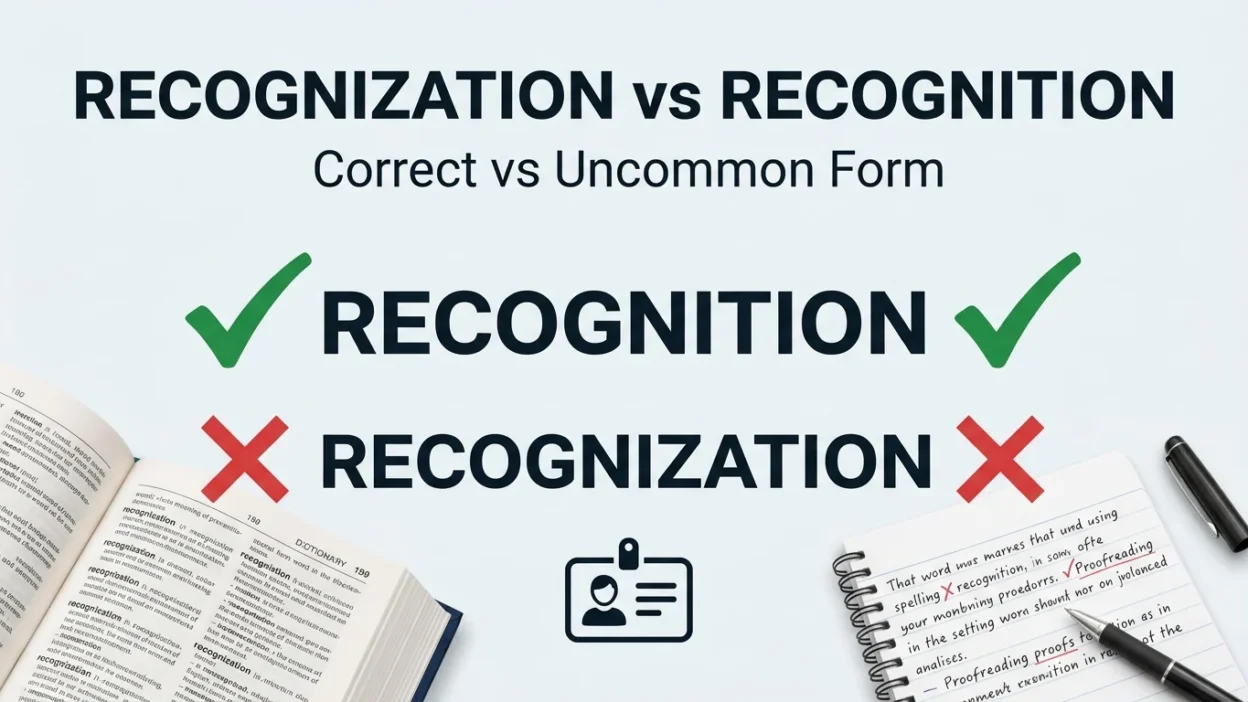
Are you unsure about recognization vs recognition? You are not alone. The two forms look closely related because they both seem to come from the verb recognize. However, standard modern English normally uses recognition as the noun.
Recognition means the act of identifying someone or something, accepting something as true or valid, or giving credit and appreciation for an achievement. It is the established noun used in expressions such as facial recognition, recognition of achievement, and in recognition of. Cambridge and Dictionary.com both list recognition as the standard noun.
The form recognization does have a historical record in English, dating to the 1500s, but it is rare in present-day usage. For normal school, professional, academic, and everyday writing, recognition is the natural choice.
Quick Answer
Recognition is the standard modern English word. It is the noun related to recognize and means identifying, acknowledging, or appreciating someone or something. Recognization has historical usage but is uncommon today. In ordinary modern writing, use recognition, especially in phrases such as public recognition, facial recognition, and in recognition of.
Why Do People Confuse It?
The main reason for the confusion is word formation.
English often creates nouns from verbs with endings such as -tion, -sion, or -ization. Learners may know patterns like:
- organize → organization
- realize → realization
- modernize → modernization
Because of this, it can seem logical to form:
recognize → recognization
But English does not always follow a single predictable pattern. The standard noun that developed from recognize is recognition. Its history goes back to Middle English and ultimately to Latin recognitio.
That means the safest pattern to remember is:
recognize → recognition
rather than trying to create the noun by simply adding -ization.
First Word: Recognization
What Does Recognization Mean?
Recognization is a rare and historically attested noun meaning roughly the act of recognizing. Etymonline records it from the 1550s, formed from recognize with the noun ending -ation.
Although the word has existed in English, it is not the normal noun used by modern speakers and writers.
For example, a reader may encounter recognization in older material or unusual modern usage, but contemporary English normally chooses recognition instead.
Is Recognization Wrong?
For ordinary modern English, recognization is generally not the form you should choose. It is much less common than recognition and can sound unnatural to modern readers.
For example:
Less natural:
The student received recognization for her achievement.
Standard:
The student received recognition for her achievement.
The second sentence uses the established modern noun.
Second Word: Recognition
What Does Recognition Mean?
Recognition is a standard English noun with several connected meanings.
It can mean identifying a person or thing that you have seen or known before. It can also mean accepting something as true or valid, or publicly acknowledging someone’s achievement or contribution.
Examples:
- I knew her immediately by recognition.
- The company gained international recognition.
- She received recognition for her work.
- The system uses facial recognition.
Recognition for Achievement
One very common meaning is credit, appreciation, or acknowledgment for an achievement.
Examples:
- He received recognition for his leadership.
- Her research earned international recognition.
- The school gave recognition to the top students.
- The award was presented in recognition of outstanding service.
Recognition as Identification
Recognition can also mean identifying someone or something because it is familiar.
Examples:
- I saw a brief flash of recognition in his eyes.
- She showed no recognition of the old building.
- The software uses facial recognition.
- Voice recognition helps the device understand commands.
Cambridge defines recognition in terms that include knowing someone or something because it has been seen or experienced before, as well as public appreciation for achievements.
Comparison Table
| Feature | Recognization | Recognition |
|---|---|---|
| Modern standard English | Rare and uncommon | Standard |
| Meaning | Act of recognizing | Identifying, acknowledging, or appreciating |
| Common in everyday writing | No | Yes |
| Common in academic writing | No | Yes |
| Common in professional writing | No | Yes |
| Common dictionary entry | Rare/historical | Yes |
| Example phrase | Rare usage | in recognition of |
| Recommended choice | Usually avoid | Use |
When to Use Each
When to Use Recognition
Use recognition in normal modern English whenever you mean:
- Identification of a person or thing
- Acknowledgment of a fact or claim
- Appreciation for an achievement
- Public credit or honor
- Official acceptance
- Recognition technology
Examples:
- The scientist gained recognition for her research.
- Facial recognition is used by the device.
- There is growing recognition of the problem.
- The award was given in recognition of his service.
These uses are supported by standard dictionary definitions of recognition.
When Might Recognization Appear?
Recognization may appear in historical texts, quotations, archival documents, or unusual language. Its historical existence is documented, but that does not make it the preferred modern form.
So, you might encounter it while reading older material, but you would normally write recognition yourself.
10+ Examples of Recognition
Here are practical examples showing how recognition is used naturally.
- She received recognition for her excellent performance.
- The company gained international recognition.
- Facial recognition can identify a person from an image.
- The award was presented in recognition of his contribution.
- The teacher gave recognition to students who worked hard.
- Her work deserves greater recognition.
- There is growing recognition of the importance of education.
- He smiled when he saw the familiar face in recognition.
- The organization earned public recognition for its efforts.
- Voice recognition allows users to control the device.
- The scientist finally received recognition for years of research.
- The promotion was a form of recognition for her dedication.
- The report shows a growing recognition of the problem.
- The school held a ceremony in recognition of student achievements.
- The technology uses facial recognition to verify identity.
These examples cover the major meanings of recognition, including identification, acknowledgment, appreciation, and technology-related uses.
Common Mistakes
Mistake 1: Using Recognization After Recognize
A common assumption is:
recognize → recognization
But the standard noun is:
recognize → recognition
Correct:
She received recognition for her work.
Not normally preferred:
She received recognization for her work.
Mistake 2: Assuming Every -ize Verb Uses -ization
The spelling pattern found in words such as organize → organization can make recognization look natural.
However, related words do not always form their nouns in exactly the same way.
Compare:
- organize → organization
- realize → realization
- recognize → recognition
Learning the complete word family is more reliable than trying to apply one ending to every verb.
Mistake 3: Confusing Recognition With Recommendation
These words sound somewhat similar but have different meanings.
Recognition means identification, acknowledgment, or appreciation.
Recommendation means advice or a suggestion about what someone should choose or do.
Example:
- She received recognition for her achievement.
- My teacher gave me a recommendation for the course.
Mistake 4: Confusing Recognition With Realization
Recognition can involve identifying or acknowledging something.
Realization usually means becoming aware of or understanding something.
Examples:
- I knew him by recognition.
- The realization that I was late came suddenly.
Mistake 5: Using Recognization in a Common Phrase
The established expression is:
in recognition of
Correct:
The medal was awarded in recognition of her service.
Using in recognization of would sound unusual in standard modern English.
Memory Trick
A simple way to remember the correct spelling is:
Recognize → Recognition
Do not automatically add -ization to recognize.
You can also memorize the very common phrase:
in recognition of
For example:
The award was given in recognition of her hard work.
Once this phrase becomes familiar, the spelling recognition becomes easier to remember.
Another useful connection is the spelling:
recognition = recogn + ition
The standard noun ends in -ition, not -ization.
American vs British English
There is no standard British-versus-American spelling difference between recognition and recognition. The noun is spelled recognition in both varieties of English. Cambridge provides the noun in both American and British contexts.
There is, however, a difference in the related verb:
- American English: recognize
- British English: recognise
Both spellings are standard in their respective usage traditions. Dictionary.com lists recognise as the British variation of recognize.
But the noun remains:
recognition
So you can write:
- American: recognize → recognition
- British: recognise → recognition
Similar Words
Several words are related to recognition, but each has a different meaning.
Acknowledgment
Means openly accepting, admitting, or noting something.
Example:
He gave acknowledgment to everyone who helped.
Appreciation
Means understanding the value of something or expressing gratitude.
Example:
The manager showed appreciation for the team’s effort.
Identification
Means determining who or what someone or something is.
Example:
The identification of the suspect took several hours.
Acceptance
Means agreeing to or receiving something as valid or satisfactory.
Example:
The acceptance of the proposal came later.
Realization
Means becoming aware of something or understanding it clearly.
Example:
She came to the realization that she needed more practice.
Recognition
Can combine some of these ideas, especially when it means identifying something or acknowledging its value.
Final Verdict
For modern standard English, recognition is the form you should use.
Recognization is a real historical formation, but it is rare today and is not the normal noun choice for contemporary English writing. Historical evidence places the word in English as far back as the 1550s, while recognition is the established modern noun.
So the practical rule is simple:
Use recognition.
Examples:
- recognition for achievement
- facial recognition
- public recognition
- recognition of a problem
- in recognition of service
FAQs
Is recognization a correct word?
Recognization has historical usage in English, but it is rare today. Recognition is the standard modern noun and the better choice for normal writing.
Which is correct: recognization or recognition?
Recognition is the standard modern English form.
What is the noun form of recognize?
The standard noun form is recognition.
Example:
The company received recognition for its work.
Why do people say recognization?
People may form recognization by assuming that recognize follows the same noun pattern as words such as organize → organization. English word formation does not always work that way.
Is recognition used in both American and British English?
Yes. Recognition is used in both American and British English. The main spelling difference appears in the verb: recognize in American English and recognise in British English.
What does recognition mean?
Recognition can mean identifying someone or something, accepting something as true or valid, or giving credit and appreciation for an achievement.
What does in recognition of mean?
In recognition of means as a way of showing appreciation, acknowledgment, or credit for someone or something.
Example:
The award was presented in recognition of her service.
Is facial recognization correct?
No. The standard term is facial recognition.
Remember This
The easiest rule is:
Recognize → Recognition
Not:
Recognize → Recognization
Use recognition when you are talking about identification, acknowledgment, appreciation, achievement, or technologies such as facial and voice recognition.
Conclusion
When comparing recognization vs recognition, the standard modern English choice is recognition. It is used for identifying people or things, accepting or acknowledging facts, and giving credit for achievements. It is also the established word in common expressions such as facial recognition and in recognition of.
Although recognization has a documented history in English, it is uncommon in present-day usage. For essays, schoolwork, business communication, websites, and everyday writing, recognition is the natural form to use. Remember the simple word family recognize → recognition, and you will avoid this common word-choice mistake.

Gabriel John is a language enthusiast and grammar writer at Synolexes. He creates clear, practical content on English grammar, vocabulary, and writing, helping learners improve communication skills with confidence.