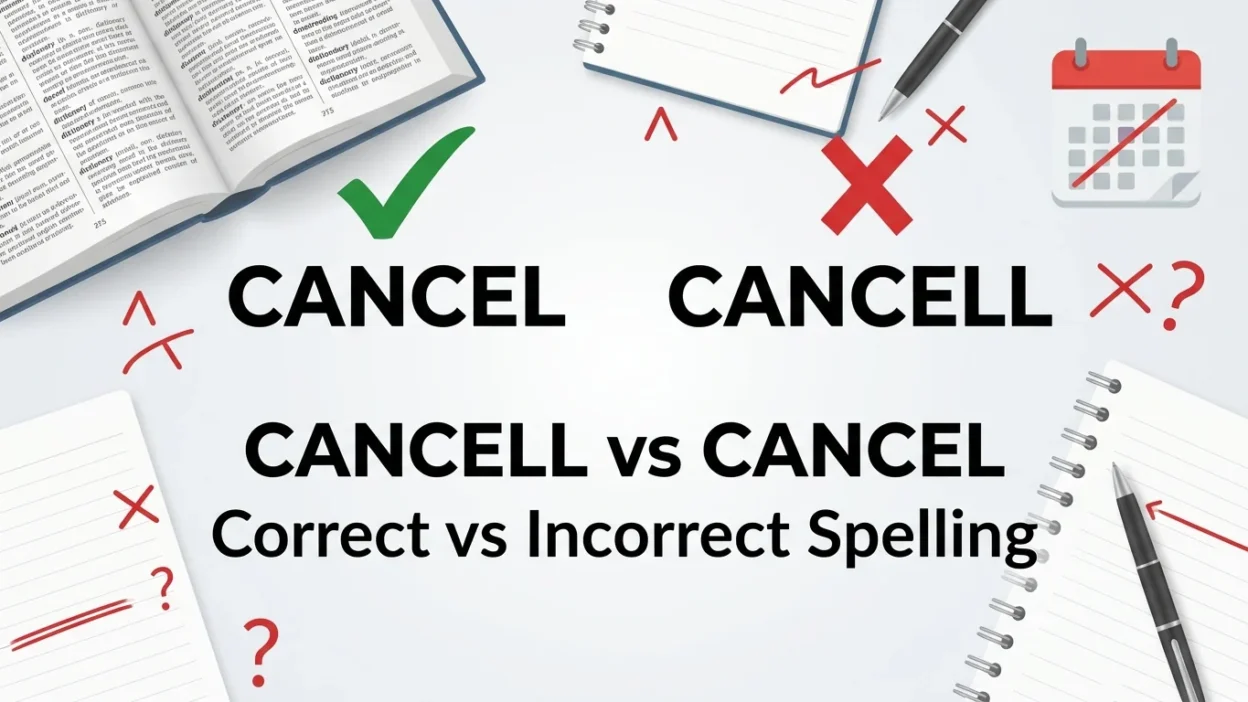
Are you unsure whether the correct spelling is cancell or cancel? This is a common spelling mistake because the word may take a double l in some of its other forms, especially in British English.
The correct base-form spelling is cancel, with only one l at the end. It is a verb that means to stop, call off, or decide that something arranged or planned will not happen. For example, you can cancel a meeting, cancel an order, or cancel a reservation. The spelling cancell is not the standard English base form.
The confusion becomes more understandable when you look at words such as cancelled and cancelling, where British English normally uses a double l. American English commonly uses canceled and canceling instead. This article explains cancell vs cancel, the correct spelling, usage rules, examples, common mistakes, and an easy way to remember the difference.
Quick Answer
Cancel is the correct standard spelling of the base verb. Cancell is incorrect in standard English. Use cancel when you mean to stop or call off something. In British English, the related forms are usually cancelled and cancelling, while American English commonly uses canceled and canceling. The base form remains cancel in both varieties.
Why Do People Confuse It?
People often confuse cancell and cancel because the word changes spelling when certain endings are added.
The base form is:
cancel
In British English, when -ed or -ing is added, the final l is commonly doubled:
cancel → cancelled
cancel → cancelling
This can make learners think the base word itself should also contain two l letters:
cancell ❌
But that is not the standard spelling.
The correct pattern is:
cancel → cancelled
not:
cancell → cancelled
Understanding the base form first makes the other forms much easier to remember.
First Word: Cancell
Is Cancell Correct?
No. Cancell is not the standard spelling of the English verb.
If you want to say that you are stopping an event, order, appointment, subscription, or plan, use cancel.
Incorrect:
I need to cancell the appointment.
Correct:
I need to cancel the appointment.
The extra l should not be present in the base form.
Why Does Cancell Look Correct?
The spelling can look believable because English sometimes doubles final consonants before adding suffixes. Since cancelled and cancelling contain two l letters in British English, writers may incorrectly transfer that spelling to the base verb.
Remember:
cancel is the original form.
The double l belongs to certain derived forms, not to the base word.
Second Word: Cancel
What Does Cancel Mean?
Cancel means to stop something that was planned, arranged, scheduled, or ordered.
Examples:
- We had to cancel the meeting.
- She canceled her appointment.
- The airline canceled the flight.
- I want to cancel my order.
- They decided to cancel the event.
The word can also mean to make something ineffective, remove an obligation, or mark something as no longer valid.
Examples:
- Please cancel the old subscription.
- The company canceled the agreement.
- The ticket was canceled.
Comparison Table
| Spelling | Correct? | Usage | Example |
|---|---|---|---|
| Cancel | Yes | Base verb | We need to cancel the meeting. |
| Cancell | No | Incorrect base form | I will cancell the order. |
| Cancelled | Yes in British English | Past tense/past participle | The match was cancelled. |
| Canceled | Yes in American English | Past tense/past participle | The match was canceled. |
| Cancelling | Yes in British English | Present participle/gerund | They are cancelling the event. |
| Canceling | Yes in American English | Present participle/gerund | They are canceling the event. |
When to Use Each
When to Use Cancel
Use cancel as the base form of the verb.
Examples:
- I need to cancel my reservation.
- Please cancel the appointment.
- They may cancel the trip.
- We decided to cancel the meeting.
It is used with helping verbs such as will, can, should, must, and to.
Examples:
- We will cancel the order.
- You can cancel the subscription.
- They decided to cancel the event.
When to Use Cancelled
Use cancelled in British English when you need the past tense or past participle.
Examples:
- The flight was cancelled.
- They cancelled the concert.
- The appointment has been cancelled.
When to Use Canceled
Use canceled in American English for the past tense and past participle.
Examples:
- The flight was canceled.
- They canceled the concert.
- The appointment has been canceled.
When to Use Cancelling
Cancelling is the common British English spelling of the -ing form.
Example:
- They are cancelling the event.
When to Use Canceling
Canceling is the common American English spelling of the -ing form.
Example:
- They are canceling the event.
10+ Examples of Cancel
Here are practical examples showing the correct base form.
- I need to cancel my appointment.
- We decided to cancel the meeting.
- Please cancel my order before it ships.
- The organizers may cancel the event because of the weather.
- She wants to cancel her subscription.
- You can cancel the reservation online.
- They had to cancel their travel plans.
- Please cancel the old membership.
- The customer called to cancel the booking.
- We may cancel the class tomorrow.
- He forgot to cancel the automatic payment.
- The company decided to cancel the project.
- I had to cancel dinner because I was busy.
- They might cancel the flight if conditions become unsafe.
- You can cancel the service at any time.
In each example, cancel is correctly used as the base verb.
Common Mistakes
Mistake 1: Writing Cancell
Incorrect:
I need to cancell my booking.
Correct:
I need to cancel my booking.
The base form contains one l.
Mistake 2: Assuming Cancel Has Two Ls
Incorrect:
She will cancell the event.
Correct:
She will cancel the event.
The spelling does not become cancell simply because the word may have a doubled l in some other forms.
Mistake 3: Confusing Cancel With Cancelled
The two forms are both correct, but they have different grammatical uses.
Cancel is the base verb.
Example:
- We may cancel the trip.
Cancelled is the British English past tense or past participle.
Example:
- We cancelled the trip yesterday.
Mistake 4: Mixing American and British Forms
In American English, it is common to write:
canceled
In British English, it is common to write:
cancelled
Both are standard within their respective spelling conventions.
The important point is that the base form is always:
cancel
Mistake 5: Writing Cancellling
Some writers may accidentally add too many letters when forming the -ing form.
British English:
cancelling
American English:
canceling
Neither should be confused with cancell.
Memory Trick
The easiest way to remember the spelling is:
Cancel = one L
Think of the base word as a single unit:
C-A-N-C-E-L
When you add certain endings in British English, the final l may be doubled:
cancel → cancelled
cancel → cancelling
So remember:
One L in cancel. Two Ls in cancelled and cancelling in British English.
This simple pattern can help prevent many spelling mistakes.
American vs British English
The biggest difference appears in the forms of cancel that use -ed and -ing.
American English
American English commonly uses:
- cancel
- canceled
- canceling
Examples:
- The flight was canceled.
- They are canceling the event.
British English
British English commonly uses:
- cancel
- cancelled
- cancelling
Examples:
- The flight was cancelled.
- They are cancelling the event.
What Stays the Same?
The base verb is cancel in both varieties.
So these are not the standard base forms:
cancell ❌
The spelling difference only becomes important when certain suffixes are added.
Similar Words
Several English words have a meaning related to cancel.
Call Off
Call off means to cancel something that was planned.
Example:
- They called off the meeting.
Withdraw
Withdraw can mean to remove or take back something.
Example:
- She withdrew her application.
Revoke
Revoke means to officially cancel or withdraw something such as permission, a license, or an agreement.
Example:
- The authority revoked his license.
Abandon
Abandon can mean to stop a plan, activity, or effort completely.
Example:
- The team abandoned the project.
Rescind
Rescind means to officially cancel or withdraw a decision, agreement, or order.
Example:
- The company rescinded the offer.
These words are related to cancel, but their meanings and contexts are not always identical.
Cancel as a Noun?
In standard modern English, cancel is mainly used as a verb.
However, related nouns are common, including:
cancellation
Example:
- The cancellation of the flight caused problems.
The noun cancellation is important because it contains the double l:
cancel → cancellation
This is another reason some writers may mistakenly think the base form is cancell.
Cancel vs Cancellation
Cancel is a verb.
Example:
- They will cancel the appointment.
Cancellation is a noun.
Example:
- The cancellation was announced this morning.
The spelling of cancellation may help explain the confusion, but it does not change the spelling of the base verb.
The correct forms are:
cancel
cancellation
Cancel in Different Contexts
Appointments
- I need to cancel my appointment.
Travel
- The airline may cancel the flight.
Orders
- I want to cancel my order.
Events
- The organizers had to cancel the concert.
Subscriptions
- You can cancel your subscription anytime.
Meetings
- We may need to cancel the meeting.
Plans
- They decided to cancel their weekend plans.
The word works naturally in many everyday situations.
How to Choose the Right Spelling
The rule is simple:
Use Cancel
Use cancel when you need the base verb.
Examples:
- to cancel
- will cancel
- can cancel
- should cancel
Use Cancelled in British English
Use cancelled for the past tense and past participle.
Example:
- They cancelled the event.
Use Canceled in American English
Use canceled for the past tense and past participle.
Example:
- They canceled the event.
Never Use Cancell as the Base Form
Do not write:
cancell
Write:
cancel
Final Verdict
Cancel is the correct standard spelling of the English base verb. Cancell is incorrect.
The confusion usually comes from the spelling of related forms. British English commonly doubles the final l in cancelled and cancelling, while American English commonly uses canceled and canceling. However, both varieties use cancel as the base form.
The key rule is easy to remember:
cancel = one L
So write cancel the meeting, cancel the order, and cancel the appointment.
FAQs
Is cancell a correct spelling?
No. Cancell is not the standard spelling of the English base verb. The correct form is cancel.
Is it cancel or cancell?
The correct form is cancel with one l at the end.
Why does cancelled have two Ls?
In British English, the final l of cancel is commonly doubled before -ed, giving cancelled.
Is canceled or cancelled correct?
Both are standard. Canceled is commonly used in American English, while cancelled is commonly used in British English.
Is canceling or cancelling correct?
Both are standard. Canceling is common in American English, while cancelling is common in British English.
What is the past tense of cancel?
The past tense is canceled in American English and cancelled in British English.
What is the noun form of cancel?
The common noun form is cancellation.
Example:
The cancellation of the event was unexpected.
How do I remember the spelling of cancel?
Remember that the base form is cancel with one l. The extra l appears in forms such as cancelled and cancelling in British English.
Remember This
Keep this spelling pattern in mind:
Cancel → Cancelled → Cancelling in British English
Cancel → Canceled → Canceling in American English
The base form never becomes cancell.
Cancel = one L.
Conclusion
When comparing cancell vs cancel, the correct spelling is cancel. It is the standard base form of the verb meaning to stop, call off, or end something that was planned or arranged. Whether you are talking about an appointment, meeting, order, subscription, event, or trip, write cancel.
The confusion often comes from British English forms such as cancelled and cancelling, which use a double l. American English commonly uses canceled and canceling instead. Despite this difference, the base form remains cancel in both varieties. Remember the simple rule cancel = one L, and you will avoid the common mistake of writing cancell.

Julian Luke is a passionate grammar and language writer at Synolexes. He simplifies complex grammar rules, vocabulary, and writing concepts, helping learners improve their English communication skills with confidence.