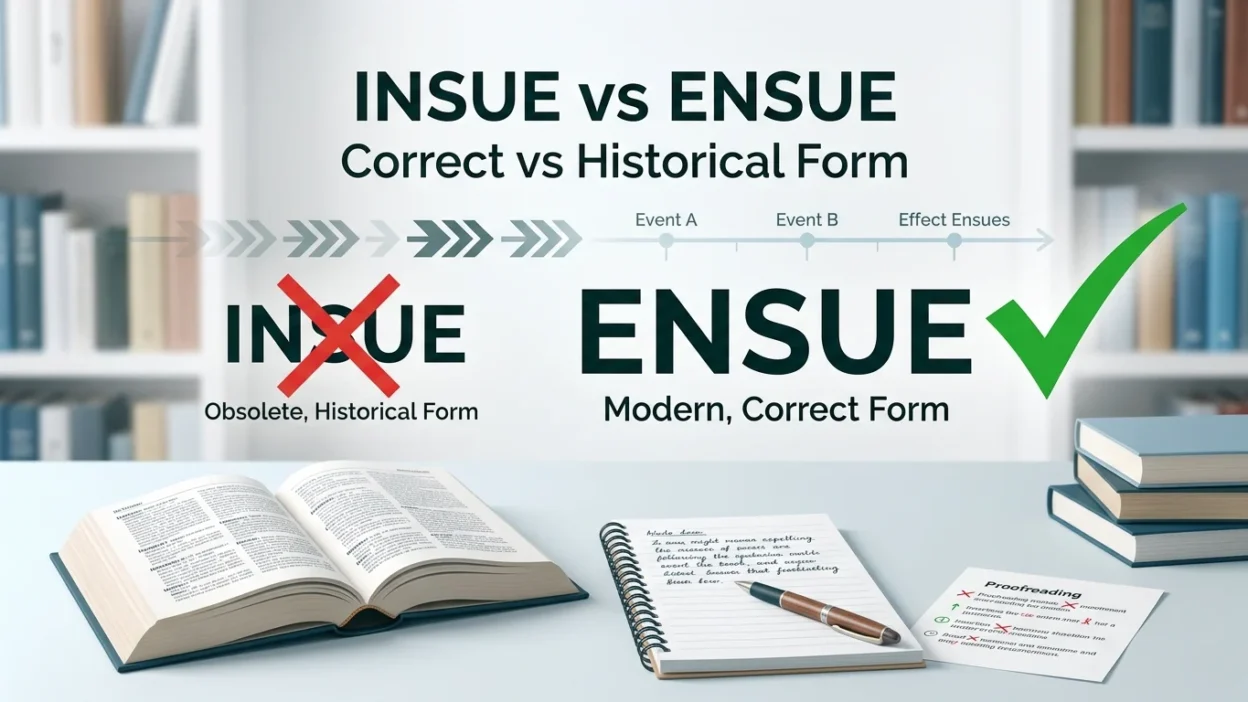
Are you confused about insue vs ensue? These spellings look very similar, but they do not have the same status in modern English. The standard spelling used today is ensue. It is a formal verb meaning to happen after something else, especially as a result of it. For example, you can say that an argument ensued after a disagreement.
The form insue has a historical connection to ensue. Oxford notes that insue was formerly used, tracing the word to Old French and Latin roots associated with following. In present-day standard English, however, ensue is the form readers normally expect. This article explains insue vs ensue, their meanings, correct usage, examples, common mistakes, pronunciation, and related words so you can use the correct form confidently.
Quick Answer
Ensue is the correct standard modern English spelling. It means to happen after something else, often as a result of it. Insue is an older historical form that may appear in older texts but is not the normal spelling used today. In modern writing, use ensue, as in chaos ensued, an argument ensued, or problems ensued.
Why Do People Confuse It?
The confusion is easy to understand because insue and ensue differ by only one vowel.
Both forms are connected historically with the idea of something following something else. Oxford identifies insue as a former spelling of ensue and traces the word to Old French ensivre and ultimately Latin insequi.
Another reason is pronunciation. The first vowel in ensue is not strongly emphasized, so learners may hear the word and spell it as insue.
Modern dictionaries, however, use ensue as the standard headword. Cambridge defines it as a formal verb meaning to happen after something else, especially as a result of it.
So the easiest modern rule is:
Use ensue, not insue.
First Word: Insue
Is Insue Correct?
Insue is not the normal modern spelling of the verb used to mean follow or happen afterward.
Oxford notes that insue was formerly used, which means you may encounter it in historical or older English material.
For contemporary writing, however, use ensue.
Less common or historical:
The argument did insue.
Modern standard English:
The argument ensued.
Why Does Insue Appear?
Insue is historically related to ensue rather than being a completely unrelated word. Oxford specifically lists it as a former form of the verb.
This is useful to know when reading older books, historical documents, or texts that preserve older spelling. However, recognizing a historical form does not mean it is the preferred form for present-day writing.
Should You Use Insue Today?
Generally, no.
For essays, school assignments, articles, reports, emails, and other modern English writing, choose ensue.
Second Word: Ensue
What Does Ensue Mean?
Ensue is a formal verb meaning to happen after something else, especially as a result of it. Cambridge gives examples involving arguments, chaos, fights, and other events that happen afterward.
Examples:
- An argument ensued.
- Chaos ensued.
- A long silence ensued.
- A debate ensued.
Is Ensue a Verb?
Yes. Ensue is an intransitive verb, meaning it normally does not take a direct object. Oxford lists the forms ensue, ensues, ensued, and ensuing.
You generally say:
An argument ensued.
rather than:
Someone ensued an argument.
This distinction is useful when learning how to use the word correctly.
Comparison Table
| Feature | Insue | Ensue |
|---|---|---|
| Standard modern spelling | No | Yes |
| Historical usage | Yes | Yes |
| Meaning in historical context | Related to following or happening afterward | To happen after or as a result |
| Common today | No | Yes |
| Formal English | Avoid | Appropriate |
| Academic writing | Avoid | Appropriate |
| Typical pattern | Historical form | Chaos ensued |
| Recommended form | No | Yes |
When to Use Each
When to Use Ensue
Use ensue when you want to say that something happens after another event, particularly when there is a cause-and-effect relationship.
Examples:
- A heated discussion ensued.
- Confusion ensued after the announcement.
- A period of silence ensued.
- Serious problems ensued.
The word is especially common in formal writing and descriptions of events. Cambridge labels it formal, and Oxford also marks it as a formal verb.
When Insue May Appear
You may see insue in historical writing because it is an older form of the same word. It is mainly relevant when discussing the history of English or reading older texts.
For normal modern communication, replace it with ensue.
10+ Examples of Ensue
- A heated argument ensued after the announcement.
- Chaos ensued when the lights suddenly went out.
- A long silence ensued after his question.
- Panic ensued when the alarm sounded.
- A lively discussion ensued during the meeting.
- A brief struggle ensued between the two players.
- Confusion ensued after the instructions were changed.
- Several problems ensued from the original mistake.
- A celebration ensued after the team won.
- A debate ensued over the proposed changes.
- An awkward silence ensued after the joke.
- A series of unexpected events ensued.
- Trouble ensued when the two groups disagreed.
- A period of uncertainty ensued after the decision.
- Further negotiations ensued following the announcement.
These examples reflect the standard meaning of ensue: an event happens after another event, often as a consequence of it.
Common Mistakes
Mistake 1: Writing Insue in Modern English
Incorrect:
Chaos insued after the announcement.
Correct:
Chaos ensued after the announcement.
The modern standard form is ensued.
Mistake 2: Using Ensue With the Wrong Grammar
Because ensue is intransitive, it normally appears with the event that follows as its subject.
Correct:
An argument ensued.
Correct:
Chaos ensued.
A less natural construction would be to treat ensue as though it normally takes a person or object directly.
Mistake 3: Confusing Ensue With Insist
The beginning of ensue can resemble other words beginning with en-, but its meaning is completely different.
Ensue means to happen afterward.
Insist means to state something firmly or demand something.
Example:
- A disagreement ensued.
- She insisted on an explanation.
Mistake 4: Confusing Ensue With Ensure
These words look and sound somewhat similar but have very different meanings.
Ensure means to make certain.
Example:
- Please ensure that the door is locked.
Ensue means to happen afterward.
Example:
- Problems may ensue if the door is left open.
Mistake 5: Using Ensue as a Synonym for Cause
Ensue generally describes what happens after something. It does not simply mean to cause something.
Example:
- A disagreement occurred, and an argument ensued.
The disagreement happened first; the argument followed.
Memory Trick
A simple way to remember ensue is to connect it with the word follow.
Think:
ensue = follow or happen afterward
For example:
An argument ensued.
This means the argument happened after another event or situation.
You can also remember the related adjective:
ensue → ensuing
Examples:
- the ensuing discussion
- the ensuing chaos
- the ensuing months
- the ensuing debate
Cambridge and Oxford both list ensuing as the related adjective or participle form.
So remember:
ensue = happen afterward
American vs British English
There is no major spelling difference between American and British English for ensue. The standard written form is ensue in both varieties.
There is a pronunciation difference. Cambridge gives the British pronunciation as /ɪnˈsjuː/ and the American pronunciation as /ɪnˈsuː/.
The word remains formal in both varieties.
Examples:
- American English: An argument ensued.
- British English: An argument ensued.
The spelling does not change.
Similar Words
Several words have meanings related to ensue, but their exact uses differ.
Follow
Follow can mean to happen after something.
Example:
The announcement was followed by a period of silence.
This is one of the closest everyday alternatives to ensue. Oxford specifically lists follow as a synonym.
Result
Result can mean to happen because of something.
Example:
Serious problems resulted from the mistake.
Occur
Occur simply means to happen.
Example:
The accident occurred late at night.
Unlike ensue, it does not necessarily emphasize that the event followed another event.
Develop
Develop can describe a situation gradually coming into existence.
Example:
A disagreement developed between the two groups.
Arise
Arise can mean to appear or happen, especially in connection with a problem or situation.
Example:
Several difficulties arose during the project.
Emerge
Emerge means to become known, visible, or apparent.
Example:
New problems emerged during the investigation.
These words overlap with ensue in certain contexts, but ensue specifically emphasizes something happening after another event.
Ensue vs Follow
Ensue and follow are especially close in meaning.
Compare:
- A heated argument ensued.
- A heated argument followed.
Both indicate that the argument happened afterward.
However, ensue is more formal and often appears in written English.
Oxford lists follow as a synonym for ensue, reinforcing this close relationship.
Ensue vs Result
Ensue can suggest that one event follows another, often as a result of it.
Result places more emphasis on the consequence.
Compare:
- Confusion ensued after the instructions changed.
- Confusion resulted from the change in instructions.
The first emphasizes what happened afterward. The second emphasizes the cause-and-effect relationship.
Ensue vs Ensure
These two words are often confused because their spelling is similar.
Ensue
Means to happen afterward.
Example:
- A heated debate ensued.
Ensure
Means to make certain that something happens.
Example:
- Please ensure that everyone understands the instructions.
The key distinction is:
ensue = happen afterward
ensure = make certain
Ensue vs Insue Pronunciation
The modern word is ensue.
Cambridge lists the pronunciation as /ɪnˈsjuː/ in British English and /ɪnˈsuː/ in American English.
The first syllable is unstressed, while the main stress falls on the second syllable.
Learning the pronunciation together with the spelling can help prevent the mistaken form insue.
Forms of Ensue
Knowing the different forms of the verb can make the word easier to use.
| Form | Example |
|---|---|
| Ensue | A discussion may ensue. |
| Ensues | Confusion ensues after the error. |
| Ensued | An argument ensued. |
| Ensuing | The ensuing debate lasted an hour. |
Oxford confirms ensued as both the past simple and past participle, and ensuing as the -ing form.
Common Phrases With Ensue
Some combinations appear particularly naturally with ensue.
Chaos Ensued
Example:
- Chaos ensued after the announcement.
An Argument Ensued
Example:
- An argument ensued between the two groups.
A Debate Ensued
Example:
- A lively debate ensued.
Confusion Ensued
Example:
- Confusion ensued when the system stopped working.
Panic Ensued
Example:
- Panic ensued after the alarm sounded.
Silence Ensued
Example:
- A long silence ensued.
These patterns are useful because they show how ensue commonly appears in real English. Cambridge’s examples include chaos, a scuffle, a fight, a deadlock, and other events as subjects of ensue.
How to Choose the Right Spelling
When choosing between insue and ensue, keep the rule simple.
Use Ensue
Use ensue in modern English when you mean something that happens afterward or as a result of another event.
Avoid Insue
Do not normally use insue in current standard writing. Treat it as a historical form that you may encounter in older material.
Remember Ensuing
If you know the adjective ensuing, it can help you remember the spelling of the verb.
For example:
- the ensuing discussion
- the ensuing problems
- the ensuing chaos
Final Verdict
The correct standard modern English spelling is ensue.
Insue is a historical form connected to the development of the word, and Oxford records it as a former spelling. However, modern English uses ensue as the standard verb.
Use ensue when you mean that something happens after another event, especially as a consequence of it. Common examples include an argument ensued, chaos ensued, and a long silence ensued.
FAQs
Is insue or ensue correct?
Ensue is the correct standard modern English spelling. Insue is an older historical form.
What does ensue mean?
Ensue means to happen after something else, especially as a result of it.
Is insue a word?
Insue is a historical form of ensue. It may appear in older English, but it is not the normal modern spelling.
Is ensue a formal word?
Yes. Both Cambridge and Oxford label ensue as formal.
What is the past tense of ensue?
The past tense is ensued.
Example:
An argument ensued.
What is the adjective form of ensue?
The related -ing form is ensuing, which is commonly used as an adjective before a noun.
Example:
The ensuing discussion was productive.
What is a synonym for ensue?
Depending on context, follow, result, and occur can be related alternatives. Oxford specifically lists follow as a synonym.
Is ensue the same in American and British English?
Yes, the spelling is ensue in both. The pronunciation differs slightly between British and American English.
Remember This
The easiest rule is:
Ensue = happen afterward
Insue = historical form, not the normal modern spelling
Remember the common expressions:
- chaos ensued
- an argument ensued
- a debate ensued
- the ensuing discussion
When you mean that something happened after another event, use ensue.
Conclusion
When comparing insue vs ensue, the standard modern English spelling is ensue. It is a formal verb meaning to happen after something else, especially when the later event is a result or consequence of what came before. Expressions such as an argument ensued, chaos ensued, and a long silence ensued are common examples of its natural use.
Although insue has a genuine historical connection to the word and was formerly used, it is not the spelling normally used in modern English. For schoolwork, professional writing, articles, and everyday communication, choose ensue. A simple way to remember it is ensue = happen afterward, while ensuing describes something that follows.

Gabriel John is a language enthusiast and grammar writer at Synolexes. He creates clear, practical content on English grammar, vocabulary, and writing, helping learners improve communication skills with confidence.