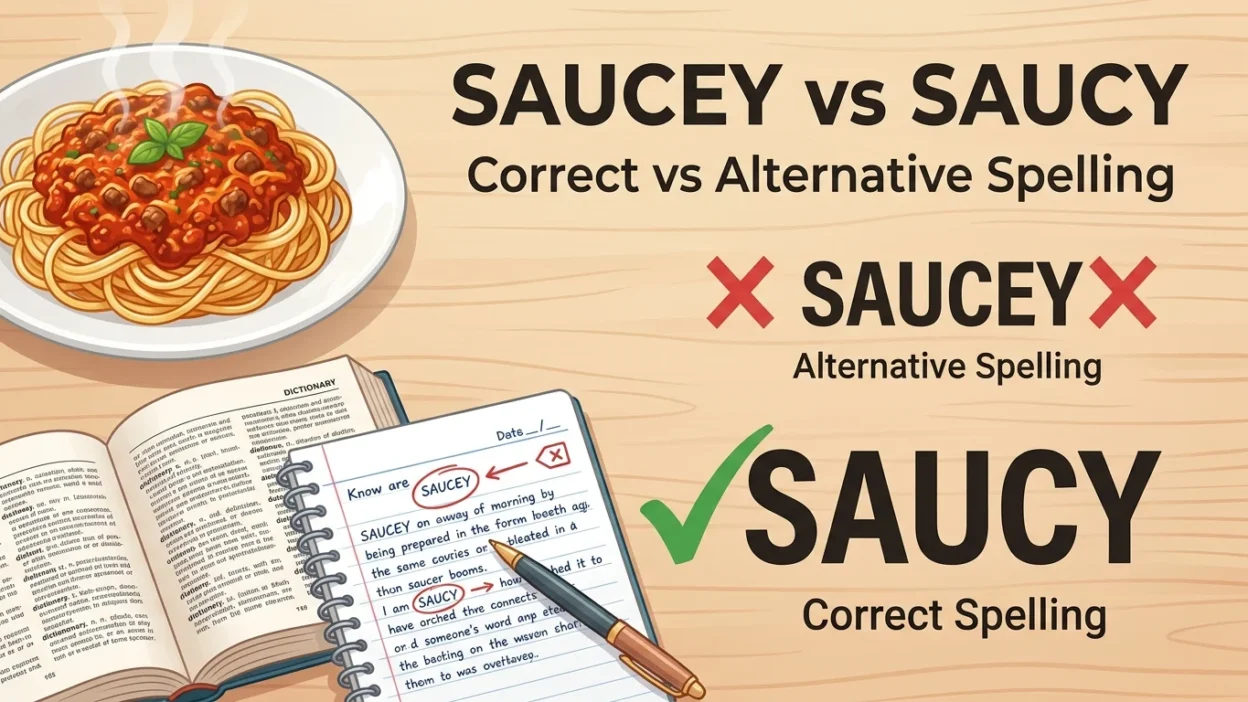
Are you wondering whether the correct spelling is saucey or saucy? The standard modern English spelling is saucy. The word can describe someone who is cheeky, bold, or slightly rude, and it can also describe something that has a lot of sauce or a sauce-like quality. Cambridge lists saucy as an English adjective with meanings related to cheeky or disrespectful behavior, while historical dictionaries also record its food-related sense.
The spelling saucey can still be found as an alternative form, and it may also appear in creative names or branding. Wiktionary records saucey as an alternative form of saucy, with historical examples of its use. For ordinary modern English writing, however, saucy is the established spelling to choose.
Quick Answer
Saucy is the standard spelling in modern English. It can describe food with plenty of sauce or someone who is cheeky, bold, or slightly rude. Saucey exists as an alternative spelling in some sources and contexts, but it is much less common. For essays, articles, emails, and standard English writing, use saucy.
Why Do People Confuse It?
The confusion comes from the noun sauce.
When people see:
sauce
they may naturally think that adding -y gives:
saucey
That looks logical, but the established adjective is:
saucy
English often changes the spelling of a base word when a suffix is added. Similar patterns can be seen in:
- spice → spicy
- ice → icy
- juice → juicy
- noise → noisy
So the safest approach is to remember the established word rather than trying to build it from sauce every time.
First Word: Saucey
What Does Saucey Mean?
Saucey is an alternative form of saucy recorded in some English sources. Wiktionary lists it specifically as an alternative spelling and provides historical examples.
This means saucey is not simply a completely unrelated invented form. However, it is far less common than saucy and is not the spelling most readers expect in standard modern English.
Should You Use Saucey?
For normal writing, it is better to use saucy.
You may encounter saucey in:
- Older or historical writing
- Creative writing
- Informal internet language
- Brand names
- Product names
- Intentional alternative spellings
For example, a company might deliberately choose Saucey as part of its name. That does not change the standard spelling of the adjective saucy.
Second Word: Saucy
What Does Saucy Mean?
Saucy is the standard English adjective.
It can describe behavior or language that is cheeky, bold, or slightly disrespectful, often in an amusing way. Cambridge gives examples such as a saucy remark, saucy manner, and saucy look.
Examples:
She gave him a saucy smile.
The child made a saucy remark.
In food-related contexts, saucy can describe something that contains or is covered with sauce. Historical dictionary sources record this meaning as well.
Example:
The pasta was rich and saucy.
Comparison Table
| Feature | Saucy | Saucey |
|---|---|---|
| Standard modern spelling | Yes | Less common |
| Common in general English | Yes | Rare |
| Used for cheeky behavior | Yes | Rare |
| Used for food | Yes | Rare |
| Dictionary-established form | Yes | Recorded as an alternative |
| Suitable for formal writing | Yes | Usually avoid |
| Used in branding | Sometimes | Can be intentional |
| Recommended for ordinary writing | Yes | Usually no |
When to Use Each
When to Use Saucy
Use saucy in normal modern English when describing:
- A cheeky or bold person
- A slightly rude remark
- A playful expression
- Food covered in or containing sauce
Examples:
He made a saucy comment.
The chicken was wonderfully saucy.
These uses are consistent with dictionary definitions and established English usage.
When to Use Saucey
Use saucey only when it is intentionally written that way, such as in a proper name, brand, product title, username, or creative text.
It can also appear as a historical or alternative spelling. Wiktionary records saucey as an alternative form of saucy.
For example, if a company officially spells its name Saucey, keep that spelling when referring to the company.
10+ Examples
Here are examples showing the standard use of saucy.
1. Food
The pasta has a rich, saucy texture.
2. Food
These wings are deliciously saucy.
3. Personality
He has a saucy sense of humor.
4. Comment
She made a saucy remark during the conversation.
5. Smile
He gave her a saucy smile.
6. Child
The saucy child answered back with a grin.
7. Restaurant
The chef prepared a saucy chicken dish.
8. Advertisement
The advertisement uses a playful, saucy tone.
9. Fiction
The character gave a saucy reply.
10. Conversation
That was a surprisingly saucy comment.
11. Recipe
Add the cooked vegetables to the saucy mixture.
12. Personality
She is known for her saucy and confident style.
These examples show that saucy can have different shades of meaning depending on context. Cambridge particularly emphasizes the cheeky or slightly rude sense, while other dictionary sources also record the food-related meaning.
Common Mistakes
Mistake 1: Adding E Before Y
Incorrect:
The pasta was saucey.
Standard:
The pasta was saucy.
The established adjective is saucy.
Mistake 2: Using Saucey for a Person
Incorrect for standard usage:
He made a saucey remark.
Standard:
He made a saucy remark.
Mistake 3: Assuming Sauce Must Become Saucey
The noun is sauce, but the adjective is saucy.
Remember:
sauce → saucy
Mistake 4: Assuming Saucey Never Exists
It would be too broad to say that saucey has never been used. Historical and alternative usage is documented. Wiktionary specifically lists saucey as an alternative form.
The practical distinction is that saucy is the standard choice for ordinary contemporary English.
Mistake 5: Confusing Saucy With Spicy
A dish can be saucy without being spicy.
Saucy emphasizes sauce or a sauce-like quality.
Spicy emphasizes a hot or strongly seasoned flavor.
Example:
The noodles are very saucy but not spicy.
Memory Trick
The easiest way to remember the spelling is:
sauce → saucy
Not:
sauce → saucey
You can connect it with similar patterns:
- spice → spicy
- ice → icy
- juice → juicy
- noise → noisy
The final e is dropped before -y in these familiar forms.
So remember:
SAUCY = no extra E
American vs British English
The spelling saucy is used in both American and British English. Cambridge provides both U.S. and U.K. pronunciation information while retaining the same spelling.
There is therefore no ordinary American-versus-British spelling difference here.
American English:
The sauce is saucy.
British English:
The sauce is saucy.
The spelling remains saucy.
Similar Words
Depending on the context, several words can be similar to saucy.
Cheeky
Often means slightly rude or bold in an entertaining way.
Example:
That was a cheeky comment.
Bold
Can describe someone who is confident or willing to take risks.
Example:
She made a bold statement.
Playful
Describes something light, teasing, or fun.
Example:
He gave her a playful smile.
Impudent
Means boldly disrespectful.
Example:
The impudent remark surprised everyone.
Flippant
Describes a lack of seriousness, especially in an inappropriate situation.
Example:
His flippant response annoyed the manager.
Spicy
Can describe food with a hot or strongly seasoned flavor.
Example:
The curry is very spicy.
These words are related to particular meanings of saucy, but none is a perfect replacement in every context.
Saucy vs Cheeky
Saucy and cheeky often overlap when describing a person’s behavior.
Cheeky is especially common for playful, mildly disrespectful behavior.
Saucy can suggest a similar attitude but may also carry a suggestive or flirtatious meaning depending on context. Cambridge notes that saucy can refer to sex in a humorous way.
Compare:
He gave a cheeky answer.
He gave a saucy answer.
The second may sound more teasing or suggestive depending on the situation.
Saucy vs Spicy
When talking about food, these words are different.
Saucy can mean having plenty of sauce or a sauce-like quality.
Spicy means containing spices or having a strong, hot, or pungent flavor.
For example:
The pasta is saucy but mild.
The curry is spicy but not very saucy.
So do not automatically replace one word with the other.
Saucy vs Sauce
These are different parts of speech.
Sauce is mainly a noun or verb.
Example:
The chef made a tomato sauce.
Saucy is an adjective.
Example:
The pasta is saucy.
Understanding the word family can make the spelling easier to remember.
Saucy in Food Writing
Saucy is useful in food descriptions when you want to emphasize that a dish has plenty of sauce or a rich sauce-like consistency. Historical and dictionary sources record this food-related sense.
Examples:
The ribs were tender and saucy.
I prefer my pasta extra saucy.
The chicken was coated in a thick, saucy glaze.
This use is common in informal food descriptions and recipes.
Saucy in Social and Personal Language
When used to describe a person, expression, or remark, saucy usually suggests cheekiness or boldness.
Examples:
She gave him a saucy grin.
That was a saucy comment.
He has a saucy sense of humor.
Depending on context, it can also have a mildly suggestive meaning. Cambridge explicitly includes this sense in its dictionary definition.
Because of that, consider the context before using saucy in professional communication.
Saucey as a Creative Spelling
You may see Saucey written intentionally in names, advertising, usernames, or product branding.
In these situations, spelling is part of the identity of the name.
For example, if a business officially calls itself Saucey, you should preserve the name exactly as the business writes it.
This is different from using saucey as an ordinary adjective.
Final Verdict
For standard modern English, saucy is the spelling to use.
Saucey is recorded as an alternative form and may appear in historical material or intentional creative and brand usage, but it is much less common than saucy.
So, when describing food, a remark, a person, or a playful attitude, the standard spelling is:
Saucy ✅
For example:
The pasta is saucy.
She made a saucy remark.
He gave her a saucy smile.
FAQs
Is saucey or saucy correct?
Saucy is the standard modern English spelling. Saucey exists as an alternative form but is much less common.
Is saucey a real word?
Yes, saucey is attested as an alternative form of saucy, including historical usage. It is not the usual spelling in contemporary standard English.
What does saucy mean?
Saucy can mean cheeky, bold, or slightly disrespectful. It can also describe something that has plenty of sauce or a sauce-like quality.
Is saucy a British or American word?
Saucy is used in both British and American English. The spelling is the same in both varieties.
Is saucy only used for food?
No. It can describe food, but it can also describe a person’s behavior, a remark, a smile, or something mildly suggestive.
Why is it saucy and not saucey?
The established adjective is saucy. The spelling does not simply keep the final e from sauce before adding -y.
Can Saucey be a name?
Yes. Saucey can be used intentionally in names, branding, usernames, or other creative contexts. The spelling of a proper name should be preserved as officially written.
Remember This
The easiest rule is:
Sauce → Saucy
Use saucy in ordinary modern English.
Remember:
Saucy = standard spelling
Saucey = alternative or intentional spelling
When you are writing an essay, article, email, recipe, or professional document, saucy is the form to choose.
Conclusion
When comparing saucey vs saucy, the standard modern English spelling is saucy. It can describe food with plenty of sauce, or it can describe someone or something as cheeky, bold, playful, or slightly suggestive depending on context.
The spelling saucey is not completely without precedent because it is recorded as an alternative form of saucy and may also appear intentionally in names or branding. However, for clear and conventional English writing, remember the simple pattern sauce → saucy and choose saucy.