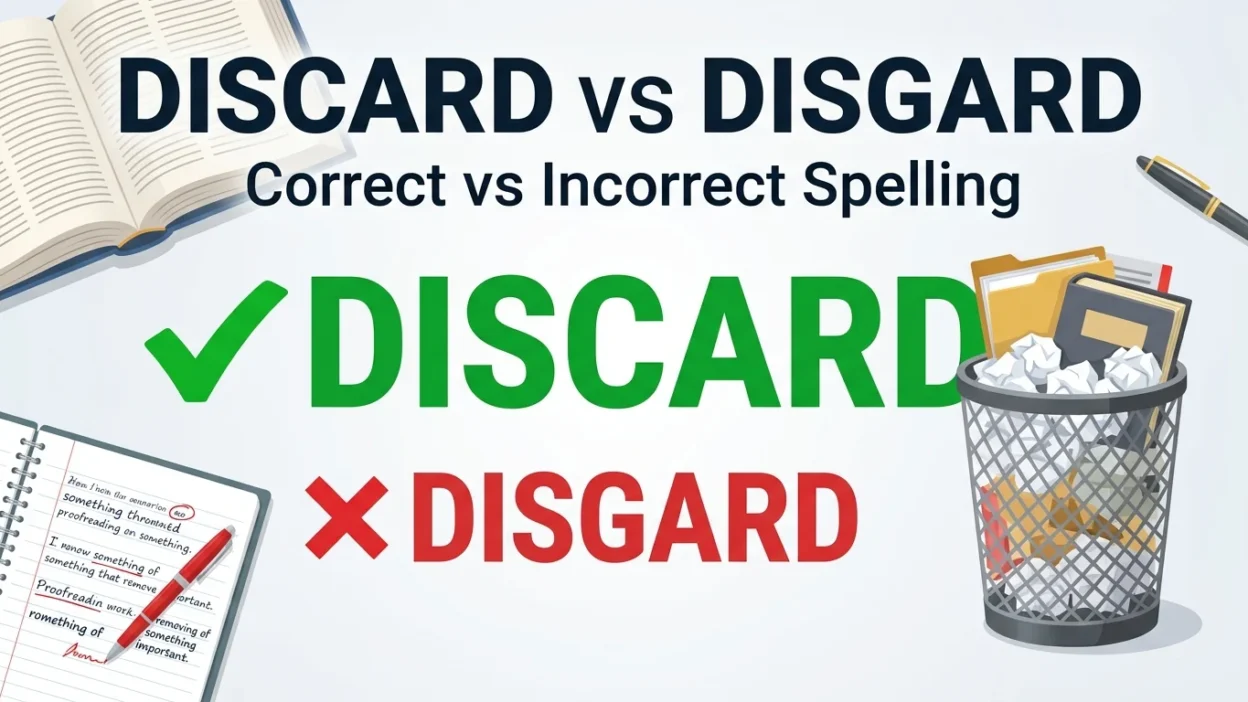
Are you confused about discard vs disgard? These two forms look and sound similar, but only one is the standard English spelling. The correct word is discard, with a c in the middle. It means to throw something away, get rid of something you no longer want, or reject something that is no longer useful. Cambridge Dictionary lists discard as both a verb and a noun.
The spelling disgard is a common misspelling of discard rather than a standard alternative spelling. This mistake can happen because the sound in the middle of discard may be easy to misremember, especially when the word is spoken quickly. In this guide, you will learn the meaning of discard, why disgard is incorrect, how to use the word in sentences, common related forms, and an easy memory trick to remember the correct spelling.
Quick Answer
Discard is the correct standard English spelling. It means to throw away, remove, reject, or get rid of something that is no longer wanted or useful. Disgard is a misspelling and should not be used in standard writing. Remember the middle c in discard: dis + card = discard.
Why Do People Confuse It?
The main confusion comes from the sound and appearance of the word.
When people hear discard, they may remember the middle sound incorrectly and write disgard. Another possible influence is the word guard, which has the spelling -guard, making disgard look like it could be a real English word.
However, the correct spelling is:
discard
The incorrect form is:
disgard
A useful way to remember the difference is to notice that discard contains card:
dis + card = discard
First Word: Disgard
Is Disgard Correct?
No. Disgard is not the standard spelling of the English word meaning to throw away or reject something.
For standard English writing, use discard.
Incorrect:
Please disgard these papers.
Correct:
Please discard these papers.
Why Does Disgard Look Right?
The spelling can seem logical because English has many words beginning with dis-, and the ending -gard appears in words such as regard and disregard.
This can create a spelling association that leads writers toward disgard. However, the standard word is formed as discard, and that is the form used in dictionaries and normal English writing.
Should You Use Disgard?
No. Avoid disgard in essays, emails, reports, articles, applications, and other standard English writing.
Use discard instead.
Second Word: Discard
What Does Discard Mean?
Discard means to throw something away or get rid of it because you no longer want or need it. Cambridge also gives a specific card-game meaning: to get rid of a card you are holding.
Examples:
- Please discard the empty bottle.
- We decided to discard the old files.
- She discarded the damaged clothes.
- He discarded a card during the game.
The word can be used for physical objects as well as ideas, plans, information, or options.
Discard as a Verb
As a verb, discard means to get rid of something.
Examples:
- Discard any damaged items.
- The editor discarded the unnecessary paragraph.
Discard as a Noun
Discard can also be a noun, especially in card games, where it refers to a card that has been discarded. Cambridge lists this noun use directly.
Example:
- The discard was placed on the table.
Comparison Table
| Feature | Discard | Disgard |
|---|---|---|
| Standard English spelling | Yes | No |
| Meaning | Throw away, remove, or reject | Usually a misspelling of discard |
| Verb | Yes | No |
| Noun | Yes | No |
| Used in formal writing | Yes | No |
| Used in academic writing | Yes | No |
| Used in British English | Yes | No |
| Used in American English | Yes | No |
| Recommended | Use | Avoid |
When to Use Each
When to Use Discard
Use discard when you mean to:
- Throw something away
- Get rid of something
- Reject an unwanted option
- Remove unnecessary information
- Let go of an idea or plan
Examples:
- Discard the damaged box.
- The editor discarded the weakest paragraph.
When Not to Use Disgard
Do not use disgard as the spelling of this word in standard English.
Write:
Discard the old documents.
Not:
Disgard the old documents.
10+ Examples of Discard
- Please discard the empty container.
- We should discard these broken tools.
- She decided to discard her old clothes.
- The editor chose to discard the unnecessary section.
- Please discard any expired products.
- The company discarded outdated equipment.
- He discarded the losing card.
- You can discard the unwanted files from your computer.
- They decided to discard the original plan.
- The chef told the assistant to discard the damaged vegetables.
- The researchers discarded the unreliable results.
- She discarded the idea after considering the alternatives.
- The system automatically discards duplicate information.
- Workers were instructed to discard defective items.
- He carefully discarded the papers he no longer needed.
These examples show that discard can be used for objects, information, ideas, plans, and other things that someone decides to remove or reject. Cambridge defines the core meaning as throwing something away or getting rid of it because it is no longer wanted or needed.
Common Mistakes
Mistake 1: Writing Disgard
Incorrect:
Please disgard the old documents.
Correct:
Please discard the old documents.
Mistake 2: Writing Disguard
Another incorrect form is disguard.
Incorrect:
We should disguard the old equipment.
Correct:
We should discard the old equipment.
Do not add u after the g.
Mistake 3: Writing Disgarded
The correct past form is:
discarded
Not:
disgarded
Example:
The company discarded the outdated files.
Mistake 4: Writing Disgarding
The correct -ing form is:
discarding
Not:
disgarding
Example:
The company is discarding unnecessary materials.
Mistake 5: Confusing Discard With Disregard
These words look similar, but their meanings are different.
Discard means to throw away or get rid of something.
Disregard means to ignore something or give it no attention. Cambridge defines disregard as ignoring something.
Compare:
- Discard the broken equipment.
- Disregard the warning.
One means get rid of it; the other means ignore it.
Memory Trick
The easiest way to remember discard is to see the word card inside it:
dis + card = discard
Imagine a card game. When you discard a card, you get rid of it.
So remember:
CARD → DISCARD
This is a useful memory connection because discard itself has a specific meaning in card games. Cambridge lists the card-game meaning as one of the standard uses of the word.
Whenever you hesitate between discard and disgard, think of card.
American vs British English
There is no standard American-British spelling difference between discard and discard. The word is spelled discard in both varieties of English.
American English:
- Please discard the old files.
British English:
- Please discard the old files.
The spelling stays the same.
The same is true for the common related forms:
- discarded
- discarding
- discards
So disgard is not a British or American alternative. It is simply not the standard spelling.
Similar Words
Several words can have meanings related to discard, but each has its own use.
Throw Away
This is a common everyday expression meaning to get rid of something.
Example:
- Please throw away the empty box.
Dispose Of
A more formal phrase meaning to get rid of something.
Example:
- Dispose of the waste properly.
Get Rid Of
A common conversational expression.
Example:
- I need to get rid of these old papers.
Reject
Means to refuse to accept something.
Example:
- The committee rejected the proposal.
Abandon
Means to stop supporting or continuing something.
Example:
- They abandoned the original plan.
Remove
Means to take something away.
Example:
- Remove the damaged part.
Disregard
Means to ignore something rather than physically throw it away.
Example:
- Please disregard the previous message.
These words can overlap with discard in certain situations, but they are not interchangeable in every sentence.
Discard vs Disregard
This is one of the most important distinctions to remember.
Discard means to get rid of something.
Disregard means to ignore something.
Compare:
- Discard the unwanted files.
- Disregard the previous instructions.
The files are removed in the first sentence. The instructions are ignored in the second.
Discard vs Reject
These words are also related.
Discard often means getting rid of something that is no longer wanted or useful.
Reject often means refusing to accept something.
Compare:
- The editor discarded the extra paragraph.
- The editor rejected the article.
The first focuses on removal. The second focuses on refusal or non-acceptance.
Discard vs Dispose
Dispose of is a formal expression meaning to get rid of something.
Compare:
- Please discard the packaging.
- Please dispose of the packaging properly.
Both can be correct, but dispose of can sound more formal and is often used for waste or materials that require proper handling.
Discarded, Discarding, and Discards
Learning the related forms can help you avoid spelling mistakes.
Discarded
Past tense and past participle.
Example:
The old files were discarded.
Discarding
Present participle or gerund.
Example:
They are discarding unnecessary materials.
Discards
Third-person singular present tense.
Example:
The machine discards damaged items.
Discard
Base form.
Example:
Please discard the old receipt.
The spelling remains based on discard, with the important c.
Discard in Everyday English
The word discard is useful in many ordinary situations.
You might discard:
- Old clothes
- Broken items
- Expired food
- Unwanted files
- Unnecessary papers
- Bad ideas
- Outdated plans
Examples:
- I discarded my old shoes.
- We discarded the original idea.
This makes discard a useful word when you want a more precise alternative to throw away.
Discard in Formal Writing
Discard is also useful in academic and professional writing.
Examples:
- The researchers discarded unreliable data.
- The editor discarded irrelevant information.
- The company discarded the outdated procedure.
- The analysis discarded several unsuitable options.
In these contexts, discard can sound more precise than casual expressions such as throw away.
How to Choose the Right Spelling
Remember these simple rules:
Use Discard
Use discard when you mean to throw away, remove, or reject something.
Remember the C
The middle of the word is c, not g:
dis c ard
Think of Card
Remember:
dis + card = discard
Avoid Disgard
Disgard is a spelling mistake, not the standard form of the word.
Final Verdict
Discard is the correct standard English spelling. It means to throw away or get rid of something because it is no longer wanted or needed, and it can also mean getting rid of a card during a card game.
Disgard is a misspelling and should be avoided in standard English writing. The easiest way to remember the correct form is to see card inside discard:
dis + card = discard
Whether you are writing about old files, unwanted objects, rejected ideas, or playing cards, use discard.
FAQs
Is it discard or disgard?
The correct spelling is discard. Disgard is a misspelling.
What does discard mean?
Discard means to throw something away or get rid of it because you no longer want or need it. It can also refer to getting rid of a card during a card game.
Is disgard a real English word?
Disgard is not the standard spelling of the word meaning throw away or get rid of. When that meaning is intended, use discard.
What is the past tense of discard?
The past tense is discarded.
Example:
She discarded the old papers.
What is the present participle of discard?
The -ing form is discarding.
Example:
They are discarding unnecessary files.
Can discard be a noun?
Yes. Discard can be a noun, particularly in card games, where it refers to a card that has been discarded.
What is a synonym for discard?
Depending on the context, synonyms include throw away, get rid of, dispose of, remove, reject, and abandon.
What is the difference between discard and disregard?
Discard means to get rid of something, while disregard means to ignore something.
Remember This
The correct spelling is:
DISCARD ✅
Not:
DISGARD ❌
The best memory trick is:
DIS + CARD = DISCARD
Think of throwing away a card in a card game. That connection makes the spelling much easier to remember.
Conclusion
When comparing discard vs disgard, the correct standard English form is discard. The word can mean throwing something away, getting rid of something unwanted, rejecting an option, or removing unnecessary material. It is also used as a noun in card games.
The spelling disgard is a common mistake and should not be used in standard English. To remember the correct spelling, think of card inside discard: dis + card = discard. Once you remember that small pattern, you can confidently use discard, discarded, and discarding in your writing.