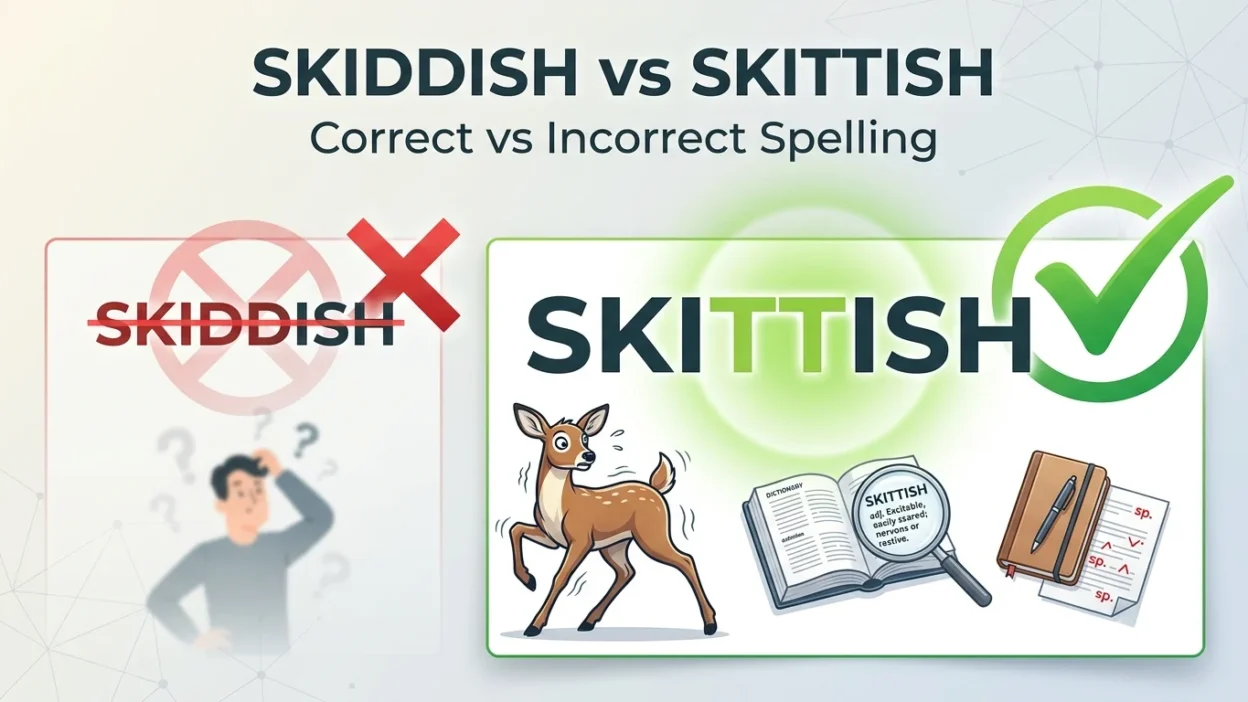
Are you confused about skiddish vs skittish? The correct standard English spelling is skittish, with a double t. Skiddish is generally treated as a misspelling or nonstandard form when the intended meaning is nervous, easily frightened, jumpy, or unpredictable. Cambridge lists skittish as an adjective for people and animals that are nervous or easily frightened, and it also uses the word for people or situations that may be changeable or uncertain.
The word skittish is especially common when describing animals, such as horses, cats, or deer that react quickly to unfamiliar sights or sounds. It can also describe people, investors, markets, moods, or situations that seem nervous or uncertain. Skiddish may appear because it looks connected to the familiar word skid, but standard English uses skittish for this meaning. Cambridge also records different British and American pronunciations, but the spelling remains the same.
Quick Answer
Skittish is the correct standard spelling. It means nervous, easily frightened, jumpy, or sometimes unpredictable. Skiddish is generally considered a misspelling or nonstandard form when it is intended to mean the same thing. Use skittish in formal, academic, professional, and everyday English writing.
Why Do People Confuse It?
The confusion is easy to understand because skiddish looks like a natural English word.
One possible reason is the familiar word skid. A car that skids can move suddenly or unpredictably, so it is easy to associate that idea with the nervous or jumpy meaning of skittish.
However, the standard word is spelled with tt:
skittish
not:
skiddish
Another reason is pronunciation. In American English, the t in skittish may be pronounced as a flap, which can sound somewhat like a d to some listeners. Cambridge gives the American pronunciation as /ˈskɪt̬.ɪʃ/ and the British pronunciation as /ˈskɪt.ɪʃ/.
First Word: Skiddish
Is Skiddish Correct?
When you mean nervous, easily frightened, or jumpy, skiddish is not the standard spelling.
For example:
Incorrect:
The skiddish horse became nervous near the traffic.
Correct:
The skittish horse became nervous near the traffic.
Some informal or user-generated sources may contain skiddish, and Wiktionary identifies it as a misspelling of skittish.
Why Does Skiddish Look Natural?
The spelling skiddish may feel natural because of words such as:
- skid
- skidding
- skidder
These words contain d, and the sound of skittish can sometimes encourage that spelling.
But skittish and skid are not the same word family for this meaning. To avoid the mistake, remember the double t.
Second Word: Skittish
What Does Skittish Mean?
Skittish is an adjective meaning nervous, easily frightened, easily startled, or jumpy. Cambridge gives this meaning for both people and animals. It can also describe someone who is not very serious or who changes opinions or behavior easily.
Examples:
- The skittish horse moved away from the fence.
- The kitten was skittish around strangers.
- Investors became skittish about the economy.
Collins also lists meanings such as lively, easily frightened, fickle, shy, and uncertain.
Skittish for Animals
This is one of the most common uses of the word.
A skittish animal reacts quickly to unfamiliar people, sounds, movement, or surroundings.
Examples:
- a skittish horse
- a skittish cat
- a skittish deer
- a skittish puppy
A skittish animal may suddenly move away, hide, run, or become alert.
Skittish for People
The word can also describe a person who is nervous, easily unsettled, or quick to react.
Example:
- She felt skittish before the interview.
It can suggest that someone is uneasy or not completely comfortable with a situation.
Skittish for Markets and Investors
Skittish is also common in financial and business writing.
Examples:
- Investors are becoming skittish about rising costs.
- The market remained skittish after the announcement.
Here, skittish means nervous, uncertain, or quick to react to possible problems. Cambridge specifically includes examples involving investors and economic concerns.
Comparison Table
| Feature | Skittish | Skiddish |
|---|---|---|
| Standard English spelling | Yes | No, for this meaning |
| Correct consonant | Double t | Uses dd |
| Meaning | Nervous, easily frightened, jumpy | Usually a misspelling of skittish |
| Used for animals | Yes | No |
| Used for people | Yes | No |
| Used for investors or markets | Yes | No |
| Recommended in formal writing | Yes | No |
When to Use Each
When to Use Skittish
Use skittish when something or someone is:
- nervous
- easily frightened
- easily startled
- jumpy
- uncertain
- quick to react
Examples:
- a skittish horse
- a skittish child
- skittish investors
- a skittish market
When Not to Use Skiddish
Avoid skiddish when you mean nervous or easily frightened.
Write:
skittish
not:
skiddish
This is especially important in school assignments, articles, reports, business writing, and other edited English.
10+ Examples
- The horse became skittish when it heard the loud noise.
- The kitten is skittish around unfamiliar people.
- Deer can be very skittish in areas with heavy traffic.
- She was feeling skittish before the important meeting.
- Investors grew skittish after the unexpected announcement.
- The dog was too skittish to approach the visitors.
- The skittish bird quickly flew away.
- The market remained skittish throughout the week.
- He became skittish when the conversation turned serious.
- The rescue horse was nervous and skittish at first.
- The team was cautious because investors were becoming skittish.
- The cat looked skittish when it heard footsteps outside.
- The young deer was especially skittish around people.
- She had a skittish reaction to the sudden change.
- The horse is normally calm but becomes skittish in crowds.
These examples reflect the standard uses recorded for skittish, including nervous behavior in animals and people and uncertainty in markets or attitudes.
Common Mistakes
Mistake 1: Writing Skiddish
Incorrect:
The dog is very skiddish.
Correct:
The dog is very skittish.
The correct spelling has tt, not dd.
Mistake 2: Writing Skitish
Another common error is dropping one t.
Incorrect:
The horse was skitish.
Correct:
The horse was skittish.
The standard spelling uses two ts.
Mistake 3: Connecting It to Skid
It is easy to think skiddish comes from skid because a skidding object can move unpredictably.
But that connection does not give you the standard spelling. The word you need is:
skittish
Mistake 4: Using Skittish for Every Kind of Fear
Skittish usually describes nervousness, jumpiness, or being easily startled. It does not always mean deep terror.
For intense fear, words such as terrified or frightened may be more suitable.
Mistake 5: Confusing Skittish With Shy
A shy person may avoid social interaction because they feel uncomfortable or lacking in confidence.
A skittish person may be nervous, jumpy, or quick to react.
The meanings can overlap, but they are not identical.
Memory Trick
The easiest way to remember skittish is to focus on the double t.
Think:
skittish = tt
You can connect it with words such as skitter, which also suggests quick, light movement. The spelling connection can help you remember the double t.
Another simple trick is:
skit, not skid
When you see skiddish, stop and remember that the standard spelling is skittish.
American vs British English
The spelling skittish is the same in American and British English. There is no standard spelling difference between the two varieties.
The pronunciation differs slightly. Cambridge gives:
- British English: /ˈskɪt.ɪʃ/
- American English: /ˈskɪt̬.ɪʃ/
So whether you use American or British English, the spelling remains:
skittish
Similar Words
Several words can be close in meaning to skittish, depending on context.
Nervous
Means worried, uneasy, or lacking confidence.
Example:
The dog became nervous around strangers.
Jumpy
Means easily surprised or startled.
Example:
He felt jumpy after hearing the strange noise.
Easily Frightened
A direct phrase for someone or something that reacts strongly to possible danger.
Example:
The young horse is easily frightened.
Startled
Means suddenly surprised or frightened by something unexpected.
Example:
The bird was startled by the loud sound.
Fidgety
Means unable to stay still, often because of nervousness or impatience.
Example:
The child became fidgety during the long meeting.
Uncertain
Means not confident or not sure about what will happen.
Example:
Investors remained uncertain about the future.
Fickle
Means likely to change opinions, feelings, or decisions.
Example:
His fickle attitude made planning difficult.
Skittish can overlap with several of these words, but its exact meaning depends on context.
Final Verdict
The correct spelling is skittish.
Use skittish when describing someone or something that is nervous, easily frightened, easily startled, or uncertain. It is commonly used for animals, people, investors, and markets.
Skiddish is generally a misspelling or nonstandard form when it is intended to express the same meaning. If you are writing in standard English, choose skittish.
FAQs
Is skiddish or skittish correct?
Skittish is the correct standard spelling. Skiddish is generally a misspelling when it is intended to mean nervous or easily frightened.
What does skittish mean?
Skittish means nervous, easily frightened, easily startled, or jumpy. It can also describe someone or something that is uncertain or changeable.
Why is skittish spelled with two Ts?
The standard spelling is skittish, with tt in the middle. The pronunciation can make the spelling less obvious, especially in American English.
Is skiddish a real word?
Skiddish can appear in informal or user-generated writing, but when it is intended to mean nervous or easily frightened, it is generally treated as a misspelling or nonstandard form rather than the standard word.
Can you use skittish for a person?
Yes. Skittish can describe a person who is nervous, uneasy, or quick to react.
Can you use skittish for investors?
Yes. Skittish is commonly used to describe investors who are nervous or uncertain about economic conditions or possible risks.
Is skittish the same in American and British English?
Yes. The spelling is skittish in both American and British English. The pronunciation can differ slightly.
What are some synonyms for skittish?
Depending on the context, useful alternatives include nervous, jumpy, easily frightened, startled, uncertain, and fickle.
Remember This
The correct word is:
SKITTISH ✅
The incorrect form is:
SKIDDISH ❌
Remember the double T:
ski + tt + ish
A useful mental check is:
skit, not skid
When you mean nervous, jumpy, easily frightened, or uncertain, write skittish.
Conclusion
When comparing skiddish vs skittish, the correct standard English spelling is skittish. It is an adjective used for people, animals, and sometimes markets or situations that are nervous, easily frightened, jumpy, or uncertain. The word is especially common when describing animals that react quickly to unfamiliar sounds or surroundings.
The spelling skiddish is generally treated as a misspelling or nonstandard form for this meaning. The easiest way to remember the correct spelling is to focus on the double t in skittish. Whether you are writing an essay, article, story, or everyday message, use skittish, not skiddish.