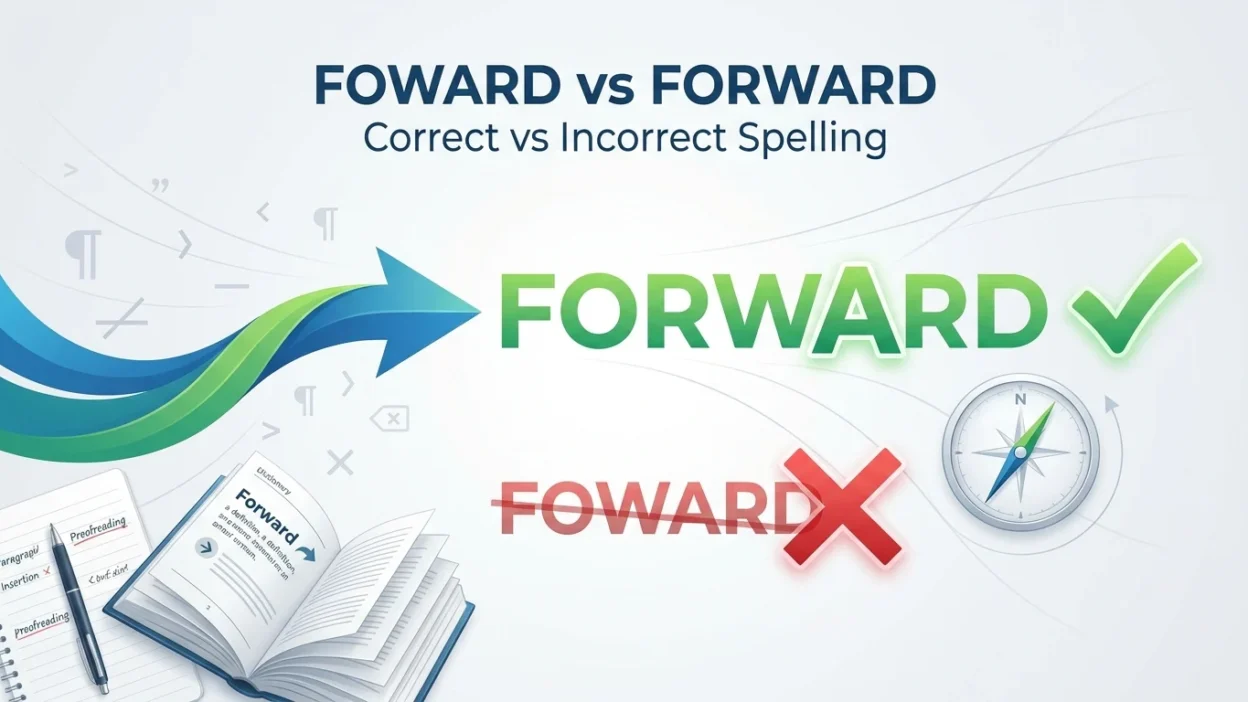
Are you confused about foward vs forward? The correct standard English spelling is forward, with an r after the letter o. Foward is a common spelling mistake. The word forward can mean toward the front, toward a place or time ahead, or in the direction of progress.
You will see forward in many common expressions, including move forward, look forward to, forward message, forward-thinking, and going forward. It is used as an adverb, adjective, verb, and sometimes a noun depending on the context. Because the first part of the word can sound quick when spoken, some writers accidentally leave out the second r and write foward. This article explains the difference between foward and forward, gives practical examples, highlights common spelling mistakes, and shows you an easy way to remember the correct form.
Quick Answer
Forward is the correct standard English spelling. It can mean toward the front, ahead in space or time, or toward progress. Foward is a misspelling and should not be used in standard English. Remember the spelling: F-O-R-W-A-R-D. The extra r after fo is essential.
Why Do People Confuse It?
The main reason people write foward instead of forward is that the second r can be difficult to notice in quick speech.
The word is often pronounced smoothly, especially in connected speech, so learners may hear something closer to foward even though the spelling contains the additional r.
Another reason is that English has several words beginning with fo-, and writers may spell the word according to how they think it sounds.
The correct spelling is:
forward
not:
foward
A useful approach is to remember the word as two parts:
for + ward
This makes the missing r much easier to notice.
First Word: Foward
Is Foward Correct?
No. Foward is a misspelling of forward.
If you mean moving ahead, being directed toward the front, or progressing toward the future, use forward.
Incorrect:
Please move foward.
Correct:
Please move forward.
Why Does Foward Look Correct?
The spelling foward looks believable because the pronunciation of forward can make the second r less noticeable.
However, the correct spelling contains two r letters:
forward
The spelling can be remembered as:
for + ward
Second Word: Forward
What Does Forward Mean?
Forward has several related meanings.
It can mean moving toward the front.
Example:
- Take two steps forward.
It can mean toward a later time.
Example:
- From this point forward, things will change.
It can describe progress or development.
Example:
- We need to move forward with the plan.
It can also mean sending something onward, such as an email or message.
Example:
- Please forward the email to the manager.
Dictionary definitions commonly cover these ideas of direction, progress, time, and sending something onward.
Forward as an Adverb
As an adverb, forward describes movement toward the front or ahead.
Examples:
- She stepped forward.
- The car moved forward.
- He leaned forward.
- We should move forward.
Forward as an Adjective
As an adjective, forward can describe something positioned toward the front or something focused on future development.
Examples:
- The forward section of the ship is damaged.
- The company has a forward-looking strategy.
- She is a forward-thinking leader.
Forward as a Verb
As a verb, forward means to send something to another person or place.
Examples:
- Please forward the document.
- I forwarded your message to the team.
- Can you forward me the details?
Comparison Table
| Spelling | Correct? | Meaning | Example |
|---|---|---|---|
| Forward | Yes | Ahead, toward the front, onward, or sent onward | Please move forward. |
| Foward | No | Misspelling of forward | Please move foward. |
When to Use Each
When to Use Forward
Use forward when you mean:
- Toward the front
- Ahead in time
- Toward progress
- Sending something onward
- Focused on the future
Examples:
- Move forward carefully.
- Looking forward to meeting you.
- Please forward the email.
- We need to move forward with the project.
- The company has a forward-thinking approach.
When Not to Use Foward
Do not use foward in standard English writing.
This applies to:
- school assignments
- professional emails
- reports
- articles
- business documents
- applications
- formal communication
Always use forward.
10+ Examples of Forward
- Please move forward and take your seat.
- The car slowly moved forward.
- She stepped forward to answer the question.
- We must move forward with the project.
- I look forward to hearing from you.
- Please forward the email to the customer.
- He leaned forward to get a better view.
- From this day forward, we will follow the new rules.
- The team is looking forward to the competition.
- The company plans to move forward with the expansion.
- Can you forward the document to my office?
- We should focus on moving forward rather than repeating the same mistakes.
- The forward section of the building is under renovation.
- She has a forward-thinking approach to education.
- The discussion moved forward after everyone agreed on the main issue.
These examples show the most common uses of forward, including movement, future time, progress, communication, and description.
Common Mistakes
Mistake 1: Writing Foward
Incorrect:
We need to move foward.
Correct:
We need to move forward.
The second r is part of the standard spelling.
Mistake 2: Forgetting the R After Fo
Incorrect:
f-o-w-a-r-d
Correct:
f-o-r-w-a-r-d
A simple spelling check is to look for for at the beginning:
for + ward = forward
Mistake 3: Confusing Forward With Foreword
Forward and foreword are different words.
Forward means ahead, toward the front, or onward.
Example:
- We moved forward.
Foreword is a short introduction at the beginning of a book, usually written by someone other than the main author.
Example:
- The author wrote a foreword for the new edition.
Mistake 4: Confusing Forward With Towards
Forward describes movement ahead or toward the front.
Example:
- She walked forward.
Towards means in the direction of a person, place, or thing.
Example:
- She walked towards the door.
They can sometimes occur together:
- He moved forward towards the entrance.
Mistake 5: Confusing Forward With Onward
Both can describe progress, but onward often emphasizes continuing farther or into the future.
Examples:
- We moved forward with the plan.
- From here onward, things will be different.
Memory Trick
The easiest way to remember forward is:
FOR + WARD
The first part is for, not fo.
Think:
for + ward = forward
Another useful memory sentence is:
Move FORward.
The word forward contains for near the beginning, which helps you remember the extra r.
American vs British English
The spelling forward is standard in both American and British English.
American English:
- move forward
- look forward to
- forward the email
British English:
- move forward
- look forward to
- forward the email
There is, however, a related spelling difference worth knowing.
In American English, forward is the usual form.
In British English, forward is also common, but forwards can be used as an adverb in some contexts.
Examples:
- He stepped forward.
- He stepped forwards.
The spelling foward is not a standard alternative in either variety.
Similar Words
Several words are related to forward, but their meanings vary by context.
Ahead
Means in front or at a later point in time.
Example:
- There is a long road ahead.
Onward
Means continuing forward or farther.
Example:
- The travelers continued onward.
Advancing
Means moving forward or making progress.
Example:
- The team is advancing toward its goal.
Progressive
Means favoring development, change, or improvement.
Example:
- The company has a progressive approach.
Forth
A more formal or literary word meaning forward or onward.
Example:
- The journey moved forth.
Frontward
Means toward the front, although it is less common than forward.
Example:
- The seats face frontward.
Ahead
Can refer to position, time, or progress.
Example:
- We have many challenges ahead.
These words can overlap with forward, but they are not always interchangeable.
Forward vs Foreword
This is one of the most common word-choice confusions.
Forward means ahead, toward the front, onward, or to send something onward.
Example:
- Please forward the message.
Foreword is an introductory section at the beginning of a book.
Example:
- The professor wrote the foreword.
A useful memory trick is:
foreword = words before the main book
while:
forward = moving ahead
Forward vs Forwards
Forward and forwards can both be used to describe movement toward the front.
Examples:
- She stepped forward.
- She stepped forwards.
Forward is the form commonly preferred in American English and is also widely used in British English. Forwards is more frequent in some British contexts.
However, this variation does not affect the spelling of the first syllable.
Never change forward to foward.
Forward vs Onward
These two words are often related to progress.
Forward can emphasize movement toward a point ahead.
Example:
- The project is moving forward.
Onward often emphasizes continued movement.
Example:
- The travelers continued onward.
Both can be useful, but forward is much more common in everyday modern English.
Forward vs Ahead
Ahead often means in front of you or at a later point.
Example:
- There is a difficult road ahead.
Forward focuses more directly on movement or direction.
Example:
- Take one step forward.
Both can describe progress:
- We must look ahead.
- We must move forward.
Forward in Common Expressions
Look Forward To
Look forward to means to feel pleased or excited about something that will happen.
Example:
- I look forward to seeing you.
Remember that when a verb comes after look forward to, it normally takes the -ing form:
- I look forward to meeting you.
- She looks forward to visiting her family.
Move Forward
Means to continue or make progress.
Example:
- We need to move forward with the plan.
Going Forward
Means from now on or in the future.
Example:
- Going forward, we will use a new system.
Forward-Thinking
Describes someone or something focused on new ideas and future development.
Example:
- The company needs a forward-thinking strategy.
Forward a Message
Means to send a message received from one person to another person.
Example:
- Please forward this message to Sarah.
Forward as a Direction
When used as a direction, forward means toward the front.
Examples:
- Lean forward.
- Walk forward.
- Step forward.
- Move forward.
It is often used as the opposite of backward or backwards.
Compare:
- Move forward.
- Move backward.
Forward in Time
Forward can also refer to future time.
Examples:
- From this point forward, the rules will change.
- We must plan several months forward.
- Looking forward, the company expects continued growth.
The expression from this point forward is especially common when describing a new situation that will continue into the future.
Forward in Communication
As a verb, forward is common in digital communication.
Examples:
- Forward the email to me.
- I forwarded the attachment.
- She forwarded the message to her manager.
It is particularly useful in email, messaging, and office communication.
How to Choose the Right Spelling
The rule is simple.
Use Forward
Use forward when you mean:
- ahead
- toward the front
- toward the future
- toward progress
- sending something onward
Remember the First Four Letters
Think:
F-O-R-W
not:
F-O-W
The r after fo is essential.
Avoid Foward
Foward is simply a misspelling of forward.
Final Verdict
The correct spelling is forward, not foward.
Use forward when talking about movement toward the front, progress, future time, or sending something to another person. It is one of the most common words in English and appears in expressions such as move forward, look forward to, going forward, and forward-thinking.
The easiest way to remember the spelling is:
FOR + WARD = FORWARD
Keep the r after fo, and you will avoid the common mistake of writing foward.
FAQs
Is foward or forward correct?
Forward is correct. Foward is a misspelling.
How do you spell forward correctly?
The correct spelling is F-O-R-W-A-R-D.
What does forward mean?
Forward can mean toward the front, ahead in time, toward progress, or to send something onward.
Is foward a real word?
Foward is not the standard spelling of forward in modern English. It is normally treated as a spelling mistake.
What is the opposite of forward?
The most common opposite is backward or backwards, depending on the sentence and variety of English.
Is forward the same in American and British English?
Yes. Forward is standard in both American and British English. British English may also use forwards in some adverbial contexts.
What does look forward to mean?
Look forward to means to feel happy or excited about something that is expected to happen.
Example:
I look forward to meeting you.
What is the difference between forward and foreword?
Forward relates to movement, direction, progress, or sending something onward. Foreword is an introduction at the beginning of a book.
Remember This
The correct spelling is:
FORWARD ✅
The incorrect spelling is:
FOWARD ❌
Remember:
FOR + WARD = FORWARD
The important letter is the R after FO.
Conclusion
When comparing foward vs forward, the correct standard English spelling is forward. The word can describe movement toward the front, progress, a later point in time, or the act of sending something onward. It is widely used in everyday, academic, business, and digital communication.
The spelling foward is a common mistake caused mainly by the way forward can sound in quick speech. The easiest way to remember the correct form is to break it into for + ward and make sure the r is present. Whether you are writing an email, essay, report, or message, always use forward, not foward.

Gabriel John is a language enthusiast and grammar writer at Synolexes. He creates clear, practical content on English grammar, vocabulary, and writing, helping learners improve communication skills with confidence.