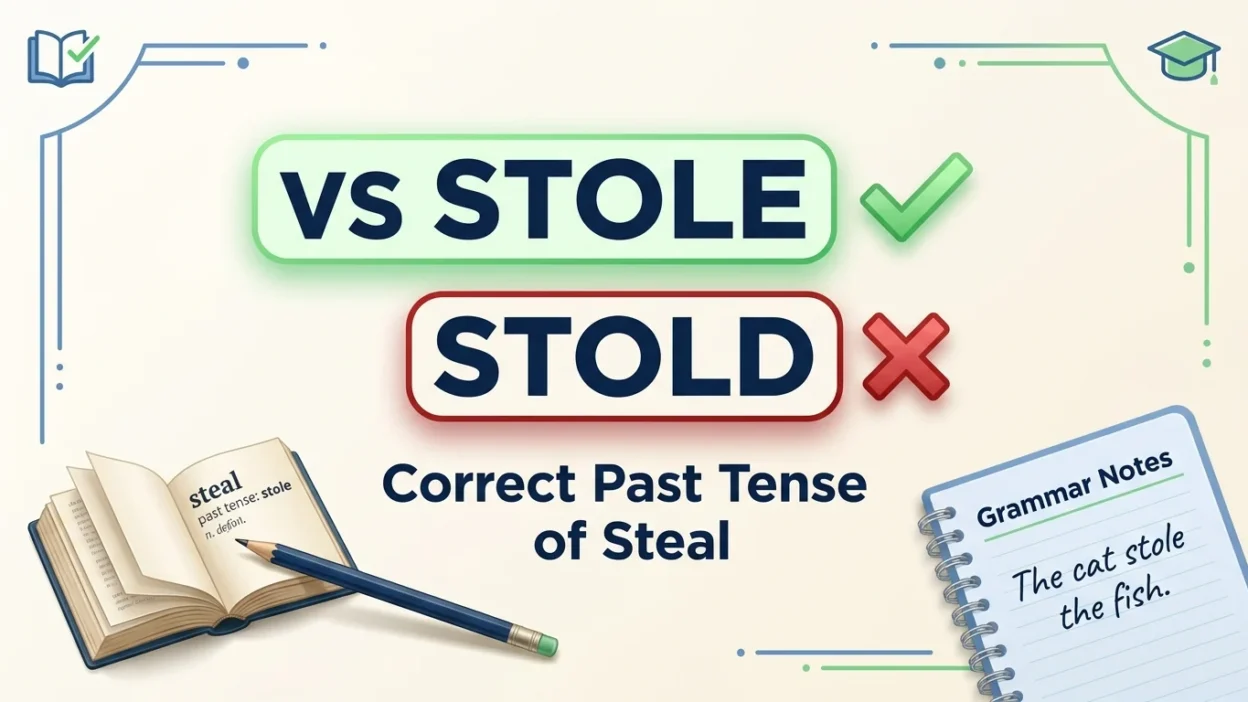
The difference between stole vs stold is simple: stole is the correct past tense of steal, while stold is a misspelling. If you want to describe taking something without permission, use stole. For example, She stole my pen is grammatically correct, but She stold my pen is incorrect. Learning the difference helps you write clear sentences, avoid common spelling mistakes, and use English verbs correctly.
Many English learners confuse these words because English has both regular and irregular verbs. Regular verbs usually form their past tense by adding -ed, such as walk and walked. However, irregular verbs change in different ways. Steal is an irregular verb, so its past tense is stole rather than stealed or stold. Understanding this pattern makes it easier to recognize the correct form in everyday conversations, school assignments, emails, and formal writing. In this guide, you will learn the meaning of stole, why stold is incorrect, how to use stole in sentences, and how to remember the correct spelling.
Quick Answer
Stole is the correct word, and stold is incorrect in standard English. Stole is the simple past tense of steal, meaning to take something without permission. For example, The boy stole a bicycle. Remember the verb forms: steal, stole, stolen. Do not use stold in standard writing.
Why Do People Confuse Stole and Stold?
People confuse stole and stold because they may expect every English verb to follow the same past-tense pattern.
Regular verbs usually add -ed to form the past tense:
- Walk → walked
- Talk → talked
- Help → helped
However, steal is an irregular verb. Its past tense changes to stole, and its past participle is stolen.
Some learners mistakenly add a different ending or change the spelling because they are unfamiliar with this irregular pattern. Although stold may look like a possible past-tense form, it is not accepted as the standard form of steal.
First Word: Stole
Stole is the correct simple past tense of steal.
It describes an action that happened in the past when someone took something without the owner’s permission.
Meaning of Stole
Stole means took something dishonestly or without permission.
Examples:
- Someone stole my wallet yesterday.
- The thief stole a valuable painting.
- My brother stole a glance at the surprise gift.
- Someone stole her bicycle from outside the school.
The word can also be used figuratively. For example, She stole the show means she attracted the most attention or gave the most impressive performance.
Verb Forms of Steal
| Verb form | Word | Example |
|---|---|---|
| Base form | Steal | Never steal from others. |
| Simple past | Stole | He stole my notebook. |
| Past participle | Stolen | My notebook was stolen. |
| Present participle | Stealing | Someone is stealing the packages. |
| Third-person singular | Steals | He steals ideas from others. |
Remember that stole is used for a completed past action, while stolen is used with helping verbs such as has, have, and had or in passive constructions.
Second Word: Stold
Stold is an incorrect spelling of the past tense of steal in standard English.
It is sometimes written by people who misunderstand how irregular verbs work. However, dictionaries and standard English grammar use stole as the simple past form.
Is Stold Ever Correct?
No, not as the standard past tense of steal. In schoolwork, professional writing, exams, and everyday standard English, use stole instead.
Incorrect: She stold my phone last night.
Correct: She stole my phone last night.
Incorrect: He has stold my money.
Correct: He has stolen my money.
The second correction uses stolen because the present perfect tense requires has or have plus the past participle.
Stole vs Stold: Comparison Table
| Feature | Stole | Stold |
|---|---|---|
| Correct spelling | Yes | No |
| Part of speech | Verb | Incorrect verb form |
| Meaning | Took without permission | No standard meaning as a past tense of steal |
| Grammar | Simple past tense of steal | Not accepted in standard English |
| Example | He stole my bag. | He stold my bag. |
| Use in formal writing | Correct | Incorrect |
The main difference is that stole is the established past-tense form, while stold is a spelling error.
When Should You Use Stole or Stold?
Use Stole When Talking About the Past
Use stole when describing an action that happened previously.
Examples:
- Someone stole my bicycle yesterday.
- The company stole his idea.
- She stole a cookie before dinner.
- The actor stole the spotlight.
Do Not Use Stold in Standard English
Avoid stold in essays, messages, school assignments, professional documents, and other standard English writing.
Instead of writing He stold the keys, write He stole the keys.
Use Stolen With Has, Have, Had, or Passive Voice
Although stole is correct for the simple past, stolen is the correct past participle.
Examples:
- She has stolen my book.
- They had stolen the documents before the police arrived.
- My phone was stolen last week.
Choosing between stole and stolen depends on the sentence structure, not just the time of the action.
12 Examples of Stole vs Stold in Sentences
Here are practical examples showing how to use the correct word.
- Correct: The boy stole my pencil.
Incorrect: The boy stold my pencil. - Correct: Someone stole her handbag on the bus.
Incorrect: Someone stold her handbag on the bus. - Correct: He stole money from the drawer.
Incorrect: He stold money from the drawer. - Correct: The thief stole a valuable necklace.
Incorrect: The thief stold a valuable necklace. - Correct: They stole the documents last night.
Incorrect: They stold the documents last night. - Correct: My little brother stole a cookie from the jar.
Incorrect: My little brother stold a cookie from the jar. - Correct: Someone stole my bicycle outside the library.
Incorrect: Someone stold my bicycle outside the library. - Correct: The player stole the ball from his opponent.
Incorrect: The player stold the ball from his opponent. - Correct: She stole the show with her excellent performance.
Incorrect: She stold the show with her excellent performance. - Correct: The artist stole the audience’s attention.
Incorrect: The artist stold the audience’s attention. - Correct: He stole a quick look at the answer sheet.
Incorrect: He stold a quick look at the answer sheet. - Correct: The company stole the competitor’s idea.
Incorrect: The company stold the competitor’s idea.
These examples demonstrate that stole works in both literal and figurative expressions. Stold should not replace it in standard English.
Common Mistakes With Stole and Stold
English learners often make several mistakes when using the verb steal.
1. Writing Stold Instead of Stole
Incorrect: He stold my wallet.
Correct: He stole my wallet.
2. Using Stealed as the Past Tense
Incorrect: She stealed the money.
Correct: She stole the money.
Steal is irregular, so its past tense does not follow the regular -ed pattern.
3. Using Stole After Has or Have
Incorrect: He has stole my phone.
Correct: He has stolen my phone.
Use stolen after has, have, or had when forming perfect tenses.
4. Confusing Stole With Stolen
Incorrect: The bag was stole yesterday.
Correct: The bag was stolen yesterday.
Passive sentences require the past participle stolen in this construction.
5. Forgetting the Meaning of Steal
Steal means to take something without permission or legal right. It is not the same as borrow, which generally means taking something with the intention of returning it.
Memory Trick: How to Remember Stole
Use this simple pattern:
Steal → Stole → Stolen
Think of these three sentences:
- Today, I do not steal.
- Yesterday, I stole.
- My belongings have been stolen.
Another helpful trick is to remember the familiar phrase He stole the show. The phrase uses the correct spelling and demonstrates that stole can also mean attracting attention or impressing an audience.
Whenever you are unsure whether to write stole or stold, remember that the correct past-tense form contains no d at the end.
Stole vs Stold in American and British English
There is no standard American-versus-British spelling difference for this pair.
Both American English and British English use stole as the simple past tense of steal. Both also use stolen as the past participle.
Examples in American English:
- Someone stole my backpack.
- My laptop was stolen yesterday.
Examples in British English:
- Someone stole my bag.
- My bicycle was stolen yesterday.
The spelling remains the same in both varieties. Stold is not the standard form in either variety of English.
Similar Words to Stole and Stold
Learning related words can help you understand the correct verb forms.
| Word | Meaning | Example |
|---|---|---|
| Steal | Take something without permission | Never steal another person’s property. |
| Stole | Took something in the past | Someone stole my keys. |
| Stolen | Past participle of steal | Her purse has been stolen. |
| Stealing | Taking something without permission | He was caught stealing. |
| Robbed | Took property from a person or place through a crime | The shop was robbed last night. |
| Took | General past tense of take | She took my book by mistake. |
| Borrowed | Took something temporarily with the intention of returning it | I borrowed his pen. |
These words are related, but they are not always interchangeable. For example, robbed often refers to a crime involving a person or place, while stole focuses on the act of taking something without permission.
Final Verdict: Stole or Stold?
Stole is correct; stold is incorrect in standard English.
Use stole when describing something taken without permission in the past. Use stolen with has, have, had, or in appropriate passive constructions.
Remember the three main forms:
- Present: steal
- Past: stole
- Past participle: stolen
For example, He stole my watch yesterday is correct, while He stold my watch yesterday is incorrect.
FAQs
1. Is stole or stold correct?
Stole is correct. It is the simple past tense of steal. Stold is an incorrect spelling in standard English.
2. What is the past tense of steal?
The past tense of steal is stole. For example, She stole my notebook yesterday.
3. Is stold a real English word?
Stold is not accepted as the standard past-tense form of steal. Use stole in standard English writing and speech.
4. Is it stealed or stole?
Stole is correct. Steal is an irregular verb, so its simple past tense is stole rather than stealed.
5. What is the past participle of steal?
The past participle is stolen. For example, Someone has stolen my phone.
6. Should I write he stole or he has stole?
Write he stole for a simple past action and he has stolen for the present perfect tense. For example, He stole my wallet yesterday, but He has stolen my wallet before.
7. Do Americans and British people spell stole differently?
No. Both American and British English use stole as the past tense of steal and stolen as its past participle.
8. What is the difference between stole and stolen?
Stole is the simple past tense, while stolen is the past participle. You can write She stole the bag and She has stolen the bag, but the two forms cannot be freely exchanged.
Remember This
- Stole = correct simple past tense of steal.
- Stold = incorrect in standard English.
- Stolen = past participle of steal.
- Steal → Stole → Stolen = the correct verb pattern.
If you remember these three forms, you can avoid the most common mistakes with this verb.
Conclusion
The difference between stole and stold is straightforward once you understand irregular verbs. Stole is the correct past tense of steal, while stold is a misspelling in standard English. Use stole when describing an action that happened in the past, such as He stole my bag yesterday. When using has, have, had, or a suitable passive construction, choose stolen instead.
To improve your English, practise the pattern steal, stole, stolen and use it in your own sentences. Remember that the correct form stays the same in American and British English. With a little practice, you will find it easier to choose the right word in conversations, school assignments, and professional writing.

Gabriel John is a language enthusiast and grammar writer at Synolexes. He creates clear, practical content on English grammar, vocabulary, and writing, helping learners improve communication skills with confidence.