If you are unsure whether to write proceed or procede, you are dealing with a common English spelling confusion. The two forms look almost identical, but they do not have the same status in standard English.
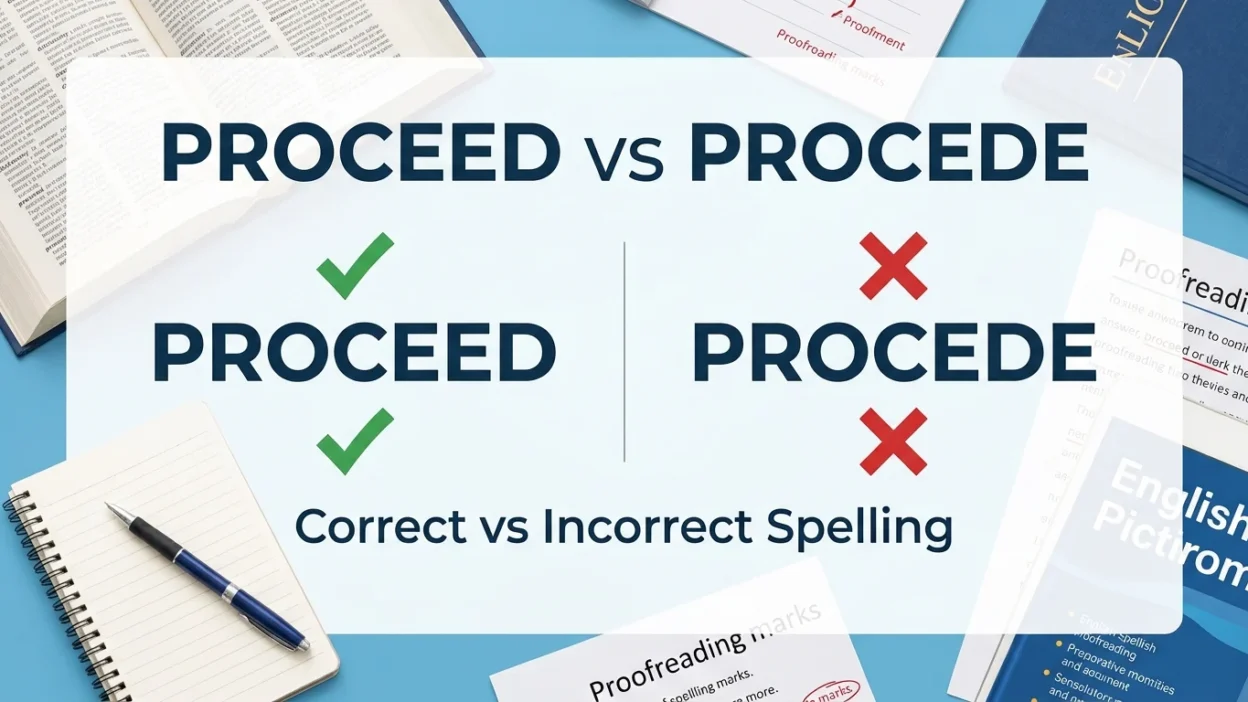
The correct spelling of the common English verb meaning to continue, move forward, or go ahead is proceed. The spelling procede is generally incorrect when you intend to use that verb.
In this guide, we will explain proceed vs procede in simple English, with meanings, examples, common mistakes, usage rules, and an easy memory trick.
Quick Answer
Proceed is the correct standard English spelling.
Proceed means to continue, move forward, or go ahead with something.
Procede is generally a misspelling of proceed and should not be used in standard English when you mean continue or move forward.
Correct: Please proceed to the next room.
Incorrect: Please procede to the next room.
Why Do People Confuse Proceed and Procede?
The confusion happens because proceed and procede look and sound very similar. The ending can be especially confusing because English has several words that use different combinations of -ceed and -cede.
For example:
- proceed
- succeed
- exceed
- recede
- concede
- precede
Because precede is a correctly spelled English word, some people may mistakenly assume that procede should also be correct.
However, the standard spelling of the verb meaning continue or move forward is:
PROCEED
Proceed: Meaning and Usage
Proceed is a verb that means to continue doing something, move forward, or go ahead.
It is commonly used in formal, professional, academic, and everyday English.
Proceed Means Continue
When you continue an activity after something has happened, you can use proceed.
Examples:
- We can proceed with the meeting.
- She proceeded with her work.
- The teacher told the students to proceed with the exercise.
- After a short break, the team proceeded with the discussion.
Proceed Means Move Forward
Proceed can also mean physically moving forward or going to a particular place.
Examples:
- Please proceed to the main entrance.
- The passengers were asked to proceed to the boarding area.
- After checking the map, we proceeded toward the village.
- The officer instructed the driver to proceed carefully.
Proceed With Something
One of the most common patterns is:
proceed with + noun
Examples:
- We decided to proceed with the plan.
- The company will proceed with the project.
- They are ready to proceed with construction.
- You may proceed with your application.
Proceed to Do Something
Another common structure is:
proceed to + verb
This means to move on to the next action.
Examples:
- He proceeded to explain the problem.
- She proceeded to answer the questions.
- The speaker proceeded to discuss the main issue.
- The guide proceeded to describe the next step.
Procede: Is It Correct?
In standard modern English, procede is generally not the correct spelling of the verb meaning continue, move forward, or go ahead.
If you want to express that meaning, use proceed.
Incorrect: We will procede with the project.
Correct: We will proceed with the project.
Incorrect: Please procede to the next step.
Correct: Please proceed to the next step.
It is important not to confuse procede with the correctly spelled word precede.
Proceed vs Procede Comparison Table
| Word | Standard English? | Meaning | Example |
|---|---|---|---|
| Proceed | Yes | Continue or move forward | Please proceed with the task. |
| Proceed | Yes | Go to a place or next step | Proceed to the reception desk. |
| Proceed | Yes | Continue after an event | The meeting proceeded as planned. |
| Procede | No, in this intended meaning | Usually a misspelling of proceed | Do not write procede when you mean proceed. |
When to Use Proceed
Use proceed when you want to say continue, move forward, go ahead, or move to the next step.
In Formal Instructions
- Please proceed to the designated area.
- Candidates should proceed to the examination hall.
- Proceed to the next question when you are ready.
In Business Writing
- We are ready to proceed with the agreement.
- The company will proceed with the proposed changes.
- The team decided to proceed with the project.
In Everyday Conversation
- You can proceed without me.
- Go ahead and proceed.
- We should proceed carefully.
- They proceeded toward the exit.
In Academic Writing
- The researchers proceeded with the experiment.
- We can now proceed to the next section.
- The study proceeded according to the planned procedure.
10+ Examples of Proceed
Here are practical examples showing how proceed is used correctly.
- Please proceed to the reception desk.
- We can proceed with the meeting now.
- The students proceeded to the next exercise.
- She decided to proceed with her original plan.
- The driver proceeded slowly because of the heavy rain.
- After receiving permission, they proceeded with the work.
- Please proceed to the next page.
- The manager asked the team to proceed carefully.
- He proceeded to explain the situation.
- Once everyone arrived, the event proceeded as planned.
- You may proceed with your application.
- The investigation will proceed according to the established procedure.
Common Mistakes with Proceed and Procede
Mistake 1: Writing Procede
The most common mistake is replacing the final -ceed in proceed with -cede.
Incorrect: We will procede with the plan.
Correct: We will proceed with the plan.
Mistake 2: Confusing Proceed With Precede
Proceed and precede are both real words, but their meanings are different.
Proceed = continue or move forward
Precede = come before something
Examples:
- We will proceed with the meeting.
- A short introduction will precede the presentation.
Mistake 3: Using Proceed When You Mean Precede
Consider these sentences:
The introduction precedes the main presentation.
This means the introduction comes before the presentation.
The speaker proceeded with the presentation.
This means the speaker continued or moved forward with the presentation.
The difference between these words is important.
Memory Trick for Proceed
A simple memory trick is:
Proceed = Continue
Think of proceed as moving forward.
You can remember:
PROCEED → GO AHEAD
And remember the spelling:
PRO + CEED
The word proceed has -ceed at the end.
Proceed vs Precede Memory Trick
This comparison can make the spelling easier:
PROCEED = MOVE FORWARD
PRECEDE = COME BEFORE
If you are talking about continuing or moving forward, choose proceed.
American vs British English
The spelling proceed is standard in both American and British English.
There is no major American-versus-British spelling difference for this word.
| English Variety | Correct Spelling |
|---|---|
| American English | proceed |
| British English | proceed |
| Canadian English | proceed |
| Australian English | proceed |
The spelling procede does not become standard simply because of regional English differences.
Proceed vs Precede vs Succeed
These words are easy to confuse because of their similar spellings.
Proceed
Proceed means to continue or move forward.
Example: We can proceed with the plan.
Precede
Precede means to come before something.
Example: The introduction will precede the main speech.
Succeed
Succeed can mean to achieve a desired result or to come after someone or something.
Example: She worked hard to succeed in her career.
A quick comparison:
| Word | Meaning |
|---|---|
| Proceed | Continue or move forward |
| Precede | Come before |
| Succeed | Achieve success or come after |
Why Is Proceed Spelled With -ceed?
The spelling of proceed is connected to its word history and is not simply based on how the word sounds.
English contains several words ending in -ceed, including:
- proceed
- succeed
- exceed
It also contains words ending in -cede, such as:
- precede
- recede
- concede
- intercede
Because both patterns exist, spelling these words correctly often requires remembering the individual word.
For everyday writing, the simplest approach is to memorize:
Proceed = P-R-O-C-E-E-D
Final Verdict: Proceed or Procede?
For standard English, use proceed when you mean continue, move forward, or go ahead.
Proceed ✅
Procede ❌
For example:
Correct: We are ready to proceed with the project.
Incorrect: We are ready to procede with the project.
Also remember that precede is a different correct word meaning to come before.
FAQs
Is proceed or procede correct?
Proceed is the correct standard English spelling when you mean to continue, move forward, or go ahead.
Is procede a word?
Procede is generally considered a misspelling when it is intended to mean continue or move forward. The standard spelling is proceed.
What does proceed mean?
Proceed means to continue, move forward, go ahead, or move to the next stage.
How do you spell proceed?
The correct spelling is P-R-O-C-E-E-D.
What is the difference between proceed and precede?
Proceed means to continue or move forward, while precede means to come before something.
What is the opposite of proceed?
Depending on the context, possible opposites include stop, halt, remain, or retreat.
Is proceed formal?
Proceed can sound somewhat formal, especially in instructions and professional writing, but it is also commonly used in everyday English.
What is the noun form of proceed?
The related noun proceeding can refer to an action, process, or formal event. The plural proceedings is commonly used for formal activities or legal processes.
Remember This
When you mean continue, move forward, or go ahead, use:
PROCEED ✅
Not:
PROCEDE ❌
The easiest memory trick is:
PROCEED = GO FORWARD
Also remember:
PROCEED = continue
PRECEDE = come before
Conclusion
The difference between proceed vs procede is mainly a spelling issue. Proceed is the correct standard English word when you want to say continue, move forward, or go ahead. It is common in instructions, business communication, academic writing, and everyday English.
Procede is generally a misspelling of proceed. If you remember PROCEED = GO FORWARD, you can avoid this common error. And when you mean that something comes before something else, use the different word precede.
Meta Description: Learn whether proceed or procede is correct, with meanings, examples, spelling rules, common mistakes, and an easy memory trick.

Gabriel John is a language enthusiast and grammar writer at Synolexes. He creates clear, practical content on English grammar, vocabulary, and writing, helping learners improve communication skills with confidence.