If you are unsure whether the correct spelling is hazard or hazzard, you are not alone. These words look very similar, but only one is the standard English spelling for a danger or risk. Knowing the difference can help you avoid common spelling mistakes in school, work, writing, and everyday communication.
In this guide, we will explain hazard vs hazzard in simple English. You will learn the correct spelling, meanings, examples, common mistakes, memory tricks, and when to use each form.
Quick Answer
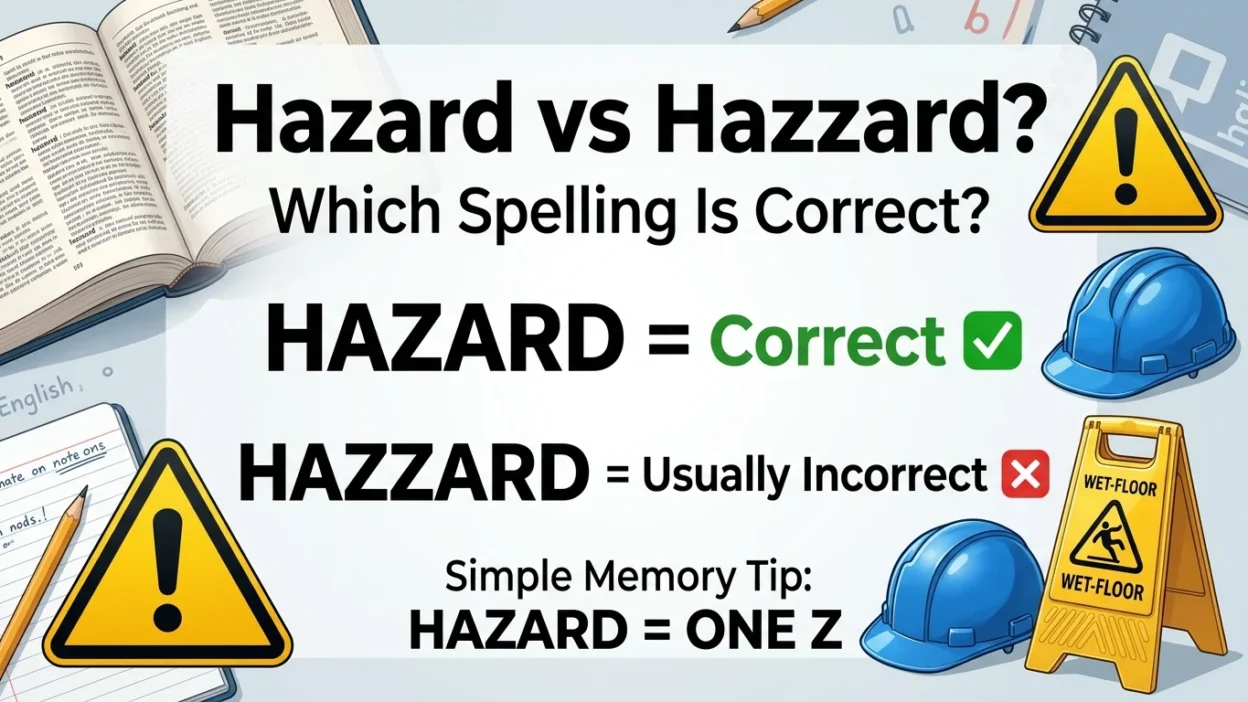
The correct standard English spelling is hazard.
Hazard is a noun or verb that refers to something dangerous, risky, or likely to cause harm.
Hazzard is generally a misspelling of hazard when the intended meaning is danger or risk. However, Hazzard can appear as a proper name or surname.
Correct: The wet floor is a safety hazard.
Incorrect: The wet floor is a safety hazzard.
Why Do People Confuse Hazard and Hazzard?
The confusion mainly comes from the pronunciation and appearance of the two spellings. Since hazard contains a strong z sound, some people mistakenly write an extra z and produce hazzard.
English has many words in which pronunciation does not make spelling completely obvious. When people hear the word hazard, they may incorrectly assume that the middle sound should be represented by zz.
The standard spelling is much simpler:
HAZARD = H-A-Z-A-R-D
There is only one z.
Hazard: Meaning and Usage
Hazard is the standard English word used for something that can cause injury, damage, loss, or danger.
It can be used as both a noun and a verb.
Hazard as a Noun
As a noun, hazard means a danger or a source of possible harm.
Examples:
- Broken glass on the floor is a serious hazard.
- Driving in heavy fog can be a safety hazard.
- Chemicals must be stored away from potential hazards.
- The loose electrical wire is a fire hazard.
- Poor lighting can create a hazard for pedestrians.
Common expressions include:
- health hazard
- safety hazard
- fire hazard
- environmental hazard
- workplace hazard
- road hazard
- biological hazard
- chemical hazard
Hazard as a Verb
As a verb, hazard means to take a risk or to make a suggestion or guess.
Examples:
- I would not hazard a guess about the final result.
- She decided to hazard an opinion.
- I would hazard that the meeting will begin soon.
This verb use is less common in everyday conversation than the noun use.
Hazzard: Is It Correct?
Hazzard is generally not the correct spelling when you mean danger or risk.
For example:
Incorrect: The damaged bridge is a dangerous hazzard.
Correct: The damaged bridge is a dangerous hazard.
However, Hazzard can exist as a proper name or surname. A well-known example is the surname Hazzard. In such cases, the spelling is part of the person’s or family’s name and should not be changed to Hazard.
So, the important distinction is:
hazard = standard English word for danger or risk
Hazzard = usually a misspelling in ordinary English, but it can be a proper name
Hazard vs Hazzard Comparison Table
| Word | Correct Standard Spelling? | Meaning | Example |
|---|---|---|---|
| Hazard | Yes | Danger or possible source of harm | The wet floor is a hazard. |
| Hazard | Yes | To risk or make a guess | I would hazard a guess. |
| Hazzard | Usually no | Generally a misspelling of hazard | Hazzard is incorrect when meaning danger. |
| Hazzard | Yes in specific contexts | A surname or proper name | Hazzard is the person’s family name. |
When to Use Hazard
Use hazard whenever you are talking about danger, risk, or something that could cause harm.
Safety
- The exposed wire is an electrical hazard.
- Workers were warned about the safety hazard.
- Keep the hallway clear to prevent hazards.
Health
- Smoking is a major health hazard.
- The contaminated water may pose a health hazard.
- The chemical can become a hazard if handled incorrectly.
Environment
- Plastic waste can create environmental hazards.
- Flooding is a serious hazard in some areas.
- The factory must control hazardous materials.
Roads and Transportation
- Ice on the road is a driving hazard.
- Fallen trees created a road hazard.
- Poor visibility can become a serious traffic hazard.
Risk or Uncertainty
Hazard can also be used in phrases involving uncertainty or guessing.
- I would hazard a guess that he is already home.
- She would not hazard an opinion.
- I can only hazard an estimate.
10+ Examples of Hazard
Here are some simple examples to help you understand the correct spelling.
- The broken stairs are a serious hazard.
- Wet floors can be a slipping hazard.
- The workers were trained to identify workplace hazards.
- Smoke from the fire created a health hazard.
- The loose cable is an electrical hazard.
- Driving too fast can create a dangerous situation.
- The storm created several hazards along the highway.
- The warning sign alerts visitors to a potential hazard.
- I would hazard a guess that they will arrive tomorrow.
- The chemical should be treated as a hazardous substance.
- Poor visibility is a major hazard for drivers.
- The company removed the safety hazard immediately.
Common Mistakes with Hazard and Hazzard
Mistake 1: Adding an Extra Z
A common spelling error is writing hazzard instead of hazard.
Incorrect: This machine is a safety hazzard.
Correct: This machine is a safety hazard.
Mistake 2: Assuming the Pronunciation Determines the Spelling
The pronunciation may make the middle sound seem stronger than a single z, but English spelling does not always work that way.
Remember the standard spelling:
HAZARD
Mistake 3: Treating Hazzard as the Normal Alternative
Hazzard is not a standard alternative spelling of hazard in ordinary English.
If your sentence means danger, choose hazard.
Memory Trick for Hazard
A simple way to remember the spelling is:
HAZARD has ONE Z.
Think:
HAZARD = Danger
HAZZARD = Extra Z, usually wrong
You can also break the word into parts:
HA + ZARD
There is only one Z in the standard spelling.
Another useful reminder is:
One danger → one Z → HAZARD
American vs British English
The spelling hazard is standard in both American English and British English.
There is no major American-versus-British spelling difference here.
| English Variety | Standard Spelling |
|---|---|
| American English | hazard |
| British English | hazard |
| Canadian English | hazard |
| Australian English | hazard |
The form hazzard does not become a standard spelling simply because of regional English differences.
Similar Words to Hazard
Several words have meanings related to hazard, although they are not always interchangeable.
Danger
Danger means the possibility of harm or injury.
Example: The storm created serious danger for residents.
Risk
Risk refers to the possibility that something harmful or unwanted may happen.
Example: There is a risk of flooding.
Threat
Threat refers to something or someone that may cause harm.
Example: The damaged structure poses a threat to public safety.
Peril
Peril means serious or immediate danger.
Example: The hikers were in great peril.
Menace
Menace describes something that presents a threat or causes fear or trouble.
Example: The abandoned building had become a public menace.
Obstacle
An obstacle is something that blocks progress. It is not necessarily dangerous.
Example: The fallen tree was an obstacle on the path.
Hazard vs Danger
Although hazard and danger are closely related, they are not always used in exactly the same way.
A hazard is often a thing or condition that has the potential to cause harm.
A danger is the harmful or threatening situation itself.
For example:
The wet floor is a hazard.
There is a danger of slipping.
Both words are correct, but their meanings and grammatical uses differ slightly.
Hazard vs Risk
Hazard and risk are also related but different.
A hazard is something that can cause harm.
A risk is the possibility of experiencing harm because of that hazard.
For example:
A slippery floor is a hazard.
The risk is that someone may slip and fall.
This distinction is especially useful in workplace safety and health writing.
Final Verdict: Hazard or Hazzard?
For ordinary English writing, the correct spelling is hazard.
Use hazard when you mean a danger, source of harm, or possible risk. You can also use it as a verb when talking about making a guess or taking a risk.
Hazzard is generally a spelling mistake when you intend to write hazard. However, it can be correct when it is used as a proper name or surname.
The easiest rule to remember is:
Hazard = danger
Hazzard = usually a misspelling
FAQs
Is hazard or hazzard correct?
Hazard is the correct standard English spelling when you mean danger, risk, or a source of possible harm.
Is hazzard a word?
Hazzard can appear as a proper name or surname, but it is generally not the standard spelling of the English word meaning danger.
How do you spell hazard?
The correct spelling is H-A-Z-A-R-D.
Does hazard have one or two Zs?
Hazard has one Z.
What does hazard mean?
Hazard means something that can cause harm, injury, damage, or danger. As a verb, it can also mean to make a guess or take a risk.
What is the plural of hazard?
The plural is hazards.
Example: The inspector identified several hazards.
What is the adjective form of hazard?
The common adjective is hazardous, meaning dangerous or risky.
Example: The workers were handling hazardous materials.
Is Hazzard an acceptable spelling of hazard?
Not when you mean the ordinary English word for danger. Hazzard may be correct as a proper name or surname.
Remember This
If you are writing about danger, risk, or possible harm, use:
HAZARD ✅
Not:
HAZZARD ❌
The standard spelling contains one Z.
Conclusion
Understanding the difference between hazard vs hazzard is simple once you remember the standard spelling. Hazard is the correct English word for something dangerous, risky, or capable of causing harm. It can also be used as a verb in expressions such as hazard a guess.
Hazzard is generally a misspelling when used in place of hazard, although it may appear correctly as a surname or other proper name. When you mean danger, risk, or a potential source of harm, always choose hazard.

Julian Luke is a passionate grammar and language writer at Synolexes. He simplifies complex grammar rules, vocabulary, and writing concepts, helping learners improve their English communication skills with confidence.