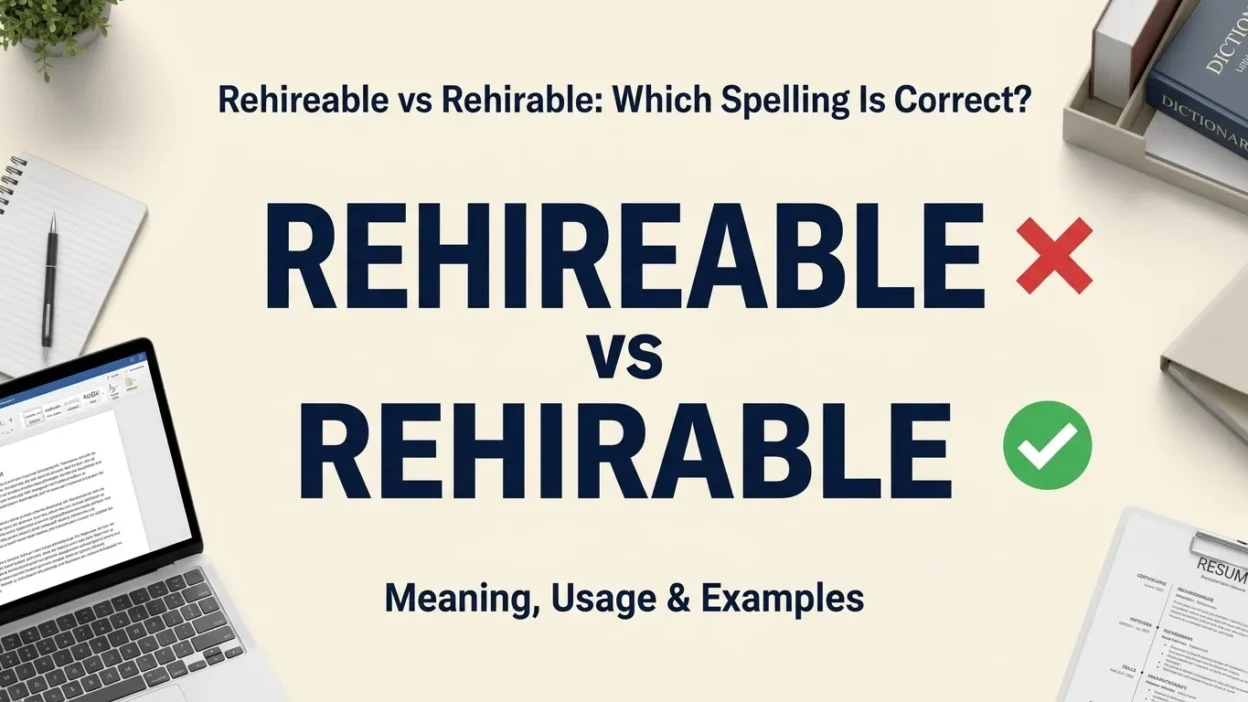
The correct spelling is generally rehireable, but rehirable is also an accepted spelling in some dictionaries and usage contexts. Both forms are used to describe someone who can be hired again. However, rehirable is often preferred because it follows a simpler spelling pattern, while rehireable keeps the final e of the verb rehire before adding the suffix -able. If you are writing a résumé, job application, or workplace document, it is important to understand both forms and use one consistently.
The word rehireable or rehirable is commonly associated with employment, human resources, and workplace decisions. It describes a former employee who may be considered for employment again. For example, a manager might describe a former worker as rehirable if the person left on good terms and performed well. Understanding the spelling, meaning, and usage of these words can help you communicate clearly in professional settings. This guide explains the difference between rehireable and rehirable, provides useful examples, and helps you choose the right form for your writing.
Quick Answer
Rehirable and rehireable are both used to mean capable of being hired again. Rehirable is the shorter spelling, while rehireable retains the final e in rehire before adding -able. Usage can vary by dictionary, organization, and style guide. For formal writing, choose the spelling preferred by your employer or reference source.
Why Do People Confuse Rehireable and Rehirable?
People confuse these spellings because English has different rules for adding suffixes to words ending in silent e.
The base word is rehire, which means to hire someone again. When adding -able, writers may keep the final e or remove it, resulting in rehireable or rehirable.
English spelling does not follow one simple rule for every suffix. For example:
- Use → usable
- Manage → manageable
- Rehire → rehirable or rehireable
Both forms can be understood, but spelling preferences may differ. In employment documents, consistency and clarity are more important than switching between the two forms.
First Word: Rehireable
Rehireable means capable of being hired again or suitable for reemployment.
It is formed from rehire and the suffix -able, which expresses possibility or capability.
Meaning of Rehireable
A rehireable employee is someone who may be considered for another job with the same employer after leaving the organization.
For example, an employee might be considered rehireable if they:
- Left the company on good terms.
- Performed their duties responsibly.
- Followed workplace policies.
- Gave appropriate notice before leaving.
- Had a positive employment record.
Being described as rehireable does not guarantee that an employer will hire the person again. It simply suggests that the person may be eligible for future employment.
How to Use Rehireable in a Sentence
- The manager considered her rehireable after she left the company.
- His employment record showed that he was rehireable.
- The company marked the former employee as rehireable.
- She hopes to remain rehireable after completing her contract.
Rehireable is a useful form when you want to emphasize the relationship between the base verb rehire and the suffix -able.
Second Word: Rehirable
Rehirable also means capable of being hired again.
It is a shorter spelling that removes the final e from rehire before adding -able. The meaning is essentially the same as rehireable.
Meaning of Rehirable
Rehirable describes a person who can potentially return to work for a previous employer.
For example:
- The supervisor said the former worker was rehirable.
- Her positive performance review made her a strong candidate for reemployment.
- The organization considers eligible former employees rehirable.
- He asked whether he would be considered rehirable after resigning.
The word is particularly relevant in human resources, employee records, job applications, and discussions about returning to a former workplace.
Is Rehirable a Correct Word?
Rehirable is a recognized spelling used in employment-related contexts. However, preferences may vary among dictionaries, employers, and style guides. If a company uses one form in its official documents, follow that form for consistency.
Rehireable vs Rehirable: Comparison Table
| Feature | Rehireable | Rehirable |
|---|---|---|
| Meaning | Capable of being hired again | Capable of being hired again |
| Base word | Rehire | Rehire |
| Spelling pattern | Retains the final e | Drops the final e |
| General usage | Used in employment contexts | Used in employment contexts |
| Meaning difference | Essentially none | Essentially none |
| Best practice | Follow the preferred style | Follow the preferred style |
The main difference is spelling, not meaning. Neither form automatically indicates that an employee will receive another job offer.
When to Use Rehireable or Rehirable
Use Rehireable When You Want to Retain the Base Word
Rehireable makes the connection to rehire visually clear. You may encounter it in workplace documents, employee evaluations, or informal HR discussions.
Examples:
- The former employee is rehireable.
- Her supervisor described her as rehireable.
- The company updated his status to rehireable.
Use Rehirable When It Matches Your Preferred Style
Rehirable offers a shorter spelling and is also used in employment-related writing.
Examples:
- The employee is considered rehirable.
- The manager confirmed that she was rehirable.
- His record indicates that he may be rehirable.
Which Spelling Should You Choose for a Résumé?
If you need to discuss your eligibility for future employment, either spelling may communicate the intended meaning. However, it is often clearer to use a direct phrase such as eligible for rehire or eligible for reemployment.
For example:
- My previous employer considered me eligible for rehire.
- I left the company on good terms and would welcome future employment opportunities.
These expressions are clear and professional without requiring you to choose between the two spellings.
12 Examples of Rehireable vs Rehirable in Sentences
The following examples show how both forms can be used.
- Rehireable: The manager considered him rehireable after his contract ended.
- Rehirable: The manager considered him rehirable after his contract ended.
- Rehireable: Her performance review stated that she was rehireable.
- Rehirable: Her performance review stated that she was rehirable.
- Rehireable: The company keeps records of employees who are rehireable.
- Rehirable: The company keeps records of employees who are rehirable.
- Rehireable: He asked his former supervisor whether he was rehireable.
- Rehirable: He asked his former supervisor whether he was rehirable.
- Rehireable: The HR department listed the employee as rehireable.
- Rehirable: The HR department listed the employee as rehirable.
- Rehireable: She hopes to remain rehireable after leaving her current position.
- Rehirable: She hopes to remain rehirable after leaving her current position.
These examples demonstrate that the intended meaning remains the same. In real workplace documents, use the spelling that matches the organization’s preferred style.
Common Mistakes With Rehireable and Rehirable
1. Assuming One Form Always Has a Different Meaning
Both forms are used to describe someone who can potentially be hired again. The spelling difference does not create a meaningful distinction in ordinary employment usage.
2. Confusing Rehireable With Rehired
These words have different meanings.
- Rehireable means capable of being hired again.
- Rehired means actually hired again.
Example: She was rehireable, and the company eventually rehired her.
3. Assuming Rehireable Guarantees a Job
Being considered rehireable does not guarantee a future job offer. The employer may still consider qualifications, available positions, performance, and current hiring needs.
4. Switching Spellings in the Same Document
Using both forms in one résumé, policy, or report may look inconsistent. Choose one form and use it throughout the document.
5. Ignoring the Employer’s Terminology
Some organizations use the phrase eligible for rehire in their HR systems. When completing an employment form, use the terminology provided by the employer whenever possible.
Memory Trick: How to Remember Rehireable and Rehirable
Think of the base word first:
Rehire + able = rehireable or rehirable
Remember that rehire means to hire again, while -able indicates possibility.
You can also remember these related forms:
- Hire → hireable or hirable
- Rehire → rehireable or rehirable
- Rehired → hired again
For professional writing, the easiest alternative is often eligible for rehire. It is clear, natural, and widely understandable.
Rehireable vs Rehirable in American and British English
There is no widely established American-versus-British distinction that assigns one of these spellings exclusively to one variety of English.
Both forms occur in employment-related writing, and spelling preferences may depend on the dictionary, employer, or style guide being followed.
In both American and British workplace communication, these phrases are also useful:
- Eligible for rehire
- Suitable for reemployment
- May be considered for future employment
For formal documents, follow the spelling and terminology used by your organization rather than assuming that the difference is regional.
Similar Words to Rehireable and Rehirable
Understanding related employment terms can help you express the intended meaning more precisely.
| Word or phrase | Meaning | Example |
|---|---|---|
| Rehire | Hire someone again | The company may rehire the former employee. |
| Rehired | Hired again | She was rehired last month. |
| Reemployment | Employment again after a period away | He applied for reemployment. |
| Employable | Having qualities that make someone suitable for employment | Her skills make her highly employable. |
| Eligible for rehire | Meeting the conditions for possible rehiring | His record shows that he is eligible for rehire. |
| Reinstated | Restored to a previous position or status | She was reinstated in her former role. |
| Recruited | Selected or sought for a job or role | The company recruited several engineers. |
These terms are related but not interchangeable. For example, employable generally refers to suitability for employment in general, while rehireable and rehirable specifically concern the possibility of being hired again.
Final Verdict: Rehireable or Rehirable?
Rehireable and rehirable are both used to mean capable of being hired again. The main difference is the spelling: rehireable retains the final e in rehire, while rehirable removes it before adding -able.
Neither spelling means that someone has already been hired again. For the clearest professional wording, consider using eligible for rehire, especially in résumés, HR records, and employment applications.
Choose one form, follow your organization’s preferred spelling, and use it consistently.
FAQs
1. Is rehireable or rehirable correct?
Both forms are used to describe someone who can potentially be hired again. Spelling preferences vary, so check the dictionary or style guide relevant to your writing.
2. What does rehireable mean?
Rehireable means capable of being hired again, usually by a previous employer. It does not guarantee that the employer will offer the person another job.
3. What does rehirable mean?
Rehirable has essentially the same meaning as rehireable. It describes someone who may be considered for employment again.
4. Which spelling is better for professional writing?
Follow your employer’s preferred terminology. If you are unsure, eligible for rehire is a clear and professional alternative.
5. Is rehireable the same as rehired?
No. Rehireable means someone can potentially be hired again, while rehired means someone has actually been hired again.
6. Does being rehireable guarantee another job?
No. It indicates potential eligibility or suitability, not a guaranteed job offer. The employer may consider current vacancies, qualifications, and other hiring requirements.
7. How do you use rehireable in a sentence?
You can write, The company considers her rehireable because she left on good terms. The sentence means the company may consider employing her again.
8. Is there a difference between American and British spelling?
There is no widely established regional rule that makes one spelling exclusively American or British. Follow the preferred form in your chosen dictionary or workplace style guide.
Remember This
- Rehireable: Capable of being hired again.
- Rehirable: Also used to mean capable of being hired again.
- Rehired: Actually hired again.
- Eligible for rehire: A clear alternative for professional writing.
The key is to understand the meaning, choose a consistent spelling, and avoid confusing potential eligibility with an actual job offer.
Conclusion
The difference between rehireable and rehirable is mainly a matter of spelling. Both forms are used in employment contexts to describe someone who may be hired again. Neither form means that the person has already returned to work, and neither guarantees that a former employer will offer another position. Understanding this distinction can help you communicate more accurately when discussing employment history, HR records, and future job opportunities.
For professional documents, consistency is important. Follow your organization’s preferred spelling or use the clear phrase eligible for rehire when you want to avoid uncertainty. By understanding the related words rehire, rehired, and reemployment, you can choose the most appropriate expression for your situation.

Gabriel John is a language enthusiast and grammar writer at Synolexes. He creates clear, practical content on English grammar, vocabulary, and writing, helping learners improve communication skills with confidence.