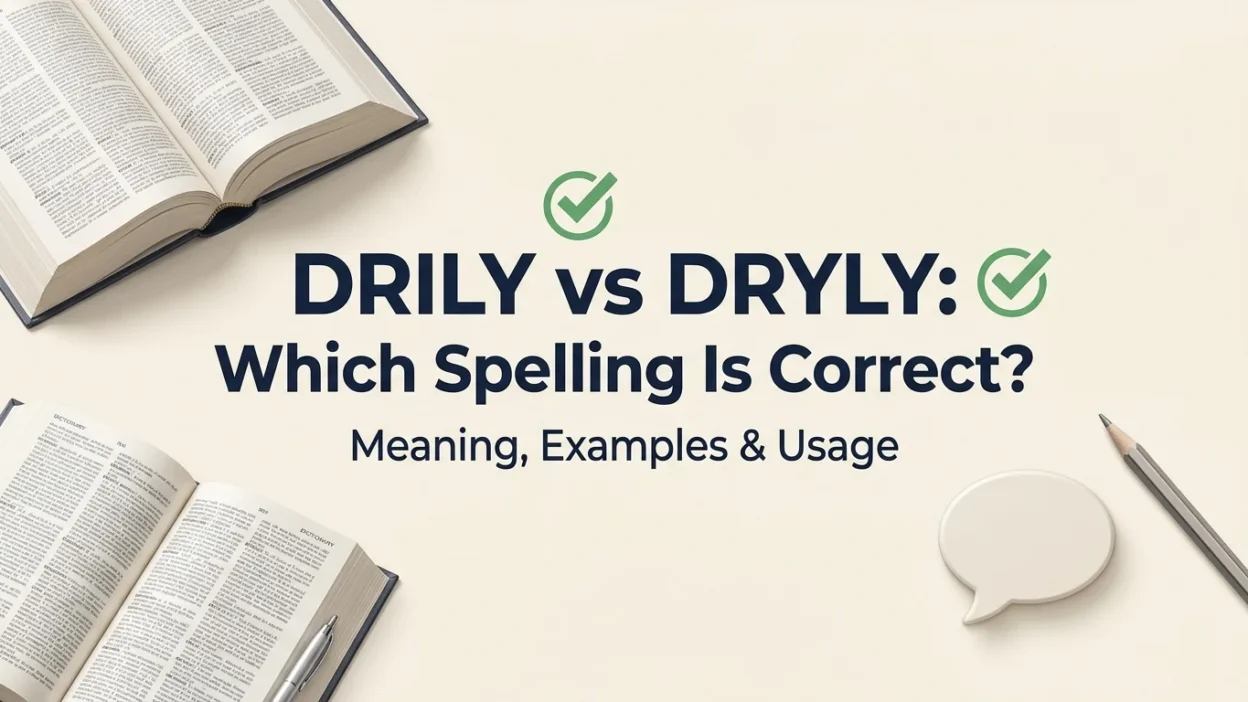
The words drily and dryly are both correct spellings of the adverb formed from the adjective dry. Both can describe speaking in a matter-of-fact, unemotional, or subtly humorous way. For example, She commented drily and She commented dryly are both acceptable sentences. However, dryly is often preferred in modern American English because it follows a familiar spelling pattern and is easier for many readers to recognize.
Understanding drily vs dryly can help you choose the right spelling when writing stories, articles, essays, dialogue, and everyday messages. Both forms can describe a person speaking without much emotion or delivering a sarcastic remark with a straight face. They can also describe something becoming dry, such as paint or soil. Although the meanings are generally the same, spelling preferences may vary by region, dictionary, and writing style. In this guide, you will learn the meanings of drily and dryly, understand their differences, explore practical examples, and discover which spelling works best for your writing.
Quick Answer
Drily and dryly are both correct spellings. They are adverbs formed from dry and can describe speaking in an unemotional, matter-of-fact, or subtly humorous way. Dryly is generally the more familiar choice in American English, while drily is also accepted. Choose one spelling and use it consistently.
Why Do People Confuse Drily and Dryly?
People confuse these words because English spelling rules sometimes allow more than one form of an adverb.
The adjective dry ends in a consonant followed by y. When adding -ly, the y can change to i, producing drily. However, dryly retains the original y.
Both spellings are accepted, so neither is automatically a mistake.
Examples:
- She replied drily to the question.
- She replied dryly to the question.
Both sentences describe the same general manner of speaking. The choice depends on your preferred spelling convention and the style of your writing.
First Word: Drily
Drily is a correct adverb meaning in a dry, unemotional, matter-of-fact, or subtly humorous manner.
It can describe someone speaking with little visible emotion or making a joke without an obvious change in expression.
Meaning of Drily
Drily is commonly used to describe speech, comments, observations, or reactions that sound restrained or understated.
Examples:
- He drily remarked that the meeting could have been an email.
- She answered drily when asked about the delay.
- The teacher drily observed that nobody had completed the assignment.
- He smiled faintly and drily added another comment.
In these sentences, drily suggests a controlled or understated delivery, sometimes with a touch of sarcasm.
How to Use Drily in a Sentence
Use drily when describing the manner in which someone speaks, writes, or reacts.
Examples:
- She drily pointed out the obvious mistake.
- The writer drily described the office’s endless paperwork.
- He drily commented on the unexpected result.
- The speaker responded drily to the criticism.
Drily is grammatically correct, although some readers may find dryly more familiar.
Second Word: Dryly
Dryly is also a correct adverb formed from dry. It has the same general meaning as drily.
Dryly can describe speech that is unemotional, restrained, matter-of-fact, or subtly funny. It can also describe an action performed in a dry manner.
Meaning of Dryly
The word dryly often appears in writing about dialogue, humor, and reactions.
Examples:
- She dryly remarked that the weather was perfect for a picnic, despite the rain.
- He answered dryly that he had only been waiting for two hours.
- The comedian delivered the joke dryly.
- The manager dryly noted that the deadline had passed.
Dryly is especially useful when describing deadpan humor, in which someone delivers a joke with little visible emotion.
How to Use Dryly in a Sentence
Use dryly when you want to show how a person speaks or reacts.
Examples:
- He dryly observed that the plan was not working.
- She dryly thanked him for his extremely helpful advice.
- The author dryly described the character’s ridiculous behavior.
- The student dryly replied that the test had been surprisingly easy.
Dryly is a familiar option for general writing and is particularly common in American English.
Drily vs Dryly: Comparison Table
| Feature | Drily | Dryly |
|---|---|---|
| Correct spelling | Yes | Yes |
| Part of speech | Adverb | Adverb |
| Meaning | In a dry or unemotional manner | In a dry or unemotional manner |
| Formed from | Dry | Dry |
| Spelling pattern | Changes y to i | Retains y |
| Common use | Accepted English spelling | Familiar, especially in American English |
| Example | He replied drily. | He replied dryly. |
The key difference is spelling, not meaning. Both forms are standard, and both can be used to describe dry humor or an unemotional response.
When Should You Use Drily or Dryly?
Use Drily When It Matches Your Preferred Style
Drily is a valid spelling and can be used in formal and informal writing.
Examples:
- The author drily described the situation.
- She drily commented on the mistake.
- He answered drily without looking up.
If your dictionary or publisher prefers drily, there is no need to avoid it.
Use Dryly for Familiar, Modern Usage
Dryly is often a convenient choice for general writing, particularly for American audiences.
Examples:
- He dryly explained why the plan had failed.
- She dryly joked about the long meeting.
- The actor delivered the line dryly.
Which Spelling Is Better for an Article or Essay?
Both spellings are correct. If you are writing for a general audience and have no specific style guide to follow, dryly is a reasonable default because it is widely familiar.
However, if your publication consistently uses drily, keep that spelling throughout the text.
12 Examples of Drily vs Dryly in Sentences
The following examples show how both forms can be used naturally.
- Drily: He drily remarked that the meeting was incredibly exciting.
Dryly: He dryly remarked that the meeting was incredibly exciting. - Drily: She drily commented on the team’s repeated mistakes.
Dryly: She dryly commented on the team’s repeated mistakes. - Drily: The teacher drily observed that nobody had studied.
Dryly: The teacher dryly observed that nobody had studied. - Drily: He drily explained that the computer had stopped working again.
Dryly: He dryly explained that the computer had stopped working again. - Drily: She drily thanked him for the unnecessary advice.
Dryly: She dryly thanked him for the unnecessary advice. - Drily: The writer drily described the office’s endless meetings.
Dryly: The writer dryly described the office’s endless meetings. - Drily: He drily noted that they were already late.
Dryly: He dryly noted that they were already late. - Drily: The actor drily delivered the final line.
Dryly: The actor dryly delivered the final line. - Drily: She drily pointed out the obvious problem.
Dryly: She dryly pointed out the obvious problem. - Drily: The manager drily mentioned the missed deadline.
Dryly: The manager dryly mentioned the missed deadline. - Drily: He drily joked about his terrible cooking skills.
Dryly: He dryly joked about his terrible cooking skills. - Drily: The journalist drily described the confusing announcement.
Dryly: The journalist dryly described the confusing announcement.
In each pair, the spelling changes, but the intended meaning remains the same.
Common Mistakes With Drily and Dryly
1. Thinking Drily Is Always Incorrect
Drily is a legitimate spelling. It should not automatically be treated as a typo.
Incorrect assumption: Drily is never correct.
Correct understanding: Both drily and dryly are accepted spellings.
2. Thinking Dryly Is Always Incorrect
Dryly is also correct. Keeping the y does not make the word misspelled.
Example: He dryly responded to the criticism.
3. Confusing Dryly With Dully
Dryly can suggest restrained or sarcastic humor. Dully usually means in a boring, uninteresting, or lacking-energy manner.
Example: She dryly joked about the problem is not necessarily the same as She spoke dully about the problem.
4. Assuming Dryly Always Means Sarcastically
Dryly can describe understated humor, but it can also mean matter-of-factly or without much emotion. The surrounding sentence determines the exact meaning.
5. Switching Spellings Without a Reason
Although both forms are correct, changing between drily and dryly in the same article may distract readers. Pick one and use it consistently.
Memory Trick: How to Remember Drily and Dryly
Use this simple reminder:
Dry + ly = dryly, or dry → drily.
Remember that both forms are acceptable. If you want the spelling that retains the original adjective’s y, choose dryly. If you prefer the traditional y-to-i pattern, choose drily.
You can also connect the word with the phrase dry humor:
- Dry humor is often understated.
- A person may speak dryly when delivering dry humor.
- The same sentence can also use drily.
For example, He dryly remarked that everything was going perfectly, even though the project had failed.
Drily vs Dryly in American and British English
Both drily and dryly are accepted in English, and neither spelling is restricted exclusively to American or British English.
However, dryly is especially familiar in American English, while drily is also encountered in British and other varieties of English. Individual dictionaries and publishers may differ in their preferences.
Examples:
American-style writing: She dryly commented on the situation.
British-style writing: She drily commented on the situation.
These examples illustrate possible preferences, not strict regional rules. Both spellings are understandable and acceptable across English varieties. Follow the dictionary or style guide required for your writing.
Similar Words to Drily and Dryly
Learning related adverbs can help you describe different speaking styles more precisely.
| Word | Meaning | Example |
|---|---|---|
| Sarcastically | Using words to mock or criticize | He sarcastically praised the poor service. |
| Wryly | Showing dry, often slightly ironic humor | She smiled wryly at the situation. |
| Dully | In a boring or unenergetic way | He spoke dully during the presentation. |
| Flatly | In a direct manner with little emotion | She flatly refused the offer. |
| Matter-of-factly | In a practical, unemotional way | He matter-of-factly explained the problem. |
| Calmly | Without agitation or excitement | She calmly answered the question. |
| Deadpan | With little or no visible emotion, often for humor | He delivered the joke with a deadpan expression. |
These words overlap in some contexts but have different shades of meaning. For instance, sarcastically often implies mockery, while dryly can convey subtle humor without openly expressing criticism.
Final Verdict: Drily or Dryly?
Both drily and dryly are correct spellings. They are adverbs with essentially the same meaning and can describe speaking in a restrained, unemotional, or subtly humorous manner.
Use dryly if you want a familiar choice for general writing, particularly for American readers. Use drily if it matches your preferred dictionary or publication style.
Remember that neither spelling is inherently wrong. The most important points are to understand the meaning, choose a spelling that suits your audience, and remain consistent throughout your writing.
FAQs
1. Is drily or dryly correct?
Both are correct. Drily and dryly are accepted spellings of the adverb formed from dry.
2. What does drily mean?
Drily means in a dry, unemotional, matter-of-fact, or sometimes subtly humorous manner. For example, He drily commented on the mistake.
3. What does dryly mean?
Dryly has essentially the same meaning as drily. It often describes understated humor, sarcasm, or speech delivered without much emotion.
4. Which spelling is more common, drily or dryly?
Dryly is especially familiar in American English and is a convenient choice for general audiences. However, drily is also correct and remains in use.
5. Is drily British English and dryly American English?
Not strictly. Both spellings occur across English varieties. Some regional or editorial preferences exist, but neither spelling belongs exclusively to one variety.
6. Does drily mean sarcastically?
Sometimes, but not always. Drily can describe understated humor or an unemotional manner of speaking. Whether it sounds sarcastic depends on the context.
7. How do you use dryly in a sentence?
Example: She dryly remarked that the weather was wonderful while standing in the pouring rain. The word suggests understated humor or irony.
8. Can I use drily in formal writing?
Yes. Drily is an accepted spelling and can be used in formal writing. Follow your publication’s preferred spelling and remain consistent.
Remember This
- Drily: Correct spelling.
- Dryly: Correct spelling.
- Both mean in a dry, unemotional, or subtly humorous manner.
- Dryly is a familiar choice for many American readers.
- Neither spelling is exclusively American or British.
- Choose one spelling and use it consistently.
Conclusion
The difference between drily and dryly is mainly a matter of spelling preference. Both words are correct, and both describe an action performed in a dry, restrained, or sometimes humorous manner. You can write He replied drily or He replied dryly without changing the intended meaning. The choice depends on the style you prefer and the conventions followed by your audience or publisher.
For everyday writing, dryly is a practical option because it is widely familiar, especially in American English. However, drily remains a valid choice and should not be marked incorrect simply because it looks less familiar. By understanding both spellings and using one consistently, you can write with greater confidence and describe dialogue, humor, and reactions more precisely.