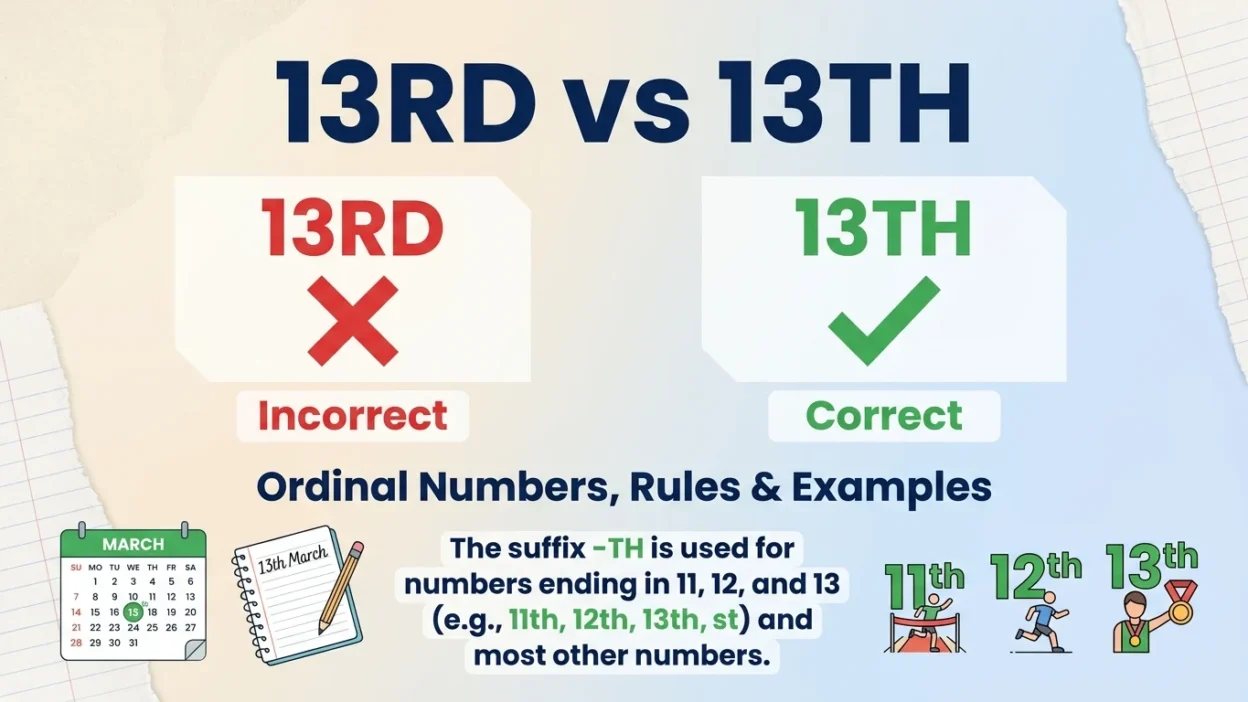
The correct form is 13th, not 13rd. When writing the number thirteen as an ordinal number, use 13th to express position, order, or rank. For example, you should write 13th place, 13th birthday, or 13th of October. The form 13rd is incorrect in standard English.
Ordinal numbers show the position of something in a sequence. For example, first, second, third, and fourth are ordinal numbers. When writing numbers as digits, their endings usually follow a pattern: 1st, 2nd, 3rd, and 4th. However, numbers ending in 11, 12, and 13 are exceptions to this pattern. That is why the correct form is 13th rather than 13rd. Learning this rule can help you write dates, birthdays, rankings, school assignments, and formal documents correctly.
Quick Answer: 13rd vs 13th
13th is correct, while 13rd is incorrect in standard English. The number thirteen is written as thirteenth in words and 13th in digits. Although numbers ending in 3 often use rd, such as 3rd and 23rd, the numbers 11, 12, and 13 are exceptions. Therefore, always write 13th birthday, 13th place, and 13th October.
Why Do People Confuse 13rd and 13th?
People often confuse 13rd and 13th because they learn that numbers ending in 3 usually take the suffix rd.
For example:
- 3rd — third
- 23rd — twenty-third
- 33rd — thirty-third
However, English ordinal numbers have a special rule for 11, 12, and 13. These numbers use th, regardless of their final digit.
Examples:
- 11th — eleventh
- 12th — twelfth
- 13th — thirteenth
Because 13 ends in 3, some people mistakenly write 13rd. The correct spelling follows the number’s full form, thirteenth, rather than the final digit alone.
1. What Does 13rd Mean?
13rd is an incorrect ordinal-number form in standard English. It is usually written by mistake when someone intends to express the position or order of thirteen.
For example:
Incorrect: My birthday is on the 13rd of October.
Correct: My birthday is on the 13th of October.
The mistake happens because the writer applies the usual suffix pattern for numbers ending in 3 without considering the exception for thirteen.
Examples of Incorrect Usage
- She finished in 13rd place.
- His 13rd birthday is next week.
- The meeting is scheduled for the 13rd of May.
- This is my 13rd attempt.
In standard English, replace 13rd with 13th in each sentence.
2. What Does 13th Mean?
13th is the correct ordinal form of the number thirteen. It represents the position immediately after twelfth and before fourteenth.
The word form is thirteenth.
Common Uses of 13th
Dates: The event takes place on the 13th of June.
Birthdays: She celebrated her 13th birthday with her friends.
Rankings: Our team finished in 13th place.
Lists and sequences: Read the 13th chapter of the book.
Anniversaries: They celebrated their 13th wedding anniversary.
In each example, 13th correctly shows position, order, or a date.
13rd vs 13th: Comparison Table
| Feature | 13rd | 13th |
|---|---|---|
| Correctness | Incorrect in standard English | Correct |
| Word form | No standard ordinal equivalent | Thirteenth |
| Suffix | Incorrectly uses rd | Correctly uses th |
| Dates | Incorrect | Correct |
| Birthdays | Incorrect | Correct |
| Rankings | Incorrect | Correct |
| Formal writing | Avoid | Recommended |
When Should You Use 13rd or 13th?
Use 13th for Dates
When writing the thirteenth day of a month, use 13th.
Examples:
- The exam is on the 13th of September.
- Our school event will take place on June 13th.
In many formal styles, dates are also written without ordinal endings, such as June 13 or 13 June.
Use 13th for Birthdays
Use 13th when referring to someone’s thirteenth birthday.
Example: My younger brother will celebrate his 13th birthday tomorrow.
Use 13th for Rankings
Use 13th to describe a position in a competition or list.
Example: The runner finished in 13th place.
Use 13th for Chapters and Sequences
Use 13th when identifying the thirteenth item in an ordered series.
Example: Please complete the 13th question on the worksheet.
Avoid 13rd in Standard English
Do not use 13rd in schoolwork, emails, formal documents, invitations, or everyday writing. The standard form is always 13th.
12 Examples of 13rd vs 13th in Sentences
Here are examples showing the incorrect and correct forms.
1. Incorrect: Today is the 13rd of March. Correct: Today is the 13th of March.
2. Incorrect: She celebrated her 13rd birthday. Correct: She celebrated her 13th birthday.
3. Incorrect: He finished in 13rd place. Correct: He finished in 13th place.
4. Incorrect: The meeting will happen on the 13rd of July. Correct: The meeting will happen on the 13th of July.
5. Incorrect: Read the 13rd chapter carefully. Correct: Read the 13th chapter carefully.
6. Incorrect: This is the 13rd question on the test. Correct: This is the 13th question on the test.
7. Incorrect: Their 13rd anniversary is coming soon. Correct: Their 13th anniversary is coming soon.
8. Incorrect: The school trip is planned for October 13rd. Correct: The school trip is planned for October 13th.
9. Incorrect: She ranked 13rd in the competition. Correct: She ranked 13th in the competition.
10. Incorrect: The 13rd student entered the classroom. Correct: The 13th student entered the classroom.
11. Incorrect: Please submit the assignment by the 13rd. Correct: Please submit the assignment by the 13th.
12. Incorrect: He lives on the 13rd floor. Correct: He lives on the 13th floor.
Common Mistakes With 13rd and 13th
1. Using the Last Digit Only
A common mistake is assuming that every number ending in 3 takes rd.
Remember that 13 is an exception. Write 13th, not 13rd.
2. Confusing 13th With 3rd
The correct forms are:
- 3rd — third
- 13th — thirteenth
- 23rd — twenty-third
- 33rd — thirty-third
The suffix depends on the complete number, not simply its final digit.
3. Writing 13rd in Dates
When writing dates with ordinal endings, use 13th.
Correct: April 13th.
Also correct in common date styles: April 13 or 13 April.
4. Using the Wrong Suffix in Schoolwork
Ordinal numbers appear in exam answers, lists, rankings, and assignments. Using 13rd can make your writing look incorrect.
5. Forgetting the Exception for 11, 12, and 13
These three numbers use th:
- 11th — eleventh
- 12th — twelfth
- 13th — thirteenth
This exception is one of the easiest ways to remember the correct form.
Memory Trick: How to Remember 13th
Use this simple rule:
11, 12, and 13 always use th.
Remember these examples:
- 11th
- 12th
- 13th
After these exceptions, the usual pattern returns:
- 21st
- 22nd
- 23rd
- 24th
Another helpful trick is to say the number in words. Thirteen becomes thirteenth, so its abbreviated form is 13th.
American vs British English: 13rd or 13th
American and British English use the same ordinal form: 13th. There is no standard regional difference that makes 13rd correct.
| Context | American English | British English |
|---|---|---|
| Ordinal number | 13th | 13th |
| Number in words | Thirteenth | Thirteenth |
| Date example | June 13th | 13th June |
| Date without suffix | June 13 | 13 June |
Date formatting may vary between American and British English, but the correct ordinal suffix remains th.
Similar Ordinal Numbers You Should Know
Learning related ordinal numbers can help you avoid similar mistakes.
- 1st: First
- 2nd: Second
- 3rd: Third
- 4th: Fourth
- 11th: Eleventh
- 12th: Twelfth
- 13th: Thirteenth
- 21st: Twenty-first
- 22nd: Twenty-second
- 23rd: Twenty-third
- 31st: Thirty-first
Notice that 23rd is correct, but 13rd is not. The difference comes from the special rule for 13.
Final Verdict: 13rd or 13th?
13th is the only correct standard form for the ordinal number thirteen. Use it for dates, birthdays, rankings, chapters, floors, and other situations where you need to show the thirteenth position.
The form 13rd is incorrect because thirteen is an exception to the usual suffix pattern for numbers ending in 3. Remember that 11, 12, and 13 all use th, and you will be much less likely to make this mistake.
FAQs
1. Is 13rd or 13th correct?
13th is correct. The ordinal word is thirteenth, so the correct abbreviated form uses th rather than rd.
2. Why is 13th correct instead of 13rd?
Thirteen is an exception to the usual rule for numbers ending in 3. Although 3rd and 23rd are correct, 13 takes th because its word form is thirteenth.
3. How do you write 13 in ordinal form?
Write it as 13th in digits and thirteenth in words.
4. Is it correct to write 13rd birthday?
No. The correct form is 13th birthday. For example, She celebrated her 13th birthday with her family.
5. Is 13th correct in American and British English?
Yes. Both American and British English use 13th. Date order and formatting may differ, but the ordinal suffix does not.
6. Why is 23rd correct but 13th is correct?
The number 23 is written twenty-third, so it takes rd. The number 13 is written thirteenth, so it takes th. The suffix depends on the full ordinal number.
7. Can I write a date as June 13 instead of June 13th?
Yes. June 13 is a standard date format, especially in American English. You can also write June 13th in contexts where ordinal dates are preferred.
Remember This
- 13th = correct
- 13rd = incorrect in standard English
- Thirteen in words is thirteenth.
- The numbers 11, 12, and 13 all use th.
- American and British English follow the same ordinal suffix rule.
Conclusion
The difference between 13rd and 13th is simple once you remember the special rule for thirteen. The correct form is 13th because the word thirteen becomes thirteenth when expressing position or order. The form 13rd is a common mistake and should be avoided in standard English.
Use 13th when writing dates, birthdays, rankings, chapters, and other ordinal numbers. Remember the sequence 11th, 12th, and 13th to make the rule easier to recall. With regular practice, you can use ordinal numbers accurately in everyday and formal writing.

Gabriel John is a language enthusiast and grammar writer at Synolexes. He creates clear, practical content on English grammar, vocabulary, and writing, helping learners improve communication skills with confidence.