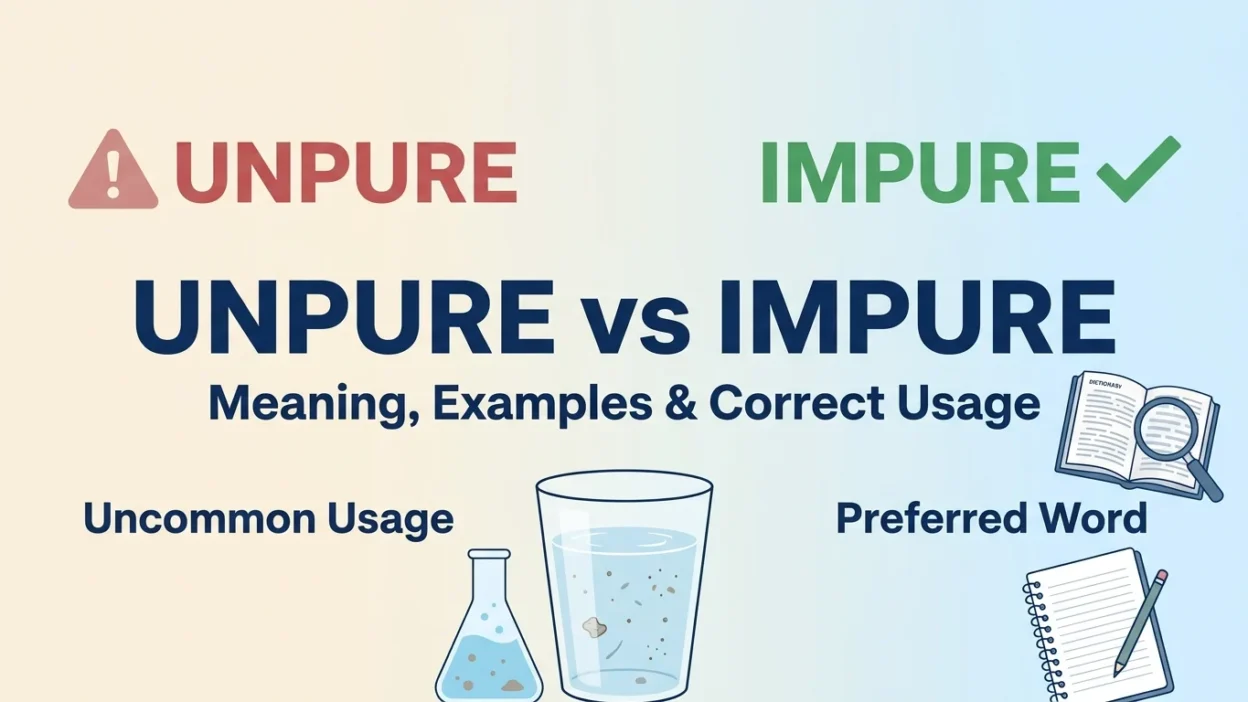
The correct and more widely accepted word is impure. It means not pure, contaminated, mixed with unwanted substances, or lacking moral or spiritual purity. The word unpure also appears occasionally in English, but it is uncommon and is generally less natural than impure in standard writing. If you are unsure which word to use, choose impure.
Understanding the difference between unpure and impure can help you write more clearly in school assignments, professional documents, and everyday communication. Both words appear to express the opposite of pure, but they are not equally common or natural. Impure is the established choice in contexts involving water quality, chemicals, substances, intentions, and moral descriptions. For example, impure water may contain harmful substances, while an impure motive may involve dishonest intentions. Learning when to use impure—and why unpure is usually avoided—will help you choose the right word for your sentence.
Quick Answer: Unpure vs Impure
Impure is the preferred standard word, meaning not pure, contaminated, mixed with unwanted substances, or morally unclean. Unpure is occasionally used with the same general meaning, but it is uncommon and usually sounds less natural. In academic, professional, and everyday writing, choose impure when describing substances, motives, or a lack of purity.
Why Do People Confuse Unpure and Impure?
People confuse unpure and impure because both begin with prefixes that can express the opposite of a word.
- Un- often means not, as in unhappy or unfair.
- Im- can also express the opposite of a word, as in impossible or imperfect.
Since both prefixes can indicate a negative meaning, someone might assume that unpure and impure are equally common alternatives.
However, English does not use every negative prefix interchangeably. Many words have established forms that sound natural to fluent speakers. Impure is the conventional choice for the opposite of pure.
For example:
- Natural: The laboratory detected impurities in the sample.
- Less natural: The laboratory detected unpurity in the sample.
The noun impurity is also much more established than unpurity.
1. Unpure: Meaning and Usage
Unpure means not pure, but it is uncommon in modern standard English. Although readers may understand it, impure is generally the better choice in ordinary writing.
Is Unpure a Real Word?
Unpure does appear in English usage, but it is rare compared with impure. It may occur in unusual, creative, historical, or specialized contexts. However, most writers should avoid it when a more familiar word expresses the intended meaning clearly.
Examples of Unpure
Here are examples of how someone might use unpure, along with the more natural alternatives.
- Less natural: The unpure water was unsuitable for drinking.
- Preferred: The impure water was unsuitable for drinking.
- Less natural: His intentions were unpure.
- Preferred: His intentions were impure.
- Less natural: The sample contained unpure materials.
- Preferred: The sample contained impurities.
When Might Unpure Be Used?
A writer might choose unpure deliberately for a poetic effect, an unusual stylistic choice, or a context where the author wants to emphasize the literal meaning of not pure. Even then, the word may sound awkward to many readers.
For standard English writing, impure is the safer and more natural option.
2. Impure: Meaning and Usage
Impure is the established adjective meaning not pure. It can describe a substance containing unwanted materials, something that lacks purity, or a motive considered morally questionable.
Meaning 1: Not Chemically or Physically Pure
Impure describes a substance that contains other materials or unwanted elements.
Example: The scientist tested the impure sample before using it.
Meaning 2: Contaminated or Not Clean
When a substance contains contaminants, it may be described as impure.
Example: The village installed a filtration system to treat impure water.
Important note: In health and safety contexts, whether water is safe to drink should be determined through appropriate testing rather than appearance alone.
Meaning 3: Morally Questionable
Impure can describe thoughts, intentions, or motives that someone considers morally wrong.
Example: The investigator questioned his impure motives.
This meaning often depends on the moral, cultural, or religious context in which the word is used.
Meaning 4: Not Pure in Composition
A material may be impure when it contains more than one substance or unwanted components.
Example: The impure metal required further processing.
Related Forms of Impure
- Impurity: The state of being impure or a substance that makes something less pure.
- Impurely: An adverb meaning in an impure manner, although it is relatively uncommon.
- Purity: The state or quality of being pure.
- Purify: To remove unwanted substances or make something pure.
Unpure vs Impure: Comparison Table
| Feature | Unpure | Impure |
|---|---|---|
| Meaning | Not pure | Not pure; contaminated or lacking purity |
| Commonness | Uncommon | Established and widely used |
| Standard writing | Usually avoid | Preferred |
| Scientific contexts | Unusual | Natural and appropriate |
| Moral descriptions | Rare and less natural | Established usage |
| Related noun | Unpurity is rare | Impurity is standard |
| Example | An unpure sample | An impure sample |
When Should You Use Unpure or Impure?
Use Impure in Science and Chemistry
When describing substances that contain unwanted elements or contaminants, impure is the natural choice.
Example: The impure compound was separated into its components.
Use Impure When Discussing Water or Air
Impure can describe water or air containing unwanted substances.
Example: The filter helps remove contaminants from impure water.
Use Impure for Moral or Spiritual Meaning
When describing motives, thoughts, or intentions that lack moral purity, impure is the established word.
Example: She believed that his actions came from impure intentions.
Because this meaning can be subjective, consider your audience and context when using it.
Use Impure in Academic and Professional Writing
In essays, reports, laboratory notes, and formal documents, impure is the clearer choice.
Example: The researchers repeated the experiment using a purer sample.
Avoid Unpure When a Natural Alternative Exists
Although unpure may be understood, it often sounds unusual. Use impure instead unless you have a specific stylistic reason for choosing unpure.
12 Examples of Unpure vs Impure in Sentences
The following examples show why impure is generally preferred.
1. Less natural: The unpure water was sent for testing. Preferred: The impure water was sent for testing.
2. Less natural: The scientist discovered an unpure chemical. Preferred: The scientist discovered an impure chemical.
3. Less natural: The unpure sample affected the results. Preferred: The impure sample affected the results.
4. Less natural: The metal was unpure and needed cleaning. Preferred: The metal was impure and needed cleaning.
5. Less natural: The filter removes unpure particles. Preferred: The filter removes unwanted particles from the water.
6. Less natural: The test revealed that the substance was unpure. Preferred: The test revealed that the substance was impure.
7. Less natural: He was accused of having unpure motives. Preferred: He was accused of having impure motives.
8. Less natural: The laboratory rejected the unpure material. Preferred: The laboratory rejected the impure material.
9. Less natural: The unpure mixture required another process. Preferred: The impure mixture required another process.
10. Less natural: The researcher measured the amount of unpure material. Preferred: The researcher measured the amount of impurity in the material.
11. Less natural: The unpure substance could not be used in the experiment. Preferred: The impure substance could not be used in the experiment.
12. Less natural: The water became unpure after contamination. Preferred: The water became impure after contamination.
These examples illustrate common usage preferences. The less natural forms are not necessarily impossible to interpret, but the preferred versions sound more conventional in standard English.
Common Mistakes With Unpure and Impure
1. Assuming Both Words Are Equally Common
Both words may communicate a similar idea, but impure is far more established. Choose the conventional form unless you have a clear reason to do otherwise.
2. Using Unpure in Scientific Writing
Scientific writing benefits from familiar, precise terminology. Impure sample, impure compound, and impurities are natural expressions.
3. Using Unpurity Instead of Impurity
The standard noun is impurity.
Incorrect or unusual: The unpurity of the sample caused a problem.
Better: The impurity of the sample caused a problem.
Often even clearer: The impurities in the sample affected the results.
4. Confusing Impure With Dirty
Impure and dirty can overlap in some situations, but they do not always mean the same thing. Impure often refers to composition or contamination, while dirty usually describes something visibly or physically unclean.
5. Assuming Impure Always Means Dangerous
An impure substance contains something besides the pure material, but that does not automatically mean it is harmful. The risk depends on what the substance contains and how much is present.
Memory Trick: How to Remember Impure
Use this simple memory trick:
Pure becomes impure, and impurity is the noun.
Remember these related words together:
- Pure → Impure
- Purity → Impurity
- Purify → Purification
You can also remember the phrase impure water. It is a familiar expression that helps reinforce the preferred spelling and word form.
When writing a sentence, ask yourself whether you would naturally say impure substance or impurity in the substance. In most standard contexts, these forms will help you express the meaning clearly.
American vs British English: Unpure or Impure
American and British English both generally prefer impure over unpure. There is no major spelling difference between the two varieties for this word.
| Context | American English | British English |
|---|---|---|
| Preferred adjective | Impure | Impure |
| Preferred noun | Impurity | Impurity |
| Scientific writing | Impure sample | Impure sample |
| Uncommon alternative | Unpure | Unpure |
Although individual writers may occasionally use unpure, it is not a standard American-versus-British spelling distinction. Impure remains the safer choice for both audiences.
Similar Words You Should Know
Several words can express ideas related to impure, but their meanings differ slightly.
- Contaminated: Contains unwanted or potentially harmful substances.
- Dirty: Not clean; often used for visible dirt or general uncleanliness.
- Polluted: Made harmful or unpleasant by contaminants, especially in the environment.
- Tainted: Spoiled, contaminated, or damaged in quality or reputation.
- Adulterated: Made less pure by adding another substance, often in a way that violates standards.
- Mixed: Contains two or more substances or elements; not necessarily negative.
- Unclean: Not clean physically or, in some contexts, not morally or spiritually pure.
- Defiled: Made impure or damaged, often with a strong moral or religious meaning.
Choose the word that best matches your intended meaning. For example, polluted water emphasizes environmental contamination, while impure water simply indicates that the water is not pure.
Final Verdict: Unpure or Impure?
Impure is the preferred word in standard English. It means not pure and can describe contaminated substances, materials containing unwanted elements, or motives considered morally questionable.
Unpure is occasionally used, but it is uncommon and often sounds less natural. In school assignments, scientific reports, professional writing, and everyday communication, impure is the better choice. Remember the related noun impurity, which is also the established form.
FAQs
1. Is unpure or impure correct?
Impure is the preferred standard word. Unpure appears occasionally, but it is uncommon and generally less natural in modern English.
2. Is unpure a real English word?
Unpure does appear in English, but it is rare. In most ordinary contexts, writers use impure to mean not pure.
3. What does impure mean in simple English?
Impure means not completely pure. It can describe a substance containing other materials or a motive considered morally questionable.
4. What is the noun form of impure?
The noun form is impurity. For example, The laboratory found impurities in the sample.
5. Is impure the same as contaminated?
The meanings can overlap, but they are not identical. Impure means not pure, while contaminated usually emphasizes the presence of unwanted or potentially harmful substances.
6. Should I use impure in academic writing?
Yes. Impure is the conventional choice for academic, scientific, and professional writing when describing a lack of purity or unwanted components.
7. Is impure used in both American and British English?
Yes. Both American and British English use impure and impurity. Unpure is uncommon in both varieties.
Remember This
- Impure is the preferred standard word.
- Unpure is uncommon and usually less natural.
- Impurity is the established noun form.
- Impure can describe substances, materials, and motives.
- American and British English both generally prefer impure.
Conclusion
The difference between unpure and impure is mainly a matter of standard usage. Although unpure may be understood as the opposite of pure, impure is the established adjective in modern English. It works naturally in scientific, academic, professional, and everyday contexts.
To write clearly, choose impure when describing a substance that is not pure or a motive that lacks moral purity. Use impurity when you need the noun form. Remembering these related words will help you avoid awkward phrasing and communicate your meaning more naturally.

Gabriel John is a language enthusiast and grammar writer at Synolexes. He creates clear, practical content on English grammar, vocabulary, and writing, helping learners improve communication skills with confidence.