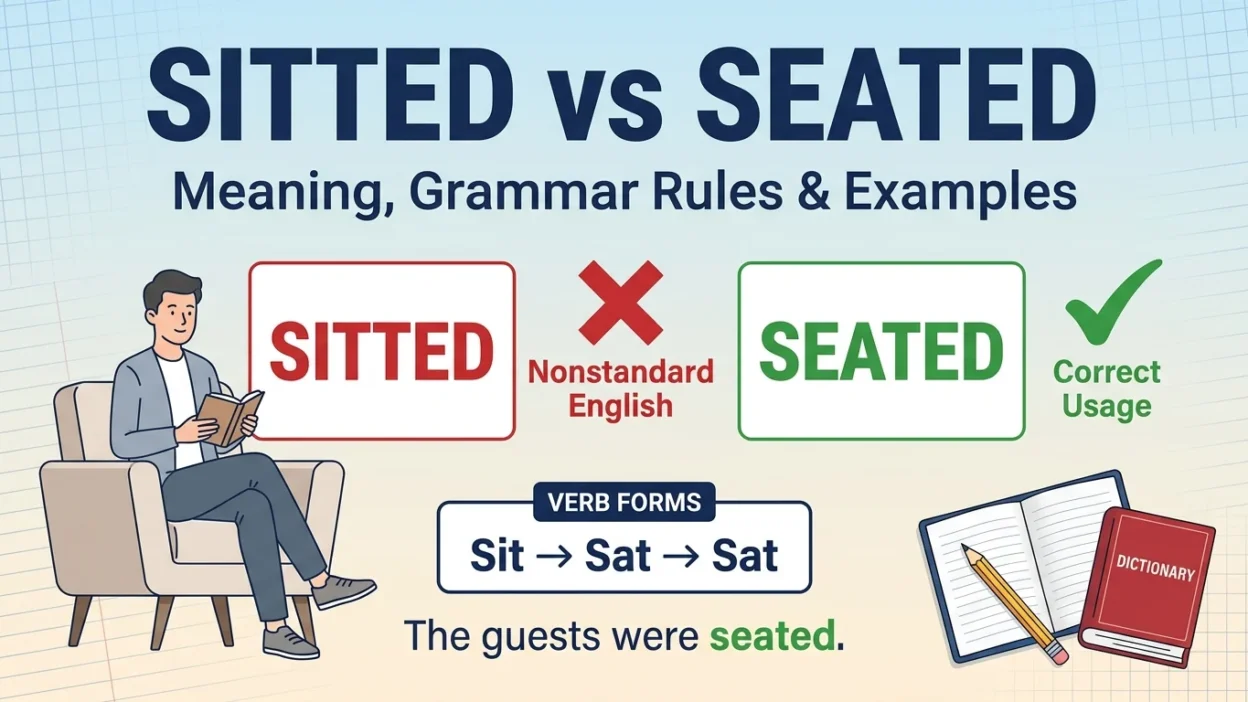
The correct word is usually seated, not sitted, when you want to describe someone sitting or being in a sitting position. Sitted is not the standard past tense or past participle of sit in modern English. The correct forms of sit are sit, sat, and sat. For example, you should write She sat on the chair or She was seated near the window.
Understanding the difference between sitted and seated can help you avoid common grammar mistakes in school assignments, emails, conversations, and professional writing. Although both words may seem related to the action of sitting, they follow different usage patterns. Seated is commonly used as an adjective or participle to describe someone’s position, while sat is the standard simple past tense of sit. Learning these forms will help you choose the right word and write more naturally in English.
Quick Answer: Sitted vs Seated
Seated is correct when describing someone who is sitting or has been placed in a sitting position. Sitted is not standard English. The simple past tense of sit is sat, as in He sat on the bench. You can also say He was seated on the bench. Remember: sit, sat, sat—not sit, sitted, sitted.
Why Do People Confuse Sitted and Seated?
People confuse sitted and seated because both seem connected to the action of sitting. In English, many regular verbs form their past tense by adding -ed, such as walked, played, and cleaned.
However, sit is an irregular verb. It does not follow the regular -ed pattern.
Its main forms are:
- Present: sit
- Simple past: sat
- Past participle: sat
For example:
- Present: I sit near the window.
- Past: I sat near the window.
- Present perfect: I have sat here before.
Seated is a separate, standard form used to describe someone in a sitting position or the act of placing someone in that position.
Example: The guests were seated before dinner began.
1. Sitted: Meaning and Correct Usage
Sitted is not the standard past tense or past participle of sit. In ordinary modern English, you should use sat or seated, depending on the sentence.
Is Sitted a Real Word?
You may occasionally encounter sitted in learner writing, nonstandard speech, or unusual historical or dialectal contexts. However, it is not accepted as the standard form of the verb sit in contemporary general English.
For schoolwork, professional communication, and everyday standard English, avoid sitted.
Incorrect Examples of Sitted
- Incorrect: She sitted on the sofa.
- Correct: She sat on the sofa.
- Incorrect: They have sitted in the front row.
- Correct: They have sat in the front row.
- Incorrect: He was sitted near the door.
- Better: He was seated near the door.
Why Is Sitted Incorrect?
The verb sit is irregular, so its past forms do not take the usual -ed ending. The correct forms are sat and sat, not sitted and sitted.
2. Seated: Meaning and Correct Usage
Seated is a standard English word that describes someone who is sitting or someone who has been placed in a sitting position. It is commonly used as an adjective and as the past participle of seat.
Meaning 1: Being in a Sitting Position
Seated can describe someone who is already sitting.
Example: All the students were seated before the lesson began.
Meaning 2: Being Asked or Directed to Sit
Seated can describe the action of placing someone in a seat.
Example: The usher seated the guests near the stage.
Meaning 3: Describing Arrangements
Seated is common when discussing formal events, restaurants, ceremonies, and meetings.
Example: Guests will be seated according to their table numbers.
Meaning 4: Formal Instructions
The word seated often appears in announcements or polite instructions.
Example: Please remain seated until the aircraft comes to a complete stop.
Related Forms
- Sit: The base verb.
- Sat: The simple past and past participle of sit.
- Seat: To provide or place someone in a seat.
- Seated: The past form of seat or an adjective describing someone in a sitting position.
- Seating: The arrangement or availability of seats.
Sitted vs Seated: Comparison Table
| Feature | Sitted | Seated |
|---|---|---|
| Standard English | Nonstandard as a form of sit | Correct and commonly used |
| Meaning | Usually intended to mean sat or seated | Sitting or placed in a sitting position |
| Grammar | Incorrect as the normal past form of sit | Adjective or form of the verb seat |
| Past tense of sit | No | No; sat is correct |
| Example | She sitted on the chair | She was seated on the chair |
| Formal writing | Avoid | Appropriate |
When Should You Use Sitted or Seated?
Use Sat for the Past Tense of Sit
When describing an action that happened in the past, use sat.
Example: He sat beside his friend during the meeting.
Not: He sitted beside his friend during the meeting.
Use Sat After Have, Has, or Had
The past participle of sit is also sat.
Examples:
- I have sat here for an hour.
- She has sat in this classroom before.
- They had sat quietly until the teacher arrived.
Use Seated to Describe Someone’s Position
Use seated when you want to describe someone’s position.
Example: The children were seated in a circle.
Use Seated When Someone Is Placed in a Seat
The verb seat means to place someone in a seat.
Example: The staff seated the visitors near the entrance.
Use Seated in Formal Instructions
Seated is natural in announcements, event directions, and polite instructions.
Example: Please remain seated while the presentation is in progress.
12 Examples of Sitted vs Seated in Sentences
The following examples show how to replace sitted with the correct form.
1. Incorrect: She sitted on the chair. Correct: She sat on the chair.
2. Incorrect: He sitted beside his brother. Correct: He sat beside his brother.
3. Incorrect: They have sitted in the waiting room. Correct: They have sat in the waiting room.
4. Incorrect: The guests were sitted before dinner. Correct: The guests were seated before dinner.
5. Incorrect: I sitted near the window yesterday. Correct: I sat near the window yesterday.
6. Incorrect: The students have sitted in their places. Correct: The students have sat in their places.
7. Incorrect: She was sitted in the front row. Correct: She was seated in the front row.
8. Incorrect: The manager sitted the visitors near the entrance. Correct: The manager seated the visitors near the entrance.
9. Incorrect: We had sitted there for ten minutes. Correct: We had sat there for ten minutes.
10. Incorrect: Please remain sitted during the announcement. Correct: Please remain seated during the announcement.
11. Incorrect: The children sitted around the table. Correct: The children sat around the table.
12. Incorrect: Everyone was sitted comfortably in the hall. Correct: Everyone was seated comfortably in the hall.
Notice that the correct replacement depends on the sentence. Sometimes you need sat, and sometimes seated is more natural.
Common Mistakes With Sitted and Seated
1. Adding -ed to Sit
Because many English verbs form their past tense with -ed, learners sometimes write sitted.
Remember that sit is irregular:
- Present: sit
- Past: sat
- Past participle: sat
2. Using Seated as the Simple Past of Sit
Seated is not normally the simple past tense of sit.
Incorrect: Yesterday, I seated on the bench.
Correct: Yesterday, I sat on the bench.
However, I seated the child on the bench is correct because seat is a different verb meaning to place someone in a seat.
3. Confusing Sat and Seated
Both can describe a sitting situation, but their grammar differs.
- She sat near the window. — Describes what she did.
- She was seated near the window. — Describes her position.
4. Writing Sitted in Formal Documents
Avoid sitted in assignments, business emails, reports, and other standard writing. Choose sat or seated based on the intended meaning.
5. Using the Wrong Form After Have
After have, has, or had, the correct past participle of sit is sat.
Correct: I have sat here before.
Incorrect: I have sitted here before.
Memory Trick: How to Remember Sitted vs Seated
Use this simple rule:
Sit, sat, sat — never sitted in standard English.
Remember these examples:
- Today, I sit on the chair.
- Yesterday, I sat on the chair.
- I have sat on this chair before.
- I am seated on the chair.
You can also remember that seat is a different verb. You seat another person, and that person becomes seated.
Example: The teacher seated the students, and the students sat quietly.
American vs British English: Sitted or Seated
American and British English follow the same standard rules for sit, sat, and seated.
| Context | American English | British English |
|---|---|---|
| Present tense | Sit | Sit |
| Simple past | Sat | Sat |
| Past participle | Sat | Sat |
| Sitting position | Seated | Seated |
| Nonstandard form | Sitted | Sitted |
There is no major regional difference that makes sitted the standard past tense of sit. Use sat and seated in both varieties.
Similar Words You Should Know
These words are related to sitting, but each has a different use.
- Sit: To rest your body on a seat or another surface.
- Sat: The past tense and past participle of sit.
- Seat: To place someone in a chair or other seat.
- Seated: Sitting or placed in a seat.
- Sitting: The act of being in a sitting position.
- Settle: To become comfortable or establish yourself in a position.
- Remain: To continue in a particular state or position.
- Stand: To be upright on your feet rather than sitting.
For example, She sat down describes an action, while She remained seated describes continuing to be in a sitting position.
Final Verdict: Sitted or Seated?
Seated is correct when describing someone who is sitting or has been placed in a seat. Sitted is not the standard form of sit. If you are describing a past action, use sat instead.
Remember the difference:
- She sat on the chair.
- She was seated on the chair.
- The teacher seated the students.
- She has sat here before.
Choosing the correct form depends on the sentence’s meaning and grammar. Once you understand the difference between sit, sat, seat, and seated, you can avoid this common English mistake.
FAQs
1. Is sitted or seated correct?
Seated is correct when describing someone in a sitting position. Sitted is not standard English. If you mean the past tense of sit, use sat.
2. Is sitted a real English word?
Sitted may appear in nonstandard or unusual usage, but it is not the standard past tense or past participle of sit. In everyday English, use sat or seated.
3. What is the past tense of sit?
The past tense of sit is sat. For example, She sat beside her friend yesterday.
4. What is the past participle of sit?
The past participle is also sat. Use it with have, has, or had, as in They have sat here before.
5. What is the difference between sat and seated?
Sat is the past tense and past participle of sit. Seated describes someone in a sitting position or refers to placing someone in a seat. For example, He sat near the door and He was seated near the door are both correct.
6. Is it correct to say remain seated?
Yes. Remain seated is a standard expression meaning to continue sitting. It is commonly used in formal instructions and announcements.
7. Is sitted correct in American or British English?
No. Sitted is not the standard form of sit in either American or British English. Both varieties use sat and seated.
Remember This
- Sit is the present form.
- Sat is the simple past and past participle.
- Seated describes someone sitting or being placed in a seat.
- Sitted is nonstandard in ordinary English.
- American and British English use the same standard forms.
Conclusion
The difference between sitted and seated becomes clear when you learn the correct forms of the verb sit. Sit is the present form, sat is both the simple past and past participle, and seated describes someone in a sitting position or the action of placing someone in a seat. Sitted is not the standard form used in modern everyday English.
To avoid mistakes, remember the pattern sit, sat, sat. Use seated when describing someone’s position, as in The guests were seated before the ceremony. With these simple rules and examples, you can use the words correctly in schoolwork, professional writing, and daily conversation.