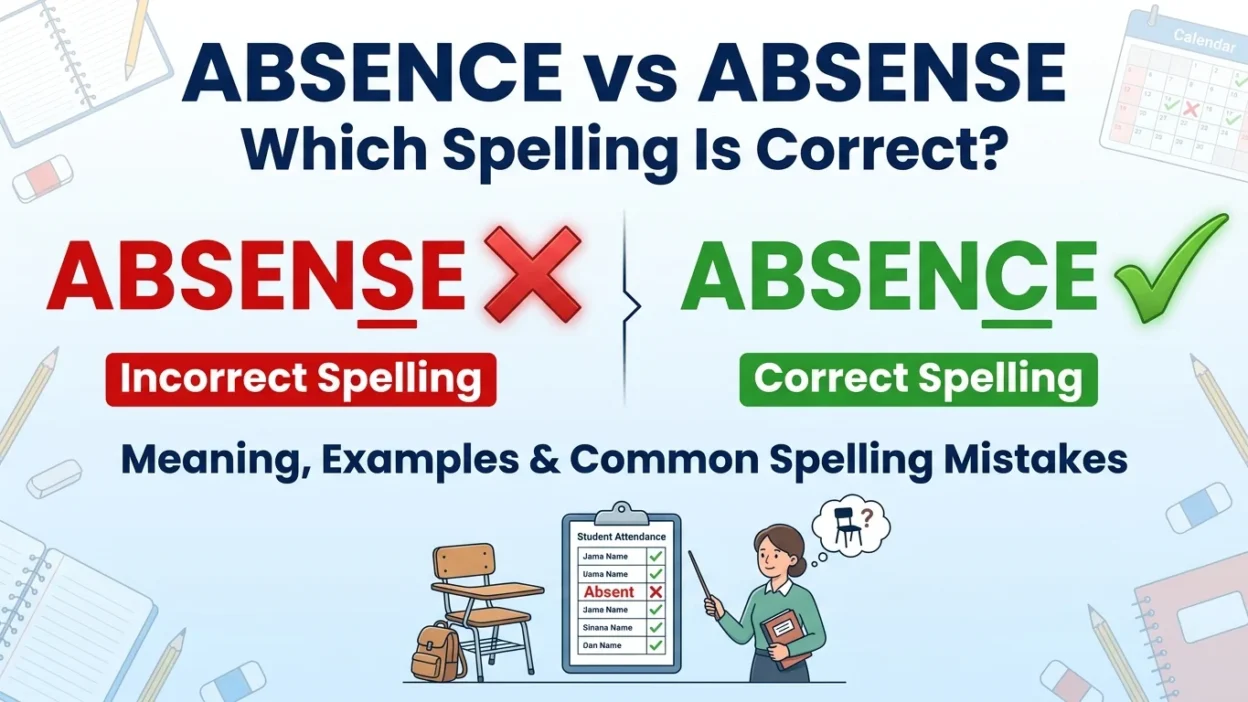
English spelling can be confusing, especially when two words look almost identical. One common spelling mistake is absence vs absense. Both forms may look familiar, but only one is the standard spelling used in modern English. Understanding the difference can help students, English learners, writers, and professionals avoid mistakes in everyday communication.
The correct spelling is absence. It is a noun that means the state of being away from a place, the lack of something, or the fact that someone or something is not present. For example, a student may be marked absent because of illness, and their absence may be recorded by the school. In contrast, absense is a misspelling of absence and should not be used in standard English writing.
In this guide, you will learn the meanings of absence and absense, see practical example sentences, explore common spelling mistakes, and discover an easy memory trick to help you remember the correct form.
Quick Answer: Absence vs Absense
Absence is the correct spelling. It means the state of being away or not being present, or the lack of something. Absense is a misspelling and is not the standard English spelling. For example, The teacher recorded his absence from class. Remember to write absence with a C, not an S, before the final E.
Why Do People Confuse Absence and Absense?
People often confuse absence and absense because the words look almost identical and have similar pronunciations. When speaking, the C in absence can sound like an S, which may lead people to spell the word with an S instead.
English contains many words whose pronunciation does not clearly reveal their spelling. As a result, learners sometimes write words according to how they sound rather than how they are conventionally spelled.
The best way to avoid this mistake is to remember that absence contains the letter C after the N. Practicing the correct spelling in sentences can also help make it easier to remember.
What Does Absence Mean?
Absence is a noun that describes the state of being away from a place or not being present. It can also refer to the lack of a quality, object, person, or condition.
The word is commonly used in schools, workplaces, meetings, official records, and everyday conversations.
Examples of Absence in Sentences
- Her absence from school was due to illness.
- The teacher noticed his absence from the classroom.
- Please inform the manager about your absence.
- His absence made the meeting less productive.
- The school recorded the student’s absence.
- In the absence of clear instructions, we waited for guidance.
- The absence of evidence made the decision difficult.
- Her long absence worried her friends.
- The team struggled in the absence of its captain.
- Regular attendance is important, but occasional absence may be unavoidable.
Common Phrases With Absence
- Absence from school: Not being present at school.
- Absence from work: Not attending work.
- In someone’s absence: When someone is not present.
- In the absence of: When something is missing or unavailable.
- Leave of absence: Official permission to be away from work, school, or another responsibility.
- Unexplained absence: An absence without a known or provided reason.
Example: In the absence of the principal, the vice principal managed the school.
What Does Absense Mean?
Absense is a misspelling of absence in standard English. It is not the accepted spelling when referring to someone being away or something being missing.
You may encounter this form in online posts, informal messages, or text containing spelling mistakes. However, you should use absence in school assignments, professional emails, essays, reports, and other forms of standard writing.
Incorrect and Correct Examples
- Incorrect: His absense from class was unexpected.
- Correct: His absence from class was unexpected.
- Incorrect: Please explain your absense from work.
- Correct: Please explain your absence from work.
- Incorrect: The absense of water caused problems.
- Correct: The absence of water caused problems.
Absence vs Absense: Comparison Table
| Feature | Absence | Absense |
|---|---|---|
| Spelling status | Correct | Incorrect spelling |
| Part of speech | Noun | Not the standard word intended here |
| Meaning | Being away or lacking something | No standard meaning as a spelling of absence |
| Used in formal writing | Yes | No |
| Example | Her absence was noted. | Her absense was noted. |
| Recommended choice | Use this spelling | Correct it to absence |
When Should You Use Absence Instead of Absense?
Use absence whenever you want to describe someone being away or something being missing.
1. When Talking About School Attendance
Use absence when a student does not attend school.
Example: The teacher asked about her absence yesterday.
2. When Talking About Work
Use absence to describe not being present at a workplace.
Example: His absence from work was approved by the manager.
3. When Describing Something Missing
Use absence when a quality, object, or condition is lacking.
Example: The absence of sunlight made the room feel dark.
4. When Writing Official Documents
Use absence in attendance records, leave applications, workplace reports, and formal correspondence.
Example: Please submit a written explanation for your absence.
5. When Referring to Someone Who Is Not Present
Use the phrase in someone’s absence when that person is away.
Example: The meeting continued in the director’s absence.
In all these situations, absence is the correct spelling. Do not replace the C with an S.
15 Example Sentences: Absence vs Absense
These examples show how to use absence correctly and recognize the common spelling error.
- Correct: The teacher marked his absence on the attendance sheet.
- Correct: Her absence from the meeting was unexpected.
- Correct: I informed my supervisor about my absence.
- Correct: The absence of rain affected the crops.
- Correct: His absence was noticed by everyone.
- Correct: The school requires a note explaining each absence.
- Correct: She returned after a three-day absence.
- Correct: In the absence of the manager, the assistant handled the requests.
- Correct: The absence of clear communication caused confusion.
- Correct: Please explain the reason for your absence.
- Incorrect: The teacher recorded her absense.
- Correct: The teacher recorded her absence.
- Incorrect: His absense from work was approved.
- Correct: His absence from work was approved.
- Correct: The absence of necessary information delayed the project.
Common Mistakes to Avoid
1. Writing Absense Instead of Absence
Incorrect: I apologize for my absense.
Correct: I apologize for my absence.
The correct word contains a C before the final E.
2. Spelling Words Based Only on Their Sounds
The C in absence is pronounced with an S sound. This can make the spelling confusing, but the correct written form still uses C.
3. Using Absence When You Mean Absent
Absence is a noun, while absent is an adjective.
- Correct: Her absence was unexpected.
- Correct: She was absent yesterday.
Use absence to name the situation and absent to describe someone who is not present.
4. Forgetting the Correct Spelling in Formal Writing
A spelling mistake can make an otherwise professional document look less polished. Always proofread attendance records, leave applications, emails, and school assignments.
5. Confusing Absence With a Lack of Attendance Only
Absence can refer to people being away, but it can also describe the lack of something.
Example: The absence of trust damaged their relationship.
Easy Memory Trick: Absence vs Absense
Here is a simple way to remember the correct spelling:
Absence has a C, just like the word present is connected to attendance records.
For a more direct memory trick, remember this spelling pattern:
A-B-S-E-N-C-E = ABSENCE
Focus on the C near the end of the word. Even though it sounds like S, it is written with C.
You can also practice this sentence:
Her absence was recorded by the teacher.
Writing the sentence several times can help you remember the spelling.
American vs British English: Absence or Absense?
There is no spelling difference between American and British English for this word. Both use absence.
| English variety | Correct spelling |
|---|---|
| American English | Absence |
| British English | Absence |
| Canadian English | Absence |
| Australian English | Absence |
Absense is not a standard regional alternative in these varieties. If you are writing for an American, British, Canadian, or Australian audience, use absence.
Related Words: Absent, Absentee, and Absenteeism
Learning related words can help you understand the meaning and use of absence more clearly.
- Absent: Not present at a place or event.
- Absentee: A person who is not present, especially when expected.
- Absenteeism: The practice or pattern of frequently being absent.
- Absent-minded: Forgetful or not paying attention.
- Presence: The state of being present or in a place.
Examples of Related Words
- Absent: The student was absent on Monday.
- Absentee: The teacher contacted the absentee’s parents.
- Absenteeism: Frequent absenteeism can affect academic progress.
- Absent-minded: He was absent-minded and forgot his keys.
- Presence: Her presence made everyone feel welcome.
Remember that absence and presence have opposite meanings in many contexts.
Final Verdict: Absence or Absense?
The correct spelling is absence. It is a standard English noun meaning the state of being away, not being present, or lacking something.
Absense is a misspelling and should be corrected to absence in standard English writing. Although the word may sound as if it contains an S, its accepted spelling uses a C before the final E.
To avoid this mistake, practice writing absence in common phrases such as absence from school, absence from work, and in the absence of. Remembering the correct letter pattern will help you write more confidently and accurately.
FAQs
1. Is absence or absense correct?
Absence is correct. Absense is a misspelling of the standard English word.
2. What does absence mean in simple English?
Absence means being away from a place or not being present. It can also mean that something is missing.
3. Why is absence spelled with a C?
The standard spelling is absence, with a C before the final E. Although the C sounds like S, the spelling follows the established English word form.
4. Is absense a real English word?
Absense is not the standard spelling of absence. Use absence in ordinary English writing.
5. What is an example sentence using absence?
Her absence from school was caused by illness.
6. Is absence spelled differently in British and American English?
No. Both British and American English use the spelling absence.
7. What is the difference between absence and absent?
Absence is a noun describing the state of not being present. Absent is an adjective describing someone who is not present.
Example: His absence was unexpected. He was absent yesterday.
8. What is the opposite of absence?
The most common opposite is presence, which means being present or in a particular place.
Remember This
- Absence = correct spelling.
- Absense = misspelling.
- Absence means being away, not being present, or lacking something.
- Both American and British English use absence.
- Memory tip: Remember the C in A-B-S-E-N-C-E.
Conclusion
Knowing the difference between absence and absense can help you avoid a common English spelling mistake. Absence is the correct word for describing someone being away or something being missing, while absense is an incorrect spelling in standard English. The key is to remember the C before the final E, even though it sounds like an S.
Practice using absence in sentences about school attendance, work, meetings, and missing things. With regular reading and writing, the correct spelling will become easier to recognize and remember.