English contains many words that look almost identical but have very different meanings. One common spelling confusion is costumer vs customer. Although these words differ by only one letter, they refer to different things. Choosing the right word is important for students, writers, business owners, and anyone who wants to communicate clearly in English.
The word customer is used when talking about a person who buys goods or services from a business. For example, a customer may visit a shop to buy clothes or order food from a restaurant. In contrast, costumer is also a correct English word, but it has a different meaning. A costumer is someone who designs, makes, selects, or supplies costumes, especially for theater, film, television, or other performances. Therefore, neither spelling is universally incorrect; the right choice depends on what you mean. Understanding this difference will help you avoid spelling mistakes and use both words accurately in everyday conversations and professional writing.
Quick Answer: Costumer vs Customer
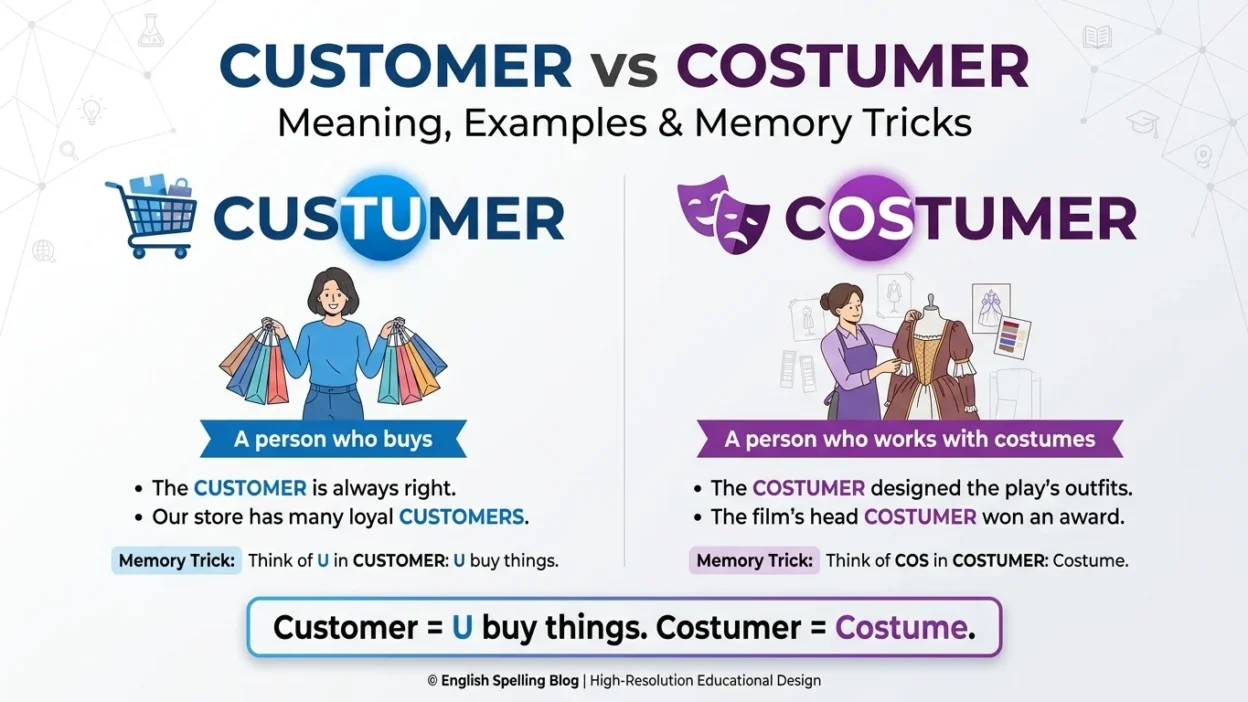
Customer means a person who buys goods or services from a business. Costumer means a person who designs, makes, selects, or supplies costumes for performances, productions, or events. Both are correct English words, but they have different meanings. For example, a customer buys a shirt, while a costumer prepares clothing for actors in a movie.
Why Do People Confuse Costumer and Customer?
People often confuse costumer and customer because the words look almost identical. The only spelling difference is the letter O in costumer versus U in customer.
Their pronunciations can also sound similar, depending on a speaker’s accent. Since both words end in -stomer, readers and writers may accidentally use one when they mean the other.
Another reason for the confusion is that customer appears frequently in shopping, business, and marketing, while costumer is less common in everyday conversation. Someone who rarely encounters the word costumer may assume it is simply a misspelling of customer.
The easiest way to remember the difference is to connect customer with buying and costumer with costumes.
What Does Customer Mean?
A customer is a person who buys goods or services from a business. Customers may purchase products from physical stores, online shops, restaurants, supermarkets, or service providers.
The word is commonly used in business, retail, marketing, hospitality, and everyday conversations.
Examples of Customer in Sentences
- The customer asked for a receipt after paying.
- Every customer deserves polite and respectful service.
- The shop offers discounts to regular customers.
- A customer complained about the damaged product.
- The restaurant welcomed its first customer of the day.
- The company listens carefully to customer feedback.
- Each customer received a confirmation email.
- The store introduced a loyalty program for its customers.
- A satisfied customer may recommend the business to others.
- The customer returned the item because it was the wrong size.
Common Phrases With Customer
- Customer service: Help and support provided to people who buy or use a company’s products or services.
- Customer satisfaction: How satisfied customers are with a product, service, or experience.
- Customer feedback: Opinions and comments shared by customers.
- Regular customer: Someone who frequently buys from the same business.
- Potential customer: Someone who may buy a product or service in the future.
- Customer experience: The overall experience a person has when interacting with a business.
Example: Good customer service can help a business build trust and encourage repeat purchases.
What Does Costumer Mean?
A costumer is a person whose work involves costumes. This may include designing, creating, selecting, fitting, organizing, or supplying clothing for actors, performers, or other participants in a production.
Costumers commonly work in theater, film, television, opera, dance, and other performance settings. They help ensure that clothing suits the characters, time period, setting, and style of a production.
Examples of Costumer in Sentences
- The costumer designed historical clothing for the movie.
- The theater hired an experienced costumer for its new production.
- The costumer helped the actors prepare for their roles.
- Our school play needs a costumer to organize the outfits.
- The costumer selected costumes that matched each character.
- A skilled costumer pays attention to fabric, color, and detail.
- The film’s costumer researched clothing from the nineteenth century.
- The production team thanked the costumer for the beautiful outfits.
- The costumer adjusted the actor’s costume before filming.
- She worked as a costumer for a local theater company.
Common Phrases With Costumer
- Theater costumer: A person who works on costumes for theater productions.
- Film costumer: A person responsible for costume-related work in a film.
- Costume designer: A professional who plans the visual design of costumes.
- Costume department: The team responsible for costumes in a production.
- Costume fitting: A session in which clothing is tried on and adjusted.
Example: The costumer worked with the director to create clothing that suited each character.
Costumer vs Customer: Comparison Table
| Feature | Customer | Costumer |
|---|---|---|
| Spelling | C-U-S-T-O-M-E-R | C-O-S-T-U-M-E-R |
| Meaning | A person who buys goods or services | A person who works with costumes |
| Common setting | Shops, businesses, restaurants | Theater, film, television |
| Main activity | Buying or using products and services | Designing, making, selecting, or supplying costumes |
| Example | The customer bought a jacket. | The costumer prepared a jacket for an actor. |
| Is it a correct word? | Yes | Yes |
When Should You Use Customer or Costumer?
Choose the word according to the meaning you want to communicate.
1. Use Customer When Talking About Shopping
If someone buys a product from a shop or online store, customer is the correct word.
Example: The customer purchased a new pair of shoes.
2. Use Customer When Talking About Business
In business writing, customer usually refers to someone who buys or uses a company’s products or services.
Example: The company improved its customer support system.
3. Use Costumer When Talking About Theater
If someone prepares clothing for a stage production, costumer may be the correct term.
Example: The costumer prepared traditional outfits for the school play.
4. Use Costumer When Talking About Film Production
A costumer may select, organize, or help create clothing for actors in a film or television program.
Example: The costumer helped create outfits for the historical drama.
5. Use Costumer When Referring to Costume Work
When describing a person’s professional role in costume preparation, use costumer.
Example: The costumer repaired the actor’s clothing before the performance.
Simple rule: A customer buys things; a costumer works with costumes.
15 Example Sentences: Costumer vs Customer
These examples show how the two words work in different contexts.
- Correct: The customer asked whether the store offered refunds.
- Correct: The costumer designed an outfit for the lead actor.
- Correct: The restaurant received a positive review from a customer.
- Correct: The costumer selected clothing for the theater production.
- Correct: Every customer received a discount coupon.
- Correct: The film’s costumer researched traditional clothing.
- Correct: The customer contacted support about a late delivery.
- Correct: Our costumer repaired the costumes before the show.
- Correct: The shop owner thanked every customer for visiting.
- Correct: The costumer organized the actors’ outfits.
- Incorrect for the intended meaning: The costumer bought groceries at the supermarket.
- Correct: The customer bought groceries at the supermarket.
- Incorrect for the intended meaning: The customer prepared costumes for the play.
- Correct: The costumer prepared costumes for the play.
- Correct: The business listened to its customers while the theater hired a professional costumer.
Notice that sentences 11 and 13 are not necessarily impossible in every context. They are incorrect only when the writer intends the other word’s meaning.
Common Mistakes to Avoid
1. Assuming Costumer Is Always Incorrect
Costumer is a real English word. It is correct when referring to someone who works with costumes.
Incorrect assumption: Costumer is always a spelling mistake.
Correct understanding: Both costumer and customer are correct, but they mean different things.
2. Using Costumer When You Mean a Buyer
Incorrect for the intended meaning: The costumer purchased a phone from the store.
Correct: The customer purchased a phone from the store.
3. Using Customer When You Mean a Costume Professional
Incorrect for the intended meaning: The customer prepared the actors’ outfits for the play.
Correct: The costumer prepared the actors’ outfits for the play.
4. Forgetting the Different Vowels
The words differ in their internal spelling:
- Customer: C-U-S-T-O-M-E-R
- Costumer: C-O-S-T-U-M-E-R
Remember that customer contains U before S, while costumer begins with COS.
5. Confusing Costumer With Costume Designer
A costumer works with costumes and may have different responsibilities depending on the production. A costume designer specifically focuses on developing the visual design of clothing for characters. The roles may overlap, but they are not always identical.
Easy Memory Trick: Costumer vs Customer
Use this simple memory trick to remember the difference:
Customer = U buy things.
The word customer contains U, which can remind you of the person buying or using a product or service.
Costumer = Costume.
The word costumer contains the word costume. A costumer works with costumes for actors, performers, or productions.
Remember these two examples:
- The customer bought a costume.
- The costumer designed a costume.
Both sentences are correct, but the people are doing different things. The customer buys the item, while the costumer works with costume preparation.
American vs British English: Costumer or Customer?
Both customer and costumer are standard English words in American and British English. Their meanings remain essentially the same in both varieties.
| English variety | Person who buys goods or services | Person who works with costumes |
|---|---|---|
| American English | Customer | Costumer |
| British English | Customer | Costumer |
| Canadian English | Customer | Costumer |
| Australian English | Customer | Costumer |
Neither spelling is an American-versus-British variation. The correct choice depends on the meaning, not the country.
Similar Words: Customer, Client, Consumer, and Costumer
Learning related vocabulary can help you choose the right word.
- Customer: A person who buys goods or services from a business.
- Client: A person or organization that receives professional services.
- Consumer: A person who uses or purchases goods and services.
- Buyer: A person who purchases something.
- Shopper: A person who visits shops or searches for products to buy.
- Costumer: A person who works with costumes.
- Costume designer: A professional who develops costume designs for performances or productions.
Examples of Related Words
- Customer: The customer ordered a meal.
- Client: The lawyer met with a new client.
- Consumer: Consumers often compare prices before buying.
- Buyer: The buyer negotiated a lower price.
- Shopper: The shopper visited several stores.
- Costumer: The costumer prepared outfits for the actors.
- Costume designer: The costume designer created the clothing concept for the production.
Although customer, client, consumer, buyer, and shopper can overlap in meaning, their use depends on the situation. Costumer belongs to a different context involving costumes.
Final Verdict: Costumer or Customer?
Both costumer and customer are correct English words, but they have different meanings.
- Customer means a person who buys goods or services.
- Costumer means a person who designs, makes, selects, or supplies costumes.
Use customer when discussing shopping, sales, customer service, or business relationships. Use costumer when discussing costume work for theater, film, television, or other performances.
The easiest way to remember the distinction is to connect customer with buying and costumer with costumes. Once you understand the difference, you can use both words accurately and confidently.
FAQs
1. Is costumer or customer correct?
Both are correct English words. Customer refers to someone who buys goods or services, while costumer refers to someone who works with costumes.
2. What does customer mean in simple English?
A customer is someone who buys goods or services from a business, shop, restaurant, or other provider.
3. What does costumer mean?
A costumer is a person who designs, makes, selects, or supplies costumes, often for theater, film, television, or performances.
4. Why do people confuse costumer and customer?
The words look similar and differ in their vowel arrangement. People may mistakenly assume that costumer is simply a misspelling of customer.
5. What is an example sentence using customer?
The customer asked for a refund because the product was damaged.
6. What is an example sentence using costumer?
The costumer prepared historical outfits for the actors in the movie.
7. Is costumer a spelling mistake?
No. Costumer is a valid English word when it refers to someone who works with costumes. It is the wrong choice only when you intend to mean customer.
8. What is the difference between a costumer and a costume designer?
A costumer may handle costume selection, preparation, fitting, or supply. A costume designer focuses on developing the costume designs and visual clothing concepts for a production. Their responsibilities can overlap.
Remember This
- Customer = a person who buys goods or services.
- Costumer = a person who works with costumes.
- Both words are correctly spelled.
- The difference is meaning, not American or British spelling.
- Memory trick: Customer buys; costumer works with costumes.
Conclusion
The difference between costumer and customer is important because the words refer to two different roles. A customer buys products or services from a business, while a costumer works with costumes for performances and productions. Although their spellings are similar, neither word is automatically incorrect.
To choose the right word, think about the situation you are describing. If the person is buying something, use customer. If the person is preparing or working with costumes, use costumer. Practicing these words in context will help you improve your vocabulary and communicate more accurately in everyday and professional English.