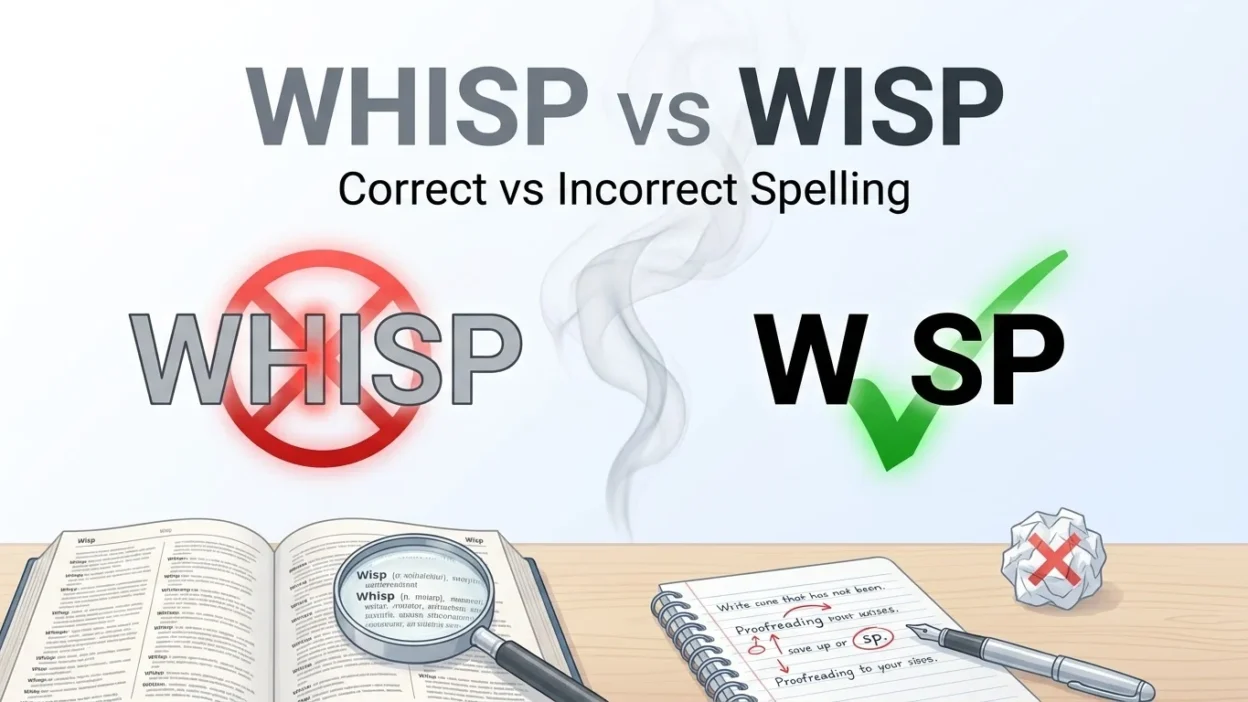
Are you confused about wisp vs whisp? The correct standard English word for a thin strand, small bundle, or delicate trail of something is wisp. Whisp is not the normal spelling for this everyday meaning, although the form does appear in some historical and specialized sources. Cambridge and Collins both list wisp as the established English word for a thin piece or strand of hair, smoke, cloud, grass, or similar material.
The word wisp is useful in both everyday and descriptive writing. You can talk about a wisp of smoke, a wisp of hair, a wisp of cloud, or a wisp of mist. It can also describe something small, delicate, or barely noticeable. The spelling whisp may look natural because English has words beginning with wh, but for standard modern usage, wisp is the form to choose.
Quick Answer
Wisp is the standard English spelling. It means a thin, delicate strand or small amount of something, such as hair, smoke, cloud, or grass. Whisp is not the usual modern spelling for this meaning, although historical dictionaries and some specialized sources record it in other senses. For normal writing, use wisp.
Why Do People Confuse It?
The confusion between wisp and whisp often comes from the spelling pattern of other English words beginning with wh.
Common examples include:
- what
- when
- where
- which
- white
- whisper
Because whisper begins with a similar sound and shares several letters with wisp, it may seem reasonable to spell the word as whisp.
However, wisp has its own established spelling and pronunciation. Cambridge lists the pronunciation as /wɪsp/ in both British and American English.
The safest way to remember it is simply:
wisp = the standard spelling
First Word: Wisp
What Does Wisp Mean?
Wisp is a noun that describes a thin, delicate, or small amount of something. It is especially common with things that can form a loose strand, streak, or thin trail. Cambridge gives examples involving smoke, cloud, hair, grass, and hay.
Examples include:
- a wisp of smoke
- a wisp of hair
- a wisp of cloud
- a wisp of mist
- a wisp of grass
- a wisp of hay
Collins similarly defines wisp as a small, thin bunch of hair or a long, thin amount of something such as smoke or cloud.
Wisp of Hair
One of the most familiar uses is a wisp of hair.
It refers to a small, thin, often loose strand or bunch of hair.
Example:
A wisp of hair fell across her face.
Wisp of Smoke
A wisp of smoke describes a small, thin trail of smoke.
Example:
A thin wisp of smoke rose from the fire.
This is a very common descriptive expression.
Wisp of Cloud
A wisp of cloud is a small, thin area of cloud.
Example:
A few wisps of cloud drifted across the blue sky.
Wisp of Mist
A wisp of mist is a thin, delicate patch or trail of mist.
Example:
A wisp of mist hung above the lake.
Second Word: Whisp
Is Whisp Correct?
For the ordinary modern meaning of a thin strand or small amount of something, whisp is not the standard spelling.
If you mean a thin strand of hair or smoke, write:
wisp
not:
whisp
However, whisp is not simply a nonexistent form. Historical dictionary sources record other uses of the word. Wordnik, drawing on older dictionary material, lists whisp as an erroneous historical form of wisp in one source, while other sources record it as a term for a flock of snipe.
This is why it is more accurate to say that whisp is uncommon and nonstandard for the everyday meaning of wisp, rather than claiming that the sequence of letters has never been used in English.
Why Does Whisp Appear?
The spelling may appear in:
- historical writing
- dialectal material
- unusual vocabulary references
- specialized or obsolete uses
- occasional modern misspellings
Collins also has a user-submitted entry suggesting whisp for a flock of snipe, but that submission is presented as a new-word proposal rather than a standard dictionary definition.
For ordinary modern English, however, wisp is the word readers expect.
Comparison Table
| Word | Standard for Everyday English? | Meaning | Example |
|---|---|---|---|
| Wisp | Yes | A thin strand, small bundle, or delicate trail | A wisp of smoke rose from the fire. |
| Whisp | No, for the usual meaning | Rare/historical or specialized uses; often a nonstandard form of wisp | Use wisp for a thin strand of hair or smoke. |
When to Use Each
When to Use Wisp
Use wisp when you are describing:
- a thin strand of hair
- a small amount of smoke
- a thin line of cloud
- a delicate piece of grass
- a small bundle of hay or straw
- something slight, delicate, or barely visible
Examples:
- a wisp of hair
- a wisp of smoke
- a wisp of cloud
- a wisp of mist
This is the normal modern usage supported by major dictionaries.
When Might Whisp Appear?
You may encounter whisp in historical or specialized vocabulary. Some older dictionary sources record it in connection with wisp, and other sources record a sense meaning a flock of snipe.
For normal writing, though, there is usually no reason to choose whisp when you mean a thin strand or small amount.
10+ Examples of Wisp
- A thin wisp of smoke rose from the chimney.
- She brushed a wisp of hair away from her eyes.
- A few wisps of cloud covered the moon.
- A wisp of mist drifted across the valley.
- The fire sent a small wisp of smoke into the air.
- Several wisps of grass grew between the stones.
- A soft wisp of hair rested on the child’s forehead.
- We saw a wisp of fog moving through the trees.
- Only a faint wisp of steam came from the machine.
- A wisp of white cloud appeared above the mountains.
- The breeze carried a wisp of smoke toward the road.
- She noticed a loose wisp of hair near her ear.
- A delicate wisp of mist floated above the water.
- The old chimney released another wisp of smoke.
- A few wisps of dried hay remained on the floor.
These examples reflect the established uses of wisp for thin, delicate, or small amounts of hair, smoke, cloud, grass, mist, and similar materials.
Common Mistakes
Mistake 1: Writing Whisp of Smoke
Incorrect:
A whisp of smoke rose into the air.
Correct:
A wisp of smoke rose into the air.
The standard expression is wisp of smoke.
Mistake 2: Writing Whisp of Hair
Incorrect:
A whisp of hair fell across her face.
Correct:
A wisp of hair fell across her face.
Mistake 3: Adding H Because of Whisper
The word whisper may influence the spelling because it begins with wh and can have a similar initial sound.
But:
whisper
and
wisp
are different words with different spellings.
Mistake 4: Confusing Wisp With Wispy
Wisp is a noun.
Example:
A wisp of smoke appeared.
Wispy is an adjective meaning thin, light, delicate, or resembling wisps.
Example:
Wispy clouds covered the sky.
Mistake 5: Treating Wisp as Only a Smoke Word
Although wisp of smoke is very common, the word is much broader.
You can also have:
- wisps of hair
- wisps of cloud
- wisps of mist
- wisps of grass
- wisps of hay
Cambridge and Collins both provide examples beyond smoke.
Memory Trick
A simple way to remember the spelling is:
Wisp has no H.
Think:
W + ISP = WISP
not:
WH + ISP
You can also connect wisp with wispy:
wisp → wispy
Both words use the same beginning.
Another useful memory phrase is:
A wisp is thin and wispy.
This gives you a direct spelling connection.
American vs British English
The spelling wisp is the same in American and British English.
American English:
wisp
British English:
wisp
Cambridge gives the same pronunciation, /wɪsp/, for both varieties.
There is therefore no standard American-British spelling difference between wisp and whisp. The standard everyday English word remains wisp.
Similar Words
Several words are close in meaning to wisp, depending on what you are describing.
Strand
A strand is a thin length of hair, thread, fiber, or similar material.
Example:
A strand of hair was caught in her jacket.
Thread
A thread can mean a very thin length of material or something similarly narrow.
Example:
A thread of smoke appeared above the building.
Streak
A streak is a long, narrow line or mark.
Example:
A streak of light crossed the sky.
Puff
A puff can describe a small amount or short burst of smoke, air, or similar material.
Example:
A puff of smoke came from the chimney.
Strand of Hair
This is a more direct phrase when talking specifically about hair.
Example:
A strand of hair fell across her forehead.
Tuft
A tuft is a small bunch or cluster of hair, grass, feathers, or similar material.
Example:
A tuft of grass grew near the wall.
Trace
A trace means a very small amount or sign of something.
Example:
There was a trace of smoke in the air.
These words overlap with wisp, but each emphasizes a slightly different shape, amount, or quality.
Wisp vs Strand
Wisp and strand are often similar when describing hair or thin material.
A strand usually emphasizes a long, narrow piece.
A wisp suggests something thin, delicate, light, or loose.
Compare:
- a strand of hair
- a wisp of hair
Both are natural, but wisp often creates a softer or more delicate image.
Wisp vs Tuft
A tuft is generally a small cluster or bunch.
A wisp is usually thinner and lighter.
Examples:
- a tuft of grass
- a wisp of grass
- a tuft of hair
- a wisp of hair
The best choice depends on how large, dense, or delicate the material is.
Wisp vs Wispy
These words belong to the same word family.
Wisp is a noun.
Example:
A wisp of fog appeared.
Wispy is an adjective.
Example:
Wispy fog covered the road.
The noun identifies the thin piece or trail, while the adjective describes something as thin, light, or delicate.
Wisp in Figurative Language
The word wisp can also be used figuratively for something small, weak, slight, or barely noticeable.
Collins includes uses such as a wisp of a girl and a mere suggestion or hint, showing how the word can move beyond physical strands and become a descriptive metaphor.
Examples:
- He was only a wisp of a man.
- There was a wisp of doubt in her voice.
- A wisp of an idea began to form.
In such sentences, the word suggests something slight, fragile, or barely substantial.
Wisp as a Verb
Although wisp is most commonly encountered as a noun, dictionaries also record verb uses.
Collins lists wisp as a verb meaning to move or act like a wisp, and it also records specialized British uses involving twisting something into a wisp or grooming a horse with a wisp of straw.
Examples:
- The smoke wisped away in the wind.
- The material was wisped into a small bundle.
These uses are much less common than the noun.
Wisp and Will-o’-the-Wisp
You may also come across the expression will-o’-the-wisp.
It refers to a mysterious light or something that is difficult to catch or achieve. The expression is also used figuratively for an elusive goal or idea.
Example:
The perfect solution seemed like a will-o’-the-wisp.
The expression contains the standard spelling wisp.
How to Choose the Right Spelling
The easiest rule is straightforward.
Use Wisp
Choose wisp when you mean a thin, delicate strand, small bundle, or faint trail.
Examples:
- wisp of smoke
- wisp of hair
- wisp of cloud
- wisp of mist
Avoid Whisp for the Everyday Meaning
When you mean the standard noun described above, use wisp, not whisp.
Remember Wispy
Think:
wisp → wispy
Both spellings begin with wis-, which makes the correct form easier to remember.
Final Verdict
The standard modern English spelling is wisp.
Use wisp for a thin strand or small, delicate amount of something, especially hair, smoke, cloud, mist, grass, or hay. Major English dictionaries list these meanings under wisp.
Whisp may appear in historical or specialized sources, including records of older or unusual meanings, but it is not the normal spelling for everyday modern English. When writing about a thin strand of hair or a faint trail of smoke, choose wisp.
FAQs
Is wisp or whisp correct?
Wisp is the standard spelling for the common English word meaning a thin strand, small bundle, or delicate trail of something.
Is whisp a real word?
Whisp has appeared in historical and specialized sources, including a recorded sense related to a flock of snipe, but it is not the normal modern spelling for the everyday meaning of wisp.
What does wisp mean?
A wisp is a thin, delicate piece, strand, or small amount of something such as hair, smoke, cloud, mist, grass, or hay.
What is an example of wisp?
A common example is a wisp of smoke, meaning a thin, small trail of smoke.
What is the plural of wisp?
The plural of wisp is wisps.
Example:
A few wisps of cloud drifted overhead.
Is wisp the same in American and British English?
Yes. The spelling is wisp in both American and British English, and Cambridge gives the same basic pronunciation in both varieties.
What is a synonym for wisp?
Depending on the context, possible alternatives include strand, tuft, thread, streak, puff, and trace.
What does wispy mean?
Wispy is an adjective describing something thin, light, delicate, or resembling a wisp.
Example:
Wispy clouds covered the sky.
Remember This
The correct word is:
WISP ✅
For the everyday meaning, avoid:
WHISP ❌
Remember:
wisp → wispy
And remember the common expressions:
wisp of smoke
wisp of hair
wisp of cloud
Conclusion
When comparing wisp vs whisp, wisp is the correct and standard spelling for the common modern English word. It refers to a thin, delicate strand, small bundle, or faint trail of something, including hair, smoke, cloud, mist, grass, and hay. It can also be used figuratively for something slight or barely noticeable.
Although whisp appears in some historical and specialized sources, it is not the normal spelling to use for these everyday meanings. For clear and natural modern English, remember the simple form wisp, with no h. The easiest connection is wisp → wispy, which can help you remember the correct spelling.