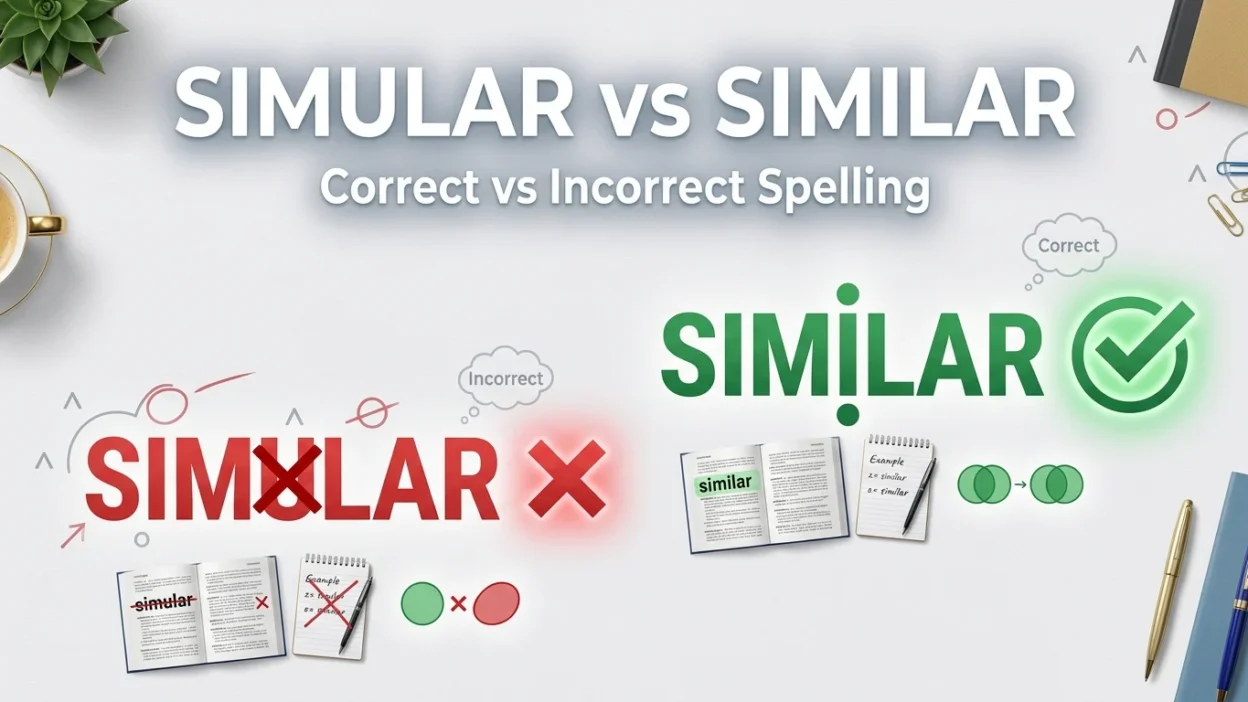
Are you confused about simular vs similar? The correct spelling in standard English is similar, with the letters -ilar at the end. Simular is not the standard English spelling when you want to describe two people or things that are almost, but not exactly, the same. Cambridge defines similar as having many things in common without being exactly the same.
The word similar is extremely common in everyday, academic, professional, and formal English. You can use it to compare people, objects, ideas, appearances, situations, methods, or results. Common expressions include similar to, very similar, similar ideas, and similar characteristics. The spelling simular is often created because the pronunciation can make the middle vowel sound less obvious, but the standard English form is similar.
Quick Answer
Similar is the correct standard English spelling. It means almost the same in appearance, quality, nature, or characteristics, but not exactly the same. Simular is not the standard English form for this meaning. Use similar in phrases such as similar to, similar ideas, and similar results.
Why Do People Confuse It?
The main confusion comes from pronunciation.
The word similar is pronounced differently enough across accents that its spelling may not seem obvious to every learner. Cambridge gives both British and American pronunciations, and the final syllables can sound less like the written -ilar than a beginner might expect.
Another reason is that simular looks like a reasonable English spelling. English has many words ending in -ular, such as regular, popular, and particular, so it is easy to assume that similar follows the same pattern.
However, the correct spelling is:
similar
not:
simular
First Word: Simular
Is Simular Correct?
No. Simular is not the standard English spelling when you mean almost the same or alike.
Incorrect:
The two designs are very simular.
Correct:
The two designs are very similar.
For standard English writing, use similar.
It is worth noting that simular can appear in other languages. For example, simular is a Spanish verb meaning to simulate or pretend. That does not make it the correct English spelling of similar.
Why Does Simular Look Correct?
The spelling can seem natural because English contains many words with -ular endings. However, similar has a different spelling pattern.
Remember:
similar = sim + ilar
The middle spelling is il, not ul.
Second Word: Similar
What Does Similar Mean?
Similar is an adjective used when two or more things have many characteristics in common but are not exactly the same. Cambridge gives examples involving appearance, backgrounds, methods, and ideas.
Examples:
- The two houses look similar.
- We have similar opinions.
- Her dress is similar to mine.
- The two studies produced similar results.
Similar to
The most common structure is:
similar to + noun/pronoun
Examples:
- This phone is similar to my old one.
- Your answer is similar to mine.
- The new design is similar to the original.
This structure is especially useful when directly comparing two things.
Comparison Table
| Word | Correct? | Meaning | Example |
|---|---|---|---|
| Similar | Yes | Almost the same, but not exactly the same | The two books are similar. |
| Simular | No, for this English meaning | Common misspelling of similar | The two books are simular. |
When to Use Each
When to Use Similar
Use similar when two or more things share important features but are not completely identical.
You can use it to describe:
- appearance
- ideas
- opinions
- situations
- backgrounds
- methods
- results
- characteristics
- behavior
- experiences
Examples:
- They have similar interests.
- The two products have similar features.
- We faced similar problems.
When Not to Use Simular
Do not use simular in standard English when you mean similar.
Write:
The results are similar.
Not:
The results are simular.
This is particularly important in school assignments, reports, articles, emails, and other formal writing.
10+ Examples of Similar
- The two houses look very similar.
- My opinion is similar to yours.
- The students had similar answers.
- These two phones have similar features.
- We experienced similar problems last year.
- The brothers have similar personalities.
- Her new hairstyle is similar to mine.
- The researchers found similar results.
- The two paintings have a similar style.
- Both companies offer similar services.
- The children come from similar backgrounds.
- The second experiment produced similar results.
- Their approaches to the problem were similar.
- The two stories have similar themes.
- These products are similar in quality.
Cambridge examples likewise use similar for things that look almost the same, as well as for similar views, backgrounds, methods, and characteristics.
Common Mistakes
Mistake 1: Writing Simular
Incorrect:
The two cars are simular.
Correct:
The two cars are similar.
The correct spelling contains -ilar.
Mistake 2: Using Simular to Compare Things
Incorrect:
Her dress is simular to mine.
Correct:
Her dress is similar to mine.
The standard comparison pattern is similar to.
Mistake 3: Adding an Extra U
The most important spelling difference is the vowel after sim.
Incorrect:
simular
Correct:
similar
Remember:
sim-i-lar
not:
sim-u-lar
Mistake 4: Confusing Similar With Same
Similar does not mean exactly the same.
Cambridge explains that similar things have many things in common even though they are not exactly the same.
Compare:
- The two shirts are the same. = They are identical or considered identical.
- The two shirts are similar. = They have many features in common, but they are not exactly the same.
Mistake 5: Confusing Similar With Identical
Identical means exactly the same.
Similar means almost the same in important ways.
Example:
- The twins have similar hairstyles.
- The two copies are identical.
Memory Trick
A simple way to remember similar is to focus on the middle letters:
SIMILAR
Think:
SIM + ILAR
The important vowel is I, not U.
You can also connect it with the related words:
- similar
- similarity
- similarly
All three use the simil- spelling.
Remember:
similar → similarity → similarly
This word family makes the spelling easier to recognize.
American vs British English
The spelling similar is the same in both American and British English.
American English:
- similar
- similarity
- similarly
British English:
- similar
- similarity
- similarly
There is no standard American-British spelling difference for this word.
The pronunciation can vary slightly between the two varieties. Cambridge lists a British pronunciation and an American pronunciation, but the written form remains similar.
Similar Words
Several words are related to similar, but each has its own meaning.
Alike
Alike means very similar or having many things in common.
Example:
The two sisters look alike.
Comparable
Comparable means similar enough to be compared meaningfully.
Example:
The two products are comparable in price.
Resembling
Resembling means looking or being similar to something else.
Example:
The building is resembling an old castle.
Related
Related can mean connected or similar in some way.
Example:
The two topics are closely related.
Analogous
Analogous means similar in some important way, especially in function or relationship.
Example:
The two systems are analogous.
Identical
Identical means exactly the same rather than merely similar.
Example:
The two documents are identical.
Comparable
This can be useful when comparing things that share enough characteristics for a fair comparison.
Example:
The results are comparable to those of the earlier study.
Similar vs Alike
Similar and alike can have almost the same meaning, but their grammar differs.
We commonly say:
- similar to
- alike
Examples:
- The two houses are similar to each other.
- The two houses look alike.
Similar normally comes before a noun or works with to. Alike is often used after a linking verb.
Similar vs Same
The difference between similar and same is important.
Same means exactly the same in the relevant context.
Similar means almost the same or sharing many characteristics.
Examples:
- We bought the same model.
- We bought similar models.
The first suggests the models are the same. The second suggests they have many features in common but may not be identical.
Similar vs Identical
These words describe different levels of resemblance.
Similar means nearly or partly the same.
Identical means exactly the same.
Examples:
- The two designs are similar.
- The two copies are identical.
When you want to say that two things have some features in common without claiming they are exactly the same, similar is the better word.
Similar vs Similarly
These words are related but have different grammatical roles.
Similar is an adjective.
Example:
- The two plans are similar.
Similarly is an adverb meaning in a similar way.
Example:
- The two teams performed similarly.
Cambridge defines similarly as meaning in a similar way.
Similar vs Similarity
Similar is an adjective.
Example:
- The two paintings are similar.
Similarity is a noun referring to the fact or quality of being similar.
Example:
- There is a clear similarity between the two paintings.
Cambridge defines similarity as the fact that people or things look or are almost the same.
Final Verdict
The correct standard English spelling is similar.
Simular is not the normal English spelling when you mean almost the same or alike. The correct word is spelled:
S-I-M-I-L-A-R
The most common structure is similar to:
- similar to me
- similar to this
- similar to the original
- similar to the previous example
If you are writing an essay, article, report, email, or assignment, use similar, not simular.
FAQs
Is simular or similar correct?
Similar is correct in standard English. Simular is not the standard spelling for this meaning.
What does similar mean?
Similar means having many characteristics in common without being exactly the same.
How do you spell similar correctly?
The correct spelling is S-I-M-I-L-A-R.
Is simular an English word?
Simular is not the standard English spelling of similar. The form can appear in other languages; for example, Spanish simular means to simulate or pretend.
What is the difference between similar and same?
Same means exactly the same in the relevant context, while similar means almost the same or sharing many characteristics.
What is the difference between similar and similarly?
Similar is an adjective, while similarly is an adverb meaning in a similar way.
What is the noun form of similar?
The noun form is similarity.
Example:
There is a strong similarity between the two designs.
What preposition is usually used after similar?
The most common structure is similar to.
Example:
This method is similar to the previous one.
Remember This
The correct word is:
SIMILAR ✅
The incorrect spelling is:
SIMULAR ❌
Remember the middle:
SIM-I-LAR
Think of the related word family:
similar → similarity → similarly
When you mean almost the same, choose similar.
Conclusion
When comparing simular vs similar, the correct standard English spelling is similar. It describes people or things that have many characteristics in common but are not exactly the same. It is widely used to compare appearance, opinions, ideas, methods, results, backgrounds, and many other things.
The spelling simular is a common mistake, often caused by pronunciation or confusion with other English words ending in -ular. The easiest way to remember the correct form is to focus on the I in similar and the related word family similarity and similarly. For clear and accurate English writing, always choose similar, not simular.

Julian Luke is a passionate grammar and language writer at Synolexes. He simplifies complex grammar rules, vocabulary, and writing concepts, helping learners improve their English communication skills with confidence.