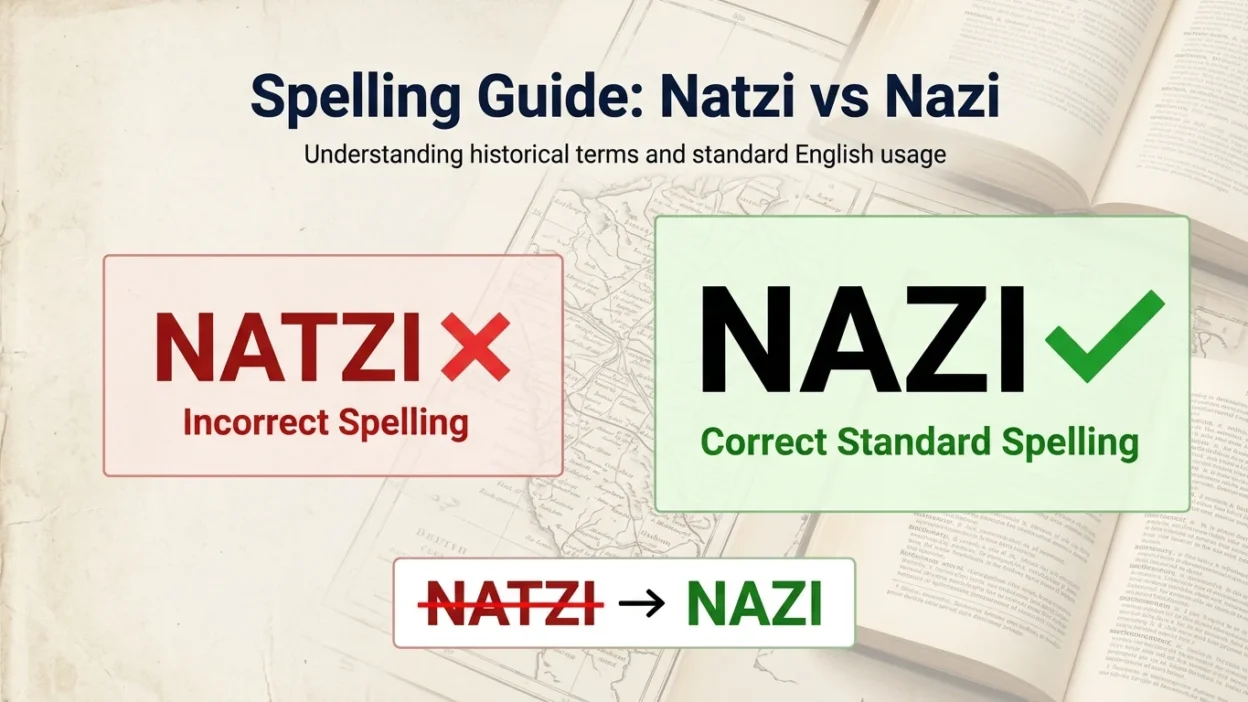
When comparing natzi vs nazi, the correct spelling is Nazi. Natzi is generally a misspelling and should not be used when referring to the historical Nazi movement, Nazi Germany, or a member of the National Socialist German Workers Party. The word Nazi is pronounced with a z sound, but it does not contain the letter t.
Understanding the difference is useful because historical and political terms are often misspelled when people write them from memory or based on pronunciation. The word Nazi has a specific historical meaning connected with the National Socialist movement led by Adolf Hitler in Germany. Today, it is also used in discussions of World War II, the Holocaust, fascism, and related historical subjects. Learning the correct spelling helps students, writers, and general readers communicate clearly and accurately when discussing this important period of history.
Quick Answer
Nazi is the correct spelling. Natzi is generally an incorrect spelling of Nazi. Nazi refers to a member or supporter of the National Socialist movement in Germany, especially during Adolf Hitler’s rule from 1933 to 1945. The standard spelling contains no t.
Why People Confuse It
People may write natzi because the pronunciation of Nazi can make the spelling less obvious, especially for English learners. The word is pronounced with a z sound, and some writers may insert a t based on how they imagine the word is spelled.
Another reason for the confusion is that the English word comes from the German abbreviation Nazi, which was formed from the name of the National Socialist movement. The spelling is therefore not something that can always be guessed from ordinary English spelling patterns.
The important point is simple:
- Nazi = standard spelling
- Natzi = generally a misspelling
- Nazi Germany = historical term for Germany under Nazi rule
- Nazi Party = common name for the National Socialist German Workers Party
The First Word: Nazi
Nazi is the standard English spelling.
Historically, a Nazi was a member or supporter of the National Socialist German Workers Party, commonly known as the Nazi Party. The movement was founded in Germany after World War I and became associated with Adolf Hitler and his dictatorship.
The Nazi regime ruled Germany from 1933 to 1945. It was responsible for aggressive expansion, mass persecution, and the systematic murder of approximately six million Jews during the Holocaust, along with the persecution and killing of millions of other victims.
What Does Nazi Mean?
The word Nazi can function as a noun or an adjective.
As a noun:
- He was a member of the Nazi Party.
As an adjective:
- The museum contains documents from the Nazi era.
- The book examines Nazi Germany.
In historical writing, the word is usually used in connection with Nazi ideology, the Nazi Party, Nazi Germany, or people and institutions associated with the regime.
Where Did the Word Nazi Come From?
Nazi developed as a shortened form of Nationalsozialist, the German word for National Socialist.
It became associated with the National Socialist German Workers Party, whose German name was Nationalsozialistische Deutsche Arbeiterpartei, commonly abbreviated as NSDAP.
The term Nazi became widely used as the common name for members and supporters of the movement.
The Second Word: Natzi
Natzi is generally not the standard spelling of the historical term.
If you are referring to Nazi Germany, the Nazi Party, or a person associated with the Nazi movement, the correct spelling is Nazi, not Natzi.
Incorrect:
- The Natzi Party ruled Germany.
Correct:
- The Nazi Party ruled Germany.
Incorrect:
- He wrote a book about Natzi Germany.
Correct:
- He wrote a book about Nazi Germany.
The spelling natzi may appear as an accidental misspelling, but it is not the standard form used in historical English.
Natzi vs Nazi Comparison Table
| Word | Standard Spelling? | Meaning | Example |
|---|---|---|---|
| Nazi | Yes | A member/supporter of the Nazi movement or something related to it | The museum displays Nazi-era documents. |
| Natzi | No, generally a misspelling | Usually intended to mean Nazi | Natzi is usually corrected to Nazi. |
When to Use Each
Use Nazi
Use Nazi when referring to the historical National Socialist movement or something directly associated with it.
Common expressions include:
- Nazi Party
- Nazi Germany
- Nazi regime
- Nazi ideology
- Nazi propaganda
- Nazi persecution
- Nazi officials
- Nazi camps
- Nazi era
- Nazi rule
Examples:
- The documentary examines Nazi Germany.
- Historians study Nazi propaganda to understand how the regime operated.
- The museum preserves artifacts from the Nazi era.
Avoid Natzi
In standard historical or educational writing, do not use natzi when you mean Nazi.
If you encounter natzi in a draft, essay, article, or school assignment, it will generally need to be corrected to Nazi.
12 Examples of Nazi
- The historian wrote a book about Nazi Germany.
- The museum contains documents from the Nazi era.
- Students studied the rise of the Nazi Party.
- The documentary examines Nazi propaganda.
- The book discusses persecution under Nazi rule.
- Historians continue to study the Nazi regime.
- The exhibition focuses on victims of Nazi persecution.
- The archive contains photographs from Nazi Germany.
- The lesson explains how the Nazi dictatorship developed.
- The memorial honors people who were murdered during the Holocaust.
- Researchers study Nazi records as historical evidence.
- The novel is set in Europe during the Nazi era.
These examples use Nazi as either a noun or an adjective depending on the sentence.
Common Mistakes
Mistake 1: Adding a T
Incorrect:
- Natzi Germany
Correct:
- Nazi Germany
The standard spelling does not contain t.
Mistake 2: Writing Nazi With the Wrong Capitalization
When referring to the historical movement, Nazi is normally capitalized because it comes from the name of a specific political movement.
Examples:
- Nazi Germany
- Nazi Party
- Nazi regime
Mistake 3: Confusing Nazi With Nazi-Related Historical Terms
The word Nazi is not interchangeable with every term related to World War II or German history.
For example:
- Nazi refers specifically to the National Socialist movement or things associated with it.
- German refers broadly to people, language, or things from Germany.
- Fascist is a broader political term and should not automatically be treated as a synonym for Nazi.
- Holocaust refers specifically to the systematic persecution and murder of European Jews by Nazi Germany and its collaborators, along with related persecution of other groups.
Using precise terms makes historical writing clearer.
Memory Trick
A simple way to remember the spelling is:
Nazi = N-A-Z-I
There is no T in the standard spelling.
You can remember it as:
Nazi has a Z, not a TZ.
If you are writing about Nazi Germany or the Nazi Party, choose Nazi.
American vs British English
There is no meaningful spelling difference between American and British English for this word.
Both use:
Nazi
The incorrect form natzi is not the standard spelling in either variety of English.
Historical names, organizations, and commonly established terms generally retain the same spelling across American and British English.
Similar Words
Several terms may appear alongside Nazi, but they do not all have exactly the same meaning.
National Socialist
National Socialist is the expanded English form associated with the Nazi political movement.
It is often used in historical explanations of Nazi ideology and the Nazi Party.
Fascist
Fascist is a broader political term. Fascism refers to a family of authoritarian and ultranationalist political movements.
The Nazi movement is generally classified as fascist, but fascist and Nazi are not always interchangeable.
Nazi Germany
Nazi Germany refers to Germany under the Nazi regime, particularly from 1933 to 1945.
Nazi Party
Nazi Party is the common English name for the National Socialist German Workers Party.
Holocaust
The Holocaust refers to the systematic persecution and murder of approximately six million Jews by Nazi Germany and its collaborators during World War II. Other groups were also persecuted and murdered by the Nazi regime.
Final Verdict
When choosing between natzi vs nazi, use Nazi.
Nazi is the standard spelling for the historical term associated with the National Socialist movement in Germany. Natzi is generally a spelling error and should normally be corrected.
Remember the spelling as N-A-Z-I. There is no t between the z and i. Using the correct spelling is especially important in historical, educational, and academic writing.
FAQs
Is Natzi or Nazi correct?
Nazi is correct. Natzi is generally a misspelling and is not the standard spelling of the historical term.
Why is Nazi spelled without a T?
Nazi comes from the German term associated with National Socialism and is conventionally spelled N-A-Z-I. The standard spelling does not contain a t.
What does Nazi mean?
Historically, Nazi refers to a member or supporter of the National Socialist movement in Germany, or something associated with that movement and its regime.
Is Nazi a German word?
The word Nazi comes from German usage and is derived from the German term Nationalsozialist, meaning National Socialist. It is also widely used in English.
How do you spell Nazi Germany?
The correct spelling is Nazi Germany, with Nazi spelled N-A-Z-I.
Is Natzi a real word?
Natzi is generally not the standard spelling of the historical term. In ordinary English writing, it is usually an accidental misspelling of Nazi.
Is Nazi the same as fascist?
Not exactly. Nazi specifically refers to the National Socialist movement and its associated regime, while fascist is a broader political term. Nazi ideology is commonly classified as a form of fascism.
Remember This
- Nazi = correct standard spelling
- Natzi = generally a misspelling
- Nazi Party = common name for the National Socialist German Workers Party
- Nazi Germany = Germany under Nazi rule from 1933 to 1945
- Nazi contains no T
The easiest memory rule is: N-A-Z-I — no T.
Conclusion
The difference between natzi vs nazi is straightforward: Nazi is the correct standard spelling, while natzi is generally an incorrect spelling. The term has a specific historical meaning and is closely associated with Nazi Germany, the Nazi Party, World War II, and the Holocaust.
Correct spelling is particularly important when discussing history because precise language helps distinguish different political movements, events, and concepts. If you are writing an essay, article, report, or educational text, use Nazi whenever you are referring to the historical National Socialist movement or something directly connected with it.

Gabriel John is a language enthusiast and grammar writer at Synolexes. He creates clear, practical content on English grammar, vocabulary, and writing, helping learners improve communication skills with confidence.