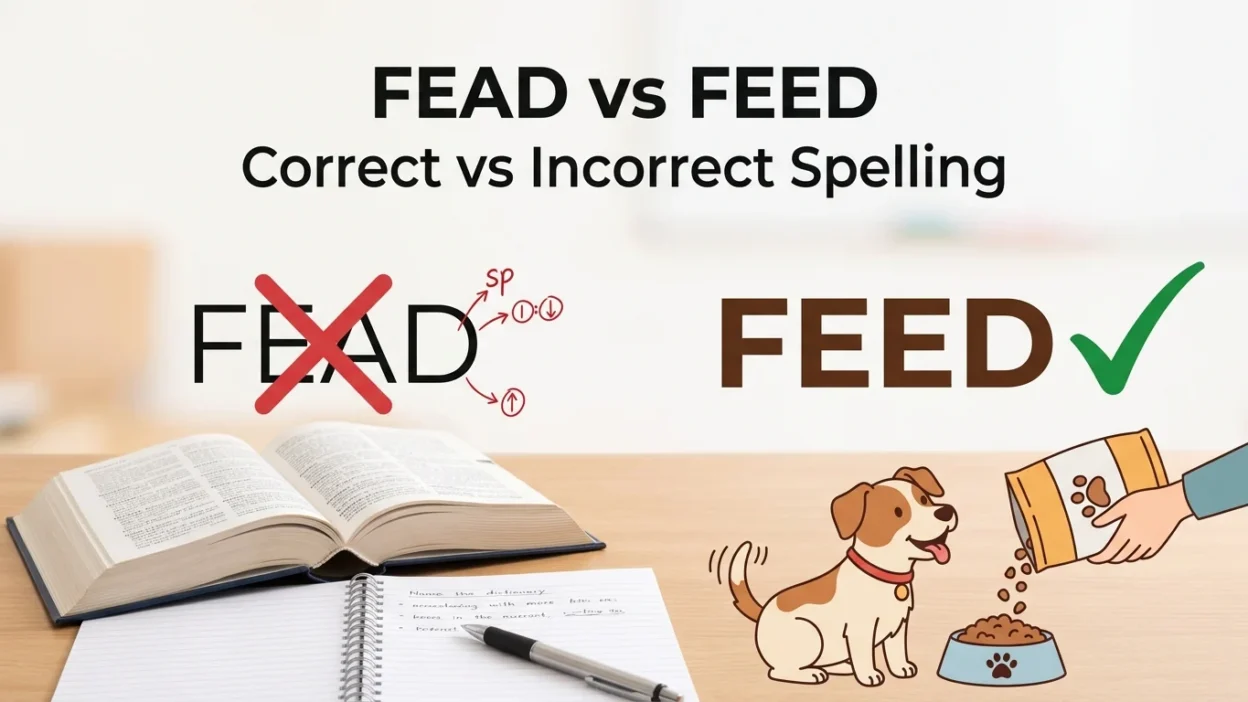
Are you confused about fead vs feed? The correct standard English spelling is feed, with two e letters. Fead is not the standard spelling of the common English verb meaning to give food, supply something, or provide information. The past tense of feed is fed, not fead.
The word feed is much more versatile than simply giving food to a person or animal. It can also mean supplying something to a machine, providing information, supporting a system, or consuming food. As a noun, feed can refer to food for animals, a supply of material, or an online stream such as a social media or news feed.
The spelling mistake usually happens because English has several ways to represent the long ee sound. Words such as read, lead, and bead may make fead look possible, but the correct spelling of this word is simply feed.
Quick Answer
Feed is the correct spelling, while fead is not the standard spelling of the common English word. Feed means to give food, take in food, supply something, or provide material or information. Its past tense and past participle are fed, so write feed → fed, not fead.
Why Do People Confuse It?
The main reason is pronunciation.
Feed is pronounced with the long ee sound. English can represent this sound in different ways, so learners may assume that ea could work:
- feed
- bead
- read
- lead
- seat
- meat
Because ea appears in many familiar words, fead may look believable.
However, spelling must be learned word by word. The standard spelling is:
f-e-e-d
There is another source of confusion: the past tense.
The verb feed is irregular:
feed → fed
It does not become feeded or fead. Cambridge and Collins both list fed as the past tense and past participle.
First Word: Fead
Is Fead Correct?
No. Fead is not the standard modern spelling of the common English verb feed.
If your sentence means giving food to a person or animal, supplying something, or adding information to a system, use feed.
Incorrect:
I fead the cat every morning.
Correct:
I feed the cat every morning.
Why Does Fead Look Correct?
Fead looks possible because the letters ea can produce the same vowel sound in some English words.
For example:
- bead
- read
- meal
- clean
But feed belongs to the ee spelling pattern.
So the correct form is:
feed
not:
fead
What About the Past Tense?
This is especially important because fead is sometimes mistakenly used as the past tense of feed.
Incorrect:
Yesterday, I fead the dog.
Correct:
Yesterday, I fed the dog.
The verb changes completely in the past tense:
feed → fed
Second Word: Feed
What Does Feed Mean?
Feed is a common English verb with several meanings.
Its most basic meaning is to give food to a person, animal, or group.
Examples:
- I feed the dog twice a day.
- She feeds the baby every morning.
- Farmers feed the animals regularly.
Cambridge defines feed as giving food to a person, group, or animal.
Feed Can Mean Eat
The verb can also describe the act of an animal or baby eating or drinking.
Examples:
- The cows feed in the field.
- The baby feeds several times a day.
- The birds feed on seeds.
Collins also describes this use of feed for animals and babies.
Feed Can Mean Supply
Feed can mean to supply something continuously.
Examples:
- The pipes feed water into the tank.
- The machine is fed with raw material.
- The system feeds data into the database.
Cambridge notes that feed can mean supplying something to a person or thing, including putting something into a machine or system.
Feed in Technology and Media
You will often see feed in technology.
Examples:
- social media feed
- news feed
- live feed
- RSS feed
- data feed
As a noun, a feed can be a stream of information or updates. Oxford includes online feeds such as an RSS feed among the noun’s meanings.
Comparison Table
| Word | Correct? | Meaning | Example |
|---|---|---|---|
| Feed | Yes | Give food, supply, or provide material/information | I feed the dog every day. |
| Fead | No for the common modern English word | Misspelling of feed | I fead the dog. |
| Fed | Yes | Past tense and past participle of feed | I fed the dog yesterday. |
| Feeding | Yes | Present participle/gerund of feed | She is feeding the birds. |
When to Use Each
When to Use Feed
Use feed when talking about the present or base form of the verb.
Examples:
- I feed my cat every morning.
- We need to feed the animals.
- The machine feeds paper into the printer.
- You can feed the information into the system.
It is also used after to, modal verbs, and other structures:
- to feed
- will feed
- can feed
- should feed
- must feed
When to Use Fed
Use fed when talking about the past tense or past participle.
Examples:
- I fed the cat yesterday.
- She fed the baby before bedtime.
- The animals were fed at noon.
When to Use Feeding
Use feeding for the -ing form.
Examples:
- The farmer is feeding the horses.
- Feeding the birds is a popular activity.
- The machine is feeding paper into the printer.
When Not to Use Fead
Do not use fead as a replacement for feed or fed in standard English.
Incorrect:
- I fead the chickens.
- I fead the baby yesterday.
Correct:
- I feed the chickens.
- I fed the baby yesterday.
10+ Examples of Feed
- I feed my dog every morning.
- She feeds the baby before leaving for work.
- The farmer feeds the chickens twice a day.
- We need to feed the fish before we leave.
- The birds feed on seeds and insects.
- Please feed the information into the computer.
- The machine feeds paper into the printer automatically.
- The website has a live news feed.
- I checked my social media feed during lunch.
- The farmer bought extra animal feed for the winter.
- The pipe feeds water into the tank.
- The system can feed new data into the database.
- The mother fed the baby before bedtime.
- We fed the horses in the evening.
- The printer has an automatic paper feed.
The examples above show that feed can be used for food, animals, machines, information, websites, and systems.
Common Mistakes
Mistake 1: Writing Fead Instead of Feed
Incorrect:
I fead the cat every day.
Correct:
I feed the cat every day.
The present form always uses ee:
feed
Mistake 2: Using Fead as the Past Tense
Incorrect:
I fead the dog yesterday.
Correct:
I fed the dog yesterday.
The past tense is fed, not fead.
Mistake 3: Writing Feeded
Incorrect:
She feeded the birds.
Correct:
She fed the birds.
Feed is an irregular verb, so its past form is fed.
Mistake 4: Confusing Feed and Food
Feed is commonly a verb, while food is a noun.
Examples:
- I feed the dog food.
- The dog needs food.
- I feed the dog every morning.
The two words are related, but they have different grammatical roles.
Mistake 5: Confusing Feed and Feeding
Feed is the base form.
Feeding is the -ing form.
Examples:
- I feed the birds every morning.
- I am feeding the birds now.
Memory Trick
The easiest way to remember the spelling is:
Feed has double E.
Think of a simple pattern:
see → feed
Both words contain ee.
You can also remember the verb forms together:
feed → fed → fed
This is especially helpful because the past form is completely different.
A quick memory sentence is:
I feed today, I fed yesterday.
Never use fead for either one.
American vs British English
There is no standard American-British spelling difference between feed and fead.
Both American and British English use:
feed
The past tense is also the same:
fed
And the -ing form is:
feeding
So these forms are standard in both varieties:
- feed
- feeds
- fed
- feeding
The word is widely used in both varieties for giving food, supplying something, and describing information streams.
Similar Words
Depending on the context, several words are related to feed.
Nourish
Nourish means to provide food or what is needed for healthy growth.
Example:
- A balanced diet nourishes the body.
Supply
Supply means to provide something that is needed.
Example:
- The system supplies water to the building.
Provide
Provide means to give someone or something what is needed.
Example:
- The charity provides food to families.
Feed on
Feed on means to eat or obtain nourishment from a particular source.
Example:
- Cows feed on grass.
Sustain
Sustain means to support or maintain something, especially over time.
Example:
- The crops provide food to sustain the community.
Nourishment
Nourishment refers to food or other substances needed for health and growth.
Example:
- The plants need water and nourishment.
These words can overlap with feed, but they are not interchangeable in every sentence.
Feed vs Fed
This is one of the most important distinctions to remember.
Feed
Use feed for the present or base form.
Example:
- I feed my cat every morning.
Fed
Use fed for the past tense and past participle.
Example:
- I fed my cat yesterday.
The pattern is:
Present: feed
Past: fed
Past participle: fed
Cambridge and Collins both list these forms.
Feed as a Noun
Feed is also a noun.
It can refer to food, particularly food given to animals.
Example:
- The farmer purchased chicken feed.
It can also refer to a supply of material used by a machine.
Example:
- The printer has an automatic paper feed.
In digital contexts, a feed can mean a stream of news, posts, images, or other updates.
Example:
- I saw the announcement in my social media feed.
Oxford lists these different noun meanings, including animal food, machine material, and online feeds.
Feed in Different Contexts
Animals
- We feed the horses every evening.
Babies
- The baby feeds several times a day.
Plants
- The gardener feeds the plants with fertilizer.
Machines
- The printer feeds paper into the machine.
Computers
- The application feeds data into the system.
Social Media
- I saw the update on my news feed.
Television
- The channel received a live feed from the event.
Feed is therefore a flexible word with both everyday and technical uses.
How to Choose the Right Spelling
The rule is simple.
Use Feed
Use feed when you mean:
- Give food
- Eat or take nourishment
- Supply something
- Put material into a machine
- Provide information to a system
- Refer to an information stream
Use Fed for the Past
Use fed when the action already happened.
Example:
- Yesterday, I fed the birds.
Avoid Fead
Do not write fead when you mean feed or fed.
The correct forms are:
feed → fed → feeding
Final Verdict
The correct spelling is feed, not fead.
Feed is the standard English word used for giving food, eating, supplying materials, putting information into a system, and describing digital or broadcast streams. Its past tense and past participle are fed, while its -ing form is feeding.
The spelling fead is a common error, often caused by confusion about how the long ee sound is written in English. For standard writing, remember the simple pattern feed → fed → fed.
FAQs
Is fead or feed correct?
Feed is correct. Fead is not the standard spelling of the common English word.
Is fead a real English word?
Fead is not the standard modern spelling of the common verb feed. In ordinary English writing, use feed instead.
What is the past tense of feed?
The past tense of feed is fed.
Example:
I fed the dog yesterday.
Is it feeded or fed?
The correct past form is fed, not feeded.
What does feed mean?
Feed can mean to give food, eat, supply something, put material into a machine, or provide information to a system. It also works as a noun for things such as animal food and online information streams.
What is the difference between feed and fed?
Feed is the base or present form, while fed is the past tense and past participle.
Examples:
- I feed the dog every day.
- I fed the dog yesterday.
Is feed the same in American and British English?
Yes. Feed and fed are standard in both American and British English.
How do I remember the spelling of feed?
Remember that feed has double e. Also memorize the verb pattern feed → fed → fed.
Remember This
Keep this simple pattern in mind:
Feed ✅
Fead ❌
Feed → fed → fed
The word feed uses ee, while its past tense changes to fed.
A useful memory sentence is:
I feed today, I fed yesterday.
Conclusion
When comparing fead vs feed, the correct standard English spelling is feed. It is used when giving food to people or animals, describing animals eating, supplying something to a system, or putting material into a machine. It is also a common noun for animal food and information streams such as a social media or news feed.
The most important spelling and grammar pattern to remember is feed → fed → fed. Do not use fead as either the present or past form. Once you remember the double e in feed and the irregular past form fed, this spelling becomes much easier to use correctly.

Gabriel John is a language enthusiast and grammar writer at Synolexes. He creates clear, practical content on English grammar, vocabulary, and writing, helping learners improve communication skills with confidence.